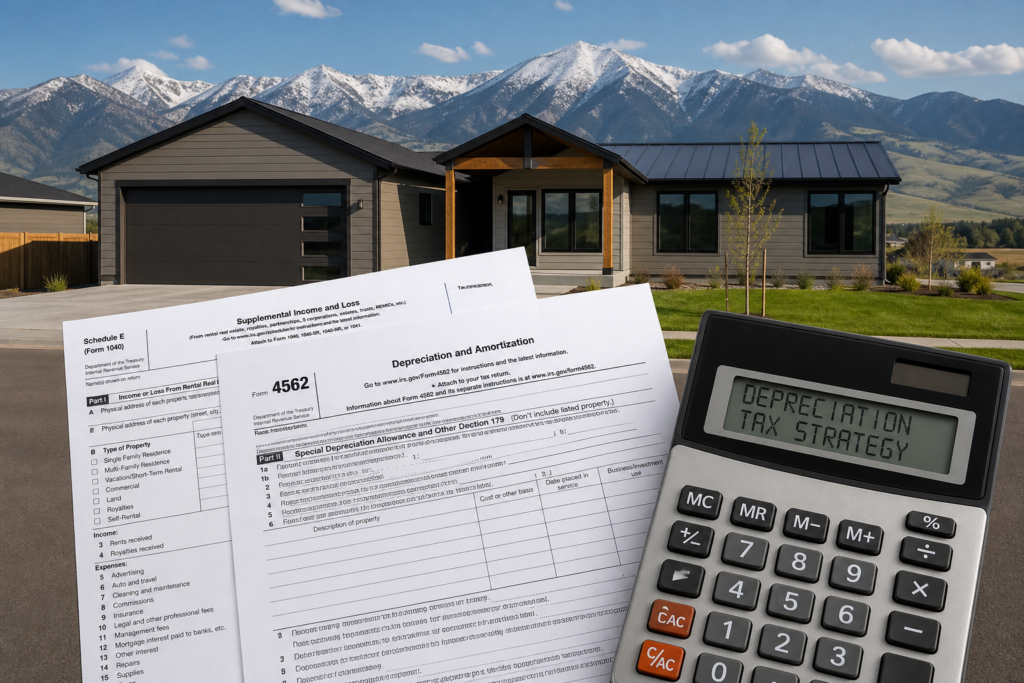
Bozeman Real Estate Depreciation in 2026: Tax Strategy, Market Data, and Investor Opportunities
For the 2026 tax year, understanding Bozeman real estate depreciation is one of the most powerful ways to cut your tax bill. Investors working with Bozeman tax preparation services now benefit from permanent 100% bonus depreciation. This guide explains the tax mechanics, current market trends, and smart strategies. Moreover, it clarifies the difference between tax depreciation and market value declines.
Table of Contents
- Key Takeaways
- What Does Bozeman Real Estate Depreciation Mean in 2026?
- How Does 100% Bonus Depreciation Work in 2026?
- What Is Cost Segregation and Why Does It Matter?
- Will Bozeman Home Prices Depreciate in 2026?
- How Do You Maximize Depreciation Tax Savings?
- Uncle Kam in Action
- Related Resources
- Next Steps
- Frequently Asked Questions
Key Takeaways
- Tax depreciation and market value declines are two very different concepts.
- Residential rentals depreciate over 27.5 years using straight-line MACRS.
- The OBBBA made 100% bonus depreciation permanent for property acquired after January 19, 2025.
- Cost segregation studies unlock large first-year deductions on Bozeman properties.
- Proactive tax planning helps Bozeman investors keep more cash flow in 2026.
What Does Bozeman Real Estate Depreciation Mean in 2026?
Quick Answer: Depreciation is a tax deduction that lets owners write off a property’s cost over time. It differs from a market price decline.
The phrase “Bozeman real estate depreciation” actually carries two meanings. First, it can mean tax depreciation. This is a paper deduction the IRS allows for wear and tear. Second, it can mean an economic decline in market value. Investors must understand both. Moreover, they often move in opposite directions. Your property can rise in market value while still generating large depreciation deductions.
Tax depreciation is a core strategy for real estate investors seeking tax savings. Furthermore, it reduces taxable rental income without any cash leaving your pocket. As a result, many Bozeman owners pay little or no tax on positive cash flow.
Tax Depreciation vs. Market Decline
Tax depreciation follows fixed IRS rules. According to IRS Publication 527 on rental property, residential rentals depreciate over 27.5 years. Commercial buildings use a 39-year schedule. Meanwhile, market decline depends on supply, demand, and interest rates. Therefore, a Bozeman rental can lose 5% in market value yet still deliver a full tax deduction that year.
What Can You Depreciate?
You cannot depreciate land. However, you can depreciate the building and many components. Common depreciable items include:
- The residential or commercial structure itself
- Appliances, carpeting, and cabinetry
- Landscaping, fencing, and driveways
- Certain fixtures and specialized systems
Pro Tip: Always separate land value from building value at purchase. Only the building portion generates depreciation deductions.
How Does 100% Bonus Depreciation Work in 2026?
Quick Answer: The OBBBA made 100% bonus depreciation permanent for property acquired after January 19, 2025. Qualifying components deduct fully in year one.
The One Big Beautiful Bill Act reshaped depreciation for 2026. Specifically, it made 100% first-year bonus depreciation permanent. This applies to qualifying property acquired after January 19, 2025. As a result, Bozeman investors can front-load massive deductions. Furthermore, this change ended years of phase-down uncertainty. You can review current federal guidance through the IRS newsroom for tax updates.
Bonus depreciation targets property with a useful life of 20 years or less. Therefore, the building shell does not qualify directly. However, many interior components do. This is where a strategic study becomes essential. Business owners exploring these deductions often consult a proactive tax strategy team first.
Which Assets Qualify for Bonus Depreciation?
Bonus depreciation applies to shorter-life assets. Common examples include:
- 5-year property such as appliances and carpet
- 7-year property such as certain furniture
- 15-year land improvements like sidewalks and fencing
A Bozeman Example With Real Numbers
Imagine you buy a Bozeman duplex for $700,000 in 2026. The land is worth $150,000. Therefore, $550,000 is depreciable. A cost segregation study identifies $130,000 in short-life assets. Under 100% bonus depreciation, you deduct that entire $130,000 in year one. Meanwhile, the remaining $420,000 building value depreciates over 27.5 years. As a result, first-year deductions can dramatically reduce taxable income.
Pro Tip: Short-term rentals with active participation may offset W-2 income. This makes cost segregation even more powerful.
What Is Cost Segregation and Why Does It Matter?
Quick Answer: Cost segregation breaks a property into components. It reclassifies assets into shorter depreciation lives for faster deductions.
Cost segregation is now going mainstream. In fact, industry experts report a surge in demand since the OBBBA passed. High earners are buying short-term rentals to deduct much of the purchase price against income. The engine behind this playbook is the cost segregation study. Consequently, Bozeman investors should understand how it works. For deeper planning, many pair this with smart entity structuring for investors.
A quality study starts with the actual parcel data. It then classifies each component correctly. However, cheap or AI-generated studies can create audit risk. Therefore, documentation and a clear source trail matter greatly. A defensible study gives the same answer twice. You can learn more about depreciation methods through IRS guidance on depreciation basics. Investors in the region often start with Tax Preparation Near Me in Montana for local support.
Depreciation Schedule Comparison
| Property Type | Depreciation Life | Bonus Eligible? |
|---|---|---|
| Residential rental building | 27.5 years | No |
| Commercial building | 39 years | No |
| Land improvements | 15 years | Yes |
| Appliances and carpet | 5 years | Yes |
| Land | Not depreciable | No |
Watch Out for Depreciation Recapture
Depreciation is not free money forever. When you sell, the IRS recaptures prior deductions. Consequently, recapture is generally taxed up to 25% for real property. Nevertheless, a 1031 exchange can defer this tax. Therefore, plan your exit strategy early. Many Bozeman investors combine depreciation with exchanges for maximum benefit.
Will Bozeman Home Prices Depreciate in 2026?
 Free Tax Write-Off Finder
Quick Answer: National data shows stabilizing prices in 2026. Bozeman remains supply-constrained, so sharp depreciation appears unlikely near-term.
Market depreciation worries many Bozeman owners. However, recent national data suggests stability. Existing-home sales rose 2.8% year-over-year in June 2026. Furthermore, the National Association of Realtors noted improving affordability. Wage growth is currently outpacing home price growth. As a result, a broad crash looks unlikely in the immediate term.
Bozeman carries unique local drivers. Strong in-migration and limited inventory support prices. Meanwhile, the luxury ranch segment behaves differently from mainstream housing. Therefore, high-end and entry-level markets can move separately. Local high-net-worth wealth strategies often account for both segments.
Key Drivers of 2026 Price Movement
Several forces shape Bozeman values this year:
- Mortgage rates and lending conditions
- Limited housing inventory and slow new supply
- Continued in-migration from higher-cost states
- Remote work demand and lifestyle appeal
Downside and Upside Scenarios
Consider a downside case. If rates spike, buyer demand could soften. Consequently, some neighborhoods might dip 5% to 10%. However, the upside case remains plausible too. Persistent supply shortages could push prices higher. Therefore, timing matters more than panic. Importantly, tax depreciation benefits apply either way.
Did You Know? Even if your Bozeman home dips in market value, you still claim full depreciation deductions on your rental.
How Do You Maximize Depreciation Tax Savings?
Quick Answer: Combine cost segregation, 100% bonus depreciation, and smart timing. Then coordinate with entity structure and exit planning.
Maximizing depreciation requires a coordinated plan. First, complete a cost segregation study in the acquisition year. Second, apply 100% bonus depreciation to qualifying components. Third, track your basis carefully. Furthermore, coordinate deductions with your income level. This approach helps business owners and property investors reduce taxes efficiently.
Timing your purchase also matters. Placing a property in service before year-end unlocks that year’s deductions. Therefore, December closings can create large write-offs. However, rushing a bad deal for tax reasons rarely pays off. Consequently, quality investing must come first. Proper tax prep and filing support keeps everything compliant.
Understand Passive Activity Rules
Rental losses often face passive activity limits. According to the IRS topic on passive activity rules, losses may be suspended. However, real estate professionals can deduct losses against active income. Similarly, short-term rentals with material participation may qualify differently. Therefore, your activity level shapes the outcome.
Sample Depreciation Savings Table
| Strategy | First-Year Deduction Example | Best For |
|---|---|---|
| Straight-line only | ~$20,000 on $550K building | Passive long-term holders |
| Cost segregation + bonus | ~$130,000 accelerated | Active investors, high earners |
| Short-term rental strategy | Offsets W-2 income potentially | Material participants |
Bozeman investors seeking ongoing guidance should consider Montana tax preparation near me for hands-on planning. Working with a local expert keeps your depreciation strategy aligned with current law.

Uncle Kam in Action: How a Bozeman Investor Saved $47,000
Client Snapshot: Meet Danielle, a Bozeman short-term rental investor. She owns two properties near downtown and works remotely as a software director.
Financial Profile: Danielle earns $310,000 in W-2 income annually. In addition, she purchased a $780,000 Bozeman property in early 2026.
The Challenge: Danielle faced a high tax bill from her W-2 income. Furthermore, she was depreciating her new property using only the standard 27.5-year method. As a result, she claimed just $22,000 in first-year deductions. Meanwhile, she paid heavy federal taxes on her salary. She wanted a smarter approach to Bozeman real estate depreciation.
The Uncle Kam Solution: Our team first confirmed her material participation in the short-term rental. Next, we ordered a defensible cost segregation study. The study reclassified $145,000 into 5-year and 15-year assets. Then we applied permanent 100% bonus depreciation under the OBBBA. Consequently, those assets deducted fully in year one. Moreover, because she materially participated, the losses offset her active income.
The Results: Danielle’s first-year depreciation jumped from $22,000 to over $160,000. As a result, she legally offset a large share of her W-2 income. Her total tax savings reached approximately $47,000 in the first year. Therefore, her return on investment was substantial and immediate.
- Tax Savings: Approximately $47,000 in year one
- Investment: $6,500 in combined study and advisory fees
- Return on Investment: Roughly 7x in the first year
Danielle now plans her acquisitions around depreciation strategy. See more outcomes like hers on our client results and case studies page.
Related Resources
- Tax Strategies for Real Estate Investors
- Ongoing Tax Advisory Services
- The Uncle Kam Tax Strategy Blog
- Free Tax Planning Calculators
Next Steps
Ready to unlock powerful depreciation savings on your Bozeman property? Take these steps now. Our Bozeman tax preparation services help you plan every deduction for 2026.
- Order a defensible cost segregation study before year-end.
- Confirm your material participation status for rentals.
- Separate land and building values at purchase.
- Schedule a review with a business and financial solutions team.
This information is current as of 7/27/2026. Tax laws change frequently. Verify updates with the IRS if reading this later.
Frequently Asked Questions
Does Bozeman real estate depreciation reduce my actual property value?
No. Tax depreciation is a paper deduction only. It does not lower your home’s market value. In fact, your Bozeman property can appreciate while you claim depreciation. Therefore, the two concepts remain separate.
How long do I depreciate a Bozeman rental property in 2026?
Residential rentals use a 27.5-year schedule. Commercial properties use 39 years. However, cost segregation can reclassify components into 5, 7, or 15-year lives. Consequently, you accelerate deductions significantly.
Is 100% bonus depreciation really permanent now?
Yes. The One Big Beautiful Bill Act made 100% first-year bonus depreciation permanent. It applies to qualifying property acquired after January 19, 2025. As a result, Bozeman investors gain lasting planning certainty.
Can depreciation offset my W-2 salary?
Sometimes. Real estate professionals can offset active income with rental losses. Similarly, short-term rentals with material participation may qualify. However, passive investors often face loss limits. Therefore, your activity level matters greatly.
Will I owe tax on depreciation when I sell?
Usually yes, through depreciation recapture. Recapture is generally taxed up to 25% for real property. However, a 1031 exchange can defer this tax. Consequently, exit planning is essential.
Is a cheap cost segregation study worth it?
Be cautious. Low-cost or AI-generated studies can create audit risk. A defensible study starts with actual parcel data. Furthermore, it keeps a clear source trail. Therefore, quality documentation protects your deductions.
Last updated: July, 2026

