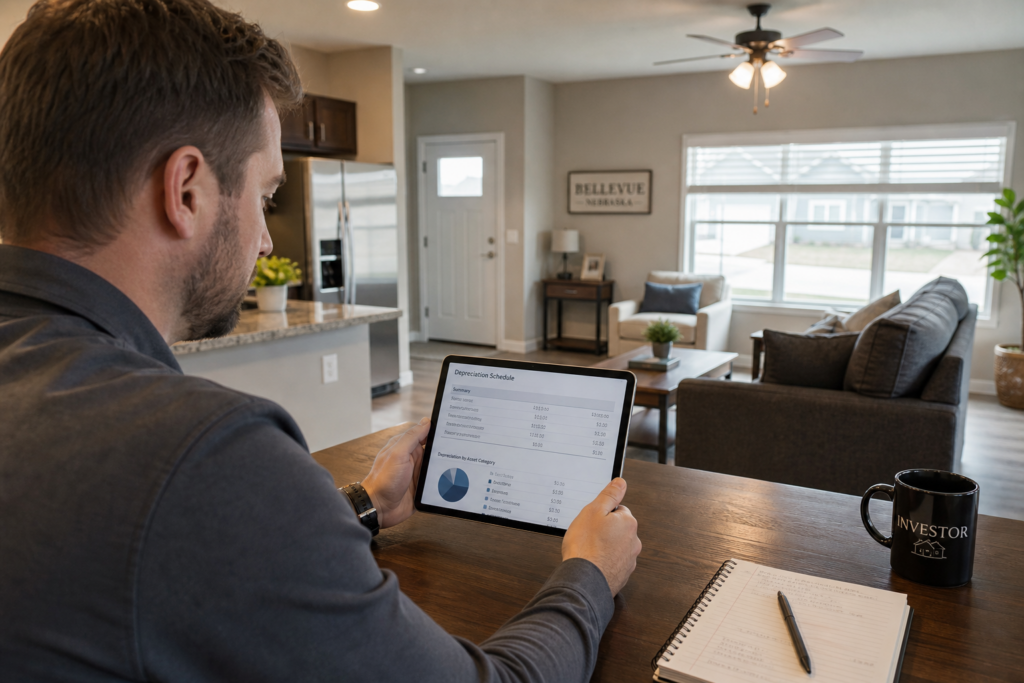
Bellevue Real Estate Depreciation: 2026 Guide for Rental Property Investors
Understanding Bellevue real estate depreciation can dramatically lower your tax bill. For the 2026 tax year, rental property owners in Bellevue, Nebraska, can deduct part of their building’s value each year. Consequently, depreciation turns paper losses into real cash flow. This guide explains the rules, the math, and the strategies you can use today. Moreover, it highlights key changes from recent federal legislation.
Table of Contents
- Key Takeaways
- What Is Real Estate Depreciation?
- Who Can Claim Depreciation in Bellevue?
- How Do You Calculate Bellevue Real Estate Depreciation?
- How Does Bonus Depreciation Work in 2026?
- What Happens to Depreciation When You Sell?
- When Should You Work With a Bellevue Tax Professional?
- Uncle Kam in Action
- Related Resources
- Next Steps
- Frequently Asked Questions
Key Takeaways
- Residential rental buildings depreciate over 27.5 years using MACRS straight-line.
- Land never depreciates, so you must separate land from building value.
- For 2026, 100% bonus depreciation applies to qualifying short-life property.
- Depreciation recapture is taxed at a maximum 25% rate when you sell.
- Report depreciation on Form 4562 and Schedule E each year.
What Is Real Estate Depreciation?
Quick Answer: Depreciation lets you deduct the cost of a rental building over its useful life. For residential property, that life is 27.5 years under IRS rules.
Real estate depreciation reflects the wear and aging of a building over time. The IRS treats a rental property as a business asset. Therefore, you may recover its cost through annual deductions. Importantly, these deductions reduce your taxable rental income. As a result, many Bellevue investors owe less tax while still collecting positive cash flow. You can review the official rules in IRS Publication 527, which covers residential rental property.
Bellevue real estate depreciation follows the same federal framework used nationwide. Nebraska does not change the depreciation schedule. However, local property values still matter. They determine how much basis you can depreciate. Consequently, understanding both the rules and your numbers is essential. Real estate investors who master this concept often build wealth faster.
Key Depreciation Terms Defined
- Cost basis: Your purchase price plus certain closing costs.
- Depreciable basis: Cost basis minus the value of the land.
- Recovery period: The years over which you deduct the basis.
- MACRS: The Modified Accelerated Cost Recovery System the IRS requires.
- Recapture: Tax owed on depreciation when you sell the property.
Why Depreciation Matters for Investors
Depreciation is often called a “phantom” expense. You never write a check for it. Nevertheless, it reduces taxable income each year. Furthermore, it can create a paper loss even when cash flow is positive. This benefit makes rental property a powerful tax shelter. For focused strategies, our team helps real estate investors reduce taxable income through depreciation planning. In addition, smart planning can offset other income in some cases.
Pro Tip: Keep your closing statement forever. It documents your original basis for depreciation and future sale calculations.
Who Can Claim Depreciation in Bellevue?
Quick Answer: Owners of income-producing property can claim depreciation. This includes landlords, real estate investors, and many business owners.
You can depreciate property that you use in a business or hold for income. In Bellevue, Nebraska, that usually means rental homes, duplexes, and small apartment buildings. Additionally, commercial property owners qualify under a longer schedule. However, you must actually own the property and use it to produce income. Many local landlords near Offutt Air Force Base rent to military families and civilian tenants.
Not every property qualifies for depreciation, though. The IRS sets clear boundaries. As a result, you must know which assets are eligible before you file. Business owners who use part of a building can also benefit. Our guidance helps Bellevue business owners plan smarter around real estate assets. If you need help filing near you, explore Tax Preparation Near Me in Nebraska for local support.
Property That Qualifies
- Single-family rental homes in Bellevue and Sarpy County.
- Duplexes, triplexes, and small multifamily buildings.
- Commercial and mixed-use investment properties.
- Short-term rentals used as a trade or business.
Property That Does Not Qualify
Your primary residence cannot be depreciated. Land itself is also excluded because it does not wear out. Furthermore, property placed in service and disposed of in the same year does not qualify. The IRS explains these limits in IRS Publication 946. Therefore, always confirm eligibility before claiming any deduction.
Did You Know? If you convert a former home into a rental, depreciation begins on the conversion date, not the purchase date.
How Do You Calculate Bellevue Real Estate Depreciation?
Quick Answer: Subtract land value from your cost basis. Then divide the building value by 27.5 years for residential rentals.
Calculating Bellevue real estate depreciation is simpler than most investors expect. First, you find your total cost basis. Next, you separate land from the building. After that, you apply the correct recovery period. Finally, you divide to reach an annual deduction. The IRS requires the straight-line method for real property. Consequently, your yearly deduction stays consistent across the recovery period.
Step-by-Step Calculation
- Determine your total cost basis, including qualifying closing costs.
- Subtract the land value shown by the Sarpy County Assessor.
- Confirm the recovery period, which is 27.5 years for residential.
- Divide the building basis by 27.5 to get the yearly deduction.
- Report the amount on Form 4562 and Schedule E.
A Bellevue Rental Example
Imagine you buy a Bellevue rental home for $400,000. The county assessor allocates $100,000 to land. Therefore, your depreciable building basis equals $300,000. Divide that by 27.5 years. As a result, you claim about $10,909 in depreciation each year. That deduction lowers your taxable rental income significantly. Over ten years, you could shelter more than $109,000 of income.
| Purchase Price | Land Value | Building Basis | Annual Depreciation |
|---|---|---|---|
| $300,000 | $75,000 | $225,000 | $8,182 |
| $400,000 | $100,000 | $300,000 | $10,909 |
| $550,000 | $150,000 | $400,000 | $14,545 |
Pro Tip: Use your county assessor’s land-to-building ratio to support your allocation. It creates a defensible paper trail.
Proactive depreciation planning fits within a larger tax strategy for rental income. Therefore, coordinate depreciation with your other deductions each year. For commercial property, the recovery period stretches to 39 years instead. Consequently, commercial owners see smaller annual deductions.
How Does Bonus Depreciation Work in 2026?
Quick Answer: For 2026, 100% bonus depreciation applies to qualifying short-life assets. It does not apply to the building structure itself.
The One Big Beautiful Bill Act reshaped bonus depreciation rules. This law, enacted in 2025, restored 100% bonus depreciation permanently. It applies to qualifying property placed in service after early 2025. Therefore, Bellevue investors can now expense certain assets fully in year one. However, the main building still depreciates over 27.5 years. You can read the legislative background on Congress.gov for official text.
What Qualifies for Bonus Depreciation
Bonus depreciation targets property with a recovery period under 20 years. As a result, it covers many components found in a rental building. Cost segregation studies help identify these assets. Furthermore, they can accelerate large deductions into the first year. This strategy can boost early cash flow dramatically.
- Appliances, carpeting, and certain fixtures.
- Land improvements like fences, sidewalks, and landscaping.
- Specialized electrical and plumbing serving equipment.
- Removable flooring and window treatments.
Cost Segregation for Bellevue Investors
Cost segregation splits a property into different asset classes. Consequently, more value shifts into short-life categories. Those categories then qualify for bonus depreciation. This approach benefits investors with substantial rental income. Moreover, our tax advisory guidance for investors can model whether a study makes sense. The University of Nebraska–Lincoln offers helpful agricultural and property economics resources for context on asset values.
Pro Tip: Order a cost segregation study in the same year you buy. Front-loaded deductions maximize early tax savings.
What Happens to Depreciation When You Sell?
 Free Tax Write-Off Finder
Quick Answer: When you sell, the IRS recaptures depreciation. This recapture is taxed at a maximum 25% rate.
Depreciation feels like a gift each year. Nevertheless, the IRS collects some of it back at sale. This process is called depreciation recapture. It applies to the total depreciation you claimed, or could have claimed. Therefore, you cannot skip depreciation to avoid recapture later. The maximum recapture rate on real property is 25%. You can review IRS Topic No. 409 on capital gains for details.
A Recapture Example
Suppose you claimed $100,000 in total depreciation over ten years. When you sell, that $100,000 faces recapture tax. At the 25% maximum rate, you could owe up to $25,000. However, the remaining gain may qualify for lower capital gains rates. As a result, planning your exit carefully matters greatly.
Deferring Recapture With a 1031 Exchange
A 1031 exchange lets you defer both gain and recapture. You simply reinvest proceeds into another qualifying property. Consequently, many Bellevue investors trade up without an immediate tax bill. However, strict deadlines apply to every exchange. Therefore, work with a professional before you list your property. Proper entity structuring for real estate can also protect your holdings.
| Item | Tax Treatment (2026) |
|---|---|
| Depreciation recapture | Up to 25% maximum rate |
| Long-term capital gain | 0%, 15%, or 20% by income |
| 1031 exchange | Defers gain and recapture |
Did You Know? Even if you never claimed depreciation, the IRS still recaptures the amount you should have taken.
When Should You Work With a Bellevue Tax Professional?
Quick Answer: Work with a professional when your basis, allocation, or exit strategy grows complex. Expert help prevents costly errors.
Many investors handle simple depreciation themselves. However, complexity often appears quickly. Land allocation, cost segregation, and recapture all invite mistakes. Therefore, a professional often pays for themselves. Furthermore, proactive planning captures deductions you might otherwise miss. Our team also helps self-employed clients who manage rentals as a side business. Learn how we support self-employed investors and contractors.
Signs You Need Expert Help
- You own multiple Bellevue rental properties.
- You want to run a cost segregation study.
- You plan to sell or complete a 1031 exchange.
- You converted a home into a rental recently.
Tools and Filing Support
Accurate filing starts with the right numbers. Consequently, our tax prep and filing services keep your Schedule E correct. If you also earn self-employment income, estimate obligations with our Self-Employment Tax Calculator for 2026 planning. Additionally, high-income landlords may benefit from advanced structures. Explore strategies for high-net-worth real estate owners when portfolios grow large. If you prefer local, in-person help, our Bellevue tax preparation team stands ready.
Pro Tip: Review depreciation every year, not just at purchase. Tax law changes can create new savings.

Uncle Kam in Action: How a Bellevue Landlord Saved $18,400
Client Snapshot: Marcus was a first-time real estate investor in Bellevue, Nebraska. He owned three single-family rentals near Offutt Air Force Base. Additionally, he worked full-time as a project manager.
Financial Profile: Marcus earned $145,000 from his job in 2026. His rentals generated $54,000 in gross rental income. However, his combined property basis totaled roughly $1.1 million. Despite this, he had never claimed proper depreciation.
The Challenge: Marcus prepared his own returns for two years. Unfortunately, he lumped land and buildings together. As a result, he understated his depreciation deductions badly. Furthermore, he never separated short-life assets. Consequently, he overpaid federal tax significantly. He worried about recapture and audit risk too.
The Uncle Kam Solution: Our team rebuilt his depreciation schedule from scratch. First, we used Sarpy County assessor data to allocate land correctly. Next, we ordered a cost segregation study on his largest rental. That study identified appliances, flooring, and land improvements. Therefore, those assets qualified for 100% bonus depreciation in 2026. In addition, we amended one prior return to capture missed deductions.
The Results: Marcus reduced his 2026 taxable income substantially. His accelerated deductions created a large paper loss. Consequently, he sheltered a meaningful portion of his rental income.
- Tax Savings: $18,400 in the first year alone.
- Investment: $4,200 in professional and study fees.
- Return on Investment: Roughly 4.4x in year one.
Marcus now reviews depreciation with us every year. See more outcomes on our client results and case studies page. Therefore, his story shows how planning turns paper losses into real savings.
Related Resources
- Uncle Kam Tax Strategy Blog
- Free Tax Calculators and Tools
- In-Depth Tax Guides Library
- The MERNA Method Explained
Next Steps
Ready to maximize your Bellevue real estate depreciation? Take these actions today.
- Gather closing statements and assessor data for each property.
- Separate land from building value before you file.
- Ask about a cost segregation study for larger properties.
- Book a review with our real estate tax advisory team.
Frequently Asked Questions
How long can I depreciate a Bellevue rental property?
Residential rental buildings depreciate over 27.5 years. Commercial property uses a 39-year schedule instead. These federal periods apply everywhere, including Bellevue, Nebraska.
Can I depreciate my primary residence in Bellevue?
No, you cannot depreciate your primary home. Depreciation requires income-producing or business property. However, a home office or rental portion may qualify partially.
Does depreciation affect my taxes when I sell?
Yes, the IRS recaptures depreciation at sale. Recapture faces a maximum 25% tax rate. Nevertheless, a 1031 exchange can defer that tax.
What form reports Bellevue real estate depreciation?
Report depreciation on Form 4562 each year. Then carry the deduction to Schedule E for rental income. Keep supporting documents with your records.
Is bonus depreciation available in 2026?
Yes, for 2026, 100% bonus depreciation applies to qualifying short-life assets. The One Big Beautiful Bill Act made this permanent. However, it excludes the main building structure.
How much does a cost segregation study cost?
Study fees vary by property size and complexity. Nevertheless, the tax savings often exceed the cost several times over. Therefore, we model the benefit before recommending one.
This information is current as of 7/27/2026. Tax laws change frequently. Verify updates with the IRS or a qualified professional if reading this later.
Last updated: July, 2026

