
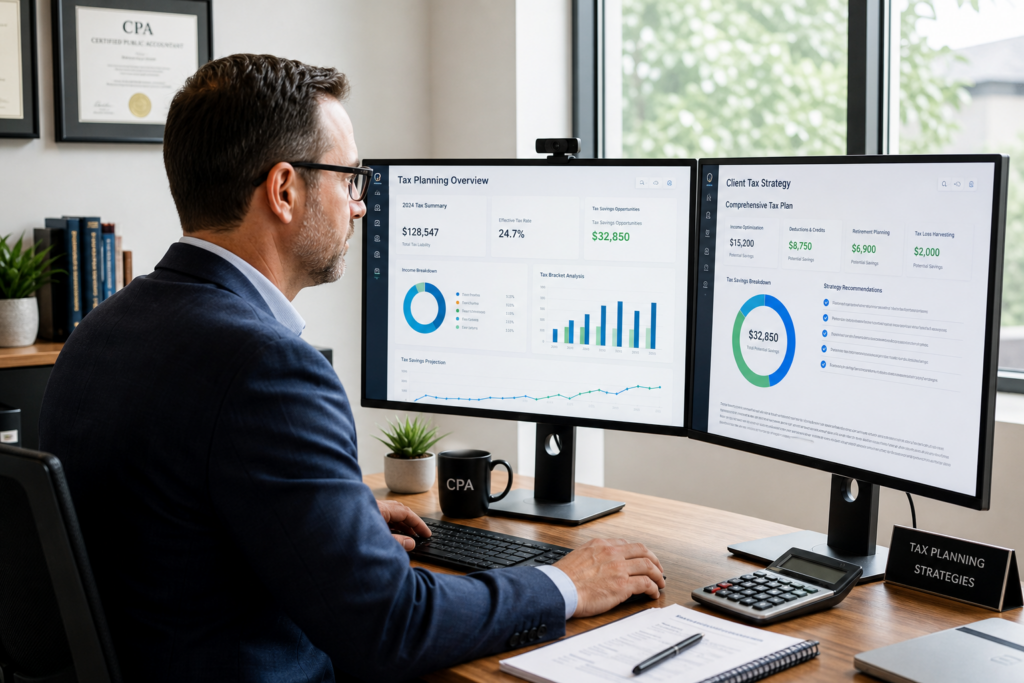
Tax Planning Software for CPAs: 2026 Guide
For the 2026 tax year, tax planning software for CPAs has evolved from basic compliance tools into AI-powered advisory platforms. Modern solutions help practitioners identify significant tax savings for clients, automate complex scenario modeling, and deliver professional deliverables that justify premium fees. This shift matters because the IRS is modernizing rapidly while firms face workforce challenges and clients demand proactive strategies.
Table of Contents
- Key Takeaways
- Why Do CPAs Need Specialized Tax Planning Software in 2026?
- What Are the Essential Features of Modern Tax Planning Software?
- How Does AI Integration Transform Tax Advisory Services?
- What Should CPAs Consider When Selecting Tax Planning Software?
- How Can CPAs Implement Tax Planning Software During Busy Season?
- What Compliance and Security Requirements Must Software Meet?
- Uncle Kam in Action: How a Mid-Sized CPA Firm Scaled Advisory Revenue
- Next Steps
- Frequently Asked Questions
- Related Resources

Key Takeaways
- Modern tax planning software integrates AI to automate routine analysis and identify complex savings opportunities.
- The IRS’s 2026 modernization push demands software with XML schema compliance and real-time data validation.
- Platforms with unlimited scenario modeling help CPAs justify premium advisory fees without usage caps.
- Client portals and professional deliverables transform technical analysis into actionable planning documents.
- Choosing software requires evaluating firm size, specialization, integration needs, and scalability for growth.
Why Do CPAs Need Specialized Tax Planning Software in 2026?
Quick Answer: Tax planning software for CPAs addresses three critical 2026 challenges: IRS modernization demands, client expectations for proactive strategies, and the need to deliver high-value advisory services that command premium fees.
The accounting profession is experiencing a fundamental transformation in 2026. Traditional compliance work is becoming commoditized while clients increasingly demand strategic tax advisory services that deliver measurable savings. According to the IRS Electronic Tax Administration Advisory Committee’s 2026 Annual Report, the agency is pushing for better technology, AI transparency, and digital-first services. CPAs who rely on outdated tools or manual processes risk falling behind.
Modern tax planning software platforms enable practitioners to shift from reactive compliance to proactive planning. This matters because clients retain advisors who demonstrate value throughout the year, not just during tax season. Software platforms automate time-consuming calculations, identify overlooked deductions, and model complex entity structures in minutes rather than hours.
The 2026 Advisory Opportunity
Tax professionals face unprecedented demand for year-round advisory relationships. Business owners earning above the $184,500 Social Security wage base need sophisticated entity structuring advice. Real estate investors require cost segregation analysis and depreciation optimization. Self-employed professionals seek strategies beyond basic Schedule C deductions. Each scenario demands complex modeling that manual spreadsheets cannot efficiently deliver.
The best tax planning software for CPAs in 2026 provides unlimited assessments without per-analysis fees. This removes the barrier preventing practitioners from running multiple scenarios for prospects and clients. When you can demonstrate $50,000 in potential savings during an initial consultation, closing advisory engagements becomes substantially easier. Some firms also position a client-facing Small Business Tax Calculator on their website as a front-end tool that helps business owners quantify potential savings before a planning conversation.
Workforce and Regulatory Pressures
The IRS reduced its workforce by approximately 30 percent between January 2025 and January 2026, according to Treasury Inspector General reports. While the agency backfilled about 2,000 positions, staffing remains constrained. Therefore, tax software must compensate by ensuring accuracy, maintaining compliance with evolving regulations, and reducing the risk of costly errors that trigger audits.
Additionally, the One Big Beautiful Bill Act (OBBBA), enacted July 4, 2025, introduced new forms including Schedule 1-A for temporary deductions. Software platforms must update rapidly to accommodate legislative changes while helping practitioners deliver timely guidance to clients navigating new provisions.
Pro Tip: Evaluate software vendors based on their update frequency during the 2025 OBBBA rollout. Platforms that delivered rapid updates demonstrate technical agility for future legislative changes.
What Are the Essential Features of Modern Tax Planning Software?
Quick Answer: Essential features include scenario modeling, multi-entity support, client collaboration portals, professional deliverable generation, integration with existing tax software, and compliance with IRS electronic filing requirements including XML schema formatting.
Not all tax planning software delivers equal value. The most effective platforms combine technical capabilities with user experience design that accelerates adoption across your firm. When evaluating solutions, prioritize features that directly impact client outcomes and operational efficiency.
Scenario Modeling and Multi-Entity Analysis
Top-tier software enables practitioners to model multiple tax scenarios simultaneously. For example, a business owner considering S Corp election needs comparisons showing current LLC taxation versus S Corp salary and distribution strategies versus C Corp retained earnings approaches. The platform should calculate federal, state, and self-employment tax impacts across all scenarios.
Multi-entity architecture matters for clients with complex structures. Real estate investors often operate multiple LLCs for liability protection. High-net-worth individuals may have trusts, holding companies, and operating entities. Software must analyze the entire ecosystem rather than treating each entity in isolation.
Professional Deliverables and Client Experience
Clients pay for clarity, not spreadsheets. The best tax planning software for CPAs generates branded, client-ready reports that transform complex analysis into actionable recommendations. These deliverables should include executive summaries, implementation timelines, compliance requirements, and risk assessments.
Client portals enhance the advisory experience by providing secure access to tax plans, allowing document uploads, and facilitating ongoing communication. When clients can log in to review their strategies and track implementation progress, engagement quality improves and retention rates increase.
Integration and Workflow Efficiency
Tax planning software should integrate with your existing technology stack. This includes connections to tax preparation software, practice management systems, and accounting platforms. Seamless data transfer eliminates manual entry errors and reduces the time spent switching between applications.
The IRS’s push toward XML schema-based electronic filing means software must format data correctly for IRS systems. According to the ETAAC 2026 report, the agency is expanding digital filing requirements for employment tax forms and improving rejection code clarity. Your software vendor should maintain current XML validation to minimize filing errors.
| Feature Category | Why It Matters | Implementation Impact |
|---|---|---|
| Unlimited Scenario Modeling | Removes cost barriers to running comprehensive analysis | Use for prospect demonstrations and ongoing client reviews |
| Multi-Entity Support | Analyzes entire client portfolios holistically | Essential for real estate investors and complex structures |
| Branded Deliverables | Justifies premium fees with professional presentation | Increases perceived value and client retention |
| Client Portals | Enhances engagement and reduces email chaos | Centralizes communication and document management |
| Software Integration | Eliminates duplicate data entry and errors | Reduces implementation friction for staff adoption |
How Does AI Integration Transform Tax Advisory Services?
Quick Answer: AI-powered tax planning software automates strategy identification, prioritizes recommendations based on savings impact, generates implementation roadmaps, and continuously updates analysis as tax laws change throughout the year.
Artificial intelligence represents the most significant advancement in tax planning software for CPAs in decades. The IRS’s 2026 focus on AI transparency, as noted in the ETAAC report, validates that machine learning will fundamentally reshape tax administration. Forward-thinking practitioners are already leveraging AI to deliver superior client outcomes.
Automated Strategy Discovery
Traditional tax planning requires practitioners to manually review client data and identify applicable strategies. This process is time-consuming and prone to oversight, especially when handling dozens of clients simultaneously. AI-powered platforms analyze client information against comprehensive strategy libraries containing hundreds of potential approaches.
For instance, when evaluating a self-employed professional earning $250,000 annually, AI can simultaneously assess home office deductions, retirement plan optimization, equipment expensing under Section 179, health insurance deductions, and qualified business income deduction eligibility. The system calculates the cumulative impact of all applicable strategies rather than analyzing each in isolation.
The MERNA Framework for Strategy Sequencing
Advanced platforms like Uncle Kam use frameworks such as MERNA (Maximize Deductions, Entity Structure, Retirement, Niche strategies, Advanced techniques) to sequence recommendations logically. This prevents practitioners from recommending strategies in the wrong order or missing foundational approaches before suggesting complex structures.
AI-driven sequencing ensures clients implement high-impact, low-complexity strategies first. This delivers immediate value while building trust for more sophisticated planning. The system also flags dependencies, such as ensuring proper entity elections occur before implementing compensation strategies that require specific business structures.
Real-Time Legislative Updates
Tax law changes throughout the year create compliance risks and planning opportunities. AI systems monitor IRS guidance, revenue procedures, and legislative developments to update strategy recommendations automatically. When new opportunities emerge or rules change, the software alerts practitioners to clients who would benefit from revised planning.
This capability proved invaluable during the OBBBA rollout in 2025, when practitioners needed to quickly advise clients on temporary deductions and new compliance requirements. Platforms with robust AI updated their recommendation engines within days of enactment rather than waiting months for manual rule updates.
Pro Tip: Test AI capabilities by entering complex client scenarios and evaluating whether the software identifies strategies your manual process might overlook. Superior AI should surface opportunities you did not anticipate.
Professional Deliverable Generation
AI does more than identify strategies. Advanced platforms convert technical analysis into client-ready deliverables with executive summaries, implementation roadmaps, risk assessments, and supporting documentation. The AI Tax Plan Generator transforms complex scenario modeling into structured documents that clients can understand and execute.
This addresses a critical challenge facing tax professionals: technical expertise does not automatically translate to effective client communication. Software that bridges this gap enables practitioners to deliver consistently high-quality advisory experiences regardless of individual communication skills.
What Should CPAs Consider When Selecting Tax Planning Software?
Quick Answer: Software selection requires evaluating firm size, specialization, existing technology stack, budget constraints, training requirements, scalability for growth, and whether the platform supports your ideal service delivery model.
Choosing tax planning software for CPAs is not a one-size-fits-all decision. Solo practitioners have different needs than regional firms with 50 staff members. Similarly, practices specializing in real estate investor taxation require different capabilities than those serving professional services firms. Therefore, begin selection with a clear assessment of your specific requirements.
Firm Size and Practice Model Considerations
Solo practitioners prioritize ease of use, affordable pricing, and minimal training requirements. You need software you can master quickly without extensive onboarding. Look for platforms offering comprehensive support resources, video tutorials, and responsive customer service. Additionally, consider whether the pricing model aligns with your client volume and revenue goals.
Small to mid-sized firms require collaboration features, user permission controls, and the ability to standardize processes across multiple tax professionals. When several team members use the platform simultaneously, workflow management becomes critical. Evaluate how the software handles task assignment, quality review processes, and knowledge sharing between senior and junior staff.
Larger firms need enterprise-grade solutions with robust security, compliance reporting, performance analytics, and integration with existing practice management systems. These organizations also require vendor stability, dedicated account management, and customization capabilities to match established internal processes.
Specialization and Client Base Alignment
Some platforms excel at specific client types. Software designed for individual tax planning may lack the entity structuring capabilities needed for business clients. Conversely, enterprise-focused platforms might overcomplicate planning for straightforward individual returns. Match the software’s strengths to your target clientele.
If you serve high-net-worth individuals, prioritize platforms with sophisticated estate planning integration, trust taxation capabilities, and charitable giving optimization. Business-focused practices need strong entity comparison tools, compensation planning features, and retirement plan analysis. Real estate specialists require cost segregation modeling, passive activity loss tracking, and 1031 exchange planning support.
| Firm Type | Priority Features | Implementation Timeline |
|---|---|---|
| Solo Practitioner | Ease of use, affordable pricing, rapid ROI | 1-2 weeks for basic proficiency |
| Small Firm (2-10 staff) | Collaboration tools, standardized workflows | 4-6 weeks with team training |
| Mid-Sized Firm (11-50 staff) | Integration, security, performance analytics | 2-3 months for full deployment |
| Large Firm (50+ staff) | Enterprise security, customization, dedicated support | 3-6 months with phased rollout |
Pricing Models and Return on Investment
Tax planning software uses various pricing structures. Per-seat licensing charges monthly or annual fees based on the number of users. Per-analysis models charge for each tax plan generated, which creates cost uncertainty and may discourage running comprehensive scenarios. Unlimited models remove usage barriers but may have higher base costs.
Calculate ROI by estimating how many new advisory clients you need to acquire to cover software costs. If the platform costs $3,000 annually and you charge $5,000 per advisory engagement, acquiring one additional client justifies the investment. Most firms report that proper software implementation enables them to serve more clients at higher fee levels, generating substantial multiples on their software investment.
Pro Tip: Request vendor case studies showing how similar firms achieved ROI. Strong vendors provide concrete examples with timelines and revenue impact data rather than vague testimonials.
How Can CPAs Implement Tax Planning Software During Busy Season?

Quick Answer: Successful busy season implementation requires phased rollout, starting with a pilot group of ideal clients, providing focused training sessions, and leveraging software support resources to minimize disruption while demonstrating value.
Many practitioners delay software adoption because they fear implementation chaos during tax season. However, strategic timing can actually leverage busy season momentum. Clients are actively engaged with tax matters and receptive to discussions about reducing future tax liabilities. The key is controlled deployment rather than firm-wide launch.
The Pilot Program Approach
Begin with 5-10 ideal clients who represent your target advisory market. These should be engaged clients who trust your expertise and would value proactive planning. Use the software to generate comprehensive tax plans as you complete their returns. This approach provides several benefits simultaneously.
First, you gain hands-on experience with real client data rather than generic examples. Second, you can demonstrate value immediately by showing clients significant savings opportunities they were previously unaware of. Third, positive client reactions validate your advisory service model and build confidence for broader rollout. Fourth, you identify workflow refinements before scaling to your entire client base.
Training and Support Resources
Effective implementation requires allocating time for training despite busy schedules. Schedule focused 30-minute sessions covering specific features rather than attempting comprehensive multi-hour workshops. For example, dedicate one session to entity comparison modeling, another to retirement plan optimization, and a third to report generation and client delivery.
Leverage vendor resources strategically. Most platforms offer live webinars, recorded tutorials, knowledge bases, and customer support. Assign team members to become platform experts who can assist colleagues with questions. This distributed knowledge approach prevents bottlenecks and accelerates firm-wide proficiency.
Integration with Existing Workflows
Rather than creating separate processes for tax planning, integrate software usage into existing client touchpoints. When reviewing completed returns, run a quick analysis to identify planning opportunities for the following year. This takes only minutes but provides conversation starters for advisory engagement discussions.
Create standardized templates for client communications about planning opportunities. For instance, develop email language explaining that your firm now offers comprehensive tax planning services and include a sample deliverable showing what clients receive. Consistency reduces the mental overhead of customizing outreach for each client.
What Compliance and Security Requirements Must Software Meet?
Quick Answer: Tax planning software must implement bank-level encryption, comply with IRS security guidelines, maintain SOC 2 certification, provide audit trails, and ensure data privacy under state and federal regulations.
CPAs handle sensitive financial information and face strict professional liability standards. Therefore, software security cannot be an afterthought. The IRS requires tax professionals to protect client data through comprehensive security measures including encryption, access controls, and incident response procedures.
Data Encryption and Access Controls
Verify that platforms encrypt data both in transit and at rest using industry-standard protocols. This ensures that client information remains protected if intercepted during transmission or if storage systems are compromised. Additionally, confirm that the software implements role-based access controls allowing you to restrict which team members can view or modify specific client data.
Multi-factor authentication adds essential security by requiring users to verify identity through multiple methods beyond passwords. This prevents unauthorized access even if login credentials are compromised. For firms handling high-net-worth clients or sensitive business information, multi-factor authentication is non-negotiable.
Compliance Certifications and Audit Trails
SOC 2 Type II certification demonstrates that vendors undergo independent audits of their security controls, data handling procedures, and operational practices. This third-party validation provides assurance that the platform meets rigorous security standards. Request current certification reports and verify that audits occur annually.
Comprehensive audit trails track every action within the system, including who accessed client data, what changes were made, and when activities occurred. This functionality proves essential during malpractice claims, regulatory inquiries, or client disputes. The ability to demonstrate exactly what analysis was performed and what recommendations were provided protects your professional standing.
| Security Feature | Why It Matters | Verification Method |
|---|---|---|
| 256-bit Encryption | Protects data from interception and unauthorized access | Review security documentation and SSL certificates |
| Multi-Factor Authentication | Prevents unauthorized login even with stolen passwords | Test during trial period to confirm functionality |
| SOC 2 Type II Certification | Independent validation of security controls | Request current audit report from vendor |
| Comprehensive Audit Trails | Demonstrates due diligence and protects against claims | Review sample audit logs during demonstration |
| Role-Based Access Control | Limits data exposure based on job responsibilities | Test permission settings with multiple user roles |
Business Continuity and Data Backup
Understand the vendor’s disaster recovery procedures. What happens if their servers experience outages? How quickly can service be restored? Where are backups stored and how frequently do they occur? Cloud-based platforms should maintain redundant systems across multiple geographic locations to ensure availability even during regional disruptions.
Confirm your ability to export client data in standard formats. Vendor lock-in creates risk if you need to switch platforms or if the company experiences financial difficulties. The ability to retrieve your data ensures business continuity regardless of vendor circumstances.
Uncle Kam in Action: How a Mid-Sized CPA Firm Scaled Advisory Revenue
Client Profile: A 12-person CPA firm in the Midwest primarily serving small business owners and professionals. Annual revenue: $2.4 million, derived almost entirely from tax preparation and bookkeeping compliance work.
The Challenge: The managing partner recognized that commodity compliance services faced margin pressure from automation and offshore competition. Clients increasingly asked for proactive planning advice, but the firm lacked systematic processes to deliver consistent advisory services. Previous attempts to offer planning resulted in inconsistent quality and poor time tracking that made engagements unprofitable.
The Uncle Kam Solution: During the 2025 tax season, the firm implemented Uncle Kam’s tax planning software with its unlimited assessment model and AI Tax Plan Generator. They started with 20 ideal clients who had complex situations and demonstrated willingness to invest in advisory services.
The platform’s MERNA framework automatically identified strategies each client had overlooked. For example, one manufacturing business owner was paying $73,000 annually in self-employment tax despite being an ideal S Corp candidate. Another client qualified for significant retirement plan contributions that would reduce current taxes while building wealth. A third owned rental properties but had never performed cost segregation analysis.
Using Uncle Kam’s branded deliverables, the firm presented professional tax plans showing cumulative savings opportunities averaging $42,000 per client. The AI-generated implementation roadmaps provided clear next steps, making it easy for clients to understand exactly what actions to take and when.
The Results: Of the 20 pilot clients, 17 engaged for ongoing advisory services at fees ranging from $4,500 to $12,000 annually. This generated $127,000 in new advisory revenue during year one. The firm’s investment in Uncle Kam was $6,000 annually, delivering a 21x first-year return on investment.
More significantly, the firm now had a replicable process. By the end of 2026, they had expanded advisory services to 63 clients and projected $380,000 in annual recurring advisory revenue. Staff reported higher job satisfaction from delivering strategic value rather than just compliance work. Client retention improved because the firm provided year-round value rather than seasonal contact.
The managing partner noted, “Uncle Kam transformed how we serve clients and how we think about our business. We are not just filing returns anymore. We are genuinely helping clients build wealth through sophisticated tax strategies we could not have identified manually. The software paid for itself with the first two advisory engagements.” Learn more about similar transformations in our client results showcase.
Next Steps
Ready to transform your practice with tax planning software for CPAs? Take these concrete actions:
- Assess your current client base to identify 10-20 ideal candidates for advisory services who would generate immediate ROI.
- Request demonstrations from multiple platforms, focusing on features that align with your specialization and firm size.
- Calculate projected ROI based on realistic advisory engagement fees and client acquisition targets for your market.
- Explore how Uncle Kam’s unlimited assessment model and AI-powered strategy identification can accelerate your tax strategy services.
- Schedule a strategy session to see how leading tax professionals are building scalable advisory practices that deliver exceptional client outcomes.
Frequently Asked Questions
Can AI-powered tax planning software replace a CPA’s professional judgment?
No. AI serves as a powerful analysis tool that augments professional expertise rather than replacing it. Software identifies strategies, calculates tax impacts, and generates recommendations. However, CPAs provide essential context about client risk tolerance, business goals, compliance history, and implementation feasibility. The combination of AI efficiency and professional judgment delivers superior outcomes compared to either approach alone.
How long does it take to become proficient with new tax planning software?
Basic proficiency typically requires 4-8 hours of focused training spread over 2-3 weeks. Most practitioners can generate their first client tax plan within the initial week. Advanced mastery of complex features develops over several months of regular use. Platforms with strong user interfaces and comprehensive support resources accelerate learning curves significantly. Therefore, prioritize vendors offering robust training programs and responsive customer support.
What is the typical return on investment for tax planning software?
Firms consistently report ROI exceeding 5-10x in the first year when they actively use software to develop advisory services. For example, software costing $5,000 annually generates positive ROI by acquiring just one or two advisory clients at typical engagement fees of $3,000-$7,000. Many practices see substantially higher returns as they scale advisory services across larger client segments. The key is systematic implementation rather than passive software ownership.
How do I determine which tax planning software best fits my practice specialization?
Start by listing your top client types and their common tax challenges. Request demonstrations showing how each platform addresses those specific scenarios. For instance, real estate specialists should see cost segregation modeling and passive loss optimization. Business advisors need robust entity comparison and compensation planning tools. High-net-worth practices require estate planning integration and charitable giving strategies. Choose platforms that excel at your core use cases rather than general-purpose solutions.
Can tax planning software integrate with my existing tax preparation platform?
Integration capabilities vary significantly between platforms. Some offer direct data connections to major tax software through APIs that automatically import client information. Others provide manual export and import functionality using standard file formats. A few operate as standalone systems requiring duplicate data entry. During vendor evaluation, specifically test integration with your current technology stack. Seamless integration dramatically improves adoption rates and reduces implementation friction.
What happens if tax laws change after I generate a client plan?
Quality platforms monitor legislative changes and update recommendation engines accordingly. When significant law changes occur, the software typically alerts you to affected clients and provides revised analysis reflecting new rules. This capability proved essential during the 2025 OBBBA implementation when temporary provisions required rapid strategy adjustments. Verify that vendors have demonstrated ability to deliver timely updates during previous legislative changes rather than relying solely on future promises.
How do I transition clients from compliance-only relationships to advisory engagements?
Begin by running tax planning analysis on ideal clients as part of your standard service delivery. Present findings showing specific dollar savings opportunities they are currently missing. Frame advisory services as implementing the strategies identified rather than abstract planning concepts. When clients see concrete opportunities worth tens of thousands of dollars, most readily engage for implementation support. Software-generated professional deliverables make this transition substantially easier than manual analysis approaches.
Related Resources
- Tax Advisory Services: Building Recurring Revenue Through Strategic Planning
- The MERNA Method: Systematic Framework for Tax Strategy Development
- Client Success Stories: Real Tax Savings From Strategic Planning
- Business Solutions: Operational Support for Growing Advisory Practices
- Tax Strategy Blog: Latest Insights for Professional Advisors
Stage 1: Advisory-focused CPAs who are ready to move beyond seasonal compliance work can plug directly into the Uncle Kam ecosystem. Learn how the Uncle Kam marketplace helps tax pros transition to advisory with built-in AI planning software, MERNA certification, and a steady flow of pre-qualified business owners seeking proactive tax strategy.
Stage 2: To see how this translates into a concrete growth plan for your firm, Book a Free Strategy Session with an Uncle Kam growth strategist. Review current capacity, ideal client profile, and pricing model, then walk away with a personalized roadmap for launching or scaling a tax advisory practice powered by technology and warm demand.
Last updated: June, 2026
This information is current as of 6/21/2026. Tax laws change frequently. Verify updates with the IRS or relevant tax authorities if reading this later.

