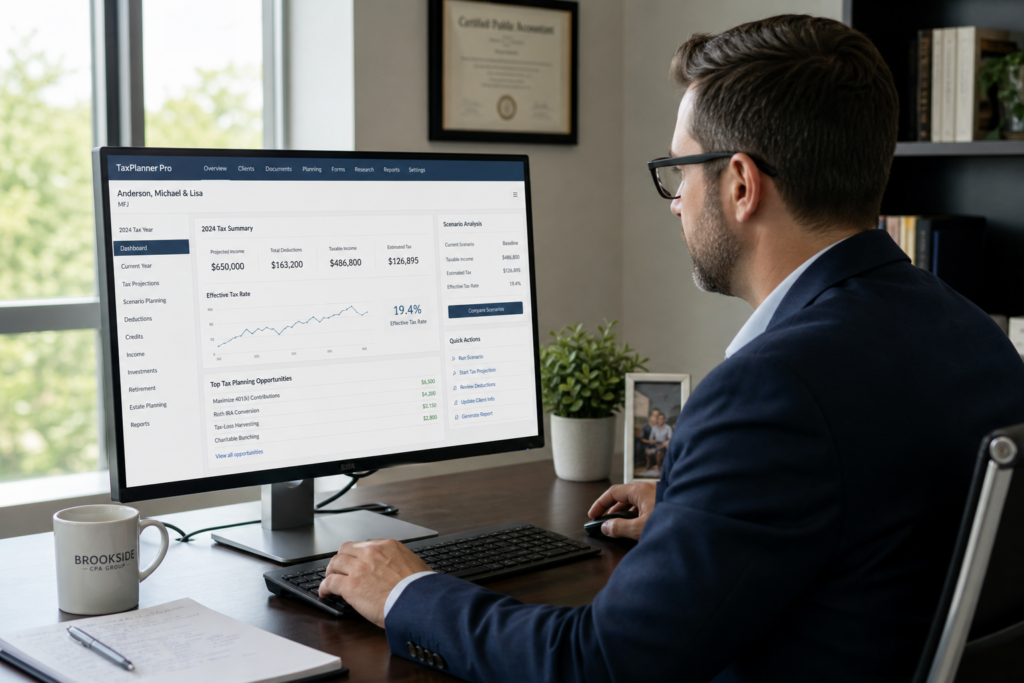
Tax Planning Software for CPAs: 2026 Guide
Tax planning software for CPAs is undergoing a revolution in 2026. The profession now faces unprecedented pressure to move beyond compliance and deliver advisory services that drive real client value. Modern software platforms now integrate AI automation, comprehensive planning frameworks, and client-ready deliverables that transform how CPAs work. For the 2026 tax year, choosing the right tax planning software for CPAs means selecting tools that support advisory transformation, not just tax preparation.
Table of Contents
- Key Takeaways
- What Is Tax Planning Software for CPAs?
- Why Are CPAs Shifting to Advisory-Focused Software?
- What Features Should CPAs Prioritize in 2026?
- How Does AI Enhance Tax Planning Software?
- What Are the Compliance Requirements for 2026?
- How Do You Evaluate Software ROI?
- Uncle Kam in Action: Mid-Size CPA Firm Transformation
- Next Steps
- Frequently Asked Questions
- Related Resources
 For Tax Professionals
Build your next chapter in tax advisory.
Explore how Uncle Kam Pro could support the next stage of your practice.
Key Takeaways
- Tax planning software for CPAs in 2026 prioritizes advisory transformation over basic compliance automation.
- AI integration enables CPAs to process returns faster while focusing on high-value client advisory work.
- IRS modernization efforts in 2026 include 18 ETAAC recommendations for electronic filing and preparer oversight.
- Modern platforms combine scenario modeling, client deliverables, and training to support complete advisory practices.
- The AICPA Tax Transformation initiative guides CPAs toward proactive, AI-enabled advisory organizations for 2026.
What Is Tax Planning Software for CPAs?
Quick Answer: Tax planning software for CPAs is a specialized technology platform designed to identify tax savings opportunities, model scenarios, and generate professional client deliverables beyond basic compliance work.
Tax planning software for CPAs has evolved far beyond simple tax preparation tools. In 2026, these platforms serve as comprehensive advisory operating systems that enable tax advisory services at scale. While traditional software focused on filing returns accurately, modern tax planning software for CPAs analyzes client data across multiple entities, identifies strategic opportunities, and produces professional deliverables that justify premium fees.
Core Components of Modern Tax Planning Software
Today’s tax planning software for CPAs typically includes several integrated components. The first is data aggregation from multiple sources including prior returns, accounting systems, and financial statements. Second is the analytical engine that identifies planning opportunities based on current tax law. Third is scenario modeling that compares different strategies side by side. Fourth is the deliverable generation system that creates client-ready reports and presentations.
According to the IRS Electronic Tax Administration Advisory Committee 2026 report, the focus is shifting toward digital-first tax administration. This creates opportunities for CPAs using modern software to differentiate themselves through superior client experience and faster turnaround times.
The Difference Between Tax Prep and Tax Planning Software
Many CPAs confuse tax preparation software with tax planning software. Tax prep software like Lacerte, ProSeries, or UltraTax focuses on accurately completing and filing returns. These tools excel at compliance. Tax planning software for CPAs focuses on proactive strategy identification, multi-year projections, and advisory deliverables. The best platforms combine both capabilities, but the core value proposition differs significantly.
Pro Tip: CPAs who position themselves as advisors rather than preparers command fees two to three times higher for the same client base.
Why Are CPAs Shifting to Advisory-Focused Software?
Quick Answer: The AICPA Tax Transformation initiative and AI automation are driving CPAs toward advisory services, which offer higher margins and recurring revenue compared to compliance work.
The CPA profession faces a fundamental shift in 2026. According to AICPA Chair Jan Lewis, AI will assist in tax return preparation, but the unique value CPAs provide comes from advisory services. Tax planning software for CPAs enables this transformation by automating routine work and elevating the professional’s role to strategic advisor.
The Economics of Advisory Transformation
Firms using modern tax planning software for CPAs report significant economic benefits. Traditional compliance work generates thin margins, often below 30 percent. Advisory services using sophisticated software platforms command margins exceeding 60 percent. The revenue per professional increases from $150,000 to $250,000 or more when firms successfully transition to advisory-focused models supported by the right technology.
Consider the standard deduction for 2026. Married filing jointly taxpayers claim $32,200, while single filers claim $24,800. A basic tax prep service simply applies these figures. Tax planning software for CPAs analyzes whether itemizing makes sense, models the impact of bunching deductions, and quantifies the multi-year tax savings of strategic timing. This analysis justifies advisory fees that dwarf basic compliance charges.
Client Expectations Are Changing
Business owners and high-income professionals expect more than tax preparation in 2026. They want year-round guidance, proactive strategies, and quantified savings projections. Tax planning software for CPAs enables firms to deliver these services efficiently. Without proper software, providing comprehensive advisory services to even 50 clients becomes overwhelming. With the right platform, a single CPA can manage strategic planning for 200 or more clients.
| Service Model | Average Fee | Margin | Client Capacity |
|---|---|---|---|
| Compliance Only | $800 | 25-30% | 300-400 |
| Compliance + Basic Advisory | $2,500 | 45-50% | 150-200 |
| Full Advisory with Software | $5,000-$15,000 | 60-70% | 50-100 |
What Features Should CPAs Prioritize in 2026?
Quick Answer: Prioritize unlimited client assessments, entity-aware scenario modeling, AI-generated deliverables, integrated training, and marketplace features that drive new business.
Not all tax planning software for CPAs offers the same capabilities. When evaluating platforms for your tax strategy practice, focus on features that directly support advisory transformation rather than incremental improvements to compliance workflows.
Unlimited Client Assessments
Many software platforms charge per analysis or impose usage limits. This creates a perverse incentive. CPAs avoid running assessments on prospects because each one costs money. The best tax planning software for CPAs offers unlimited free assessments. This enables you to prove value before engagement, run multiple scenarios for existing clients, and use tax planning as a year-round client retention tool rather than an annual upsell.
Entity-Aware Multi-Scenario Modeling
Business clients often operate multiple entities. They might have a 1040 personal return, two 1120-S corporations, and rental properties on Schedule E. Inferior tax planning software for CPAs treats each entity separately. Advanced platforms like those following the MERNA framework (Maximize deductions, Entity structure, Retirement, Niche strategies, Advanced techniques) analyze the entire portfolio simultaneously and identify strategies that span entities.
For example, in 2026, the 401(k) contribution limit is $24,500 with an additional $8,000 catch-up for those 50 and older. The super catch-up for ages 60 to 63 allows $11,250 extra for a total of $35,750. Entity-aware software identifies which entity should sponsor the plan and models the combined personal and business tax impact.
AI-Generated Professional Deliverables
Clients pay for clarity, not spreadsheets. The best tax planning software for CPAs generates structured, client-ready deliverables with strategic summaries, implementation roadmaps, and risk assessments. These documents position the CPA as a strategic advisor rather than a technician. The deliverable should explain complex tax concepts in plain language while maintaining professional credibility.
Pro Tip: Software that produces branded PDF deliverables with your firm logo significantly increases perceived value and justifies premium pricing.
Integrated Training and Support
Tax planning software for CPAs is only valuable if your team knows how to use it. Look for platforms that include regular training on the business of advisory, not just tax education. You need guidance on pricing advisory services, marketing to ideal clients, and structuring engagement letters. The software should support your entire advisory practice, not just the technical tax work.
Built-In Client Acquisition
The most sophisticated tax planning software for CPAs includes marketplace features that route pre-qualified advisory opportunities directly to certified professionals. This solves the biggest challenge for CPAs transitioning to advisory work: finding clients willing to pay for planning services. A built-in marketplace transforms software from a cost center to a revenue generator.
| Feature | Basic Software | Advisory Platform |
|---|---|---|
| Assessments | Limited/Pay-per-use | Unlimited |
| Scenario Modeling | Single entity | Multi-entity aware |
| Deliverables | Reports only | Branded client documents |
| Training | Software how-to | Advisory business coaching |
| Client Acquisition | None | Built-in marketplace |
How Does AI Enhance Tax Planning Software?
Quick Answer: AI automates data entry, identifies planning opportunities, generates client deliverables, and frees CPAs to focus on high-value advisory conversations rather than manual analysis.
Artificial intelligence is transforming tax planning software for CPAs in 2026. According to industry analysis, AI doesn’t replace CPAs but rather adds capacity. The profession doesn’t have a talent problem. It has a capacity problem. AI solves this by handling the work that doesn’t require professional judgment.
Automated Data Aggregation
Traditional tax planning software for CPAs required manual data entry from prior returns, financial statements, and accounting systems. AI-enabled platforms automatically extract data from uploaded documents. This includes recognizing income sources, identifying deductions, and mapping entity relationships. What once took hours now happens in minutes, allowing CPAs to spend time analyzing results rather than gathering inputs.
Intelligent Strategy Identification
The best AI-powered tax planning software for CPAs doesn’t just calculate tax. It identifies opportunities a human reviewer might miss. For example, if a client’s 2026 income puts them near the top of the 12 percent bracket at $100,800 for married filing jointly, the software suggests strategies to stay below the 22 percent threshold. It might recommend accelerating deductions, deferring income, or adjusting retirement contributions.
AI also identifies less obvious opportunities. If a client operates rental properties and has high W-2 income, the software might flag real estate professional status qualification or cost segregation opportunities. These strategies require CPA judgment to implement, but AI ensures nothing gets overlooked during the initial analysis.
Natural Language Deliverable Generation
Modern tax planning software for CPAs uses AI to generate plain-language explanations of complex tax strategies. Instead of presenting clients with spreadsheets and tax code references, the software produces narratives explaining what each strategy means, why it applies to their situation, and what steps they need to take. This transforms the CPA’s role from translator to strategic advisor.
Pro Tip: AI-generated deliverables should always include CPA review and customization. The technology provides the first draft, but professional judgment adds the value clients pay for.
Capacity Multiplication
Perhaps the most significant benefit of AI in tax planning software for CPAs is capacity multiplication. Firms using autonomous tax preparation and AI-enabled planning report processing returns in a fraction of previous time while maintaining quality. This allows individual CPAs to serve more clients at higher service levels. The economic impact is substantial. Revenue per professional increases while labor costs remain stable or decline.
The IRS Electronic Tax Administration Advisory Committee recommended in 2026 that the IRS expand AI applications for fraud detection, identity verification, and workflow optimization. This regulatory endorsement signals that AI in tax software is not experimental but essential for modern practice.
What Are the Compliance Requirements for 2026?

Quick Answer: The IRS issued 18 ETAAC recommendations in 2026 focusing on preparer oversight, EFIN validation, fraud prevention, and digital filing expansion for tax professionals.
Tax planning software for CPAs must comply with evolving IRS requirements. The 2026 Electronic Tax Administration Advisory Committee report outlined significant changes affecting how CPAs use software and interact with the IRS electronically.
Real-Time EFIN and PTIN Validation
The IRS recommended real-time validation of Electronic Filing Identification Numbers and Preparer Tax Identification Numbers. Tax planning software for CPAs must integrate with these validation systems to ensure only authorized preparers access client data and file returns. This protects against ghost preparers and improves system integrity. Ensure your software vendor commits to supporting these validation protocols as they roll out.
Enhanced Online Account Access
ETAAC recommended expanding Tax Pro Account functionality. CPAs with proper authorization should access taxpayer information, notices, and transcripts online through software integrations. This reduces phone calls and faxes. The best tax planning software for CPAs will integrate directly with IRS online accounts, allowing seamless data flow and faster issue resolution.
Data Security and Client Protection
With increased digital interaction comes heightened security requirements. Tax planning software for CPAs must implement strong encryption, multi-factor authentication, and audit trails. The IRS is expanding fraud detection using AI, which means unusual patterns trigger investigation. Ensure your software maintains detailed logs of who accessed what data and when.
E-File Expansion and MeF Improvements
The IRS is prioritizing electronic filing for employment tax forms like the 94X series. Tax planning software for CPAs serving business clients should support comprehensive e-filing beyond individual returns. Additionally, ETAAC recommended clarifying Modernized e-File reject codes. This helps preparers understand errors and fix them quickly rather than struggling with cryptic error messages.
| 2026 Compliance Area | Requirement | Software Impact |
|---|---|---|
| EFIN/PTIN Validation | Real-time checks | Integration required |
| Tax Pro Accounts | Enhanced access | API connection needed |
| Security Standards | Encryption and MFA | Platform certification |
| E-File Expansion | Employment tax forms | Form coverage expansion |
How Do You Evaluate Software ROI?
Quick Answer: Calculate ROI by comparing software cost against increased advisory fees, time saved, and new client acquisition. Top platforms deliver 5x to 10x first-year returns.
Investing in tax planning software for CPAs represents a significant commitment. The best platforms cost $200 to $500 monthly for unlimited access. Before committing, calculate the return on investment across three dimensions: revenue increase, time savings, and client acquisition.
Revenue Increase Calculation
Start by identifying 10 existing compliance clients who could benefit from advisory services. If you currently charge $1,200 for tax preparation, adding a $3,000 planning engagement increases revenue by $2,500 per client after accounting for reduced prep time. Ten clients generate $25,000 in additional revenue. Against $6,000 in annual software costs, that’s a 4x return in year one.
Time Savings Multiplier
Without software, creating a comprehensive tax plan takes 6 to 8 hours per client. With AI-enabled tax planning software for CPAs, the same analysis takes 1 to 2 hours. That’s 5 hours saved per engagement. At a $200 hourly rate, you save $1,000 in billable time per client. Across 20 advisory clients annually, that’s $20,000 in capacity freed for additional work or personal time.
Client Acquisition Value
If your tax planning software for CPAs includes marketplace features, calculate the value of new client opportunities. Assume the platform routes three qualified leads monthly. If you convert 30 percent at $5,000 average engagement value, that’s $54,000 in new annual revenue directly attributable to the software. This alone justifies the investment many times over.
Pro Tip: The intangible benefits of positioning yourself as a tax advisor rather than preparer significantly increase firm value if you ever sell your practice.
Implementation Costs to Consider
Beyond software subscription fees, factor in training time for your team, template customization, and initial client communication. Most firms report 20 to 30 hours of total implementation time. This investment pays back within the first three advisory engagements. The key is committing fully rather than half-heartedly adopting the platform.
Uncle Kam in Action: Mid-Size CPA Firm Transformation
A regional CPA firm with eight professionals struggled with thin margins and client commoditization. They prepared 600 returns annually at an average fee of $850, generating $510,000 in tax revenue. After expenses, partners took home modest incomes despite working 60-hour weeks during tax season.
The managing partner recognized that competing on price for compliance work was unsustainable. They needed to transition to advisory services but lacked the tools and knowledge. Traditional tax planning software for CPAs required expensive per-use credits, making it impractical to offer planning to all clients.
The firm implemented Uncle Kam’s tax planning software, which offered unlimited free client assessments, AI-driven planning, and comprehensive training on building an advisory practice. They selected 50 business owner clients as the initial advisory cohort.
Using the software’s MERNA framework, the firm identified an average of $18,000 in tax savings per client. They charged $4,500 for the planning engagement plus $2,500 for ongoing implementation support. Of the 50 clients approached, 38 engaged for planning services.
The results were transformative. The firm generated $266,000 in new advisory revenue in year one. The software cost $4,800 annually. The return on investment exceeded 55x. More importantly, the firm repositioned itself in the market. Clients viewed them as strategic advisors rather than commodity preparers. Referrals increased 40 percent as satisfied advisory clients recommended the firm to business owner peers.
By year two, the firm expanded advisory services to 80 clients and added two staff members focused exclusively on implementation. They stopped accepting new compliance-only clients below certain revenue thresholds. The managing partner reported working fewer hours while earning significantly more. The firm’s valuation increased by an estimated 60 percent as recurring advisory revenue made the practice more attractive to potential acquirers.
This transformation illustrates the power of the right tax planning software for CPAs. The tool enabled the firm to identify opportunities, communicate value, and scale advisory services without proportionally increasing headcount. Visit client results to explore additional case studies.
Next Steps
Ready to transform your practice with tax planning software for CPAs? Start with these action items:
- Evaluate your current client base and identify 10 to 20 candidates for advisory services.
- Research platforms offering unlimited assessments and integrated training, not just calculation tools.
- Calculate your potential ROI using the revenue increase, time savings, and acquisition value framework.
- Book a strategy session at Uncle Kam to discuss your specific practice transformation goals.
- Review the AICPA Tax Transformation resources to understand broader industry trends supporting advisory models.
The shift to advisory-focused practice isn’t optional for CPAs who want to thrive in 2026 and beyond. Tax planning software for CPAs provides the foundation for this transformation. The firms that adopt these tools today will dominate their markets tomorrow.
Frequently Asked Questions
Is tax planning software worth it for small CPA firms?
Yes. Small firms actually benefit more from tax planning software for CPAs than large firms. The software levels the playing field by providing enterprise-grade capabilities at affordable prices. A solo practitioner can deliver the same quality planning as a Big Four firm. The key is choosing platforms with unlimited usage rather than expensive per-analysis fees. Small firms report 3x to 5x ROI in the first year when they commit to advisory transformation.
How secure is client data in tax planning software?
Reputable tax planning software for CPAs uses bank-level encryption, multi-factor authentication, and regular security audits. Data is encrypted both in transit and at rest. Look for platforms that maintain SOC 2 compliance and provide detailed audit trails. The IRS is increasing oversight of preparer data security in 2026, so ensure your vendor meets or exceeds these standards. Ask about their incident response procedures and data backup protocols before committing.
Can tax planning software replace my current tax prep software?
Not entirely. Tax planning software for CPAs serves a different function than compliance preparation software. You still need platforms like Lacerte or ProSeries to file returns. However, advanced planning software integrates with prep systems to automate data flow. Some firms use planning software for the advisory work and less expensive prep software for filing. This hybrid approach maximizes value while controlling costs.
What training do I need to use tax planning software effectively?
Technical training on the software itself takes 5 to 10 hours. However, using tax planning software for CPAs effectively requires business development skills. You need to learn how to position advisory services, price engagements, and deliver planning meetings. The best platforms include this business coaching as part of the subscription. Budget 20 hours for complete onboarding including technical and business training. The time investment pays back quickly once you start closing advisory engagements.
How do I price advisory services using tax planning software?
Price based on value delivered, not time spent. If your tax planning software for CPAs identifies $25,000 in annual tax savings, charging $3,500 to $5,000 for the plan represents tremendous value. Many CPAs make the mistake of hourly billing for advisory work, which commoditizes their expertise. Value-based pricing tied to quantified savings justifies premium fees and increases client satisfaction. Some firms charge 15 to 20 percent of first-year identified savings.
What happens if tax laws change mid-year?
Quality tax planning software for CPAs updates automatically when tax laws change. The vendor monitors IRS announcements, congressional legislation, and regulatory guidance. Updates typically roll out within 48 to 72 hours of new law enactment. This ensures your client plans reflect current law. Additionally, software should alert you when changes affect existing client strategies so you can proactively reach out with updates. This positions you as a trusted advisor who monitors their interests year-round.
Can I use tax planning software for individual tax clients?
Absolutely. Tax planning software for CPAs works for any taxpayer, from W-2 employees to complex business owners. High-income individuals benefit significantly from planning around the 2026 tax brackets. For example, keeping taxable income below $100,800 for married filing jointly maintains the 12 percent rate. Strategic Roth conversions, charitable giving, and capital gains management all provide planning opportunities for individual clients. Don’t limit advisory services to business clients.
How does tax planning software handle multi-state taxation?
Advanced tax planning software for CPAs includes state tax calculations and identifies opportunities unique to specific states. This matters for remote workers, retirees relocating, and multi-state businesses. The software should model the impact of state tax differences when evaluating strategies like entity domicile, retirement account distributions, and residency changes. Not all platforms handle state tax comprehensively, so verify this capability if you serve multi-state clients.
What support is available if I have technical questions?
Look for tax planning software for CPAs that offers multiple support channels. This should include live chat, email support, phone access during business hours, and a comprehensive knowledge base. Some platforms provide dedicated success managers for new users. The quality and responsiveness of support directly impacts your ability to serve clients effectively. Before purchasing, test support by asking technical questions during the trial period. Response time and quality reveal whether the vendor truly supports CPAs or just sells software.
Related Resources
- Tax Strategy Services for Professionals
- Tax Advisory Programs
- MERNA Tax Planning Framework
- CPA Client Success Stories
- Comprehensive Tax Planning Guides
This information is current as of 6/20/2026. Tax laws change frequently. Verify updates with the IRS or consult current professional guidance if reading this later.
Last updated: June, 2026

