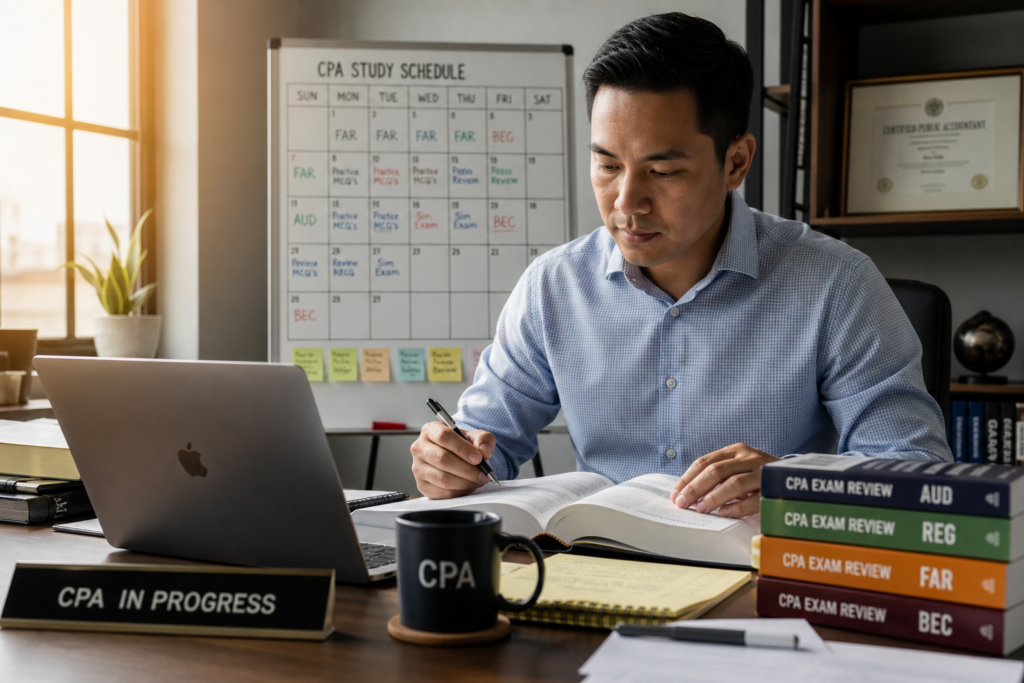
Study Schedule for CPA Exam While Working: 2026 Guide
Study Schedule for CPA Exam While Working: 2026 Guide for Tax Professionals
Creating a study schedule for CPA exam while working presents unique challenges for tax professionals in 2026. With approximately 300-400 hours of preparation needed, balancing client demands, busy season pressures, and exam preparation requires strategic planning. This guide provides actionable strategies to help working tax professionals successfully pass the CPA exam while maintaining their careers.
 For Tax Professionals
Build your next chapter in tax advisory.
Explore how Uncle Kam Pro could support the next stage of your practice.
Table of Contents
- Key Takeaways
- Why Should Tax Professionals Earn the CPA Credential in 2026?
- How Many Study Hours Do You Need for the CPA Exam While Working?
- What Study Schedule Framework Works Best for Working Professionals?
- How Can You Balance CPA Study During Busy Season?
- Which CPA Review Course Should You Choose in 2026?
- What Study Techniques Maximize Retention for Working Candidates?
- How Do You Maintain Motivation Throughout the Process?
- Uncle Kam in Action: Tax Pro Passes CPA While Building Advisory Practice
- Next Steps
- Frequently Asked Questions
- Related Resources
Key Takeaways
- Working professionals need 300-400 total study hours for the 2026 CPA exam
- Study 15-20 hours weekly for 12-16 weeks per exam section
- Schedule exams during slower work periods, avoiding busy season
- CPA credential enhances advisory capabilities as AI transforms routine tax work
- Use time-blocking and early morning study sessions for consistency
Why Should Tax Professionals Earn the CPA Credential in 2026?
Quick Answer: The CPA credential positions tax professionals for high-value advisory work as AI automates routine compliance tasks in 2026. CPAs earn premium fees and gain credibility for strategic planning services.
The accounting profession is undergoing a dramatic transformation in 2026. According to the American Institute of CPAs, AI is rapidly automating data entry and routine tax return preparation. This shift creates unprecedented opportunities for credentialed professionals.
The Advisory Revolution
Tax professionals with CPA credentials are pivoting to tax advisory services that deliver substantially higher margins. While AI handles compliance, CPAs provide strategic judgment, multi-year planning, and entity structuring advice. The AICPA’s 2026 Tax Transformation initiative specifically targets this shift from compliance to advisory.
CPAs are expanding beyond traditional tax services into wealth management and family office services. These integrated advisory models require the credibility and expertise that only the CPA designation provides. For working professionals already in tax preparation or bookkeeping, earning your CPA opens doors to premium service offerings and higher income potential.
Market Differentiation
With social media influencers and unlicensed advisors flooding the market with questionable tax advice, the CPA credential serves as a trust signal. Clients increasingly seek professionals with verified expertise, particularly for complex strategies involving entity structuring, retirement planning, and multi-state tax issues.
Pro Tip: The CPA credential significantly increases your ability to charge premium advisory fees. Many CPAs report 3-5x higher revenue per client when transitioning from compliance to strategic planning services.
How Many Study Hours Do You Need for the CPA Exam While Working?
Quick Answer: Working professionals should plan for 300-400 total study hours in 2026. This translates to 75-100 hours per exam section over 12-16 weeks of consistent preparation.
Study hour requirements vary based on your background and the specific exam section. For 2026, the National Association of State Boards of Accountancy recommends comprehensive preparation across all four sections.
Recommended Study Hours by Section
| Exam Section | Recommended Hours | Difficulty Level |
|---|---|---|
| Auditing and Attestation (AUD) | 80-90 hours | Moderate |
| Financial Accounting and Reporting (FAR) | 100-120 hours | High |
| Regulation (REG) | 75-90 hours | Moderate-High |
| Business Environment and Concepts (BEC) | 60-80 hours | Moderate |
Adjusting for Your Background
Tax professionals with strong backgrounds in certain areas can reduce study time. If you work in tax preparation daily, REG may require fewer hours. Conversely, if you lack recent accounting coursework, FAR demands additional preparation time. However, most working professionals find that consistent 15-20 hour weekly study schedules work better than cramming.
The Working Professional Reality
Unlike full-time students who study 40+ hours weekly, working professionals must integrate preparation into existing schedules. This means spreading 80 hours over 12-16 weeks rather than 4-6 weeks. While this extends the timeline, it prevents burnout and maintains work quality.
Many successful candidates working full-time find that 15-20 hours weekly—split between weekday mornings, evenings, and weekend blocks—creates sustainable momentum. This pace allows you to maintain client relationships and avoid the performance drop that excessive studying causes.
What Study Schedule Framework Works Best for Working Professionals?
Quick Answer: A time-blocked schedule with early morning sessions (5-7 AM), focused weeknight blocks (2-3 hours), and dedicated weekend time (6-8 hours) creates 15-20 weekly study hours without sacrificing work performance.
Creating an effective study schedule for CPA exam while working requires understanding your energy patterns and existing commitments. The most successful candidates treat CPA study like a non-negotiable client appointment.
The 5-7 AM Power Window
Early morning study sessions offer maximum focus before work demands begin. Tax professionals who study 5-7 AM weekdays gain 10 high-quality hours weekly. This window provides fresh mental energy and eliminates the evening exhaustion problem.
Morning sessions work particularly well for conceptual learning and watching video lectures. Save practice problems for evening sessions when you need less cognitive load. This approach aligns with how your brain processes different types of information.
Weekly Schedule Template
| Day | Time Block | Study Activity | Hours |
|---|---|---|---|
| Monday-Friday | 5:00-7:00 AM | Video lectures, reading | 10 |
| Monday/Wednesday | 7:30-9:00 PM | Practice problems | 3 |
| Saturday | 8:00 AM-2:00 PM | Mock exams, review | 6 |
| Sunday | Rest/light review | Flashcards, weak areas | 0-2 |
| Total Weekly | 19-21 hours |
The Pomodoro Technique for CPA Study
Breaking study sessions into 25-minute focused blocks with 5-minute breaks maintains concentration. This technique works particularly well for evening sessions when mental fatigue sets in. Four Pomodoro cycles create a productive 2-hour evening block.
During busy season or high-workload periods, reduce to 10-12 hours weekly. Consistency matters more than volume. Missing weeks entirely disrupts retention, while maintaining even reduced hours preserves momentum. Consider this approach part of your broader tax strategy for career advancement.
Pro Tip: Block your calendar for study time just like client meetings. Treat these blocks as non-negotiable commitments. This prevents work from consuming all available time.
How Can You Balance CPA Study During Busy Season?
Quick Answer: Schedule exam sections during off-peak periods. Take exams in May-July or September-November. Maintain minimal study (5-7 hours weekly) during busy season to preserve knowledge, then accelerate when workload decreases.
Tax professionals face unique scheduling challenges. January through April demands 50-70 hour work weeks, making intensive CPA study nearly impossible. Strategic planning around the tax calendar is essential.
Optimal Testing Windows
Target these ideal testing periods:
- May-July: Post-busy season energy remains high while workload drops
- September-October: Before extension deadline rush and year-end planning
- November-December: After October 15 deadline before holiday slowdown
Avoid January-April and late October entirely. The stress of combining exam preparation with peak work demands leads to poor performance in both areas. Many tax professionals who attempt this approach fail exams and damage client relationships simultaneously.
The Maintenance Study Approach
During busy season, shift to maintenance mode. Dedicate 5-7 hours weekly to flashcard review, practice problems, and preserving previously learned material. This prevents complete knowledge loss while acknowledging work reality.
Resume intensive study immediately after April 15. Your brain retains more than you expect, and the rapid review phase accelerates learning. Many successful working candidates use this two-phase approach: maintenance during busy season, acceleration during slower periods.
Negotiating Work Flexibility
Discuss your CPA goals with your employer. Many firms offer study time, flexible schedules, or exam bonuses. Frame the conversation around how your CPA credential benefits the firm’s business owners through enhanced service capabilities and credibility.
Request reduced client load during your exam month or the ability to shift hours. Firms investing in your professional development often provide surprising support when you demonstrate commitment and strategic planning.
Which CPA Review Course Should You Choose in 2026?

Quick Answer: Choose based on your learning style and schedule flexibility. Becker offers comprehensive structure, Roger provides engaging video instruction, and Wiley delivers affordability with adaptive technology. All three work for working professionals.
CPA review courses range from $1,500 to $3,500 for complete packages. The right choice depends on how you learn best and your available study time. According to recent Journal of Accountancy analyses, course selection matters less than consistent usage.
Top Review Courses for 2026
Becker CPA Review: Industry standard with structured lesson plans and extensive practice questions. Best for learners who want comprehensive coverage and clear progression. The adaptive learning platform adjusts to your weak areas.
Roger CPA Review: Engaging video lectures with energetic instruction style. Ideal for visual learners who benefit from personality-driven teaching. Mobile app supports study during commutes or lunch breaks.
Wiley CPAexcel: Bite-sized lessons work well for working professionals with limited time blocks. Strong question bank and adaptive technology. More affordable than competitors while maintaining quality.
Features That Matter for Working Professionals
Prioritize these features:
- Mobile access: Study during commutes, client wait times, or lunch breaks
- Flexible timelines: 18-24 month access accommodates work schedule fluctuations
- Adaptive learning: Technology that focuses on your weak areas maximizes limited study time
- Progress tracking: Clear dashboards showing readiness prevents guesswork
- Practice exam simulations: Test environment familiarity reduces exam day stress
Pro Tip: Many employers reimburse CPA review course costs upon passing. Ask about reimbursement policies before purchasing to potentially save thousands of dollars.
What Study Techniques Maximize Retention for Working Candidates?
Quick Answer: Active recall through practice problems, spaced repetition with flashcards, and teaching concepts to others create stronger retention than passive reading. Focus on application over memorization.
Working professionals cannot afford to waste study time on ineffective techniques. Research on adult learning shows that active engagement beats passive consumption.
The 30-70 Rule
Spend only 30% of study time on lectures and reading. Dedicate 70% to practice problems, simulations, and active testing. This application-focused approach mirrors how the CPA exam actually tests knowledge.
After completing a chapter, immediately work through 20-30 multiple choice questions. Review incorrect answers thoroughly, understanding why you missed them. This immediate application cements concepts far better than re-reading material.
Spaced Repetition System
Review material at increasing intervals. Study new content on Day 1, review on Day 3, again on Day 7, then Day 14. This spacing forces your brain to retrieve information, strengthening neural pathways.
Use digital flashcard apps that automate spaced repetition. Anki and Quizlet incorporate this system. Create cards for formulas, key concepts, and common exam traps. Review during micromoments throughout your day.
The Feynman Technique
Explain complex concepts in simple language as if teaching someone else. This reveals knowledge gaps immediately. Record yourself explaining topics or write explanations without referencing materials.
Join online study groups where you explain concepts to peers. Teaching forces deeper understanding than passive consumption. Many candidates find that explaining tax concepts to study partners solidifies their own knowledge.
Leveraging Work Experience
Connect exam concepts to real client situations. When studying partnership taxation, think about actual partnership returns you prepare. This practical connection makes abstract concepts concrete and memorable.
Tax professionals studying for REG have significant advantages if they actively connect exam material to daily work. Similarly, bookkeepers studying FAR can relate journal entries to actual transactions they process. Exploit these connections rather than treating work and study as separate domains.
How Do You Maintain Motivation Throughout the Process?
Quick Answer: Set section-by-section milestones, join accountability groups, and maintain a compelling vision of your CPA career. Track small wins and reward progress to sustain momentum over 12-18 months.
The CPA exam journey spans 12-18 months for working professionals. Maintaining motivation requires deliberate strategy beyond willpower.
The Compelling Why
Define specific career outcomes your CPA enables. Instead of vague goals like “advance my career,” identify concrete objectives. Examples include launching an advisory practice, serving high-net-worth clients, or commanding premium fees for strategic planning.
Write your compelling vision and review it during difficult weeks. Visualize yourself conducting strategy sessions with business owners, presenting tax plans, or speaking confidently about complex regulations. This emotional connection sustains effort when motivation wanes.
Accountability Systems
Find study partners or join online CPA communities. Weekly check-ins where you report progress create external accountability. When you commit to others, you maintain consistency during low-motivation periods.
Consider hiring a CPA exam coach or mentor who passed while working. Their experience navigating similar challenges provides both practical advice and emotional support. Many successful candidates cite mentorship as critical to persistence.
Milestone Rewards
Celebrate each passed section with meaningful rewards. After passing your first section, take a weekend trip or buy something significant. These rewards acknowledge sacrifice and refuel motivation for the next section.
Track progress visually with completion charts or progress bars. Seeing advancement creates psychological momentum. Some candidates use marble jars, moving one marble for each completed study session to visualize cumulative effort.
Pro Tip: Failed sections happen to most candidates. View them as data about weak areas, not personal failure. Adjust your study approach and schedule a retake quickly. Persistence matters more than perfect execution.
Uncle Kam in Action: Tax Pro Passes CPA While Building Advisory Practice
Client Snapshot: Marcus, a 32-year-old tax preparer with a regional firm, earning $75,000 annually preparing 300+ tax returns each season.
The Challenge: Marcus wanted to transition from compliance work to high-value advisory services. However, without his CPA credential, clients and employers viewed him as a tax preparer rather than a strategic advisor. He needed the credential to command premium fees but struggled to find study time during demanding work schedules.
The Uncle Kam Solution: Marcus connected with Uncle Kam’s tax planning software community and discovered strategies for balancing CPA study with full-time work. He implemented a structured approach:
- Scheduled exams in May, July, September, and November to avoid busy season
- Committed to 5-7 AM study sessions five days weekly for consistent progress
- Used Wiley CPA Excel with adaptive learning to maximize limited study time
- Maintained minimal study during January-April to preserve knowledge
- Joined accountability group through Uncle Kam’s network for weekly check-ins
Marcus passed all four sections within 14 months while maintaining his full client load. He immediately repositioned his services, offering comprehensive tax planning rather than just compliance.
The Results:
- Income increase: $75,000 to $135,000 within 18 months of earning CPA
- Service transformation: 70% of revenue from advisory vs. previous 100% compliance
- Client value increase: Average client fee rose from $800 to $4,200 annually
- Work-life balance: Reduced busy season hours by 30% through higher-value work
- Market positioning: Launched specialized practice serving real estate investors
Marcus invested $2,800 in his CPA review course and approximately 380 hours of study time. His first-year income increase of $60,000 represented a 2,143% return on his course investment and validated the time commitment. Today, he delivers comprehensive tax strategies using Uncle Kam’s MERNA™ framework and serves as a mentor to other tax professionals pursuing their CPA credentials.
See more success stories at Uncle Kam Client Results.
Next Steps
Ready to create your personalized study schedule for CPA exam while working? Take these specific actions:
- Block 15-20 hours weekly in your calendar for the next 12 weeks
- Research CPA review courses and request trial access to compare platforms
- Schedule your first exam section during an off-peak work period
- Join an online CPA study community for accountability and support
- Discuss your CPA goals with your employer to explore support options
The CPA credential unlocks premium advisory opportunities as AI transforms routine tax work. Tax professionals who earn this designation position themselves for the high-value planning services that define the profession’s future. Explore how entity structuring and advanced tax strategies become accessible with your CPA credential.
Book a strategy session to discuss how the CPA credential fits into your career trajectory and advisory practice goals: Book Your Strategy Session.
Frequently Asked Questions
Can I realistically pass the CPA exam while working full-time?
Yes. Thousands of tax professionals pass annually while working full-time. Success requires disciplined time management and strategic exam scheduling. Allocate 15-20 weekly hours consistently, avoid testing during busy season, and plan for 12-18 months total. The key is treating study time as non-negotiable rather than fitting it around work when convenient.
Which CPA exam section should I take first as a working professional?
Most tax professionals start with REG (Regulation) because it aligns with daily work. This creates natural reinforcement between your job and exam content. Alternatively, start with your strongest area to build confidence and momentum. Avoid FAR first unless you have recent accounting coursework, as it requires the most study time and can discourage continuation if you struggle initially.
How much does CPA exam preparation cost in 2026?
Total costs range from $3,000-$5,000 including review courses, exam fees, and application fees. CPA review courses cost $1,500-$3,500. Each exam section costs approximately $200-250 in application and testing fees. Many employers reimburse these costs upon passing, and the investment typically generates significant ROI through increased earning potential. Check with your employer about reimbursement policies before purchasing.
What if I fail a CPA exam section while working full-time?
Most candidates fail at least one section. View this as feedback about weak areas rather than personal failure. Review your score report immediately to identify specific deficiencies. Adjust your study approach—increase practice problems if you struggle with application, or add more review sessions if retention is the issue. Schedule your retake within 6-8 weeks to prevent knowledge decay. Failed sections are setbacks, not roadblocks.
Should I study for multiple CPA sections simultaneously?
No. Working professionals should focus intensively on one section at a time. Splitting attention between sections reduces retention and dilutes limited study time. Master one section completely, pass it, then move to the next. The only exception is light review of previously passed sections to prevent knowledge loss before completing all four parts within the 18-month window.
How do I maintain CPA study momentum during busy season?
Shift to maintenance mode with reduced hours during January-April. Dedicate 5-7 weekly hours to flashcard review and practice problems rather than new material. This preserves knowledge without competing with work demands. Schedule exams for May or later, never during busy season. Accept that this phase focuses on retention, not advancement. Resume intensive study immediately after April 15 when work pressures decrease.
What are the education requirements for CPA licensure in 2026?
Most states require 150 semester hours of college education, including specific accounting and business courses. Check your state’s specific requirements through the National Association of State Boards of Accountancy. Some states allow you to sit for the exam with 120 hours but require 150 for licensure. If you lack required hours, consider online programs that working professionals can complete while studying for exams. State requirements vary significantly, so verify your specific jurisdiction.
Related Resources
- Tax Advisory Services: Building Your Advisory Practice
- Tax Planning Software for CPAs
- MERNA Method: Strategic Tax Planning Framework
- Self-Employed Tax Strategies
- Business Solutions for Tax Professionals
Last updated: June, 2026
This information is current as of 6/20/2026. Tax laws and professional requirements change frequently. Verify updates with the AICPA or NASBA if reading this later.

