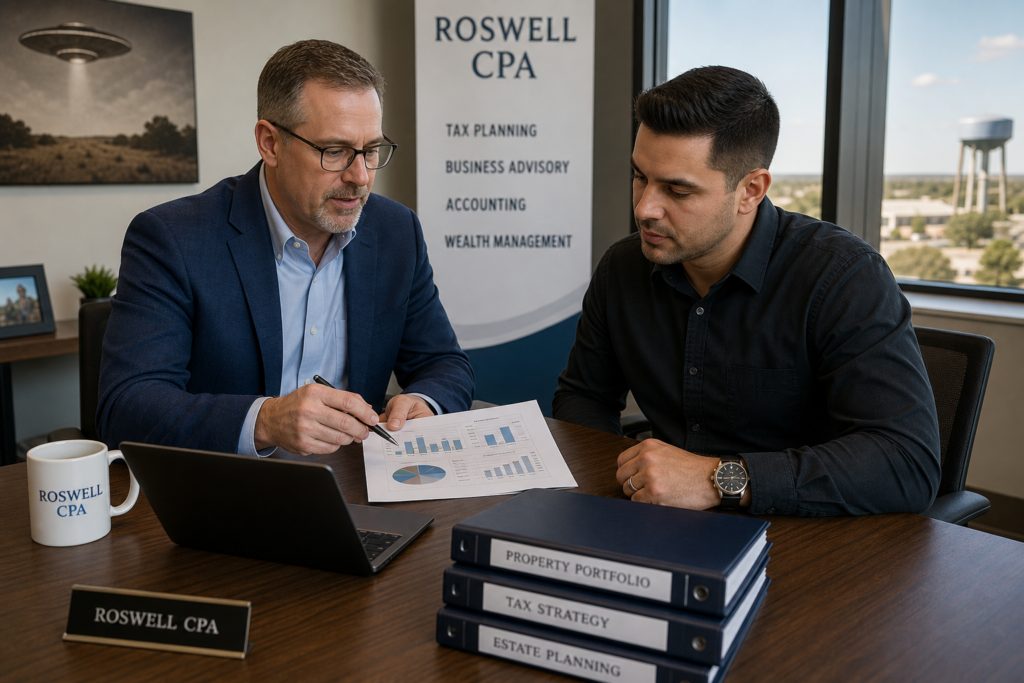
Roswell Real Estate Investor CPA: 2026 Tax Strategy Guide for Building Wealth Through Property Investment
Roswell Real Estate Investor CPA: 2026 Tax Strategy Guide for Building Wealth Through Property Investment
As a Roswell real estate investor, your success depends on more than finding profitable properties—it depends on minimizing your tax burden strategically. A knowledgeable Roswell real estate investor CPA can show you how to leverage 2026 tax laws to accelerate depreciation, maximize deductions, and build long-term wealth. Whether you own rental properties, flip houses, or build rental portfolios, understanding your tax obligations and opportunities transforms your bottom line. This guide reveals the 2026 tax strategies that separate successful real estate investors from those leaving money on the table.
Table of Contents
- Key Takeaways for 2026
- What Rental Property Deductions Can You Claim in 2026?
- How Does Depreciation Work for Real Estate Investors?
- What Is Cost Segregation and How Does It Benefit 2026 Investors?
- Can You Claim 100% Bonus Depreciation in 2026?
- How Do 1031 Exchanges Help You Avoid Taxes?
- Why Partner With a Roswell Real Estate Investor CPA?
- Frequently Asked Questions
Key Takeaways for 2026
- Real estate investors can claim 100% bonus depreciation on qualifying properties placed in service after January 19, 2025.
- Mortgage interest deductions are limited to $750,000 of qualifying acquisition debt for married filing jointly.
- Cost segregation studies produce immediate first-year deductions when combined with 100% bonus depreciation.
- 1031 exchanges remain available for deferring taxes on real estate dispositions and reinvestment strategies.
- Roswell real estate investors should work with a qualified CPA to optimize property structure and maximize tax benefits.
What Rental Property Deductions Can You Claim in 2026?
Quick Answer: For 2026, rental property owners can deduct operating expenses including mortgage interest (up to $750,000 for MFJ), property taxes (capped at $40,000), insurance, maintenance, property management fees, utilities, and advertising costs. Depreciation deductions apply to the building structure—not the land—over 27.5 years for residential properties and 39 years for commercial properties.
The foundation of real estate tax optimization begins with understanding what expenses are deductible. When you own rental property as a Roswell real estate investor, the IRS recognizes that your property generates income, and you have legitimate business expenses to reduce that income. These deductions directly lower your taxable rental income, which means more money stays in your pocket instead of going to the IRS.
Deductible Mortgage Interest and Property Taxes
For 2026, mortgage interest on your rental property is fully deductible, but there’s an important limit: the deduction applies only to interest on up to $750,000 of qualifying acquisition debt if you’re married filing jointly, or $375,000 if you’re married filing separately. This cap applies to total home acquisition debt across all your properties, not per property. Property taxes paid on rental properties are also deductible, but they’re subject to the broader state and local tax (SALT) deduction cap of $40,000 for 2026, or $20,000 if married filing separately.
Let’s consider a practical example: Sarah, a Roswell real estate investor, owns two rental properties in New Mexico. Her combined mortgage interest for 2026 is $45,000, and her property taxes total $12,000. She can deduct the full $45,000 in mortgage interest (well within the $750,000 cap) plus her $12,000 in property taxes, reducing her taxable rental income by $57,000. This is why working with a tax preparation service in New Mexico matters—they ensure you’re capturing every eligible deduction.
Pro Tip: Document all mortgage interest and property tax payments separately for each property. Your mortgage statements and property tax bills are your proof. The IRS requires itemization when claiming these deductions, so organization is critical.
Operating Expenses and Maintenance Costs
Beyond interest and taxes, rental properties generate numerous deductible expenses. Property management fees, homeowners association dues, insurance premiums, repairs, maintenance, advertising for tenants, utilities paid by the owner, and landscaping costs are all fully deductible in the year you incur them. These ordinary and necessary business expenses reduce your gross rental income.
Important distinction: repairs are immediately deductible, but capital improvements (upgrades that extend the property’s life or add value) must be depreciated over time. Your Roswell real estate investor CPA can help you properly categorize these expenses, ensuring you don’t miss deductions while maintaining compliance with IRS rules.
How Does Depreciation Work for Real Estate Investors?
Quick Answer: Depreciation allows you to deduct a portion of your rental property’s cost each year based on its recovery period. Residential rental properties depreciate over 27.5 years, commercial properties over 39 years, and components like appliances or roof systems over 5-7 years. For 2026, properties placed in service after January 19, 2025 qualify for 100% bonus depreciation, allowing immediate deduction of the entire depreciable basis.
Depreciation is a powerful tax benefit that creates deductions even when you’re not spending money in that year. The IRS recognizes that buildings wear out and lose value over time. For 2026, residential rental properties (apartments, single-family rentals, condos) depreciate at a straight-line rate over 27.5 years, while commercial properties (office buildings, retail spaces) depreciate over 39 years. The land itself never depreciates—only the building structure and improvements.
2026 Depreciation Example
Imagine you purchased a residential rental property in Roswell for $400,000. The land is valued at $100,000 and the building structure at $300,000. Your annual depreciation deduction would be $300,000 ÷ 27.5 years = approximately $10,909 per year. This deduction reduces your taxable income without requiring you to write a check—it’s a non-cash deduction that shelters your rental income from taxation.
However, there’s a critical consideration: depreciation recapture. When you sell the property, you’ll owe taxes on the accumulated depreciation at a 25% rate (or higher, depending on circumstances). This is why strategic planning with a knowledgeable Roswell real estate investor CPA is essential. They can coordinate your depreciation strategy with your long-term investment goals, including whether you’ll use IRS Publication 946 guidance on depreciation to optimize your position.
What Is Cost Segregation and How Does It Benefit 2026 Investors?
Quick Answer: Cost segregation is an engineering-based analysis that identifies building components qualifying for faster depreciation. Appliances, flooring, fixtures, and equipment that normally depreciate over 27.5-39 years can be reclassified as 5-7 year property. Combined with 2026’s 100% bonus depreciation, this creates substantial first-year deductions that reduce your taxable income immediately.
Cost segregation studies have become essential tools for sophisticated real estate investors in 2026. Here’s why: a professional cost segregation engineer reviews your property and identifies components that qualify for shorter recovery periods than the default building structure. For example, appliances, lighting systems, roofing, flooring, and interior finishes can often be classified as 5-year or 7-year property rather than 27.5-year property.
When you implement a cost segregation study for a property acquired after January 19, 2025, and placed in service before January 1, 2031, you gain access to 100% bonus depreciation. This means components classified as 5-year or 7-year property can be immediately deducted in the first year, not depreciated over multiple years.
Cost Segregation Timing Requirements
For 2026 investors, timing is critical. Construction must begin after January 19, 2025, and before January 1, 2029. The property must be placed in service after July 4, 2025, and before January 1, 2031. You must also ensure the property uses the Modified Accelerated Cost Recovery System (MACRS) for depreciation—not the Alternative Depreciation System (ADS)—and the property’s original use must commence with you as the new owner (unless specific used-property rules apply). Finally, you must make a specific election on your tax return to claim the bonus depreciation benefit.
Pro Tip: Miss any of these requirements, and the entire deduction can be eliminated. This is why a qualified Roswell real estate investor CPA must oversee your cost segregation planning. Use our Small Business Tax Calculator to estimate the impact of cost segregation on your 2026 tax liability—you might be surprised at the potential savings.
Can You Claim 100% Bonus Depreciation in 2026?
 Free Tax Write-Off Finder
Quick Answer: Yes, for 2026, eligible real estate properties acquired and placed in service after January 19, 2025, generally qualify for 100% additional first-year depreciation. This means the entire depreciable basis of qualifying assets (whether you use cost segregation or standard depreciation) can be deducted in the year the property is placed in service, subject to acquisition date rules, contract documentation, and proper election on your tax return.
The 100% bonus depreciation benefit for 2026 represents a significant opportunity for Roswell real estate investors. Under Section 168(k) guidance, qualifying property you acquire and place in service in 2026 can be fully deducted in the first year, rather than being depreciated over 27.5 years. This accelerates your tax deductions dramatically, potentially creating substantial tax savings.
Documenting Acquisition and Placement in Service
To claim 100% bonus depreciation for 2026, you must carefully document the acquisition date and when the property was “placed in service” (made available for use). The property must be acquired after January 19, 2025, through a written binding contract or purchase agreement. You can optionally elect a reduced bonus depreciation percentage (less than 100%) if it better aligns with your overall tax strategy, such as managing Alternative Minimum Tax (AMT) exposure or avoiding higher tax brackets.
How Do 1031 Exchanges Help You Avoid Taxes?
Quick Answer: A 1031 exchange allows you to defer taxes on the sale of real property by reinvesting the proceeds into another “like-kind” property. For 2026, when you sell a rental property and identify a replacement property within 45 days, then close on that replacement within 180 days, the entire gain from the sale goes untaxed—indefinitely, if you keep reinvesting.
A 1031 exchange named after IRS Section 1031 is one of the most powerful wealth-building tools available to real estate investors. When you’ve accumulated significant appreciation in a rental property and want to diversify into different real estate markets, properties, or investment types, a 1031 exchange lets you defer all capital gains taxes. Instead of paying taxes on your profit and reducing your reinvestment capital, you defer those taxes indefinitely by acquiring replacement property.
Critical 1031 Exchange Timelines for 2026
The timing rules are strict. After you close on your sale, you have exactly 45 days to identify your replacement property(ies) in writing. You then have 180 days from the sale closing to complete the purchase of your replacement property. These are federal deadlines, not suggestions—missing them disqualifies your exchange and triggers full taxation on the gain. This is why many investors work with qualified intermediaries and coordinate with their Roswell real estate investor CPA to ensure compliance.
| 1031 Exchange Timeline | Deadline | Requirements |
|---|---|---|
| Property Identification | 45 days from sale closing | Written identification submitted to qualified intermediary |
| Property Purchase | 180 days from sale closing | Must close on at least one identified property |
| Equal or Greater Value | Before 180-day deadline | Replacement property purchase price ≥ sale price |
Beyond timing, your replacement property must be “like-kind”—meaning real property for real property. For 2026 exchanges, you can trade raw land for an apartment building, a commercial office property for a residential rental house, or a shopping center for single-family rentals. The flexibility is broad, which makes 1031 exchanges excellent strategies for repositioning your portfolio.
Why Partner With a Roswell Real Estate Investor CPA?
Quick Answer: A specialized Roswell real estate investor CPA coordinates your property structure, timing of acquisitions and dispositions, depreciation strategies, cost segregation studies, and 1031 exchanges to optimize your 2026 tax position. They ensure you capture every deduction, maintain IRS compliance, and build a cohesive long-term wealth strategy that accountants without real estate expertise cannot provide.
Real estate tax strategies don’t exist in isolation. Your 1031 exchange affects your cost basis in the replacement property. Your depreciation strategy interacts with your cost segregation study. Your property structure (whether you hold properties individually, through an LLC, or in partnership) affects your self-employment tax exposure, liability protection, and pass-through taxation. These interconnections require someone who understands real estate investment at a sophisticated level.
Integrated Tax Planning for Roswell Investors
A qualified Roswell real estate investor CPA builds a coordinated plan across all your properties and investment activities. They review your current property portfolio, identify underutilized deductions, structure new acquisitions optimally, and coordinate with your real estate attorney and financial advisor. This integrated approach transforms tax planning from reactive (filing your 2026 return in April 2027) to proactive (strategically structuring each transaction to minimize lifetime taxes).

Uncle Kam in Action: David’s Multi-Property 1031 Exchange and Cost Segregation Strategy
David is a Roswell real estate investor who owned three residential rental properties with combined annual rents of $180,000. He’d accumulated approximately $400,000 in appreciation across his properties but was concerned about concentrating his portfolio in Roswell. He wanted to diversify geographically while minimizing taxes. However, selling those properties would trigger capital gains taxes exceeding $120,000.
Working with Uncle Kam’s Roswell real estate investor CPA team, David planned a 1031 exchange. He sold one property that had appreciated significantly, immediately identifying a new multi-unit apartment complex in Phoenix acquired in early 2026 through a 1031 exchange. The Phoenix property qualified for cost segregation analysis, which identified $280,000 in components (appliances, HVAC systems, flooring, fixtures) that qualify as 5-7 year property under MACRS.
With 2026’s 100% bonus depreciation, David claimed the entire $280,000 cost segregation deduction in his first year of ownership. Combined with standard building depreciation and the property’s rental expenses, David’s 2026 taxable income from his real estate portfolio dropped from $180,000 to approximately $45,000—despite receiving the same rental cash flow. The tax savings from this single strategic transaction exceeded $27,000 in David’s first year alone.
More importantly, David’s old Roswell property sale was completely untaxed through the 1031 exchange, allowing him to redeploy all his capital (not just the after-tax portion) into the Phoenix property. His portfolio now has geographic diversification, improved management efficiency through a professional property management company, and a tax-optimized structure. David also preserved his future flexibility: the Phoenix property can be part of another 1031 exchange when it’s time to diversify further.
Next Steps: Optimize Your 2026 Real Estate Tax Position
Your real estate investments represent significant capital and opportunity. The difference between merely filing your taxes and strategically optimizing them can be tens of thousands of dollars annually. Consider these action steps:
- Schedule a consultation with a Roswell real estate investor CPA to review your current property portfolio and identify missed deductions from prior years.
- Document your property details including acquisition dates, purchase prices, land-to-building allocation, and all renovation or improvement costs for current and planned properties.
- Evaluate cost segregation if you’ve recently acquired or are planning to acquire rental property in 2026—the bonus depreciation benefit this year is substantial.
- Explore 1031 exchanges if you own appreciated properties but want to reposition your portfolio geographically or by property type.
- Review Q2 2026 estimated tax payments due June 15 to ensure your withholdings align with your year-end tax projection.
The most successful real estate investors coordinate their tax strategy with their investment strategy. This coordination ensures that your acquisitions, dispositions, and financing decisions all align with your overall wealth-building goals. It’s not just about minimizing this year’s taxes—it’s about building a tax-efficient real estate portfolio that generates long-term wealth.
Frequently Asked Questions
Can I deduct HOA fees from my rental property income?
Yes, homeowners association (HOA) fees or condo association dues paid on a rental property are fully deductible as operating expenses. These are ordinary business expenses required to maintain your property and keep it operational. Keep records of all HOA payment statements for your Roswell real estate investor CPA to verify the deduction.
What’s the difference between a repair and a capital improvement for tax purposes?
Repairs restore your property to its original condition and are immediately deductible. Examples include fixing a roof leak, replacing broken windows, or patching foundation cracks. Capital improvements extend the property’s useful life or add value, like a complete roof replacement, new HVAC system, or addition of a room. Improvements must be depreciated over time (5-39 years depending on the asset). This distinction matters—misclassifying could trigger IRS scrutiny. Your Roswell real estate investor CPA should review improvement expenditures to ensure proper categorization.
Do I qualify for the 20% qualified business income (QBI) deduction on my rental property income?
Possibly, depending on your income level and how your property is structured. Rental real estate generally qualifies for the Section 199A qualified business income deduction, allowing you to deduct 20% of your net rental income. However, the deduction phases out for single filers with taxable income over $182,100 and married joint filers over $364,200 (2026 figures). Additionally, if you have passive losses from rental activities, those can offset your QBI. Your Roswell real estate investor CPA can determine whether you qualify and structure your portfolio to maximize this benefit.
What happens to my depreciation deductions when I sell a rental property?
When you sell rental property, you must “recapture” all the depreciation deductions you claimed. The accumulated depreciation is taxed at a 25% rate (or your ordinary income tax rate if higher), separate from your capital gains tax. If you use a 1031 exchange to defer your sale gain, the depreciation recapture risk continues in your replacement property. This is why long-term 1031 exchange strategies are powerful—they defer both capital gains and depreciation recapture indefinitely as long as you keep reinvesting in like-kind property.
Can I deduct a loss on my rental property against my other income?
Rental property losses are passive losses and cannot offset your active business income, W-2 wages, or investment income (unless you qualify as a real estate professional). However, passive losses carry forward to future years and can offset passive gains from your other rental properties or investments. In the year you sell the property, any remaining unused passive losses can finally offset other income types. Real estate professionals (those who spend over 750 hours annually in real estate business and for whom real estate comprises over 50% of their business hours) have different rules allowing more generous loss deductions. A Roswell real estate investor CPA can evaluate whether you qualify as a real estate professional and structure your activities accordingly.
Should I hold rental properties individually or through an LLC for tax purposes?
For Roswell real estate investors, entity structure affects liability protection, self-employment tax exposure, creditor protection, and financing availability. Individually-owned properties report on Schedule E (Rental Income) with full self-employment tax exposure on net rental income. An LLC or partnership can reduce self-employment tax by retaining some income as non-guaranteed payments. However, LLCs add complexity, accounting costs, and potential franchise tax obligations. Your Roswell real estate investor CPA and real estate attorney should jointly evaluate your specific situation, property portfolio size, liability exposure, and long-term goals before recommending a structure. The wrong entity choice can cost tens of thousands in unnecessary taxes.
How do I handle rental property taxes if I own out-of-state properties?
Out-of-state rental properties follow the same federal tax rules: deductible operating expenses, depreciation, and mortgage interest for properties placed in service by December 31, 2026 benefit from the 100% bonus depreciation bonus discussed above. However, some states impose state income taxes on rental income from out-of-state properties. A few states have special real estate investor provisions. Your Roswell-based CPA can coordinate with CPAs or tax professionals in the state where your properties are located to ensure you’re not overpaying state taxes and that you’re complying with each state’s specific requirements.
This information is current as of 6/8/2026. Tax laws change frequently. Verify updates with the IRS or a qualified Roswell real estate investor CPA if reading this later.
Last updated: June, 2026

