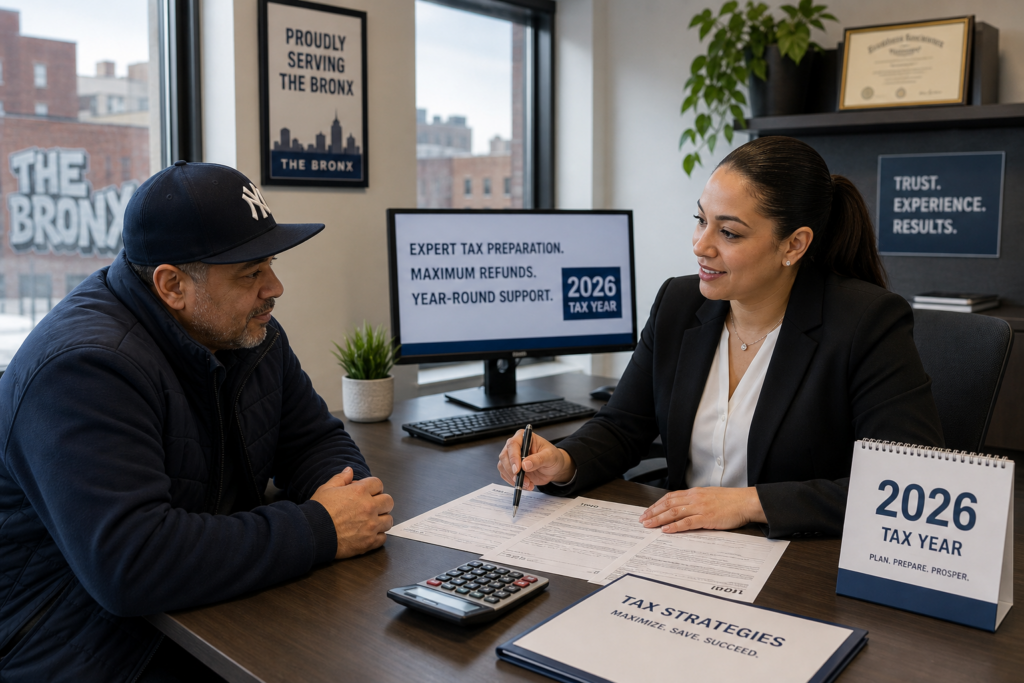
Best Tax Preparer in the Bronx: Your Complete 2026 Guide to Expert Tax Filing
Best Tax Preparer in the Bronx: Your Complete 2026 Guide to Expert Tax Filing
Finding the best tax preparer in the Bronx is one of the smartest investments you can make for your financial health. Whether you’re a freelancer navigating self-employment taxes, a small business owner, or a W-2 employee, working with a qualified tax preparer in the Bronx ensures your return is filed accurately, on time, and optimized for maximum refunds and deductions. This guide walks you through exactly what to look for, common pitfalls to avoid, and how to verify credentials so you can file with confidence for the 2026 tax year.
Table of Contents
- Key Takeaways
- Why Choosing the Right Tax Preparer in the Bronx Matters
- What Types of Tax Preparers Are Available to Bronx Residents?
- What Credentials Should You Verify Before Hiring a Tax Preparer?
- How Much Should You Expect to Pay for Tax Preparation Services in 2026?
- What Are the Key Tax Credits and Deductions for Bronx Residents?
- What Red Flags Should You Watch Out For When Hiring a Tax Preparer?
- What Is the Step-by-Step Process for Vetting and Hiring a Tax Preparer in the Bronx?
- Uncle Kam in Action: A Successful Case Study
- Next Steps
- Frequently Asked Questions
Key Takeaways
- The best tax preparer in the Bronx should have verified credentials: Enrolled Agent (EA), CPA, or tax attorney.
- Always verify credentials through official IRS resources and state licensing boards for 2026 compliance.
- Bronx residents can access multiple tax credits including NYC affordable housing benefits and state earned income credits.
- Expect to pay $200–$2,500+ for professional tax preparation depending on complexity and file type.
- Avoid preparers offering refund anticipation loans or promising inflated refunds as red flags for fraud.
Why Choosing the Right Tax Preparer in the Bronx Matters
Quick Answer: A professional tax preparer in the Bronx ensures compliance with federal, state, and local tax laws while maximizing deductions. They reduce audit risk and save you money by spotting credits you might miss.
Hiring the best tax preparer in the Bronx is more than convenience—it’s about risk management and financial optimization. The Bronx has unique tax considerations that require local expertise. New York State imposes its own income tax, New York City adds additional taxes, and the borough’s large immigrant population often faces language and documentation barriers when filing.
A qualified professional safeguards you in multiple ways. First, they ensure your filing meets all IRS requirements for the 2026 tax year. Second, they identify deductions and credits specific to Bronx residents. Third, they reduce your audit risk by properly documenting income and expenses. Finally, they provide ongoing tax planning advice that can save thousands annually.
Why Local Expertise Matters for Bronx Taxpayers
The Bronx is home to diverse taxpayer demographics: gig workers, small business owners, immigrants, renters, and recent arrivals. Each group faces different tax rules and opportunities. A local tax preparer understands the community’s specific needs and knows where to find credits that national chain preparers often miss. Additionally, Bronx residents qualify for the NYC commercial rent tax, pied-à-terre taxes (if wealthy), and specific state credits that require local knowledge to apply properly.
What Types of Tax Preparers Are Available to Bronx Residents?
Quick Answer: Three main types of tax professionals serve Bronx residents: CPAs, Enrolled Agents (EAs), and tax attorneys. Each has different levels of credential, authority, and specialization.
Certified Public Accountants (CPAs)
CPAs are the highest-credential tax professionals. They pass rigorous licensing exams, complete continuing education annually, and maintain a state license through the New York State Board of Accountancy. CPAs can represent you before the IRS on audit matters. They specialize in complex business tax situations and provide broader accounting services beyond tax filing. For Bronx small business owners and real estate investors, CPAs are often the best choice. Their fees range from $250 to $500+ per hour, but the expertise justifies the cost for complicated returns.
CPAs must maintain current professional liability insurance and carry a valid PTIN (Preparer Tax Identification Number) from the IRS. This dual credential system ensures accountability and professional standards compliance for the 2026 tax year and beyond.
Enrolled Agents (EAs)
Enrolled Agents are federally authorized tax specialists. They pass a three-part IRS exam covering individual and business taxation. EAs can represent clients before the IRS during audits, appeals, and tax disputes. Unlike CPAs, EAs focus exclusively on tax matters. This specialization often makes them excellent choices for freelancers, gig workers, and small business owners in the Bronx who need deep tax expertise without accounting services. EAs typically charge $150 to $400 per hour, making them more affordable than CPAs while maintaining high professional standards.
Tax Attorneys
Tax attorneys provide the highest level of legal and tax expertise. They represent clients in tax disputes, litigation, and complex tax planning strategies. Attorneys are essential if you’re facing an IRS audit, criminal tax charges, or planning sophisticated estate or business structures. Most Bronx residents don’t need a tax attorney for routine filing, but they’re invaluable for specialized situations. Attorney fees for tax matters typically start at $300 per hour and can exceed $1,000+ for complex work.
For Bronx residents with straightforward tax situations, using a specialized tax preparation service combining EA expertise with local knowledge often delivers the best value.
What Credentials Should You Verify Before Hiring a Tax Preparer?
Quick Answer: Always verify PTIN, state licensing, and membership in professional organizations before hiring. Use official IRS databases and state board websites for 2026 verification.
How to Verify PTIN and IRS Authorization
Every tax professional preparing returns for clients must have a valid PTIN (Preparer Tax Identification Number) issued by the IRS. You can verify a preparer’s PTIN by visiting the IRS website and checking their status. The PTIN confirms the person has passed background checks and meets minimum tax knowledge requirements. This single verification step eliminates unqualified preparers immediately.
For Enrolled Agents specifically, you can cross-reference the National Tax Association directory or contact the National Association of Enrolled Agents to confirm credentials. Both organizations maintain searchable directories of legitimate EAs throughout New York.
Checking State CPA Licensing
CPAs in New York must maintain an active license from the New York State Board of Accountancy. You can verify any CPA’s license status directly through the board’s website by searching their name and credential number. The board website lists disciplinary actions and whether the CPA is in good standing. This critical check prevents you from hiring preparers with pending complaints or past misconduct.
Professional Organization Memberships
Legitimate Bronx tax preparers often maintain memberships in professional organizations. CPAs typically belong to the American Institute of CPAs (AICPA) or New York State Society of CPAs. Enrolled Agents belong to NAEA or state EA societies. Tax attorneys belong to state bar associations and often specialize tax law organizations. Ask prospective preparers about their memberships and verify them independently. Membership commitment demonstrates professionalism and ongoing education compliance.
Pro Tip: Request references from three to five previous clients for the 2026 tax year. Ask them specifically about accuracy, communication quality, refund amounts, and whether they’d hire the preparer again. This peer validation matters more than any credential alone.
How Much Should You Expect to Pay for Tax Preparation Services in 2026?
 Free Tax Write-Off Finder
Quick Answer: Simple 1040 returns cost $200–$600. Business returns (Schedule C) cost $400–$1,500. Complex returns with multiple income streams, rental properties, or business structures cost $1,500–$5,000+.
Pricing Structure by Return Complexity
Most Bronx tax preparers charge by complexity level rather than hourly rates. Understanding these categories helps you budget correctly for 2026:
| Return Type | Typical Cost Range | Best For |
|---|---|---|
| Simple 1040 (W-2 income only) | $200–$600 | Employees with one job, standard deduction |
| 1040 with itemized deductions | $400–$900 | Homeowners, high-income earners |
| Schedule C (self-employed, sole prop) | $400–$1,500 | Freelancers, gig workers, small business owners |
| S-Corp, Partnership, rental property | $1,200–$3,000 | Business structures, rental income |
| Multi-entity, complex investments | $3,000–$5,000+ | Sophisticated structures, high-income investors |
Avoiding Hidden Fees and Refund Scams
Honest Bronx tax preparers quote all-in fees upfront. Watch for these cost traps: refund anticipation loans (predatory credit products), upsells for payment plans, charges for e-filing, and promises of inflated refunds. The IRS and Federal Trade Commission warn against preparers who charge fees based on refund size or offer loans against future refunds. These are red flags for fraud or unethical practices.
What Are the Key Tax Credits and Deductions for Bronx Residents?
Quick Answer: Bronx residents qualify for federal credits, New York State credits, and NYC credits. A qualified tax preparer identifies all applicable credits for maximum refunds in 2026.
Federal Tax Credits for Bronx Filers
Federal credits available to qualifying Bronx residents for 2026 include the Earned Income Tax Credit (EITC), Child Tax Credit (up to $2,200 per qualifying child), and American Opportunity Tax Credit for education. The EITC is particularly valuable for low- to moderate-income Bronx workers. For 2026, the IRS allows working families to claim credits that can result in refunds exceeding taxes paid, making proper filing essential.
New York State Tax Credits and Deductions
New York offers its own EITC (more generous than federal in some income ranges), property tax relief credits for renters and homeowners, and education credits. Bronx renters often qualify for the renter credit if they meet income thresholds. Homeowners can deduct property taxes up to $10,000 federally and claim additional NY deductions. The state also allows child and dependent care credits and student loan interest deductions that complement federal benefits.
NYC-Specific Tax Benefits and Challenges
New York City adds complexity to Bronx resident returns. The city has unique taxes: the commercial rent tax applies to certain businesses in Manhattan, but Bronx small business owners should verify if they’re affected. High-net-worth Bronx residents with second homes in Manhattan face the new pied-à-terre tax on properties valued over $1 million (co-ops/condos) or $5 million (houses). NYC also offers affordable housing and mixed-income building credits for eligible residents. A knowledgeable Bronx tax preparer ensures you claim all NYC benefits while avoiding unintended tax liabilities.
Pro Tip: Immigrants and non-English speakers should ask Bronx tax preparers about language services. Many qualified preparers speak Spanish, Bengali, Chinese, and other languages commonly used in the Bronx community, ensuring clear communication and accurate filing.
What Red Flags Should You Watch Out For When Hiring a Tax Preparer?
Quick Answer: Red flags include refusal to sign returns, refund anticipation loans, guarantees of inflated refunds, and lack of verifiable credentials. Avoid preparers exhibiting these warning signs.
Preparer Signature Requirements
The IRS requires all tax preparers to sign returns as a condition of filing. If a Bronx tax preparer refuses to sign or place their PTIN on your return, this is a major red flag. Signed returns ensure the preparer takes responsibility for accuracy. Unsigned returns invite IRS scrutiny and potential audits. Always require a signed return with the preparer’s name and PTIN clearly displayed.
Refund Anticipation Loans and Misleading Promises
Predatory preparers often offer refund anticipation loans—short-term, high-interest borrowing against anticipated refunds. These loans carry annual interest rates exceeding 300–500% when annualized. They’re designed to enrich the lender, not benefit taxpayers. Additionally, any preparer promising inflated refunds, guaranteeing specific refund amounts, or claiming special relationships with the IRS is committing fraud. Legitimate preparers estimate conservatively and never guarantee results.
Credential Verification Failures
Preparers who can’t provide verifiable credentials, refuse to share their PTIN, or don’t appear in official directories should be avoided. Use the IRS PTIN lookup and New York State Board of Accountancy search before hiring. If a preparer isn’t officially listed or their credentials don’t match their claims, move to another option. This single verification prevents hiring unqualified or unethical tax professionals.
What Is the Step-by-Step Process for Vetting and Hiring a Tax Preparer in the Bronx?
Quick Answer: Research locally, verify credentials, compare pricing, conduct interviews, check references, and hire based on credential-expertise fit and comfort level.
Step 1: Research and Identify Candidates
Quick Answer: Research locally, verify credentials, compare pricing, conduct interviews, check references, and hire based on credential-expertise fit and comfort level.
Start by asking friends, family, and business contacts in the Bronx for recommendations. Google reviews and Better Business Bureau ratings provide insights into preparer reputation. Search NAEA directories for local Enrolled Agents or use New York State Board to find CPAs. Create a shortlist of five to ten candidates for evaluation.
Step 2: Verify Credentials Independently
For each candidate, verify their PTIN, professional licenses, and organizational memberships directly with issuing bodies. Don’t rely on the preparer’s word or website claims alone. This verification takes 15 minutes per candidate and eliminates unqualified preparers immediately.
Step 3: Request References and Interview
Call your top three candidates and request three client references from the past two years. Ask references about accuracy, communication, refund amounts, and whether they’d rehire. Conduct a phone or in-person interview with your top choice. Discuss your specific tax situation, ask about their experience with your industry or income type, and assess their communication style and responsiveness.
Step 4: Discuss Fees and Scope
Get written fee quotes from your top candidates. Ensure fees cover all work needed: return preparation, e-filing, correspondence, and basic tax advice. Clarify what’s included (consultations, revisions) and what’s extra. A transparent fee structure builds trust and prevents surprise charges.
Step 5: Make Your Decision and Hire
Base your final decision on verified credentials, interview impression, reference feedback, and pricing. Schedule your first appointment and provide all necessary documents. Request a timeline for completion and regular check-in communication. Ensure a clear, professional engagement that makes the 2026 tax year filing smooth and confident.

Uncle Kam in Action: A Successful Case Study
The Client: Maria, a self-employed graphic designer in the South Bronx, has been filing her own taxes for five years using online software. She earns approximately $65,000 annually as a freelancer and rents an apartment in the Bronx. Maria is a single mother of two children under age 17 and received no formal financial education about tax optimization.
The Problem: Maria filed her 2025 return claiming only basic business deductions. She missed the Earned Income Tax Credit (EITC), child-dependent care credit, and numerous business deductions for her home office, equipment, and supplies. She overpaid by approximately $4,200 and received only a $1,100 refund when she qualified for $5,300+. Additionally, her sole proprietor structure meant maximum self-employment tax on all profits—no opportunity for optimization.
The Solution: Maria hired a local Enrolled Agent specializing in self-employed professionals. The EA reviewed her five-year filing history, identified missed credits and deductions, and prepared an amended return for 2025. More importantly, for 2026, the EA structured her business differently, recommended expense tracking systems, and showed how entity optimization could reduce her self-employment tax burden by 15% annually.
The Results: Maria received a $4,200 refund for 2025 (correcting her prior underclaiming) and positioned herself to save approximately $9,750 in taxes for 2026 through proper deduction planning and potential S-Corp structure optimization. She also received ongoing tax advice for quarterly planning. Her investment in professional preparation: $900 for 2025 amended return and 2026 planning. First-year return on investment (ROI): 11:1 based on refund alone, not counting future savings.
Maria’s case demonstrates why choosing the best tax preparer in the Bronx matters. Professional expertise pays for itself through credits missed, deductions optimized, and proper structures implemented. Many Bronx taxpayers like Maria are unknowingly leaving thousands on the table by attempting DIY filing without understanding tax law changes or credit eligibility.
Next Steps
- Gather Your Documents: Collect all 2026 tax documents (W-2s, 1099s, receipts, mortgage statements) before meeting with a preparer. Organized documentation saves time and reduces fees.
- Search Local Directories: Use the NAEA directory or state board website to identify qualified tax preparers in your Bronx neighborhood. Narrow your list to five candidates with relevant specialization.
- Verify Credentials: Spend 30 minutes verifying credentials through official sources. This single step prevents hiring unqualified or unethical preparers.
- Conduct Interviews: Call your top three candidates and discuss your specific tax situation. Ask about their experience with clients in your industry or with your income structure.
- Check References: Request references from recent clients and ask directly about accuracy, communication, and satisfaction. This peer feedback is invaluable.
- Compare Pricing and Hire: Get written quotes and select based on credentials, expertise fit, reference feedback, and reasonable pricing. Schedule your appointment early to avoid end-of-season rush.
Frequently Asked Questions
Can I Use an Online Tax Software Instead of Hiring a Preparer in the Bronx?
Online software works for simple returns (single W-2 income, standard deduction, no dependents). However, for self-employed individuals, business owners, rental property owners, or anyone with complex income sources, professional preparation is safer. Software often misses deductions and credits that professionals spot automatically. Additionally, you have no one to contact if the IRS audits your return or questions your filing. Professional preparers can represent you and defend your return’s accuracy.
What Should I Bring to My First Appointment With a Tax Preparer?
Bring all W-2s, 1099s, K-1s, and other income documents. Include receipts for business expenses, charitable contributions, and medical expenses. Bring last year’s return for reference. If you have mortgage statements, property tax receipts, or education expenses, include those. A preparer checklist is often available—ask for it in advance and gather items beforehand to save appointment time and reduce your overall preparation cost.
Is It Better to Hire a Local Bronx Preparer or Use a National Chain?
Local Bronx preparers typically offer better customer service, lower prices, and personal attention compared to national chains. They understand local tax situations, community demographics, and neighborhood-specific credits. National chains prioritize volume and speed, often assigning different preparers to different returns. For most Bronx residents, a local CPA, EA, or tax preparation firm outperforms national chains in quality and value.
What Happens If the IRS Audits My Return That a Preparer Filed?
A professional preparer (EA or CPA) can represent you in an IRS audit at no additional charge in many cases. This is a major benefit of hiring a professional rather than using software. The preparer can explain your deductions, provide documentation, and negotiate with the IRS on your behalf. Tax attorneys provide even broader representation rights. If you filed without a professional, you’d have to handle the audit yourself or pay a preparer retroactively just to defend the return. Professional representation during an audit often saves more than the original preparation cost.
How Much Can a Tax Preparer Save Me on My Bronx Taxes?
Savings vary by tax situation. Self-employed professionals typically see $500–$2,000+ in annual savings from proper deduction documentation alone. Business owners optimizing entity structure see $2,000–$15,000+ in savings annually. Real estate investors using cost segregation studies and proper depreciation see $5,000–$50,000+ in deferral benefits. Even simple filers often gain $300–$1,000 by capturing all available credits and deductions. Most Bronx residents recover their preparer fees many times over through identified savings.
Should I Get Tax Advice Year-Round or Just at Filing Time?
Year-round tax planning is far more valuable than filing-time-only preparation. A proactive preparer helps you make strategic decisions throughout the year (estimated tax payments, quarterly planning, entity optimization) that minimize your total tax burden. End-of-year filing cannot fix missed opportunities or inefficient structures. For business owners and self-employed Bronx residents, an ongoing relationship with a tax professional generates more value than annual filing alone. Consider engagement fees or retainer relationships with preparers who offer quarterly check-ins and strategic guidance.
What If I Disagree With My Tax Preparer’s Advice?
Professional preparers must explain their reasoning for any positions they take on your return. If you disagree, ask them to justify their approach with specific IRS guidance or court rulings. If unsatisfied, seek a second opinion from another professional. However, trust your preparer’s expertise—they have access to current tax law databases and professional updates you don’t. Most disagreements arise from misunderstandings that clear communication resolves. A good preparer welcomes questions and explains positions clearly for your 2026 return and beyond.
How Do I Switch From My Current Tax Preparer to a New One?
Switching preparers is straightforward. Request copies of your prior-year returns and all supporting documentation from your current preparer. Ask for a summary of positions taken on your last return. Provide these documents to your new preparer for context. The new preparer will use this information to ensure continuity and avoid duplicating prior-year work. Most preparers charge a separate engagement fee for tax return filing, so switching doesn’t trigger cancellation penalties or long-term commitments. If you’re unhappy with your current preparer, switching is appropriate and encouraged.
This information is current as of 6/8/2026. Tax laws change frequently. Verify updates with the IRS or New York State Department of Taxation if reading this after June 2026.
Related Resources
- Tax Strategy Planning for Bronx Residents
- Year-Round Tax Advisory Services
- Self-Employed Tax Planning for Freelancers
- Tax Solutions for Bronx Small Business Owners
- See How We’ve Helped Other Bronx Clients
Last updated: June, 2026

