
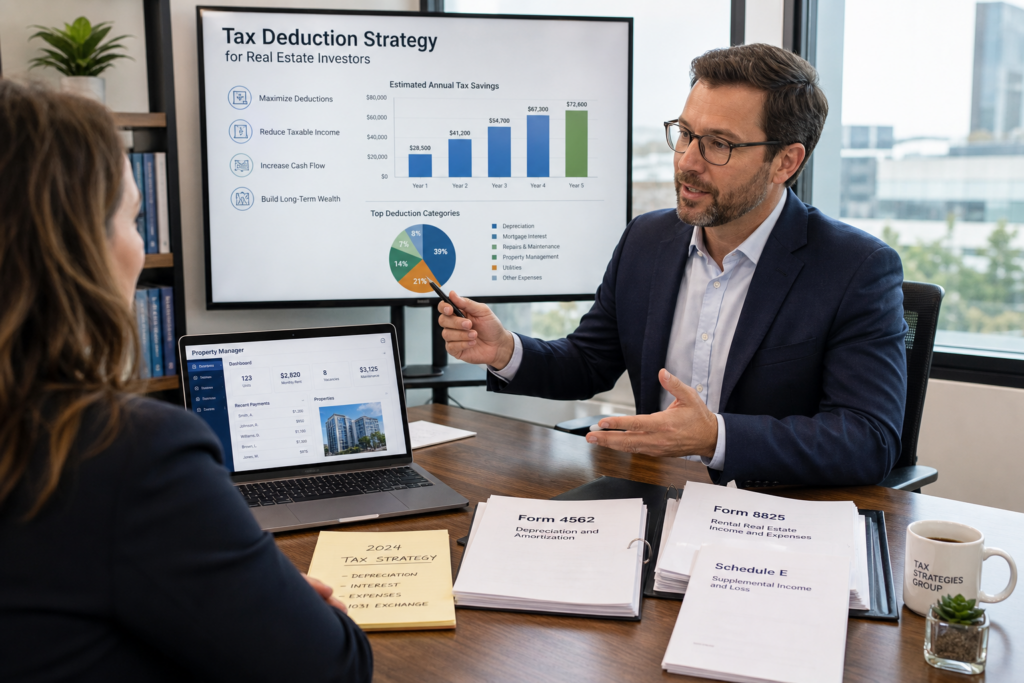
Property Manager Deductions to Maximize for Clients: 2026 Tax Advisory Playbook
For the 2026 tax year, tax professionals face a critical opportunity. Property managers across the country are leaving tens of thousands in deductions on the table annually. The One Big Beautiful Bill Act’s reinstatement of 100% bonus depreciation and expanded cost segregation opportunities create a narrow window to deliver substantial client value. This guide shows tax advisors how to identify overlooked property manager deductions to maximize for clients, transform compliance relationships into high-margin advisory engagements, and generate measurable ROI that justifies premium fees.
Table of Contents
- Key Takeaways
- What Makes Property Manager Deductions Unique in 2026?
- Which Technology and Software Expenses Qualify for Immediate Deduction?
- How Can Property Managers Maximize Vehicle and Mileage Deductions?
- What Are the Bonus Depreciation Opportunities for Property Improvements?
- How Should Tax Pros Document Home Office Deductions for Remote Property Managers?
- What Professional Development and Education Costs Are Fully Deductible?
- How Should Tax Pros Structure Entity-Level vs. Schedule E Deductions?
- Uncle Kam in Action: $47,000 Tax Savings for Multi-State Property Management Firm
- Next Steps
- Frequently Asked Questions
- Related Resources

Key Takeaways
- The 2026 OBBBA reinstates 100% bonus depreciation for property improvements and qualified equipment purchases.
- Property management technology expenses now qualify for immediate Section 179 deduction up to statutory limits.
- Multi-state property managers can stack federal deductions with state-specific incentives in 2026.
- Proper entity structuring determines whether deductions flow through Schedule E or business returns.
- The R&D expensing window closing July 6, 2026 allows retroactive deductions for property tech development.
What Makes Property Manager Deductions Unique in 2026?
Quick Answer: Property manager deductions span multiple tax categories—ordinary business expenses, rental property costs, and capital improvements—requiring specialized knowledge to maximize client savings in 2026.
Property managers operate in a unique tax environment. They incur expenses both as service providers and as parties connected to rental real estate. This dual classification creates opportunities that most CPAs miss. For 2026, understanding which expenses qualify under which code sections determines whether clients achieve 20% or 80% deduction capture.
The One Big Beautiful Bill Act fundamentally changed the depreciation landscape. According to Accounting Today, the reinstatement of 100% bonus depreciation means property managers can immediately expense qualified improvements rather than depreciating them over 15 or 27.5 years. This single provision can generate five-figure first-year deductions.
The Three-Category Framework for Property Management Deductions
Tax professionals should categorize property manager expenses into three buckets:
- Direct Operating Expenses: Office supplies, software subscriptions, marketing, professional fees
- Vehicle and Travel: Mileage, property inspections, client meetings, multi-property visits
- Capital Expenditures: Office improvements, technology infrastructure, equipment purchases
Each category requires different documentation standards and flows through different tax forms. The IRS’s updated business expense guidance provides specific recordkeeping requirements for property management professionals.
2026 Legislative Changes Affecting Property Managers
Beyond federal changes, state-level amendments create additional opportunities. Florida’s proposed HJR 1-F would reduce assessment caps on non-homestead properties from 10% to 5% starting in 2027, according to Forbes. Property managers operating in Florida should model the impact on client portfolios.
Pro Tip: Multi-state property managers can create substantial value by identifying state-specific deduction opportunities. For example, some states allow accelerated depreciation schedules while others provide credits for property technology investments.
Tax advisors should review client operations across all jurisdictions. The complexity of multi-state compliance creates natural opportunities to position ongoing tax advisory services as essential rather than optional.
Which Technology and Software Expenses Qualify for Immediate Deduction?
Quick Answer: For 2026, property management software, CRM systems, tenant portals, and communication platforms qualify for immediate Section 179 expensing or 100% bonus depreciation under the OBBBA.
Property managers typically spend $5,000 to $50,000 annually on technology. However, many treat these as simple Schedule C deductions without exploring accelerated recovery options. The distinction matters significantly for cash flow.
Software as a Service vs. Licensed Software
SaaS subscriptions qualify as ordinary business expenses and are immediately deductible. However, perpetual software licenses purchased in 2026 may qualify for Section 179 treatment if they meet the IRS definition of tangible personal property. The key distinction lies in whether the software is hosted externally or installed on company-owned hardware.
| Technology Category | 2026 Treatment | Documentation Required |
|---|---|---|
| Property management SaaS platforms | Immediate ordinary deduction | Subscription invoices, payment records |
| Perpetual software licenses | Section 179 or bonus depreciation | Purchase agreement, placed-in-service date |
| Custom software development | R&D expensing (if qualified by July 6, 2026) | Developer contracts, project specifications |
| Computer hardware and servers | 100% bonus depreciation under OBBBA | Receipts, asset tags, business-use logs |
For clients who developed proprietary property management technology between 2023 and 2025, the R&D expensing window closing July 6, 2026 allows retroactive deductions. Tax professionals should immediately file amended returns for eligible clients.
Communication and Marketing Technology
Property managers rely heavily on communication tools. For 2026, these expenses are fully deductible:
- Business phone systems and VoIP services
- Email marketing platforms and CRM databases
- Website hosting, domain registration, and maintenance
- Social media management tools and advertising platforms
- Tenant screening services and background check subscriptions
The IRS requires that these expenses be ordinary and necessary to the property management business. Advisors should help clients maintain detailed expense categorization that clearly demonstrates the business purpose.
How Can Property Managers Maximize Vehicle and Mileage Deductions?
Quick Answer: Property managers in 2026 can choose between standard mileage rates or actual vehicle expenses. Documentation quality determines audit survival and deduction sustainability.
Vehicle expenses represent one of the largest overlooked deduction categories for property managers. Most travel between properties, meet with clients, inspect units, and coordinate with contractors. These activities generate substantial deductible mileage.
However, inadequate documentation creates audit risk. The IRS Publication 463 establishes strict substantiation requirements for vehicle deductions. Tax professionals should implement systematic tracking from day one.
Standard Mileage vs. Actual Expense Method
For 2026, property managers must choose their deduction method in the first year a vehicle is used for business. The standard mileage rate provides simplicity but may not maximize deductions for expensive vehicles or those with high operating costs.
The actual expense method allows deduction of all vehicle costs proportionate to business use percentage. This includes:
- Fuel, oil, and routine maintenance
- Insurance premiums and registration fees
- Depreciation (or bonus depreciation for vehicles over 6,000 lbs GVWR)
- Lease payments if applicable
- Repairs and tire replacements
Pro Tip: Property managers purchasing SUVs or trucks exceeding 6,000 pounds GVWR can claim Section 179 deductions up to statutory limits. Combined with bonus depreciation, this creates immediate first-year write-offs exceeding $60,000 in some cases.
Documentation Systems That Survive Audits
Tax professionals should implement these documentation practices for property manager clients:
- Use mileage tracking apps that automatically log trips with GPS verification
- Maintain contemporaneous logs noting business purpose for each trip
- Document the home office as the principal business location to establish commuting deductibility
- Photograph odometer readings at year-end for total mileage verification
- Retain all receipts for actual expense method regardless of which method is chosen
Proper vehicle deduction planning is a core component of comprehensive tax strategy services for real estate professionals. This single category often generates $8,000 to $15,000 in annual deductions for active property managers.
What Are the Bonus Depreciation Opportunities for Property Improvements?
Quick Answer: The 2026 reinstatement of 100% bonus depreciation allows immediate deduction of qualified improvement property and certain building systems. Cost segregation studies unlock these benefits.
Property managers who own or improve properties can leverage accelerated depreciation strategies that most preparers overlook. The One Big Beautiful Bill Act’s bonus depreciation provisions create immediate first-year deductions for improvements previously depreciated over 15 to 39 years.
According to Treasury guidance on qualified improvement property, eligible improvements include interior renovations to non-residential property placed in service after the building’s initial construction. This encompasses most office build-outs for property management companies.
Cost Segregation for Property Management Offices
A cost segregation study identifies building components that qualify for shorter depreciation lives. For a property management office renovation completed in 2026, typical results include:
| Asset Category | Depreciation Life | 2026 Bonus Depreciation |
|---|---|---|
| Carpeting and flooring | 5 years | 100% first year |
| Electrical wiring for equipment | 7 years | 100% first year |
| Interior non-structural walls | 15 years (QIP) | 100% first year |
| Lighting fixtures and ceiling fans | 7 years | 100% first year |
| Security systems and cameras | 5 years | 100% first year |
For a $200,000 office renovation, cost segregation combined with bonus depreciation typically generates $120,000 to $160,000 in first-year deductions instead of spreading costs over 39 years. This creates immediate cash flow benefits.
Section 179 for Furniture and Equipment
Property management offices require substantial furniture and equipment. For 2026, Section 179 allows immediate expensing of qualified property up to statutory limits. This includes:
- Office furniture, desks, and filing cabinets
- Computer equipment and servers
- Security systems and surveillance equipment
- Phone systems and communication infrastructure
- Specialized equipment for maintenance operations
Tax professionals should coordinate Section 179 elections with overall income planning. These deductions are particularly valuable for real estate investors who need to offset property income or reduce passive activity limitations.
How Should Tax Pros Document Home Office Deductions for Remote Property Managers?

Quick Answer: For 2026, home office deductions require exclusive and regular use of a dedicated space. Proper documentation includes floor plans, photographs, and expense allocation schedules.
Many property managers operate from home offices, especially those managing smaller portfolios or serving as remote employees. The home office deduction remains one of the most scrutinized areas during IRS examinations. However, when properly documented, it provides substantial tax savings.
The IRS requires that the home office serve as either the principal place of business or a location where the taxpayer regularly meets clients or customers. For property managers, establishing this typically requires demonstrating that administrative work occurs primarily from the home office.
Calculating the Home Office Deduction
Property managers can choose between the simplified method ($5 per square foot up to 300 square feet) or the regular method (actual expenses multiplied by business-use percentage). For most property management businesses, the regular method generates larger deductions.
Deductible expenses under the regular method include:
- Mortgage interest or rent (proportionate to office percentage)
- Property taxes, homeowners insurance, and HOA fees
- Utilities including electricity, gas, water, and internet
- Home maintenance and repairs benefiting the entire home
- Depreciation on the home office portion (for homeowners)
Pro Tip: Direct expenses benefiting only the office space—such as painting or carpeting specifically for that room—are 100% deductible regardless of the home’s overall business-use percentage.
Establishing the Principal Place of Business
Property managers who spend time traveling between properties must demonstrate that administrative and management functions occur primarily at the home office. Tax professionals should help clients document:
- Time logs showing hours spent on administrative work vs. property visits
- Calendar entries reflecting work performed at the home office
- Email and phone records demonstrating business activity from home
- Client communication logs showing virtual meetings and correspondence
Proper home office deduction planning integrates with broader entity structuring strategies. The classification of the property management business determines whether deductions appear on Schedule C, Form 1065, or Form 1120-S.
What Professional Development and Education Costs Are Fully Deductible?
Quick Answer: For 2026, property managers can deduct education expenses that maintain or improve skills required in their current business. This includes licensing, continuing education, and industry conferences.
Property management requires ongoing education to maintain licenses, stay current on fair housing laws, and master new technology platforms. These expenses are fully deductible when they meet IRS requirements.
The key distinction lies between education that maintains current skills versus training that qualifies the taxpayer for a new trade or business. Property managers already operating in the field can deduct virtually all industry-related education.
Qualifying Education Expenses
Tax professionals should ensure clients capture these deductible education costs:
- Property management licensing courses and exam fees
- Real estate broker continuing education requirements
- Fair housing compliance training and certifications
- Industry conferences including registration, travel, and lodging
- Online courses covering property management software and systems
- Professional association memberships and dues
For property managers attending multi-day conferences, the combination of education deductions with travel expenses creates substantial write-offs. The IRS allows deduction of transportation, lodging, and 50% of meals when the primary purpose is business education.
Professional Association Memberships
Membership in property management associations provides networking opportunities and industry resources. For 2026, these memberships are fully deductible:
- National Association of Residential Property Managers (NARPM)
- Institute of Real Estate Management (IREM)
- National Apartment Association (NAA)
- Local apartment associations and property management councils
- Chamber of commerce and business networking groups
Advisors should help property manager clients understand that professional development represents an investment in their business. Positioning these expenses as strategic rather than discretionary encourages compliance and documentation.
How Should Tax Pros Structure Entity-Level vs. Schedule E Deductions?
Quick Answer: Property management business expenses flow through Schedule C, Form 1065, or Form 1120-S depending on entity structure. Rental property expenses appear on Schedule E regardless of ownership entity.
One of the most common errors in property management tax planning involves confusing business operating expenses with rental property expenses. These categories require different treatment and appear on different tax forms.
Property managers who also own rental properties must carefully segregate expenses. Management fees paid to themselves (if structured correctly), office expenses, and business equipment are business deductions. Property repairs, property taxes, and mortgage interest are rental deductions.
Entity Structure Impact on Deduction Placement
The property manager’s business structure determines where deductions are claimed:
| Business Structure | Tax Form | Key Deduction Considerations |
|---|---|---|
| Sole Proprietor | Schedule C | Subject to SE tax; QBI deduction available |
| Partnership or Multi-Member LLC | Form 1065; K-1 to partners | Guaranteed payments vs. distributions; QBI planning |
| S Corporation | Form 1120-S; K-1 to shareholders | Reasonable compensation required; SE tax savings |
| Single-Member LLC (default) | Schedule C (disregarded entity) | Same as sole proprietor; can elect S Corp |
Tax professionals should evaluate whether property managers benefit from S Corporation election. This structure allows splitting income between salary and distributions, potentially reducing self-employment tax. However, it requires reasonable compensation analysis and payroll compliance.
Maximizing the Qualified Business Income Deduction
Property managers operating as pass-through entities may qualify for the 20% QBI deduction. However, property management often falls under specified service trade or business (SSTB) limitations when gross receipts exceed certain thresholds.
For 2026, advisors should help clients structure operations to maximize QBI deductions by:
- Segregating property management services from rental property ownership
- Evaluating whether activities qualify as rental real estate enterprises under the safe harbor
- Optimizing W-2 wages and depreciable property bases for SSTB limitations
- Coordinating taxable income management to stay within phase-in ranges
This level of planning demonstrates the value of ongoing advisory relationships. Property managers who understand how strategic entity structuring affects their tax liability will pay premium fees for proper guidance.
Uncle Kam in Action: $47,000 Tax Savings for Multi-State Property Management Firm
Sarah Chen operated a growing property management business in Texas with 127 units under management across residential and commercial properties. Her previous CPA prepared tax returns but provided minimal planning guidance. Sarah’s effective tax rate exceeded 32% and she felt she was missing deduction opportunities.
The Challenge: Sarah’s business generated $340,000 in gross receipts for the 2025 tax year. Her existing advisor classified all income on Schedule C, subjecting her to both income tax and the full 15.3% self-employment tax. Additionally, a $85,000 office renovation was being depreciated over 39 years, and substantial vehicle expenses were tracked inconsistently.
The Uncle Kam Solution: Working with one of our certified tax strategists, Sarah implemented a multi-layered deduction maximization plan for 2026:
- Elected S Corporation status, establishing reasonable compensation of $95,000 and saving $13,300 in SE tax on the remaining $245,000 in distributions
- Commissioned a cost segregation study on the office renovation, reclassifying $61,000 to 5-, 7-, and 15-year property eligible for 100% bonus depreciation
- Implemented systematic vehicle tracking and shifted to actual expense method, generating $18,400 in documented vehicle deductions
- Identified $12,200 in overlooked technology, professional development, and home office expenses
- Structured operations to maximize QBI deduction eligibility despite SSTB limitations
The Results: Sarah’s 2026 tax liability decreased by $47,200 compared to her prior filing approach. She invested $6,500 in the comprehensive tax strategy including entity formation, cost segregation, and ongoing advisory support. Her first-year ROI exceeded 6:1, with ongoing annual savings projected at $22,000 to $28,000.
Sarah now participates in quarterly tax planning sessions to ensure she captures all available deductions and adjusts estimated payments appropriately. She refers other property management professionals who want to move beyond basic compliance into strategic tax planning.
This case demonstrates the compounding value of comprehensive tax advisory. Every property manager should receive this level of attention. Learn more about transforming your practice with proven client success strategies that generate measurable outcomes.
Next Steps
Tax professionals ready to maximize property manager deductions to maximize for clients should take these immediate actions:
- Audit existing property manager clients for overlooked deduction categories and missed planning opportunities
- Implement systematic documentation procedures for vehicle logs, home office measurements, and expense categorization
- Evaluate whether clients benefit from S Corporation election or other entity restructuring before year-end 2026
- Identify clients who completed office renovations or equipment purchases eligible for bonus depreciation and cost segregation
- Review R&D expensing eligibility for clients who developed proprietary technology before the July 6, 2026 deadline
The most successful tax advisors position property manager deduction planning as an ongoing service rather than a one-time compliance task. This creates recurring advisory revenue while delivering substantial client value.
Ready to transform your tax practice into a high-value advisory firm? Book a strategy session at Uncle Kam’s strategy consultation to discover how our tax planning software and training helps CPAs build $500,000+ advisory practices.
Frequently Asked Questions
Can property managers deduct meals and entertainment expenses in 2026?
Property managers can deduct 50% of business meals where business is discussed with clients, vendors, or contractors. Entertainment expenses remain non-deductible under current law. Meals provided to employees during working hours may qualify for 100% deduction. All meal deductions require contemporaneous documentation including business purpose, attendees, and discussion topics.
How do property managers handle deductions for properties they both manage and own?
Property managers who own rental properties must segregate business operating expenses from rental property expenses. Management fees paid to their own business (if properly structured with separate entities) are deductible to the rental activity and income to the management business. This requires arm’s-length pricing and proper documentation. Direct property expenses like repairs and property taxes are Schedule E deductions, while management business expenses flow through the business entity.
What documentation is required to support property manager vehicle deductions during an audit?
The IRS requires contemporaneous logs showing date, destination, business purpose, and mileage for each trip. Acceptable documentation includes mileage tracking apps with GPS verification, written logs completed at the time of travel, or calendar entries with trip details. Reconstructed logs created after the fact are generally rejected. Property managers should also maintain total mileage records via odometer readings at year-end and receipts for all actual expenses if using that method.
Does the 100% bonus depreciation apply to used equipment purchased in 2026?
Yes, the OBBBA’s reinstatement of 100% bonus depreciation applies to both new and used qualified property placed in service in 2026. This includes used vehicles, equipment, and furniture purchased for the property management business. The property must be new to the taxpayer (not previously owned by them or a related party) and meet the definition of qualified property under Section 168(k).
Can property managers claim home office deductions if they also rent commercial office space?
Property managers can claim home office deductions even with a separate commercial office if the home office is used regularly and exclusively for administrative or management activities. The home office must serve as a principal place of business for substantial administrative functions or be used to meet with clients in the normal course of business. Many property managers maintain both locations—the commercial office for client meetings and the home office for administrative work.
How should property managers handle deductions for client gifts and promotional items?
Client gifts are deductible up to $25 per recipient per year. Promotional items bearing the business name and costing less than $4 are not subject to the $25 limit. Holiday gifts, closing gifts, and appreciation items to property owners count toward the $25 cap. Property managers should maintain records of recipient names, gift amounts, dates, and business relationship to substantiate deductions.
What deductions are available for property managers who hire independent contractors?
Property managers can deduct payments to independent contractors for services like maintenance, landscaping, leasing agents, and administrative support. These are ordinary business expenses reported on Schedule C or the business return. Property managers must issue Form 1099-NEC for contractor payments exceeding $600 annually. Proper contractor classification is critical—misclassifying employees as contractors creates significant tax liability and penalties.
Are insurance premiums for property management businesses fully deductible?
Property managers can fully deduct business insurance premiums including general liability, errors and omissions, commercial property, and cyber liability insurance. Health insurance premiums for self-employed property managers are deductible above-the-line as an adjustment to income. For S Corporations, health insurance premiums paid for more-than-2% shareholders must be included in W-2 wages but remain deductible to the individual.
How do state-specific property tax rules affect deduction planning for multi-state property managers?
Multi-state property managers must track deductions by state for nexus and apportionment purposes. Some states decouple from federal tax provisions—for example, several states did not conform to the OBBBA’s bonus depreciation reinstatement. Property managers need state-by-state analysis of depreciation methods, deduction limitations, and credit availability. This complexity creates opportunities for tax advisors to provide high-value multi-state planning services.
Related Resources
- Comprehensive Tax Strategy Services for Real Estate Professionals
- Entity Structuring Guide: LLC vs S Corp for Property Managers
- Advanced Tax Strategies for Real Estate Investors
- The MERNA Method: Strategic Tax Planning Framework
- Professional Tax Planning Software with Unlimited Assessments
This information is current as of 6/21/2026. Tax laws change frequently. Verify updates with the IRS if reading this later.
Last updated: June, 2026

