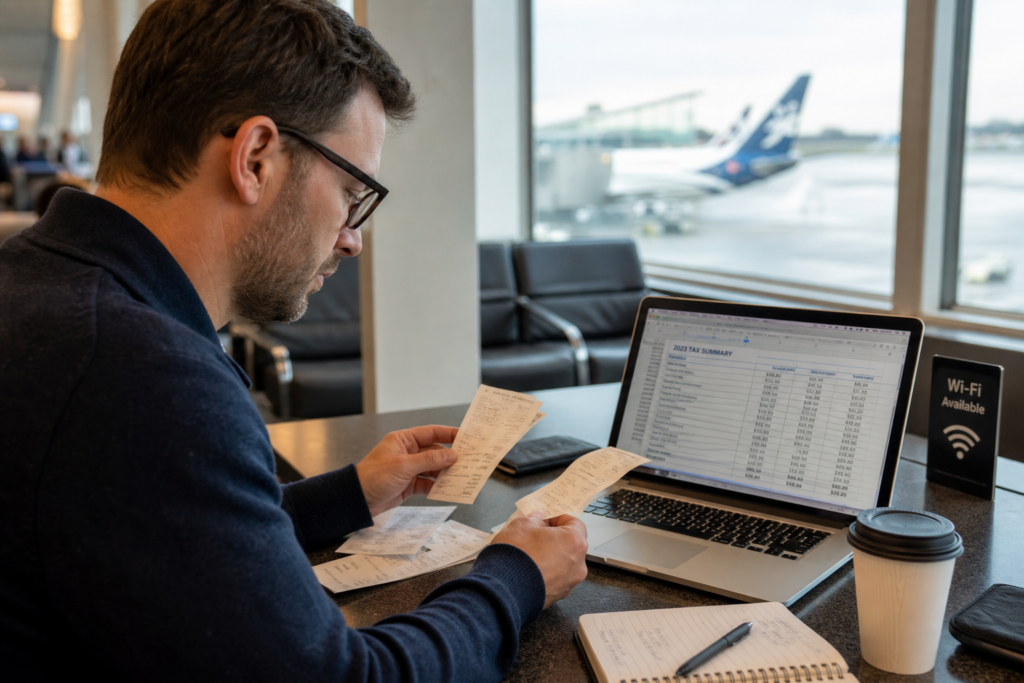
Per Diem vs Actual Expenses Travel: 2026 Guide
Per Diem vs Actual Expenses Travel: 2026 Guide
Choosing between per diem vs actual expenses travel deductions is one of the most important decisions you’ll make as a self-employed professional in 2026. The wrong choice can cost you hundreds — or even thousands — of dollars in missed deductions. This guide walks you through both methods, explains current IRS rules, and helps you pick the strategy that keeps more money in your pocket. Our self-employed tax planning resources are built for exactly this kind of decision.
This information is current as of 6/12/2026. Tax laws change frequently. Verify updates with the IRS if reading this later.
Table of Contents
- Key Takeaways
- What Is Per Diem vs Actual Expenses for Travel?
- Who Can Use Per Diem for Travel in 2026?
- How Does the Actual Expense Method Work?
- Which Method Saves More Money in 2026?
- What Records Does the IRS Require?
- What Are the Special Rules for International and Mixed Trips?
- Uncle Kam in Action: Freelancer Saves Big on Travel
- Next Steps
- Related Resources
- Frequently Asked Questions
Key Takeaways
- Self-employed individuals can only use the per diem method for meals and incidentals — not lodging.
- The actual expense method requires receipts but often yields higher deductions for big-city travel.
- Business meals remain 50% deductible in 2026 under both methods.
- You must stay consistent with your chosen method within each tax year.
- Always verify current per diem rates at GSA.gov before filing your 2026 return.
What Is Per Diem vs Actual Expenses for Travel?
Quick Answer: Per diem uses IRS-approved flat daily rates for meals and incidentals. Actual expenses tracks every real dollar you spent and deducts those instead.
When you travel for business as a freelancer or 1099 contractor, you have two ways to claim your costs. The first is the per diem method. The second is the actual expense method. Both approaches are recognized by the IRS under Publication 463: Travel, Gift, and Car Expenses. However, each method works very differently — and neither is universally better.
Defining Per Diem
Per diem is a Latin phrase meaning “per day.” In tax terms, it refers to a fixed daily allowance for certain travel expenses. The U.S. General Services Administration (GSA) sets these rates for domestic travel each fiscal year. The IRS then allows taxpayers to use these rates instead of tracking every receipt. However, the rules for self-employed individuals are more restrictive than for employees. Furthermore, not all expense categories qualify for the per diem shortcut.
The GSA rates cover two main categories. First, they cover lodging. Second, they cover meals and incidental expenses (M&IE). Incidental expenses include things like tips for hotel housekeeping and baggage fees. For the 2026 tax year, you should confirm current GSA rates directly at GSA.gov, as rates are updated each October for the new federal fiscal year.
Defining Actual Expenses
The actual expense method means you track and deduct every dollar you truly spent on qualifying business travel. This includes lodging, meals (at 50%), transportation, parking, tolls, and other ordinary and necessary costs. You need receipts — or at minimum a contemporaneous written record — for each expense. The actual expense approach gives you the most flexibility. Moreover, it can produce larger deductions in high-cost cities like New York, San Francisco, or Chicago where real costs far exceed standard per diem rates.
The Core Difference
The core difference is simplicity versus accuracy. Per diem is simpler — no receipts needed for M&IE. Actual expenses is more precise but requires more documentation. For self-employed professionals making strategic tax decisions in 2026, understanding this trade-off is essential. You can explore tax strategy options to see how travel deductions fit your broader tax plan.
| Feature | Per Diem Method | Actual Expense Method |
|---|---|---|
| Receipt requirement | Not needed for M&IE | Required for all expenses |
| Covers lodging? | No (self-employed only) | Yes, at actual cost |
| Covers meals? | Yes, at flat GSA rate | Yes, at 50% of actual cost |
| Best for | Frequent low-cost travel | High-cost city travel |
| Audit risk | Lower for M&IE | Low with good records |
Who Can Use Per Diem for Travel in 2026?
Quick Answer: Self-employed individuals can use per diem rates for meals and incidentals only. They cannot use per diem for lodging — that must be tracked as an actual expense.
This is one of the most important rules to understand. Employees reimbursed by their company can use per diem for all travel categories, including lodging. However, self-employed individuals and 1099 contractors face stricter limitations. Under IRS guidance, specifically IRS Publication 463, self-employed people may only use the per diem method for the meals and incidental expenses (M&IE) portion of their travel costs.
The Self-Employed Limitation Explained
The IRS draws a clear line here. Because self-employed individuals are not subject to an accountable plan the way employees are, the agency restricts their per diem use. Therefore, if you are a freelancer, consultant, or independent contractor, you must always track your actual lodging costs with real receipts. You cannot substitute the GSA lodging rate for your actual hotel bill. This rule applies regardless of whether you use Schedule C, Schedule E, or another business form.
What Per Diem Covers for Self-Employed Travelers
Even with the lodging restriction, the per diem option still provides real value for meals and incidentals. For 2026, the GSA publishes specific M&IE rates for hundreds of U.S. locations. There is also a standard CONUS (continental U.S.) rate that applies to any location not listed. You can use these rates without saving individual food receipts. Consequently, you simplify your record-keeping considerably for the meal portion of each trip.
Incidental expenses covered under the M&IE rate include tips given to hotel porters, baggage carriers, and other service providers. They also include fees for transportation between places of lodging and business destinations. However, they do not include laundry, phone calls, or other expenses beyond these narrow categories. For 2026, always confirm which categories your GSA rate covers before filing. The tax preparation team at Uncle Kam stays current on these rules so you don’t have to.
High-Low Method vs. Location-Specific Rates
There are two per diem approaches within the per diem system itself. The first is the location-specific method. This uses the exact GSA rate published for a given city or county. The second is the high-low method. The high-low method simplifies things further by using just two rates — one for designated high-cost areas and one for all other locations. The IRS updates the list of high-cost localities each year via a Revenue Procedure. For 2026, confirm which localities qualify under the high-cost designation on IRS.gov.
Pro Tip: The high-low method is especially useful if you travel to multiple cities during one trip. It reduces the need to look up each city’s exact rate, saving you time at tax time.
How Does the Actual Expense Method Work?
Quick Answer: The actual expense method lets you deduct every real dollar spent on qualifying business travel. You need receipts, and meals are still limited to 50% in 2026.
The actual expense method is straightforward in principle: track what you spend, save the receipts, and deduct the qualifying amounts. For self-employed professionals who travel frequently to expensive cities, this method typically yields the highest deductions. As a result, it is often the preferred choice for consultants working in major metro areas.
Deductible Travel Expense Categories
Under the actual expense method, these are the main categories of deductible business travel costs in 2026:
- Transportation: Airfare, train tickets, rental car fees, and ride-share costs between home and business destination
- Lodging: Hotel, motel, Airbnb, or similar accommodation costs — 100% deductible for legitimate business nights
- Meals: 50% of actual meal costs while away from your tax home on business
- Parking and tolls: 100% deductible when directly related to business travel
- Laundry and cleaning: If you are on an extended business trip of several nights
- Phone and internet: The business-use portion of communication costs incurred during travel
- Baggage fees: Fees charged by airlines or other carriers for business-related luggage
The 50% Meal Deduction Rule in 2026
One rule trips up many self-employed travelers. Under Section 274 of the Internal Revenue Code, business meals during travel are only 50% deductible. This applies whether you use the actual expense method or the per diem method for M&IE. The 50% limit has been a consistent IRS rule for years, and the One Big Beautiful Bill Act (OBBBA) passed in 2025 did not change it for 2026. So if you spend $120 on meals during a business trip, you can only deduct $60 on Schedule C.
Similarly, the per diem M&IE rate itself is subject to the 50% limit when used by self-employed individuals. Therefore, you don’t deduct the full per diem rate for meals — you deduct half. Keep this in mind when comparing the two methods. Otherwise, you may overestimate the value of the per diem approach.
What Counts as Your Tax Home?
Business travel deductions only apply when you are away from your tax home overnight. Your tax home is generally the city or general area where your principal place of business is located — not necessarily where you live. For most freelancers and consultants, the tax home is where they work most often. If your business has no fixed location, factors like where you conduct the most business, where you earn the most income, and where you maintain business records all help determine your tax home. Review IRS Publication 463 for the full definition and examples. Working with a dedicated tax advisor can help you correctly establish your tax home.
Pro Tip: Keep a travel log for every trip. Note the date, destination, business purpose, and who you met. This contemporaneous record is your first line of defense in any IRS audit.
Which Method Saves More Money in 2026?
 Free Tax Write-Off Finder
Quick Answer: It depends on where you travel and how much you spend. High-cost cities favor actual expenses. Budget travel in standard-rate areas may favor per diem for M&IE.
The comparison between per diem vs actual expenses travel comes down to simple math in most cases. However, the answer is not always obvious until you run the numbers for your specific situation. Let’s break it down with realistic examples for the 2026 tax year.
Example: Budget Traveler in a Standard-Rate City
Imagine a freelance consultant who visits a standard CONUS city for a 3-day client meeting. They spend $55 per day on meals (quite modest). The current IRS standard M&IE rate for most CONUS locations is $68 per day (verify current 2026 rates at GSA.gov). Here is how the two methods compare for just the meal portion:
- Per diem M&IE method: $68/day × 3 days = $204 total, then × 50% = $102 deductible
- Actual expense method: $55/day × 3 days = $165 total, then × 50% = $82.50 deductible
In this scenario, per diem wins by nearly $20 — and you don’t need food receipts. Furthermore, if you spent even less on meals, the per diem advantage grows larger. This is why budget travelers and those who pack lunches often benefit more from the per diem approach.
Example: High-Spend Traveler in a High-Cost City
Now consider a freelance marketing consultant who travels to San Francisco for a 3-day conference. They spend $180 per day on meals and entertainment while networking with clients. The GSA high-cost M&IE rate (verify 2026 rates at GSA.gov) is approximately $79 per day for high-cost locations. Here’s the comparison:
- Per diem M&IE method: $79/day × 3 days = $237, then × 50% = $118.50 deductible
- Actual expense method: $180/day × 3 days = $540, then × 50% = $270 deductible
In this case, actual expenses win by more than double. The difference is $151.50 in deductible expenses. At a combined federal and self-employment tax rate that can exceed 35%, that gap translates to real dollars saved. Moreover, you still get to deduct your actual lodging separately under either method. So your total travel deduction with actual expenses will far exceed the per diem approach when lodging costs are high.
Side-by-Side Comparison Table
| Scenario | Per Diem Deduction | Actual Expense Deduction | Winner |
|---|---|---|---|
| Budget meals, standard city, 3 days | ~$102 | ~$82 | Per Diem ✓ |
| High meals, high-cost city, 3 days | ~$119 | ~$270 | Actual ✓ |
| Lodging expense (any city) | Not applicable | Full actual cost | Actual always |
| Record-keeping burden | Low for M&IE | High — save all receipts | Per Diem ✓ |
Did You Know? Self-employment tax is 15.3% in 2026 on net earnings up to $184,500 (Social Security portion applies up to this wage base). Every dollar you reduce via travel deductions lowers both income tax and self-employment tax, making your actual savings larger than you might expect.
What Records Does the IRS Require?
Quick Answer: The IRS requires you to document the amount, time, place, and business purpose of every travel expense. Per diem simplifies the meal portion. Actual expenses require full receipts for all items.
Good record-keeping is not optional — it is your protection if the IRS ever questions your deductions. The IRS outlines specific record-keeping requirements for business travel in Publication 463. Whether you choose per diem vs actual expenses for travel, certain documentation is always required.
The Five Elements the IRS Wants to See
For every business trip, document these five things:
- Amount: The total cost of each expense (or the per diem rate applied for that day)
- Date: When the travel or expense occurred
- Place: The destination city or area
- Business purpose: Why you traveled — a client meeting, conference, site visit, etc.
- Business relationship: For meal expenses, note who attended and their business connection to you
Record-Keeping Under Each Method
Under the per diem method for M&IE, you still need to document dates, destination, and business purpose. You do not, however, need individual meal receipts. Instead, you document that the trip occurred and apply the applicable GSA rate. As a result, your record-keeping burden drops significantly for meal tracking. However, you must still keep all lodging receipts regardless of which method you use for M&IE.
Under the actual expense method, you must save receipts or bank/credit card statements for all expenses. Many self-employed professionals use expense tracking apps to photograph receipts immediately. This approach protects you in audits. The business solutions team at Uncle Kam can help you set up efficient expense tracking systems that integrate with your accounting software.
How Long to Keep Travel Records
The IRS generally has three years from the date you file a return to audit it. However, that window extends to six years if you underreport income by more than 25%. Therefore, keep your 2026 travel records for at least six years to be safe. Store them digitally if possible. Cloud backups of receipt photos are perfectly acceptable as long as they are legible and organized. The IRS Self-Employed Tax Center provides additional guidance on record retention.
Pro Tip: Set up a separate email folder or digital folder for each trip. Name it by date and city. Drop all receipts, boarding passes, and calendar invites into that folder immediately after each day of travel. This habit makes tax time effortless.
What Are the Special Rules for International and Mixed Trips?
Quick Answer: International travel follows the same general IRS rules but uses State Department per diem rates. Mixed personal-business trips require allocating costs between business and personal days.
Many freelancers and self-employed professionals travel internationally or combine business and leisure travel. These situations add complexity to the per diem vs actual expenses travel decision. Understanding the IRS rules for both scenarios protects your deductions and keeps you compliant in 2026.
International Travel Per Diem Rates
For travel outside the continental U.S., GSA rates do not apply. Instead, the U.S. Department of State publishes foreign per diem rates. These rates vary widely by country and city. For example, a business trip to Tokyo has a very different per diem allowance than one to rural Mexico. You can find these rates at the State Department’s Per Diem Rates page. The same 50% meal deduction limit applies to international travel as it does domestic.
Handling Mixed Business-Personal Trips
Mixed trips — part business, part personal — require careful cost allocation. The general IRS rule is that transportation costs are fully deductible if the primary purpose of the trip is business. However, lodging and meal costs on personal days are not deductible. You must allocate these costs between business and personal days.
For example, if you fly to Chicago for 5 days — 3 business days and 2 personal days — you can deduct all transportation costs if the trip is primarily for business. However, you can only deduct lodging and meals (at 50%) for the 3 business days. The 2 personal days produce no deduction. This allocation rule applies regardless of which method you use for M&IE. For international mixed trips, stricter rules apply if the trip lasts more than a week. Consult IRS Publication 463 or a qualified tax advisor for international trip allocation rules.
Convention and Conference Travel
Attending an industry conference is one of the most common travel situations for self-employed professionals. The good news is that conference-related travel fully qualifies for business travel deductions as long as attending the conference benefits your trade or business. This includes the registration fee, travel costs, lodging, and meals (at 50%). However, if a conference is held on a cruise ship, different and much stricter rules apply. In that case, deductions are capped at $2,000 per year and are subject to additional IRS requirements under Section 274(h). Self-employed professionals should connect with a business tax specialist before deducting cruise ship convention costs.
| Trip Type | Per Diem Applicable? | Rate Source | Special Rules? |
|---|---|---|---|
| Domestic CONUS travel | Yes (M&IE only for SE) | GSA.gov | 50% meal limit |
| International travel | Yes (M&IE only for SE) | State Dept. | 7-day rule, allocation |
| Mixed business-personal | Business days only | GSA or State Dept. | Must allocate days |
| Cruise ship convention | No | N/A | $2,000 annual cap |

Uncle Kam in Action: Freelancer Saves Big on Travel
Client Snapshot: Marcus is a freelance UX designer based in Boise, Idaho. He works with clients across the country and travels frequently for on-site workshops and project kick-offs. His annual income from 1099 contracts is approximately $148,000.
The Challenge: Marcus had been using the per diem method for all his meal expenses on the road — including trips to high-cost cities like New York and Seattle. He thought it was simpler and assumed it saved enough to justify the convenience. However, he had no idea he was leaving hundreds of dollars on the table each year. He also did not realize he could separately deduct his full actual lodging costs. Furthermore, he had never tracked which method was more beneficial for each city he visited.
The Uncle Kam Solution: Marcus connected with the Uncle Kam team to review his travel deduction strategy for 2026. The team analyzed two years of travel history, categorized his trips by city type (high-cost vs. standard-rate), and compared per diem vs actual expenses travel outcomes for each. They found that for his New York and Seattle trips, switching to actual expenses for meals would significantly increase his deductions. For his lower-cost Midwestern and Southern city trips, per diem for M&IE was still the better choice. Uncle Kam implemented a hybrid documentation system. For high-cost trips, Marcus now saves receipts. For standard-rate trips, he uses the per diem method for M&IE and focuses only on lodging receipts. They also made sure all five IRS documentation elements were properly recorded for every trip.
The Results:
- Additional travel deductions unlocked: $6,400 in previously unclaimed deductions
- Tax savings on those deductions: Approximately $2,240 in federal income and self-employment tax (at blended ~35% rate)
- Uncle Kam advisory fee: $800
- First-year ROI: 2.8x return on investment
Marcus now runs a lean, IRS-compliant travel expense system that takes less than 10 minutes per trip to maintain. The key insight — that the best method depends on your destination, not just your preference for simplicity — changed everything. See more stories like Marcus’s on our client results page.
Next Steps
Now that you understand the per diem vs actual expenses travel decision, take these concrete steps to maximize your 2026 travel deductions:
- Review your current travel history and categorize trips by city type (high-cost vs. standard).
- Check the current 2026 GSA per diem rates at GSA.gov before filing your return.
- Set up a simple expense tracking system — even a folder of photos works — starting with your next trip.
- Connect with a tax strategist at Uncle Kam to run the numbers for your specific travel pattern.
- Ensure your Q2 2026 estimated tax payment was made by June 15, 2026 to avoid underpayment penalties.
Related Resources
- Self-Employed Tax Planning Guide
- 2026 Tax Strategy for Freelancers and 1099 Contractors
- Tax Preparation and Filing Services
- IRS Deduction Guides for Self-Employed Professionals
- The MERNA Method: Maximizing Every Deduction
Frequently Asked Questions
Can self-employed individuals use per diem for lodging in 2026?
No. The IRS does not allow self-employed individuals and independent contractors to use per diem rates for lodging. This restriction is clearly stated in IRS Publication 463. Self-employed professionals must track and document their actual lodging costs with receipts. Only employees who are reimbursed under an accountable plan can use the GSA lodging per diem rate. However, self-employed individuals can use per diem for the meals and incidental expenses (M&IE) portion of their travel costs.
Can I switch between per diem and actual expenses each year?
Yes, you can switch methods from one tax year to the next. The IRS does not lock you into a permanent choice for travel expense methods the way it does for some other elections. However, you must use a consistent method within a single tax year. For example, you cannot use per diem for some trips in 2026 and actual expenses for others within the same year if you are on a trip-by-trip basis. Check with your tax advisor to confirm the exact rules for your situation before switching methods, as certain accountable plan arrangements may impose additional consistency requirements.
Are meals still 50% deductible under the per diem method in 2026?
Yes. Even when using the per diem method for M&IE, self-employed individuals can only deduct 50% of the applicable per diem rate for meals. The 50% meal deduction limit under IRC Section 274 applies to both methods. For example, if your applicable M&IE per diem rate is $68 per day, your deductible amount is $34 per day (50% × $68). The One Big Beautiful Bill Act passed in 2025 introduced new working-family deductions, but it did not change the 50% business meal rule for 2026. Always verify current rules at IRS.gov.
Where do I report business travel deductions on my 2026 tax return?
Most self-employed individuals report business travel deductions on Schedule C (Form 1040), Profit or Loss from Business. Line 24a covers deductible meal expenses (after applying the 50% limit). Line 24b is for any meals subject to Department of Transportation rules (which allow a higher 80% deduction for certain transportation workers). Other travel costs such as airfare, lodging, and transportation go on line 24 or other relevant lines of Schedule C. If you have a more complex business structure, such as a partnership or S corporation, different forms apply. Reach out to the Uncle Kam filing team for entity-specific guidance.
What happens if the IRS audits my travel deductions?
If audited, the IRS will ask you to prove that each travel expense was ordinary and necessary for your business. For the per diem method, you need records showing the trip dates, destination, and business purpose. For the actual expense method, you need those same records plus all receipts. If you cannot substantiate a deduction, the IRS will disallow it and may assess additional taxes plus a 20% accuracy-related penalty. The best protection is a contemporaneous travel log — created at the time of travel, not reconstructed later. Digital tools like expense apps paired with calendar entries provide strong audit documentation. Review the IRS Self-Employed Tax Center for audit preparedness guidance.
Do per diem rates change every year?
Yes. The GSA updates domestic CONUS per diem rates each October for the new federal fiscal year. The IRS then issues a Revenue Procedure confirming the rates taxpayers may use for business travel. As a result, the rates you used in the prior year may be different from 2026 rates. Always check GSA.gov for the most current rates before calculating your deductions or filing your return. Using outdated rates — even if they were correct in a prior year — can result in over- or under-reporting your deductions.
Last updated: June, 2026

