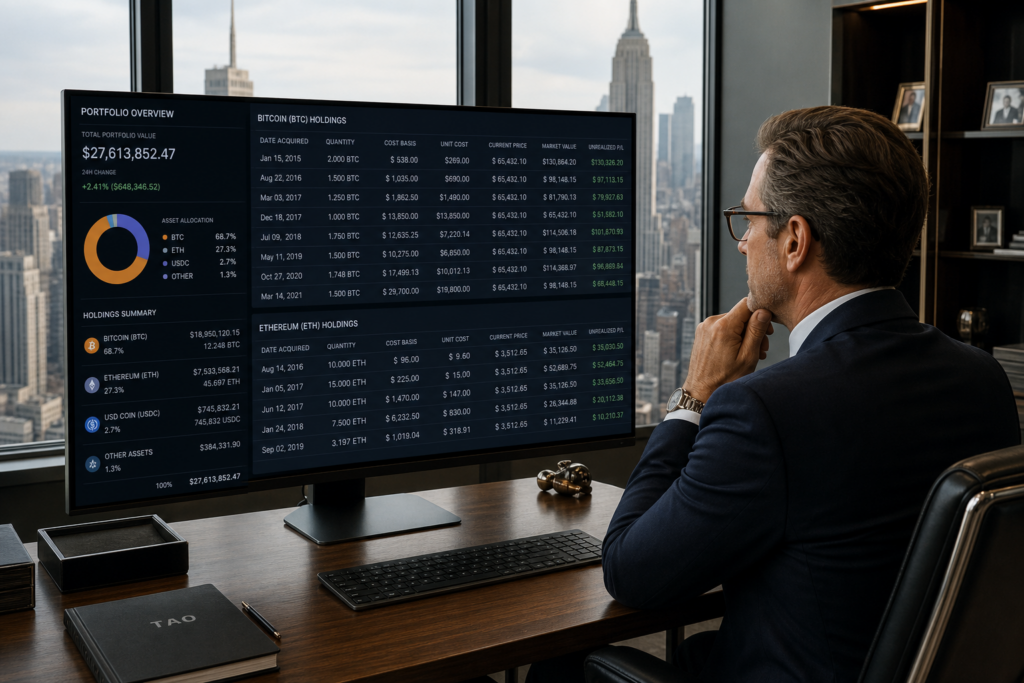
Specific Lot Selection Crypto: 2026 Tax Guide
Specific Lot Selection Crypto: 2026 Tax Guide for High-Net-Worth Investors
Specific lot selection crypto is one of the most powerful — and underused — tax strategies for high-net-worth investors in 2026. By choosing exactly which lot of cryptocurrency you sell, you control your cost basis, your gain or loss, and ultimately your tax bill. For investors with large, multi-purchase digital asset portfolios, this strategy can mean the difference between a 20% capital gains rate and a 0% rate — a gap worth tens of thousands of dollars per transaction. This guide explains every step, every rule, and every risk, using only 2026 IRS guidance.
Table of Contents
- Key Takeaways
- What Is Specific Lot Selection Crypto, and Why Does It Matter in 2026?
- How Does Specific Identification Work for Crypto Taxes?
- How Does FIFO Compare to Specific Lot Identification for Crypto?
- Which Crypto Lot Should You Sell to Minimize Taxes in 2026?
- What Record-Keeping Does the IRS Require for Specific Lot Crypto?
- How Could Pending 2026 Crypto Tax Legislation Change Everything?
- Uncle Kam in Action: High-Net-Worth Crypto Investor Saves $87,000
- Related Resources
- Next Steps
- Frequently Asked Questions
Key Takeaways
- The IRS treats crypto as property, so you must track the cost basis of every lot you purchase.
- Specific lot selection lets you pick which crypto lot you sell, directly controlling your taxable gain or loss.
- For 2026, the top long-term capital gains rate is 20% for single filers earning above $459,750 — plus the 3.8% NIIT.
- FIFO is the IRS default; you must actively elect specific identification and keep detailed records.
- Pending 2026 legislation may add wash sale rules to crypto — acting now with a clear lot strategy matters more than ever.
What Is Specific Lot Selection Crypto, and Why Does It Matter in 2026?
Quick Answer: Specific lot selection crypto is a cost basis method that lets you identify exactly which coins or tokens you are selling. This controls whether you report a large or small gain — or even a loss — on that sale.
The IRS has treated cryptocurrency as property since IRS Notice 2014-21. That one classification drives everything. Because crypto is property, every sale or exchange triggers a capital gain or loss. Your gain equals the selling price minus your cost basis. The cost basis is what you paid for the coins, plus any fees, when you bought them.
Now, here is where smart tax planning creates real value. Most people buy cryptocurrency in multiple purchases at different prices. Over time, they own dozens — or hundreds — of separate lots. When they sell, the IRS requires them to match each coin sold to a specific purchase record. Which purchase record you use determines your gain.
Why 2026 Is the Year to Get This Right
For the 2026 tax year, the stakes have never been higher for high-net-worth investors. The top long-term capital gains rate is 20% for single filers with taxable income above $459,750 and for married couples filing jointly above $518,400. On top of that, the 3.8% Net Investment Income Tax (NIIT) applies to investment income above $200,000 for single filers and $250,000 for married filers. Combined, your effective crypto gains rate can reach 23.8%.
Furthermore, Congress is actively working on new digital asset tax legislation. The House Ways and Means Committee held a hearing on June 9, 2026 to review multiple bills that would overhaul cryptocurrency taxation. Some of those proposals would introduce wash sale rules for digital assets — a change that could eliminate one of crypto’s current tax advantages. Acting now with a strong specific lot selection crypto strategy means you capture today’s rules before anything changes.
The Core Principle: You Choose the Basis
Without specific lot identification, the IRS defaults to First-In, First-Out (FIFO). This means your oldest purchase — often your cheapest lot — is treated as sold first. For long-time holders, FIFO frequently generates the largest taxable gain. Specific identification flips this dynamic. You choose the lot with the highest cost basis, the shortest holding period that qualifies you for a loss, or a long-term lot that qualifies for preferential tax rates.
Pro Tip: High-net-worth investors in the 20% capital gains bracket can save up to $23.80 in taxes for every $100 in gains they eliminate through strategic specific lot selection in 2026.
How Does Specific Identification Work for Crypto Taxes?
Quick Answer: Specific identification requires you to designate the exact lot — by purchase date and purchase price — before or at the time of sale. You must keep records that prove your choice.
The IRS permits specific identification for digital assets under the same general property tax principles that apply to stocks and other assets. The agency’s guidance confirms that, just like with shares of stock, you can identify which unit of cryptocurrency you are selling. The key requirement is that the identification must be clear and documented before or at the point of sale.
Step-by-Step: How to Use Specific Lot Selection
- Step 1 — Build your purchase log. Record every crypto purchase with the date, the quantity, the price per unit, and any fees. This data creates your lot inventory.
- Step 2 — Evaluate lots before selling. Before each sale, review your inventory. Identify which lot produces the best tax outcome given your current income level and holding period.
- Step 3 — Make the election. On your exchange, select the specific lot if your platform supports it. If not, document your intent in writing — an email, a spreadsheet note, or a signed memo — before you sell.
- Step 4 — Report accurately. On your IRS Form 8949, report the sale with the cost basis from your chosen lot. Match the holding period: short-term (under one year) or long-term (one year or more).
- Step 5 — Archive everything. Keep your records for at least three years after filing. The IRS can audit crypto transactions, and your lot records are your proof.
Which Exchanges Support Specific Lot Selection?
Major exchanges vary in their cost basis tools. Some platforms — including Coinbase and Kraken — allow users to choose an accounting method in their tax settings. Others offer only FIFO or average cost methods. If your exchange does not support specific identification natively, you can still use the method. However, you must maintain your own detailed records and document your lot selection independently before each sale.
Crypto tax software platforms such as CoinTracker or Koinly can track your lots across multiple exchanges and wallets. These tools generate Form 8949 reports using your chosen method. For high-net-worth investors managing positions across several wallets, this software is essentially required. The alternative — manual tracking of hundreds of transactions — leaves too much room for errors that trigger IRS notices.
Pro Tip: Review your exchange’s tax settings each January. Default cost basis methods can reset or change with platform updates. Verify your specific lot selection election is active before your first transaction of the year.
How Does FIFO Compare to Specific Lot Identification for Crypto?
Quick Answer: FIFO forces you to sell your oldest and cheapest lots first, which often generates the largest gains. Specific lot identification lets you choose strategically, frequently producing significantly lower tax bills.
Understanding the difference between these two methods is essential for anyone managing a significant crypto portfolio. The method you use can swing your reported gain by thousands — or even hundreds of thousands — of dollars on a single sale. Let’s look at a real-world example that illustrates the gap.
Side-by-Side Example: 2026 Bitcoin Sale
Assume a high-net-worth investor owns three lots of Bitcoin purchased at different times and prices. In June 2026, they sell 1 BTC at the current market price of approximately $60,000.
| Lot | Purchase Date | Cost Basis (per BTC) | Holding Period | Gain if Sold at $60,000 |
|---|---|---|---|---|
| Lot A (oldest) | March 2021 | $15,000 | Long-term | $45,000 |
| Lot B | November 2024 | $68,000 | Long-term | -$8,000 (loss) |
| Lot C (newest) | April 2026 | $55,000 | Short-term | $5,000 |
Under FIFO, the investor must sell Lot A first. That produces a $45,000 long-term gain taxed at 20% plus the 3.8% NIIT — a combined federal tax of up to $10,710 on that single sale. However, with specific lot selection, this investor could instead choose Lot B. Lot B produces an $8,000 capital loss. That loss can offset other gains this year. This one decision saves the investor potentially $10,710 in taxes, while also creating a tax loss they can use elsewhere in their portfolio.
Cost Basis Methods Available for Crypto in 2026
| Method | IRS Status (2026) | Best Used When | Risk Level |
|---|---|---|---|
| FIFO | IRS default | Market prices are rising and you want simplicity | Low complexity, high tax cost |
| Specific Identification | Permitted, requires records | You want to optimize each sale for minimum tax | Higher complexity, lower tax cost |
| LIFO (Last-In, First-Out) | Generally not permitted for property | Not recommended — IRS may challenge | High risk of IRS challenge |
| Average Cost | Not explicitly authorized for crypto | Possibly for certain custodial accounts only | Uncertain — consult a tax advisor |
For high-net-worth investors, specific lot selection crypto is almost always the superior choice. The tax savings on large positions far outweigh the added record-keeping burden. Work with a qualified tax advisor to ensure your elections are properly documented for 2026. Learn more about personalized crypto tax advisory services at Uncle Kam.
Which Crypto Lot Should You Sell to Minimize Taxes in 2026?
 Free Tax Write-Off Finder
Quick Answer: The best lot to sell depends on your income, your other gains and losses, and your holding period. In 2026, high earners generally benefit from selling high-basis, long-term lots to reduce gains or selling loss lots to harvest deductions.
Choosing the right lot requires a full picture of your 2026 financial situation. Your income level determines which capital gains rate applies. For 2026, the rates are as follows. Single filers with taxable income up to $45,000 pay 0% on long-term gains. Those between $45,001 and $459,750 pay 15%. Those above $459,750 pay 20%. For married couples filing jointly, the 0% bracket extends to $90,000, the 15% bracket runs to $518,400, and the 20% rate applies above $518,400.
Strategy 1: Harvest Losses to Offset Gains
If you have crypto lots that are currently underwater — meaning their current value is below your purchase price — you can sell those lots to realize a capital loss. That loss offsets gains from other sales, dollar for dollar. This is called tax-loss harvesting. Because the wash sale rule does not currently apply to cryptocurrency in 2026, you can immediately repurchase the same digital asset after selling it at a loss. This preserves your market position while capturing the tax benefit.
As a concrete example: suppose you sell Lot B from our earlier scenario at a $8,000 loss. You immediately repurchase 1 BTC at the current $60,000 price. Your tax position improves by $8,000 in deductions. However, note that pending legislation in Congress — introduced June 9, 2026 — proposes to bring crypto under wash sale rules. If that passes, the wash-sale window would restrict this strategy. Act now while the current rules still allow it.
Strategy 2: Sell Long-Term Lots to Stay in the 15% Bracket
Many high-income earners are close to the line between the 15% and 20% brackets. In 2026, that line for married filers is $518,400. If your income sits just below that threshold, selecting a long-term lot that generates a modest gain keeps you in the 15% bracket. This is more tax-efficient than crossing into the 20% rate — or triggering additional NIIT. The MERNA™ Method at Uncle Kam specifically plans around bracket management like this throughout the year.
Strategy 3: Defer Gains by Selling Low-Gain Lots First
If you need liquidity but want to minimize current-year taxes, select lots with the smallest unrealized gains. This defers your largest gain to a future year when your income may be lower — or when you have more offsetting losses. This strategy works especially well for investors who plan to donate appreciated crypto to charity, transfer assets via trusts, or retire in a lower tax bracket.
Pro Tip: For 2026, the NIIT of 3.8% applies to net investment income above $200,000 for single filers. That threshold is not indexed for inflation. High earners nearly always face NIIT on crypto gains — making specific lot selection crypto even more impactful at their income levels.
Strategy 4: Donate Appreciated Lots to Charity
A highly effective approach for HNW investors is to donate your highest-gain long-term lots directly to a qualified charity or donor-advised fund. When you donate appreciated crypto, you avoid paying any capital gains tax on the appreciation. You also receive a charitable deduction for the full fair market value at the time of the donation. For a $100,000 lot with a $10,000 basis, this strategy eliminates a potential $23,800 in combined federal taxes while generating a deduction worth thousands more. This makes specific lot selection crypto a cornerstone of advanced wealth management — not just tax filing. Visit the IRS Charities and Nonprofits resource page for qualified organization rules.
What Record-Keeping Does the IRS Require for Specific Lot Crypto?
Quick Answer: The IRS requires clear, contemporaneous records showing the date, quantity, price, and any fees for each purchase, plus documentation of your specific lot election before or at the time of each sale.
Record-keeping is the backbone of any specific lot selection crypto strategy. Without strong documentation, the IRS can disallow your specific identification election and force you to use FIFO instead — often the worst possible outcome on a large gain. Strong records also protect you during an audit. In 2026, the IRS’s automated systems continue to cross-reference broker-reported 1099-DA data with tax returns. Discrepancies trigger notices automatically. Your records are your first line of defense.
What Your Records Must Include
- Purchase date and time: Needed to determine the holding period for short-term vs. long-term treatment.
- Quantity purchased: Track exact amounts, including fractional units (e.g., 0.25 BTC).
- Cost per unit: Use the fair market value in U.S. dollars at the time of acquisition.
- Transaction fees: Fees paid to the exchange or network increase your cost basis and reduce your gain.
- Lot election documentation: A timestamped note, spreadsheet entry, exchange screenshot, or email confirming which lot you selected before the sale.
- Sale proceeds: The gross sale price in dollars, including any fees netted out.
- Wallet addresses: For self-custodied assets, retain wallet records to prove chain of custody.
The IRS Virtual Currency guidance page confirms these requirements and outlines how digital asset transactions are reported. All records should be retained for a minimum of three years after filing, and longer if you have large or complex transactions.
Form 8949 and Schedule D: How to Report Your Lots
Each sale of cryptocurrency appears as a separate line on IRS Form 8949. You report the date acquired, date sold, proceeds, cost basis, and gain or loss. Short-term sales (assets held one year or less) go in Part I. Long-term sales (held more than one year) go in Part II. The totals flow to Schedule D. If you use specific identification, your lot records directly determine every number on Form 8949. Errors here match quickly to broker-reported data — making accuracy essential.
Did You Know? In the 2026 tax season, nearly 45% of individual returns claimed new deductions from the One Big Beautiful Bill Act, according to IRS data. Meanwhile, crypto reporting errors remain one of the most common triggers for IRS automated underreporter notices. Clean lot records prevent this problem entirely.
How Could Pending 2026 Crypto Tax Legislation Change Everything?
Quick Answer: Several bills introduced in June 2026 would dramatically change crypto taxation, including wash sale rules, new staking treatment, and simplified accounting options. None have passed yet, but the direction is clear: act on your specific lot selection crypto strategy now.
The House Ways and Means Committee held a major hearing on June 9, 2026 covering a legislative package targeting digital asset tax reform. Multiple bills were introduced simultaneously. Each one could reshape how you plan your specific lot selection crypto strategy. Understanding what is proposed — even before it becomes law — allows you to plan proactively.
Key Bills Under Consideration as of June 2026
- Digital Asset PARITY Act (H.R. 8899): Proposes extensive changes to digital asset taxation, including a four-year deferral election for validation rewards and wash sale rules aligned with securities law.
- Tax Clarity for Mining and Staking Act (H.R. 9175): Would allow taxpayers to elect to defer income on newly minted digital assets and treat them more like self-created property.
- Providing Analogous Rules for Digital Assets (PAR) Act (H.R. 9176): Extends existing securities tax benefits to digital assets, including mark-to-market accounting for professional dealers and traders.
- Less Tax Paperwork for Digital Asset Owners Act (H.R. 9178): Would exclude gains or losses on regulated stablecoins and network-fee payments from taxation, and create a simplified accounting method election.
- Digital Assets Voluntary Disclosure Program Act (H.R. 9174): Would create a one-time disclosure program with reduced penalties for taxpayers who come back into compliance on past crypto tax obligations.
The Wash Sale Risk: Why You Must Act in 2026
The most significant pending change for specific lot selection crypto strategy is the proposed wash sale rule. Currently, the wash sale rule — which prevents you from claiming a loss if you repurchase the same security within 30 days — does not apply to cryptocurrency. That means you can sell a losing lot and immediately rebuy the same coin. If Congress passes the Digital Asset PARITY Act, this benefit disappears. High-net-worth investors should consider accelerating their tax-loss harvesting strategies through the rest of 2026 while this window remains open.
Shehan Chandrasekera, head of tax strategy at CoinTracker, noted in June 2026 that the proposed changes create a mixed picture: some provisions reduce complexity, while the wash sale rule adds it. The net impact depends heavily on how final regulations are written — which could take months or years. That uncertainty is exactly why a proactive lot selection strategy matters today. Explore crypto tax prep and filing services to stay ahead of these changes.
The Digital Asset PARITY Act and Stablecoins
The PARITY Act also proposes that regulated payment stablecoins — those issued under the GENIUS Act framework, backed by U.S. dollars on a one-to-one basis — would generally not generate taxable gain or loss when used for payments. This is a major shift from current rules, which treat every stablecoin transaction as a potential taxable event. High-net-worth investors who regularly transact in stablecoins should monitor this provision closely. If enacted, it simplifies lot tracking for stablecoin-denominated transactions significantly. Check the official Congress.gov bill tracker to follow these proposals.

Uncle Kam in Action: High-Net-Worth Crypto Investor Saves $87,000
Client Snapshot: Maria is a 48-year-old tech executive in Delaware with an annual income of $1.2 million. She accumulated Bitcoin and Ethereum over multiple years, starting in 2019. By early 2026, her crypto portfolio was worth $2.4 million, held across four exchanges and two hardware wallets.
The Challenge: Maria needed to liquidate $600,000 in crypto to fund a business acquisition. Her default exchange setting was FIFO. Under FIFO, her oldest Bitcoin lots — purchased at $7,000 per coin in 2019 — would have been sold first. Selling at the current $60,000 market price created a $53,000 gain per coin. On four coins sold, that meant $212,000 in long-term capital gains. At her income level, she faced the 20% rate plus the 3.8% NIIT — a total federal tax of $50,456 on those gains alone.
The Uncle Kam Solution: Uncle Kam’s team reviewed Maria’s entire lot inventory across all exchanges and wallets. They identified Ethereum lots from November 2024 purchased at $3,800 per ETH, now worth $2,200. They also found Bitcoin lots from October 2025 purchased at $97,000. Together, those positions held $136,000 in unrealized losses. Uncle Kam recommended Maria sell those loss lots first to generate capital loss carryforwards, then sell mid-basis Bitcoin lots from 2022 (purchased at $38,000 each) to meet her $600,000 liquidity target. The team documented every specific lot election in writing, synced her data across platforms using crypto tax software, and prepared her Form 8949 with perfect lot-level detail.
The Results:
- Tax Savings: $87,000 in reduced federal taxes compared to the FIFO default outcome.
- Capital Loss Generated: $136,000 in carryforward losses to offset future gains.
- Uncle Kam Fee: $8,500 for full portfolio analysis, lot strategy, and tax preparation.
- First-Year ROI: Over 10x return on her advisory investment.
Maria also received a tailored plan for her remaining portfolio, including a charitable donation strategy using her highest-gain lots. She now reviews her lot inventory every quarter with her Uncle Kam advisor. See more stories like Maria’s on our client results page.
Related Resources
- 2026 Tax Strategy Planning for High-Income Investors
- Tax Planning for High-Net-Worth Individuals
- Crypto Tax Prep and Filing Services
- Uncle Kam Tax Guides Library
- 2026 Tax Calendar and Key Deadlines
Next Steps
Specific lot selection crypto is not a set-it-and-forget-it strategy. It requires active management throughout the year. Here are your most important next steps for 2026.
- Audit your current lot inventory. Compile all purchase records across every exchange and wallet. Know exactly what you own, when you bought it, and at what price.
- Set your exchange to specific identification. Log in to each exchange and update your cost basis method setting before your next trade.
- Consider tax-loss harvesting before year-end. Act while the wash sale rule still does not apply to crypto. Identify losing positions and harvest losses now.
- Connect with a crypto-focused tax advisor. Explore Uncle Kam’s personalized tax advisory services to build a 2026 lot selection plan tailored to your portfolio.
- Monitor pending legislation. The proposed bills from June 2026 could become law later this year. Stay informed so your strategy adapts in time.
This information is current as of 6/12/2026. Tax laws change frequently. Verify updates with the IRS or a qualified tax professional if reading this later.
Frequently Asked Questions
Is specific lot selection allowed for crypto in 2026?
Yes. The IRS treats cryptocurrency as property under IRS Notice 2014-21. The same cost basis rules that apply to property apply to crypto. Specific identification is a recognized and permitted method. However, you must document your election clearly before or at the time of each sale. If you fail to maintain records, the IRS defaults to FIFO, which often produces the highest taxable gain.
What happens if I don’t choose a cost basis method?
If you do not elect a specific cost basis method, the IRS applies FIFO by default. FIFO uses your earliest purchased lots first. For long-time investors, those lots often have the lowest cost basis and therefore generate the largest taxable gains. In 2026, with the top rate for crypto gains reaching 23.8% (20% plus 3.8% NIIT), defaulting to FIFO on a large portfolio can be very expensive. Making a conscious specific lot election is always the better move.
Can I use specific identification across multiple exchanges and wallets?
Yes, but it requires careful coordination. Each exchange tracks its own records independently. When you transfer crypto between exchanges or to self-custody wallets, you must carry your cost basis information with you. Crypto tax software like CoinTracker, Koinly, or TaxBit can aggregate records across platforms, making cross-exchange lot tracking practical. High-net-worth investors with complex, multi-wallet portfolios should use professional-grade software and a qualified tax advisor to avoid costly errors.
Will the wash sale rule apply to crypto in 2026?
As of June 2026, the wash sale rule does not apply to cryptocurrency. Multiple bills introduced in Congress in June 2026 propose to change this, including the Digital Asset PARITY Act (H.R. 8899). However, none of these bills have become law. Until they do, you can sell a crypto position at a loss and immediately repurchase the same asset without triggering a wash sale disallowance. This remains one of crypto’s most valuable — and time-limited — tax advantages for loss harvesting.
How do 2026 capital gains rates affect my crypto tax strategy?
Your filing status and income determine which rate applies. For 2026, the 0% long-term rate applies to single filers up to $45,000 in taxable income and married filers up to $90,000. The 15% rate covers single filers from $45,001 to $459,750, and married filers from $90,001 to $518,400. Above those thresholds, the 20% rate applies. High-net-worth investors nearly always pay the 20% rate plus the 3.8% NIIT. Specific lot selection crypto helps at every bracket — but the dollar savings are greatest for investors in the top rate bracket.
What is the difference between short-term and long-term crypto gains in 2026?
Short-term gains apply to crypto held for one year or less. These are taxed at your ordinary income rate, which can reach 37% at the top bracket for 2026. Long-term gains apply to crypto held for more than one year. These are taxed at preferential rates of 0%, 15%, or 20%, depending on your income. This difference is enormous. A $100,000 short-term gain at the 37% bracket costs $37,000 in federal tax. The same gain at the 20% long-term rate costs $20,000 — a $17,000 difference. Specific lot selection lets you choose between short-term and long-term lots on each sale, giving you direct control over which rate applies.
Should I use specific lot selection for every crypto trade?
Ideally, yes. Every sale is an opportunity to optimize your tax outcome. In practice, small trades on everyday purchases may not justify the administrative effort. However, for significant transactions — anything over a few thousand dollars — specific lot selection crypto is always worth applying. The math is straightforward: a few minutes of analysis before each meaningful sale can save amounts that far exceed the time invested. For high-net-worth investors with six- or seven-figure crypto portfolios, this analysis should happen before every sale without exception. Work with the Uncle Kam business solutions team to automate this process within your overall wealth management workflow.
Last updated: June, 2026

