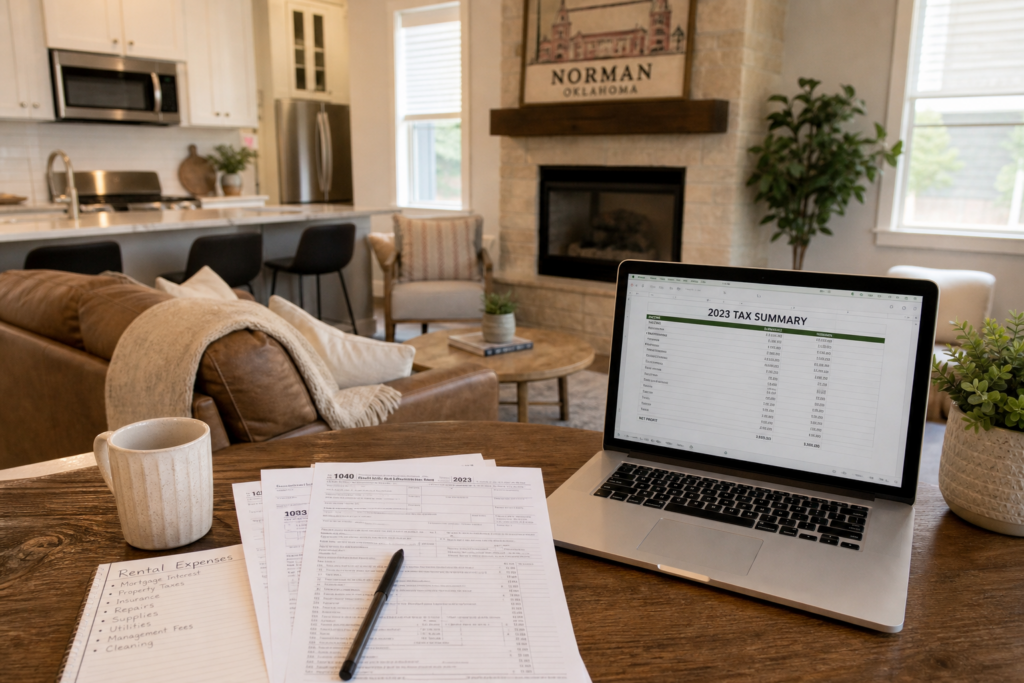
Norman Airbnb Taxes 2026: The Complete Host Tax Guide
Understanding Norman Airbnb taxes starts with smart planning, and our Norman short-term rental tax experts can help. For the 2026 tax year, short-term rental hosts face new reporting thresholds, powerful deductions, and Oklahoma lodging rules. Therefore, this guide breaks down every step. Moreover, it explains how to file correctly, cut your tax bill, and avoid costly mistakes. As a result, you can host with confidence.
Table of Contents
- Key Takeaways
- How Are Norman Airbnb Taxes Reported in 2026?
- Schedule C or Schedule E for Your Rental?
- What Can You Deduct as a Norman Host?
- What Oklahoma Lodging Taxes Apply?
- Should Norman Hosts Form an LLC or S Corp?
- How Do Depreciation and Bonus Depreciation Work?
- Uncle Kam in Action
- Next Steps
- Related Resources
- Frequently Asked Questions
Key Takeaways
- For 2026, the Form 1099-K threshold returned to $20,000 and 200 transactions.
- You must report all rental income, even without a 1099-K.
- Short-term rentals may use Schedule C or Schedule E, depending on services.
- Norman hosts owe Oklahoma and local lodging taxes on guest stays.
- Bonus depreciation and cost segregation can produce large first-year deductions.
How Are Norman Airbnb Taxes Reported in 2026?
Quick Answer: Report all Norman Airbnb income on your federal return. For 2026, platforms issue a 1099-K only above $20,000 and 200 transactions.
Reporting Norman Airbnb taxes correctly begins with understanding the paperwork. In 2026, the One Big Beautiful Bill Act (OBBBA) restored the higher Form 1099-K threshold. Consequently, platforms like Airbnb and Vrbo now report only when you cross $20,000 in gross receipts and 200 transactions. You can confirm this rule on the official IRS Form 1099-K page.
However, the threshold does not change your legal duty. In fact, you must report every dollar of rental income, even without a form. Many new hosts assume no form means no tax. Nevertheless, the IRS still expects full reporting. Working with self-employed tax specialists helps you stay compliant.
Which Forms Might You Receive?
Norman hosts may receive several documents each January. Therefore, keep them organized for accurate filing. Common forms include the following:
- Form 1099-K from Airbnb, Vrbo, or a payment processor.
- Form 1099-NEC or 1099-MISC for services above $2,000 in 2026.
- Your own booking records and platform earnings summaries.
The 14-Day Rule Explained
One valuable rule helps occasional hosts. Under Section 280A, if you rent your home for 14 days or fewer during the year, the income is tax-free. This is often called the “Augusta rule.” As a result, Norman residents renting during OU football weekends may qualify. However, you also cannot deduct expenses for those days.
Pro Tip: Track your rental nights carefully. Crossing 15 rental days ends your tax-free status for the year.
Schedule C or Schedule E for Your Rental?
Quick Answer: Use Schedule E for passive rentals. Use Schedule C when you provide substantial hotel-like services to guests.
This choice shapes your entire tax picture. Furthermore, it decides whether you owe self-employment tax. Most long-term landlords use Schedule E. However, many Airbnb hosts fall into a gray zone. Therefore, the level of service you offer matters greatly. Review the IRS Schedule E instructions before you decide.
When Schedule C Applies
You generally report on Schedule C when you offer substantial services. These services resemble a hotel or bed-and-breakfast. Consequently, your income becomes subject to the 15.3% self-employment tax. Substantial services often include the following:
- Daily cleaning during a guest’s stay.
- Meals, tours, or concierge-style services.
- Regular fresh linens and toiletries mid-stay.
When Schedule E Works Better
Most Norman hosts who simply rent space use Schedule E. In this case, you avoid self-employment tax on the profit. Basic services like Wi-Fi and cleaning between stays are fine. Moreover, Schedule E still allows strong deductions. Our real estate investor tax team reviews your services to pick the right form.
Did You Know? For 2026, the Social Security wage base is $184,500. The 15.3% self-employment rate applies up to that cap.
What Can You Deduct as a Norman Host?
Quick Answer: You can deduct ordinary and necessary rental expenses. These include cleaning, supplies, platform fees, utilities, and depreciation.
Deductions are where smart Norman Airbnb taxes planning pays off. Every legitimate expense lowers your taxable profit. Therefore, tracking costs all year is essential. The IRS Publication 527 outlines what rental owners may deduct. In addition, our proactive tax strategy services help you capture every dollar.
Common Deductible Expenses
Norman hosts overlook many valuable write-offs. However, careful records unlock major savings. Consider these frequently deductible costs:
- Airbnb and Vrbo host service fees.
- Cleaning, laundry, and turnover supplies.
- Utilities, internet, and streaming services.
- Repairs, maintenance, and property insurance.
- Furniture, appliances, and guest amenities.
Mileage and Travel Deductions
Driving to your rental for repairs or turnovers counts. For 2026, the business mileage rate is 76 cents per mile from July 1 forward. Meanwhile, the rate was 72.5 cents for January through June 2026. Therefore, track your trips carefully across both periods.
Pro Tip: Use a mileage app all year. Split your 2026 miles by the two rate periods for accuracy.
Sample Deduction Calculation
Suppose your Norman rental earns $40,000 in 2026. You spend $8,000 on cleaning and supplies, $3,000 on fees, and $4,000 on utilities. Additionally, depreciation adds $10,000. As a result, your taxable profit drops to roughly $15,000. Consequently, your tax bill shrinks dramatically.
What Oklahoma Lodging Taxes Apply?
Quick Answer: Norman hosts must collect state sales tax and a local lodging tax on short-term stays under 30 days.
Beyond income tax, Norman hosts face lodging taxes. These taxes apply to short-term stays, usually under 30 days. Furthermore, they differ from your income tax return. Airbnb often collects some of these taxes automatically. Nevertheless, you remain responsible for compliance. Our Norman tax preparation professionals confirm which taxes apply to you.
State and Local Tax Layers
Oklahoma short-term rentals typically face several tax layers. Consequently, understanding each one prevents surprises. Verify current rates with the Oklahoma Tax Commission before you file. The main layers include the following:
- Oklahoma state sales tax on the rental charge.
- Cleveland County and City of Norman local sales tax.
- A local lodging or hotel/motel occupancy tax.
Who Collects the Tax?
Airbnb may collect and remit certain taxes for you. However, coverage varies by tax type and platform. Therefore, always confirm what the platform handles. If a tax is not collected, you must remit it yourself. As a result, keeping detailed records protects you during any audit.
2026 Tax Reporting Threshold Comparison
| Form | Prior Year (2025) | 2026 Threshold |
|---|---|---|
| Form 1099-K | $2,500 (transitional) | $20,000 and 200 transactions |
| Form 1099-NEC / 1099-MISC | $600 | $2,000 |
Should Norman Hosts Form an LLC or S Corp?
 Free Tax Write-Off Finder
Quick Answer: Many hosts use an LLC for liability protection. An S Corp election rarely helps passive rental income.
Choosing an entity is a common question for growing hosts. However, the right structure depends on your service level. For passive rentals, an LLC offers liability protection without extra tax cost. Meanwhile, an S Corp usually fits active, service-heavy operations. Our entity structuring specialists match your setup to your goals.
Norman investors weighing structures can use our LLC vs S-Corp Tax Calculator to estimate 2026 tax savings. Furthermore, comparing scenarios early prevents costly mistakes. You can also review the IRS S corporation guidance for the rules.
Why S Corp Rarely Fits Rentals
The main S Corp benefit is cutting self-employment tax. However, passive Schedule E rental income already avoids that tax. Therefore, an S Corp adds cost with little benefit for most landlords. Nevertheless, hosts running true hospitality businesses may see value. In those cases, professional analysis is essential.
When an LLC Makes Sense
An LLC shields your personal assets from rental lawsuits. Moreover, it keeps your finances organized and professional. For many Norman hosts, this protection alone justifies the setup. As a result, an LLC often becomes the first smart step. Our tax guidance for business owners supports every stage.
Pro Tip: Never elect S Corp status just to save taxes on passive rentals. Confirm the numbers first.
How Do Depreciation and Bonus Depreciation Work?
Quick Answer: Depreciation spreads your property cost over years. Bonus depreciation, now permanent for 2026, front-loads big deductions.
Depreciation is one of the most powerful tools in Norman Airbnb taxes planning. It lets you deduct part of your property’s cost each year. Furthermore, it does not require any new cash outlay. Under OBBBA, 100% bonus depreciation is now permanent for qualifying property. Consequently, hosts can accelerate deductions significantly.
Cost Segregation Studies
A cost segregation study breaks your property into components. Then, items like appliances and flooring depreciate faster. As a result, you may claim large first-year deductions. Moreover, combining this with bonus depreciation multiplies the benefit. Learn the basics on the IRS cost segregation guide.
The Short-Term Rental Loophole
Short-term rentals with an average guest stay of seven days or fewer get special treatment. In this case, the activity is not automatically passive. Therefore, with material participation, losses may offset other income. Consequently, many high earners use this strategy legally. However, the rules are strict, so professional guidance matters.
Did You Know? For 2026, Section 179 expensing rises to a $2.5 million limit with a $4 million investment cap.
Depreciation Example
Imagine buying a $300,000 Norman rental in 2026. A cost segregation study reclassifies $60,000 into short-life assets. With bonus depreciation, you may deduct that $60,000 quickly. As a result, your first-year taxable income falls sharply. Therefore, your cash flow improves right away.

Uncle Kam in Action: How a Norman Host Saved $18,400
Client Snapshot: Meet Sarah, a Norman schoolteacher who owns two short-term rentals near campus. She started hosting to earn extra income. However, her tax bill kept climbing every spring.
Financial Profile: Sarah’s rentals produced $92,000 in combined gross income for 2026. Additionally, she earned a $55,000 teaching salary. Therefore, her marginal tax rate was significant.
The Challenge: Sarah had reported her rentals on Schedule E with minimal deductions. Moreover, she never used depreciation strategically. Consequently, she overpaid the IRS for two straight years. She also worried about Oklahoma lodging tax compliance.
The Uncle Kam Solution: Our team reviewed her average guest stays first. Because they averaged five nights, the short-term rental rules applied. Therefore, we documented her material participation carefully. Next, we ordered a cost segregation study on both properties. As a result, she unlocked strong bonus depreciation deductions. Furthermore, we corrected her lodging tax filings and set up clean records.
The Results: Sarah reduced her 2026 federal tax bill by $18,400. In addition, she avoided potential lodging tax penalties. Her investment with Uncle Kam totaled $4,500 for the year. Consequently, her first-year return on investment exceeded four times her fee. Moreover, she now files with total confidence. You can explore more outcomes on our client results page. As a result, Sarah reinvested her savings into a third property.
Next Steps
Ready to master your Norman Airbnb taxes in 2026? Then take these clear actions today. Working with trusted tax preparation professionals in Oklahoma makes each step easier.
- Track every rental expense and receipt all year.
- Confirm your average guest stay for the loophole.
- Explore a cost segregation study for depreciation.
- Verify your Oklahoma lodging tax obligations now.
- Schedule a review with our tax advisory team.
Related Resources
- Tax Strategies for Real Estate Investors
- Tax Preparation and Filing Services
- Uncle Kam Tax Calculators
- The Uncle Kam Tax Strategy Blog
Frequently Asked Questions
Do I owe tax if I did not receive a 1099-K?
Yes, you must report all rental income. For 2026, the 1099-K threshold is $20,000 and 200 transactions. However, the form does not change your reporting duty. Therefore, report every dollar you earn.
Can I really rent tax-free for 14 days?
Yes, the 14-day rule under Section 280A allows tax-free income. If you rent 14 days or fewer, you owe no federal tax. However, you cannot deduct related expenses. Consequently, careful day tracking matters most.
Will I owe self-employment tax on my Airbnb?
It depends on your service level. Substantial hotel-like services trigger Schedule C and the 15.3% tax. Meanwhile, basic rentals use Schedule E and avoid it. Therefore, review your services carefully.
How long does it take to set up an LLC?
Oklahoma LLC formation often takes only a few business days. However, proper tax setup takes more planning. Therefore, work with a professional from the start. As a result, you avoid costly errors later.
Is a cost segregation study worth the cost?
Often, yes, especially for higher-value properties. The study can unlock large first-year deductions. Moreover, bonus depreciation multiplies the benefit in 2026. Therefore, ask a professional to run the numbers first.
This information is current as of 7/20/2026. Tax laws change frequently. Verify updates with the IRS or the Oklahoma Tax Commission if reading this later.
Last updated: July, 2026

