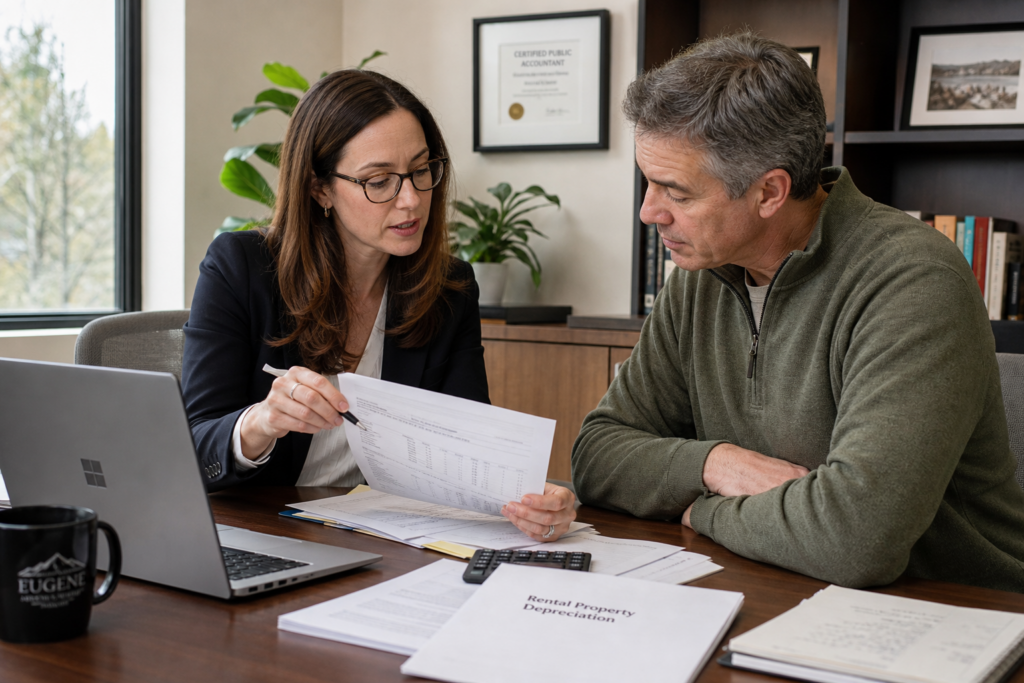
Eugene Depreciation Recapture: 2026 Guide for Oregon Property Owners
Understanding Eugene depreciation recapture matters if you own a rental, commercial building, or business equipment in Lane County. Our Eugene tax preparation team sees many owners surprised at sale time. Depreciation recapture converts prior tax breaks into taxable income. For 2026, careful planning helps you avoid an unexpected bill. This guide explains the rules, rates, and smart strategies.
Table of Contents
- Key Takeaways
- What Is Eugene Depreciation Recapture?
- How Is Depreciation Recapture Taxed in 2026?
- How Does Recapture Work When You Sell a Eugene Rental?
- Does Oregon Tax Recapture Differently From Federal Law?
- How Does Entity Structure Affect Depreciation Recapture in Eugene?
- How Can You Reduce or Defer Depreciation Recapture?
- Uncle Kam in Action
- Related Resources
- Next Steps
- Frequently Asked Questions
Key Takeaways
- Depreciation recapture taxes prior deductions when you sell business or rental property.
- For 2026, unrecaptured Section 1250 gain is taxed up to 25%.
- Section 1245 recapture on equipment is taxed as ordinary income.
- Oregon conforms to federal gain rules and adds up to 9.9% state tax.
- A 1031 exchange can defer recapture on Eugene real estate sales.
What Is Eugene Depreciation Recapture?
Quick Answer: Depreciation recapture is the tax you owe when you sell property you depreciated. It converts prior deductions into taxable income at sale.
Depreciation lets you deduct the cost of income-producing property over time. However, those deductions are not truly free. When you sell, the IRS “recaptures” part of that benefit. As a result, understanding Eugene depreciation recapture protects your profit. Many Lane County landlords and business owners forget this step until closing day.
Depreciation reduces your property’s tax basis each year. Consequently, a lower basis means a larger gain at sale. Part of that gain then faces recapture rules. The IRS Publication 544 on asset sales explains these mechanics in detail. Furthermore, real estate investors should track every prior deduction carefully.
Section 1250 Versus Section 1245
The tax code splits recapture into two categories. Section 1250 covers real property, such as buildings. Section 1245 covers personal property, such as equipment and machinery. Each category follows different rules. Therefore, knowing which applies to your asset is essential.
- Section 1250: buildings and structural components.
- Section 1245: equipment, vehicles, and fixtures.
- Land: not depreciable and never subject to recapture.
Who Faces Recapture in Eugene?
Eugene has a large rental market fueled by University of Oregon students. As a result, many local investors own single-family rentals and duplexes. Business owners with equipment-heavy trades also face recapture. Additionally, commercial building owners near downtown often trigger these rules. Many are real estate investors seeking tax efficiency across their portfolios.
Pro Tip: Keep every depreciation schedule from prior returns. You will need them to calculate recapture accurately at sale.
How Is Depreciation Recapture Taxed in 2026?
Quick Answer: For 2026, unrecaptured Section 1250 gain is taxed up to 25%. Section 1245 recapture is taxed as ordinary income.
The 2026 rates depend on which section applies. Real property depreciation faces the unrecaptured Section 1250 gain rate. That rate tops out at 25%. Meanwhile, equipment recapture is taxed as ordinary income, up to 37%. Consequently, asset type drives your final tax bill. A proactive tax strategy plan can lower this exposure.
2026 Federal Recapture Rates
The table below summarizes the 2026 federal treatment by asset type. In addition, high earners may owe the 3.8% Net Investment Income Tax. This surtax applies to passive rental gains above income thresholds.
| Asset Type | Recapture Section | 2026 Federal Rate |
|---|---|---|
| Residential rental building | Section 1250 | Up to 25% |
| Commercial building | Section 1250 | Up to 25% |
| Equipment and vehicles | Section 1245 | Ordinary income (up to 37%) |
| Remaining capital gain | Long-term gain | 0%, 15%, or 20% |
Bonus Depreciation and Section 179 Impact
The One Big Beautiful Bill Act reshaped 2026 depreciation. It reinstated 100% bonus depreciation for qualifying property. Moreover, the Section 179 expensing limit rose to $2.5 million for 2026. The investment phase-out threshold climbed to $4 million. However, larger upfront deductions mean larger recapture later. Therefore, front-loaded deductions require careful exit planning.
Did You Know? Selling equipment you fully expensed can trigger 100% recapture at ordinary rates.
The IRS Publication 946 on depreciating property details these limits. Consequently, review bonus depreciation choices before you sell.
How Does Recapture Work When You Sell a Eugene Rental?
Quick Answer: Total depreciation taken becomes unrecaptured Section 1250 gain. It is taxed first, before remaining capital gain.
Residential rentals depreciate over 27.5 years using straight-line. Commercial buildings depreciate over 39 years. When you sell, prior depreciation reduces your basis. As a result, the gain grows and part faces recapture. Let us walk through a realistic Eugene example. Many local landlords work with a tax preparation service in Oregon to run these numbers.
Eugene Single-Family Rental Scenario
Suppose you bought a Eugene rental for $400,000. The building portion was $300,000, and land was $100,000. Over ten years, you claimed roughly $109,000 in depreciation. Therefore, your adjusted basis dropped to about $291,000. Now assume you sell in 2026 for $560,000.
- Total gain: $560,000 minus $291,000 equals $269,000.
- Unrecaptured Section 1250 gain: $109,000, taxed up to 25%.
- Remaining long-term gain: $160,000, taxed at 15% or 20%.
At a 25% rate, the recapture portion alone costs about $27,250 federally. Furthermore, Oregon adds state tax on top. Consequently, planning ahead can save thousands.
Records You Must Gather Before Selling
Accurate calculations require complete documentation. Missing records often lead to overpaying recapture tax. Therefore, organize these items early:
- Original purchase price and closing statement.
- Land versus building allocation records.
- Every prior year depreciation schedule.
- Capital improvement receipts and invoices.
Pro Tip: The IRS taxes depreciation you “should have taken,” even if you skipped it. Claim it every year.
Does Oregon Tax Recapture Differently From Federal Law?
Quick Answer: Oregon largely conforms to federal gain rules. However, Oregon taxes all gain at ordinary rates up to 9.9%.
Oregon has no separate capital gains preference. Instead, it taxes gains as ordinary income. Therefore, both recapture and capital gain face Oregon rates. The top marginal rate reaches 9.9% for higher earners. As a result, Eugene sellers must stack federal and state tax. The Oregon Department of Revenue website provides current filing guidance.
Combined Tax Stacking Example
Return to the $109,000 recapture from earlier. Federally, 25% equals about $27,250. Oregon then taxes that same amount at up to 9.9%. That adds roughly $10,791 in state tax. Consequently, combined recapture tax approaches $38,041. Moreover, the 3.8% surtax may apply to some investors.
| Tax Layer | Rate | Tax on $109,000 |
|---|---|---|
| Federal Section 1250 recapture | Up to 25% | $27,250 |
| Oregon income tax | Up to 9.9% | $10,791 |
| Combined estimate | — | $38,041 |
Why Local Timing Matters
Because Oregon lacks a preferential gain rate, income timing is critical. Selling in a lower-income year can trim Oregon tax. Additionally, spreading a sale across years may help. Therefore, model your projected income before closing. Business owners often coordinate this with a year-round tax advisory relationship.
How Does Entity Structure Affect Depreciation Recapture in Eugene?
 Free Tax Write-Off Finder
Quick Answer: Recapture passes through to owners in LLCs and S corps. Entity choice affects reporting, not the recapture rate itself.
Many Eugene owners hold property inside an LLC. Recapture flows through to the owner’s personal return. Consequently, the individual pays the recapture tax. S corporations follow similar pass-through mechanics. However, entity structure still affects overall tax efficiency. Proper entity structuring for business owners supports smart planning.
Wilmington-style calculators help, but Oregon owners need local numbers. Use our LLC vs S-Corp Tax Calculator for Eugene to compare 2026 outcomes. This tool clarifies how entity choice shapes your tax picture.
Real Estate Versus Active Business Assets
Rental real estate usually stays in an LLC for liability. Meanwhile, active businesses often elect S corp status. However, holding appreciating real estate inside an S corp creates traps. Distributing property from an S corp can trigger gain. Therefore, most advisors keep real estate in a separate LLC.
Equipment-Heavy Eugene Trades
Contractors and manufacturers deduct equipment fast under Section 179. As a result, they face large Section 1245 recapture at sale. That recapture is ordinary income, not preferential gain. Consequently, timing equipment sales matters greatly. Many Eugene business owners planning growth weigh this carefully.
Pro Tip: Trade in equipment strategically to reduce Section 1245 recapture exposure in high-income years.
How Can You Reduce or Defer Depreciation Recapture?
Quick Answer: A 1031 exchange defers recapture on real property. Timing, installment sales, and record-keeping also help.
You cannot fully erase recapture, but you can defer it. The most powerful tool is a like-kind exchange. Additionally, timing and installment sales offer relief. Therefore, plan your exit well before listing. These strategies fit a broader tax strategy blog for investors.
The 1031 Like-Kind Exchange
A Section 1031 exchange lets you defer gain and recapture. You reinvest proceeds into another qualifying property. As a result, the tax bill moves to a future sale. However, strict deadlines apply to the process. The IRS like-kind exchange guidance outlines these timing rules. Consequently, hire a qualified intermediary early.
Other Practical Strategies
Several additional moves can lower your effective recapture cost. Each one requires careful timing and documentation. Therefore, review these with a professional before acting:
- Sell in a lower-income year to reduce Oregon tax.
- Use an installment sale to spread gain over years.
- Offset gains with passive losses where allowed.
- Hold property until death for a stepped-up basis.
Estate planning can eliminate recapture entirely for heirs. A stepped-up basis wipes out prior depreciation at death. Consequently, high-net-worth owners often hold long term. Explore options with our high-net-worth tax planning team. Before your next steps, confirm details with our Eugene tax professionals for accuracy.

Uncle Kam in Action: How a Eugene Landlord Saved $34,000
Client Snapshot: Marcus owned three rental homes near the University of Oregon. He also ran a small remodeling company in Eugene.
Financial Profile: His rentals generated about $95,000 in annual income. His remodeling business added roughly $180,000 in revenue.
The Challenge: Marcus planned to sell one appreciated rental in 2026. He faced roughly $140,000 in accumulated depreciation. Therefore, he worried about a large recapture bill. He also feared stacking federal and Oregon tax together.
Without planning, his combined recapture tax approached $48,000. Consequently, Marcus nearly abandoned the sale entirely. He needed a strategy that preserved his equity.
The Uncle Kam Solution: Our team modeled several 2026 exit paths. First, we structured a 1031 exchange into a larger duplex. This deferred both recapture and capital gain. Next, we timed his remodeling income to a lower year. Additionally, we documented every improvement to raise his basis. As a result, his taxable exposure dropped dramatically.
We also reviewed his entity structure for future protection. Furthermore, we set a record-keeping system for all properties. Therefore, his next sale will be far simpler.
The Results: Marcus deferred nearly all recapture through the exchange. His documented improvements trimmed the remaining gain further.
- Tax Savings: approximately $34,000 in the first year.
- Investment: $6,500 in Uncle Kam planning fees.
- First-Year ROI: more than 5x his fee.
Marcus reinvested his savings into another Eugene property. See more outcomes on our documented client results page. His story shows why proactive planning beats last-minute filing.
Related Resources
- Tax Strategies for Real Estate Investors
- Tax Prep and Filing Services
- Free Tax Planning Calculators
- The MERNA Method Explained
Next Steps
- Gather all prior depreciation schedules before you list.
- Estimate recapture early using 2026 rates and Oregon tax.
- Explore a 1031 exchange if you plan to reinvest.
- Book a review with our Eugene tax strategy team.
This information is current as of 7/20/2026. Tax laws change frequently. Verify updates with the IRS or Oregon Department of Revenue if reading this later. This content is educational and not individualized tax advice.
Frequently Asked Questions
Can I avoid depreciation recapture entirely?
You cannot avoid it through a normal sale. However, a 1031 exchange defers it. Additionally, holding until death provides a stepped-up basis. That basis can eliminate recapture for your heirs.
What if I never claimed depreciation on my Eugene rental?
The IRS still taxes depreciation you were allowed to take. Therefore, skipping deductions does not help you. Instead, you lose the benefit but still owe recapture. Claim depreciation every year to protect yourself.
Does Oregon give a discount on recaptured gain?
No, Oregon has no preferential capital gains rate. It taxes all gain as ordinary income. Consequently, the top rate can reach 9.9%. This applies to both recapture and remaining gain.
How does 2026 bonus depreciation affect recapture?
The OBBBA reinstated 100% bonus depreciation for 2026. Larger upfront deductions create larger recapture later. Therefore, equipment you fully expensed faces full Section 1245 recapture. Plan your equipment sales carefully.
When should I hire a tax professional for recapture planning?
Engage a professional well before you list the property. Early planning enables exchanges and timing strategies. Consequently, you preserve more of your equity. Waiting until closing usually limits your options.
Last updated: July, 2026

