Montana Opportunity Zone vs 1031 Exchange: 2026 Investor Tax Strategy Comparison
Montana Opportunity Zone vs 1031 Exchange: 2026 Investor Tax Strategy Comparison
For real estate investors evaluating growth opportunities across Montana, choosing between a Montana opportunity zone investment and a 1031 exchange strategy represents one of the most consequential tax decisions of 2026. Both strategies defer capital gains taxes, but they operate under fundamentally different rules, timelines, and geographic restrictions. Understanding how a Montana opportunity zone vs 1031 exchange performs under current tax law is essential to maximizing after-tax returns on your investment portfolio.
Table of Contents
- Key Takeaways
- What Is a Montana Opportunity Zone?
- Understanding 1031 Exchange Rules
- How Do Tax Benefits Compare?
- How Do Tax Implications Differ?
- Timeline and Holding Period Requirements
- Can You Combine Both Strategies?
- Uncle Kam in Action
- Next Steps
- Frequently Asked Questions
Key Takeaways
- Opportunity Zones defer capital gains taxes indefinitely and offer permanent tax exclusion on gains earned after December 31, 2026 if held for 10 years.
- 1031 exchanges defer capital gains indefinitely through property-for-property swaps of like-kind real estate without geographic restrictions.
- Opportunity Zone investments must occur in federally designated distressed areas and require a 10-year holding period for maximum tax benefits.
- 1031 exchanges require strict timelines: 45 days to identify replacement property, 180 days to close the transaction.
- Montana Opportunity Zone vs 1031 exchange selection depends on your geographic preference, investment timeline, and liquidity needs.
What Is a Montana Opportunity Zone?
Quick Answer: A Montana opportunity zone is a federally designated economically distressed geographic area where investors can defer capital gains taxes by investing in qualified businesses and real property.
An opportunity zone designated by the IRS is a tax incentive program created under the Tax Cuts and Jobs Act of 2017. For 2026, Montana investors can deploy capital gains into qualified businesses, real estate projects, and infrastructure within federally designated opportunity zones. These zones target economically disadvantaged census tracts across Montana, including areas around Billings, Missoula, and Helena.
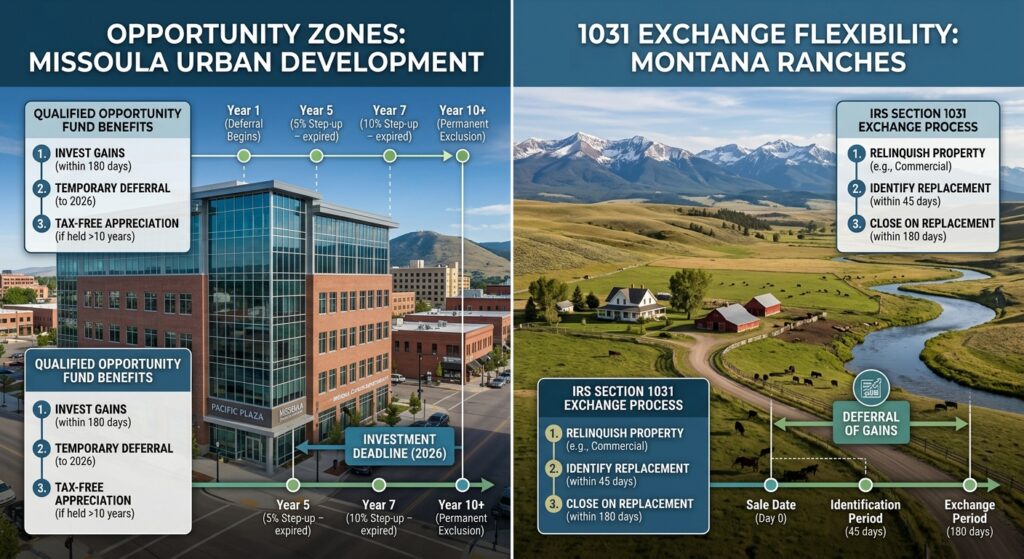
When you invest capital gains in a qualified opportunity zone fund for 2026, you accomplish two critical objectives. First, you defer the original capital gains tax indefinitely. Second, you may exclude 100% of the investment gains earned after December 31, 2026, if you hold the investment for a full 10 years. This creates a permanent tax exclusion structure unavailable through any other strategy.
Qualified Opportunity Zone Property Types
- Commercial real estate projects (office buildings, retail centers)
- Residential rental properties and apartment complexes
- Manufacturing facilities and industrial properties
- Hospitality investments (hotels, restaurants)
- Start-up businesses and qualified business operations
Key Montana Opportunity Zone Mechanics
For 2026, your capital gains must be invested within 180 days of being realized. You invest through a qualified opportunity zone fund (a pooled investment vehicle or self-directed structure). The fund then deploys capital into qualified businesses or properties within designated Montana zones. The Montana opportunity zone vs 1031 exchange distinction here is crucial: your investment geography is restricted to federally approved distressed areas, whereas 1031 exchanges allow unrestricted property location.
Pro Tip: Montana Opportunity Zone investments made before the 2026 year-end deadline provide the 10-year holding period through December 31, 2036 to achieve full capital gains exclusion on appreciation.
Understanding 1031 Exchange Rules for 2026
Quick Answer: A 1031 exchange allows investors to swap real estate properties of equal or greater value without triggering immediate capital gains taxes under IRC Section 1031.
The 1031 exchange, named after IRS Publication 544, remains one of the most powerful real estate tax deferral strategies available. When comparing Montana opportunity zone vs 1031 exchange approaches, the 1031 structure operates through direct property exchanges rather than pooled fund investments. You sell a rental property, investment real estate, or business property and purchase a like-kind replacement property of equal or greater value within strict timelines.
For 2026 exchanges, the IRS requires you to identify replacement property within 45 days of closing your sale. You then have 180 days total from the sale date to close on the replacement property. These timelines are absolute and non-extendable, making careful planning essential.
What Qualifies as Like-Kind Property?
Under current 2026 regulations, like-kind property must be real property. The rules simplify dramatically after the Tax Cuts and Jobs Act. You can exchange residential rental property for commercial property, land for a building, or an apartment complex for an office building. The key requirement: both must be real property held for investment or business use (not personal residences).
- Rental properties and investment real estate
- Vacant land and development property
- Commercial buildings and retail properties
- Multi-unit apartment complexes
- Industrial warehouses and manufacturing facilities
How Do Tax Benefits Compare Between Montana Opportunity Zone vs 1031 Exchange?
Quick Answer: Opportunity zones offer permanent tax exclusion on gains (if held 10 years). 1031 exchanges defer taxes indefinitely until property sale, but without permanent exclusion unless reinvested through future exchanges.
| Feature | Montana Opportunity Zone | 1031 Exchange |
|---|---|---|
| Tax on Original Gains | Deferred indefinitely | Deferred indefinitely |
| Tax on New Gains (10 years) | 100% excluded if held through 2036 | Taxed upon eventual sale |
| Geographic Restriction | Designated Montana opportunity zones only | No restriction (any U.S. real estate) |
| Holding Period | 10 years for maximum benefits | No minimum (but goal is 1+ year for long-term gains) |
| Investment Timeline | 180 days to invest after realizing gains | 45 days to identify, 180 days to close |
| Flexibility | Limited (geographically constrained) | High (any like-kind real property) |
The most significant distinction when evaluating Montana opportunity zone vs 1031 exchange is the permanent tax exclusion. With an opportunity zone, if you hold your investment for 10 years (through 2036 for 2026 investments), you permanently exclude 100% of appreciation gains from federal taxation. A 1031 exchange, by contrast, only defers taxes. When you eventually sell the replacement property, you owe capital gains tax unless you complete another exchange.
How Do Tax Implications Differ Between These Strategies?
 Free Tax Write-Off Finder
Quick Answer: Opportunity zones provide permanent exclusion after 10 years. 1031 exchanges require continuous reinvestment to avoid taxation. Montana investors should use our Self-Employment Tax Calculator to model these scenarios based on your income level.
Original Capital Gains Tax Treatment
With both strategies, your original capital gains tax is deferred when you invest. If you sold a Montana rental property for $500,000 with a $300,000 gain, that $300,000 gain tax is not due immediately. However, the treatment diverges significantly over time.
Step-Up Basis and Long-Term Benefits
For opportunity zone investments through 2026, the original deferred gains become taxable in 2036 (upon the 10-year anniversary). However, your basis in the new property steps up to fair market value as of December 31, 2026. Any appreciation after that date is entirely excluded from taxation if held through the full 10-year period. For a 1031 exchange, your basis carries forward (you don’t receive a step-up), meaning future appreciation is still subject to taxation unless sheltered through another exchange.
Pro Tip: For maximum 2026 tax efficiency, model your Montana opportunity zone investment with a professional who can calculate the NPV of permanent exclusion versus ongoing 1031 exchange deferral strategies over your investment timeline.
What Are the Timeline and Holding Period Requirements?
Quick Answer: Opportunity zones require 10-year holding periods. 1031 exchanges have no minimum holding period but strict 45/180-day transaction timelines. Montana investors must plan accordingly.
When deciding between Montana opportunity zone vs 1031 exchange strategies, timing is critical. Let’s examine each approach’s timeline requirements for 2026 investments.
Opportunity Zone Timeline Requirements
- Invest original capital gains within 180 days of realization
- Hold investment for minimum 10 years (through 2036)
- Maintain 90% of assets in qualified opportunity zone property
- Pay deferred original gains tax by December 31, 2026
1031 Exchange Timeline Requirements
- Day 1-45: Identify replacement property (must be in writing)
- Day 45-180: Close on replacement property (final requirement)
- No minimum holding period (but practical considerations apply)
- Equal or greater value in replacement property required
The critical distinction: opportunity zone investments lock you in for a decade to realize maximum tax benefits, while 1031 exchanges are more flexible but require precise timing. If you need liquidity or anticipate selling within 5 years, a 1031 exchange provides more flexibility than a Montana opportunity zone investment.
Can You Combine Montana Opportunity Zone and 1031 Exchange Strategies?
Quick Answer: Yes, sophisticated investors can layer both strategies, but careful coordination with Montana tax preparation professionals is essential to comply with IRS timing rules.
The most effective Montana opportunity zone vs 1031 exchange strategy for many investors isn’t choosing one—it’s combining both. You can sell a property via 1031 exchange, then invest a portion of the proceeds into an opportunity zone fund. This approach requires careful planning around the 180-day opportunity zone investment deadline and the 45/180-day 1031 exchange timeline.
For example, if you close a 1031 exchange on March 1, 2026, you have until August 28, 2026, to invest in an opportunity zone fund. The two timelines operate independently, giving you layered deferral strategies. However, you cannot use the same capital for both strategies simultaneously.

Uncle Kam in Action: Montana Real Estate Investor Case Study
Client Profile: Marcus, a Missoula-based real estate investor with a portfolio of five rental properties, faced a strategic decision in spring 2026. He was selling a commercial office building in downtown Missoula with a realized capital gain of $850,000. With a 2026 federal long-term capital gains rate of 20% (plus 3.8% net investment income tax), he faced approximately $202,000 in federal capital gains tax liability.
The Challenge: Marcus wanted to reinvest these gains but wasn’t sure whether to pursue a Montana opportunity zone investment in a distressed Missoula neighborhood development, a 1031 exchange into Montana residential properties, or a combination of both strategies.
Uncle Kam’s Solution: After analyzing Marcus’s 10-year investment horizon and his desire to eventually liquidate at retirement (age 62), we recommended a hybrid strategy. We invested $500,000 into a qualified opportunity zone fund focused on mixed-use development in a federally designated Missoula opportunity zone. This investment locked in maximum tax benefits: the original $500,000 gain deferred, plus permanent exclusion on appreciation if held through 2036.
The remaining $350,000 in gains went into a 1031 exchange structure where Marcus acquired a $400,000 apartment complex in Bozeman. This provided geographic diversification and greater liquidity if circumstances changed.
The Results: By combining strategies, Marcus deferred his $202,000 tax liability entirely in 2026. Over the next decade, the opportunity zone investment appreciated 8% annually (reaching $1.08 million by 2036 with zero taxation on appreciation gains). The 1031 exchange Bozeman property provided monthly rental income and remained flexible for future transactions. When Marcus retired in 2036, the opportunity zone position had generated over $230,000 in untaxed appreciation while maintaining reasonable liquidity through his 1031 property.
Next Steps: Making Your Montana Opportunity Zone vs 1031 Exchange Decision
Choosing between a Montana opportunity zone and a 1031 exchange is not a simple either-or decision. Your selection depends on multiple factors including your investment timeline, geographic preferences, liquidity needs, and tax position. Here’s how to proceed:
- Calculate your capital gains tax liability using your 2026 income bracket and long-term/short-term gain classification.
- Assess your holding period horizon—Can you commit capital for 10 years (opportunity zone) or do you need flexibility (1031 exchange)?
- Research available Montana opportunity zone investments and qualified 1031 exchange properties matching your criteria.
- Model both scenarios with tax software showing 10-year after-tax returns for each strategy.
- Consult a tax professional who specializes in Montana real estate tax strategies to coordinate timing and documentation.
Frequently Asked Questions
What is the difference between capital gains deferral and capital gains exclusion?
Capital gains deferral (1031 exchange) postpones your tax obligation until you sell without reinvesting. Capital gains exclusion (opportunity zone) permanently eliminates taxation on gains earned after the investment date if held for 10 years. Exclusion is superior to deferral because you never pay tax on the deferred amounts’ appreciation.
Can I do a 1031 exchange into a Montana property and then invest in an opportunity zone?
Yes, but timing is critical. If you close your 1031 exchange on March 15, 2026, you have until September 11, 2026, to invest in an opportunity zone fund (180-day deadline). The replacement property from your 1031 exchange cannot simultaneously be your opportunity zone investment, but you can deploy other capital into opportunity zones within this window.
What happens to my Montana opportunity zone investment after 2026?
Your deferred capital gains tax becomes due on December 31, 2026 (or can be paid annually). However, your investment continues growing tax-deferred. If held through December 31, 2036 (10 years), you permanently exclude all appreciation gains from federal taxation. This creates tremendous long-term tax efficiency.
Is a Montana opportunity zone better than a 1031 exchange for long-term investors?
For investors with a 10+ year horizon, Montana opportunity zones are superior because they offer permanent tax exclusion. However, 1031 exchanges provide unlimited geographic flexibility and liquidity. Many sophisticated investors use both strategies in combination to optimize tax efficiency while maintaining portfolio flexibility.
What are the risks of Montana opportunity zone investments?
Primary risks include geographic concentration (limited to designated zones), market risk in economically distressed areas, liquidity constraints (10-year holding requirement), and regulatory changes. Unlike 1031 exchanges which swap established properties, opportunity zones often involve development or underperforming assets. Diversification across multiple zones and property types mitigates these risks.
Can I use opportunity zones for 1031 exchange boot purposes?
No—these are separate strategies that don’t interact. In a 1031 exchange, you must reinvest equal or greater property value. Boot (the portion of proceeds not reinvested) is fully taxable. You cannot use an opportunity zone fund as your replacement property in a 1031 exchange, though you could invest boot proceeds in an opportunity zone separately.
What properties don’t qualify for 1031 exchanges?
Personal residences, primary homes, and properties held primarily for sale (inventory) don’t qualify. Stocks, bonds, and non-real-estate investments are ineligible. Foreign property doesn’t qualify for 1031 status. You must exchange for genuine like-kind real property held for investment or business use.
How do I ensure my 1031 exchange complies with 2026 IRS regulations?
Use a qualified 1031 exchange facilitator (not a related party). Document all property identification in writing by day 45. Close on identified property by day 180. Work with a tax professional who tracks current IRS guidance. Small timing errors can disqualify the entire exchange and trigger unexpected capital gains tax.
Which strategy is better for passive real estate investors?
Passive investors often prefer opportunity zones through pooled funds because they require minimal active management. 1031 exchanges require ongoing property identification and transaction management. However, 1031 exchanges offer greater property selection flexibility. Your lifestyle and availability for real estate management should influence this decision.
Related Resources
- Real Estate Investor Tax Strategies
- 2026 Tax Strategy Planning
- Real Estate Entity Structuring
- Professional Tax Advisory Services
- 2026 Tax Return Preparation
Last updated: May, 2026

