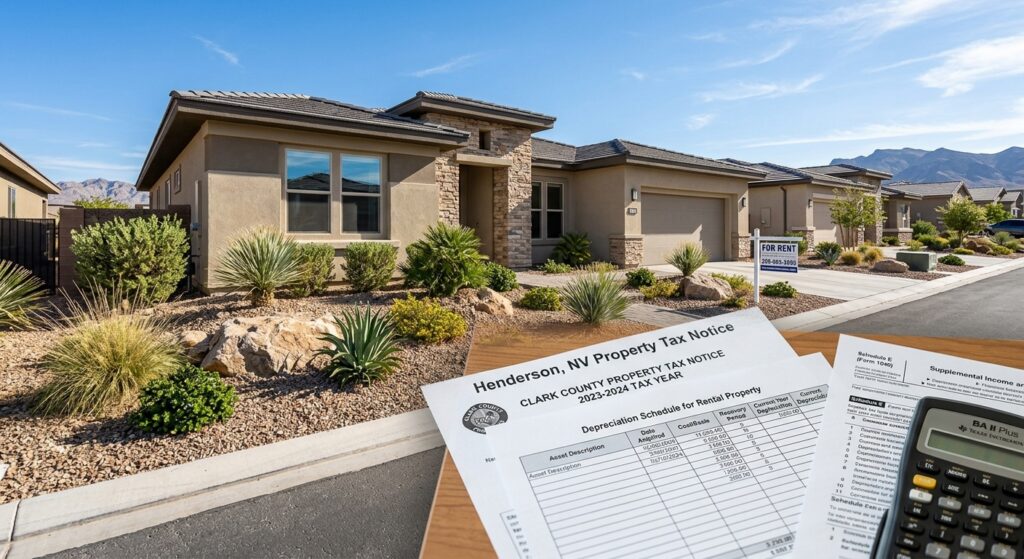
Henderson Rental Property Taxes 2026: Complete Guide for Nevada Investors
For 2026, Henderson rental property taxes present a unique advantage: Nevada has no state income tax, making the Silver State one of the most tax-efficient locations for real estate investors in America. As a Henderson landlord or rental property owner, you benefit from federal tax deductions, depreciation strategies, and entity structuring that can significantly reduce your effective tax burden. This comprehensive guide explores henderson rental property taxes for 2026, showing you how to leverage Nevada’s tax-friendly environment, optimize your business structure through our trusted tax preparation services in Henderson, and maximize cash flow through strategic tax planning.

Table of Contents
- Key Takeaways
- Nevada’s Zero Income Tax Advantage
- Federal Rental Property Deductions for 2026
- Depreciation and Cost Segregation Strategies
- Capital Gains Tax Planning for Property Sales
- Choosing the Right Business Entity
- Understanding Passive Loss Limitations
- Uncle Kam in Action
- Next Steps
- Frequently Asked Questions
Key Takeaways
- Nevada’s zero state income tax eliminates a major burden for Henderson rental property owners, saving 0-13.3% on income compared to high-tax states in 2026.
- Depreciation deductions, mortgage interest write-offs, and repairs reduce your taxable rental income at the federal level throughout the year.
- Capital gains tax on property sales ranges from 15%-20% federally for long-term holdings, with depreciation recapture at 25% requiring strategic planning.
- Selecting an LLC, S-Corp, or C-Corp significantly impacts your 2026 tax liability and self-employment tax obligations.
- Passive loss limitations cap deductions at $25,000 annually unless you qualify as a real estate professional, making documentation critical.
Nevada’s Zero Income Tax Advantage for Henderson Rental Property Taxes
Quick Answer: Nevada imposes zero state income tax on rental income, saving Henderson property owners thousands annually compared to California (13.3%), New York (8.82%), or other high-tax states during 2026.
The single most powerful advantage for Henderson rental property owners in 2026 is Nevada’s zero state income tax. Unlike properties located in California, New York, or Connecticut, your rental income from Henderson properties faces no state-level taxation. This fundamental difference creates substantial wealth-building opportunities for real estate investors, allowing you to retain more cash flow for reinvestment, debt paydown, or distribution to owners.
For perspective, a Henderson landlord earning $100,000 in net rental income pays zero to Nevada. That same income would cost $13,300 in California state taxes or $8,820 in New York. Over a career of real estate investing, this difference compounds significantly, particularly when reinvesting savings into additional properties or building your real estate portfolio.
How Nevada’s Tax Structure Differs from Other States
Nevada’s tax-friendly environment extends beyond just income tax. The state also features no corporate income tax, no franchise tax on rental properties, and limited property tax rates compared to national averages. While Clark County (Henderson’s county) does assess property taxes, the rates remain moderate relative to high-tax states, with effective rates in the 0.6%-0.8% range depending on location and local assessments.
This creates a unique situation: you pay federal taxes on your rental income (which all U.S. landlords face), but you escape the state-level burden that erodes profits for out-of-state competitors. Combined with strategic federal deductions and entity structuring, Henderson rental property ownership becomes substantially more profitable in 2026 than comparable properties in high-income-tax states.
Pro Tip: If you own rental properties in multiple states, consider structuring your Nevada properties through an LLC taxed as an S-Corp to maximize the zero-tax advantage while reducing self-employment taxes on active income.
Federal Rental Property Deductions for 2026
Quick Answer: Landlords deduct mortgage interest, property taxes, repairs, insurance, utilities, property management fees, and depreciation, reducing taxable income dollar-for-dollar through Schedule E for 2026.
Federal tax law allows Henderson rental property owners to deduct virtually all ordinary and necessary business expenses from rental income before calculating federal tax liability. These deductions directly reduce your taxable income, making them extremely valuable for 2026 tax planning. The more accurately you document and claim deductions, the lower your federal tax bill, regardless of Nevada’s state tax advantage.
Mortgage Interest and Property Taxes
The two largest deductions for most Henderson landlords are mortgage interest and property taxes. All interest paid on loans used to purchase or improve the rental property is fully deductible on your Schedule E return. If your Henderson property has a $250,000 mortgage at 6.5% interest, you deduct approximately $16,250 in year-one interest (declining as principal increases). Similarly, all property taxes paid to Clark County are fully deductible, typically ranging from $1,500-$3,000 annually depending on the property’s assessed value and local millage rates for 2026.
Operating Expenses and Repairs
All operating costs are deductible: insurance premiums, utilities (if landlord-paid), property management fees (typically 8-12% of rent), maintenance, repairs, yard care, tenant screening costs, and HOA fees. The key distinction in 2026 is that repairs are immediately deductible, while improvements must be capitalized and depreciated over time. Replacing a roof is an improvement (depreciated). Fixing gutters is a repair (immediately deductible). Proper classification matters significantly for cash flow timing and overall tax strategy.
| Expense Category | Deductible in 2026? | Example |
| Mortgage Interest | Yes (100%) | $16,250 on $250K loan at 6.5% |
| Property Taxes | Yes (100%) | Clark County taxes: $2,000-$3,000 |
| Insurance | Yes (100%) | Landlord policy: $800-$1,500 |
| Repairs | Yes (100%) | HVAC maintenance, wall repairs |
| Property Management | Yes (100%) | 10% of monthly rent collected |
Depreciation and Cost Segregation Strategies for 2026
Quick Answer: Depreciation deducts the building’s cost (not land) over 27.5 years; cost segregation accelerates deductions by reclassifying components (appliances, flooring) to 5-7 year schedules, dramatically reducing 2026 taxable income.
Depreciation is one of the most powerful deductions available to Henderson rental property owners. The IRS allows you to deduct the cost of the building structure (not the land) systematically over 27.5 years. For a $300,000 Henderson rental property where $250,000 represents the building and $50,000 the land, you deduct approximately $9,091 annually ($250,000 ÷ 27.5 years) through depreciation. This deduction appears on your Schedule E and reduces federal taxable income before calculating your tax liability.
The remarkable aspect is that depreciation is a non-cash deduction. You receive the full tax benefit without spending additional money, making it exceptionally valuable for real estate investors. Combined with Nevada’s zero state income tax, depreciation deductions create situations where landlords show little-to-no federal taxable income despite receiving substantial monthly rental cash flow.
Cost Segregation Studies: Accelerating Deductions
Cost segregation studies are specialized IRS-compliant analysis that can transform depreciation timing for Henderson rental properties acquired in 2026 or previous years. Rather than depreciating the entire building structure over 27.5 years, a cost segregation study identifies specific components (flooring, countertops, appliances, landscaping, parking surfaces) that can be depreciated over much shorter periods (5, 7, 10, or 15 years). This accelerates your deductions into the early years of ownership, providing dramatic first-year tax reductions.
For example, a $300,000 Henderson rental might generate $9,091 in standard depreciation annually. A cost segregation study could reclassify $60,000 of building costs into 5-year property, creating an additional $12,000 first-year deduction through bonus depreciation (if available) or accelerated depreciation timing. Combined with mortgage interest and operating expenses, total deductions could exceed rental income substantially, creating a tax loss for 2026 despite positive cash flow.
Pro Tip: If you acquired Henderson properties in 2024-2025 and haven’t completed a cost segregation study, you may still qualify for retroactive analysis in 2026. Consult with a real estate tax specialist to determine if your property qualifies and how much additional tax savings you might recover.
Capital Gains Tax Planning for Property Sales in 2026
Quick Answer: Long-term capital gains on Henderson property sales are taxed at 15%-20% federally; depreciation recapture adds 25% tax; planning the sale timing and structure in 2026 can reduce total tax burden significantly.
When Henderson rental property is sold, federal capital gains tax applies to the difference between your adjusted basis (cost plus improvements minus depreciation claimed) and sale price. For long-term holdings (over one year, standard for rental properties), the federal capital gains rate is 15% for most taxpayers or 20% for higher incomes. However, all depreciation claimed on the property is recaptured at 25%, creating a blended rate that often exceeds the standard capital gains percentage.
Depreciation Recapture and Exit Strategy
Suppose you purchase a Henderson property for $300,000 (building value $250,000) and hold it 10 years with average annual depreciation of $9,091. You’ll have claimed $90,910 in depreciation deductions over the decade, reducing your cost basis to $209,090. If you sell for $400,000, your gain is $190,910 (sale price minus adjusted basis). Of this gain, $90,910 represents depreciation recapture taxed at 25% ($22,728 owed), while the remaining $100,000 long-term capital gain is taxed at 15-20%, generating $15,000-$20,000 in additional tax. Total capital gains tax: $37,728-$42,728.
Strategic planning matters enormously in 2026. If you’re considering Henderson property sales, timing the disposition to manage income across years, using 1031 exchange strategies to defer gains into like-kind investments, or structuring the sale across calendar years can meaningfully reduce overall tax impact. Real estate professionals should model multiple sale scenarios before committing to a 2026 disposition timeline.
Should You Choose an LLC or S-Corp for Your Henderson Rental Property?
 Free Tax Write-Off Finder
Quick Answer: Passive rental income (no active involvement) works best in an LLC taxed as a partnership; active landlords with significant sweat equity benefit from S-Corp election to reduce self-employment taxes through reasonable salary/distribution splits.
The business entity you choose for Henderson rental properties dramatically affects 2026 tax liability. Most passive landlords use a simple LLC (taxed as a sole proprietor or partnership), paying federal income tax on profits and 15.3% self-employment tax on net rental income. However, if you actively manage properties, perform repairs, screen tenants, and handle maintenance, you may benefit from electing S-Corp taxation to split income between W-2 wages (subject to 15.3% employment tax) and distributions (avoiding employment taxes).
Entity Type Comparison for Henderson Properties
A Henderson landlord earning $100,000 in net rental income pays approximately $15,300 in self-employment tax if structured as an LLC taxed as a sole proprietor (12.4% Social Security + 2.9% Medicare). An S-Corp election allows you to pay yourself a reasonable $60,000 salary (subject to full $9,180 employment tax), then distribute the remaining $40,000 as a profit distribution (avoiding 15.3% employment tax). Total employment tax: $9,180 versus $15,300—a $6,120 savings in 2026 from entity structuring alone.
Our LLC vs S-Corp Tax Calculator for Las Vegas allows you to model these scenarios with your actual Henderson income and expenses, showing exact 2026 savings under different entity structures. The calculator incorporates Nevada’s zero state income tax advantage and provides precise projections for your situation.
Pro Tip: For Henderson landlords with multiple properties or significant rental income ($50,000+), an S-Corp election typically saves $3,000-$8,000 annually. The IRS requires reasonable salary, meaning you cannot pay yourself $20,000 to manage a $100,000 income property. Work with a tax professional to establish defensible, documented salary levels for 2026.
Understanding Passive Loss Limitations for 2026
Quick Answer: IRS passive loss rules generally limit rental property deductions to $25,000 annually unless you’re a real estate professional or materially participate; excess losses carry forward indefinitely, usable when you sell the property.
One critical limitation affects many Henderson rental property owners: passive loss rules. If your deductions (depreciation, mortgage interest, repairs) exceed rental income, creating a paper loss, the IRS generally allows you to deduct only $25,000 of that loss annually against other income (W-2 wages, business income) unless you qualify as a real estate professional or materially participate in management.
Example: A Henderson property shows $5,000 in positive cash flow (rent minus expenses) but $30,000 in deductions (including $20,000 depreciation), creating a $25,000 paper loss. You can deduct the full $25,000 against other 2026 income. However, if the same property creates a $50,000 loss, only $25,000 is deductible immediately; the remaining $25,000 carries forward to future years, ultimately deductible when you sell the property (where it reduces sale gain and associated capital gains tax).
Qualifying as a Real Estate Professional
Real estate professionals (real estate agents, developers, landlords whose primary business is real estate) can deduct unlimited passive losses against active income. To qualify for 2026, you must derive more than 50% of your gross income from real estate and spend more than 750 hours annually in real estate activities. For Henderson landlords with day jobs, this qualification is rarely achievable. However, it becomes valuable for professional landlords with portfolios of multiple properties or combined businesses (property management company + rental portfolio). Proper documentation of time spent on real estate matters—tenant screenings, maintenance coordination, property inspections, market analysis—is essential for supporting real estate professional status in 2026.
Uncle Kam in Action: Henderson Real Estate Investor Success Story
Client Profile: Marcus, a 45-year-old physician in Henderson, purchased two rental properties in 2023-2024 totaling $550,000 (land + improvements). Previously structured as separate sole proprietorships, he paid approximately $18,000 annually in self-employment taxes on his $120,000 combined net rental income while deducting mortgage interest, property taxes, depreciation, and management expenses.
The Challenge: Marcus knew Nevada’s zero state income tax was a significant advantage, but he was leaving thousands on the table through inefficient entity structuring. His W-2 physician income placed him in the 24% federal tax bracket, making rental losses particularly valuable. Additionally, he hadn’t conducted a cost segregation study, meaning his depreciation deductions were conservative and potentially leaving money unclaimed.
Uncle Kam’s Solution: We restructured Marcus’s holdings into an LLC taxed as an S-Corp and commissioned a cost segregation study. The S-Corp election split his $120,000 income into $80,000 W-2 wages (subject to employment tax) and $40,000 profit distribution (avoiding the 15.3% self-employment burden). The cost segregation study identified $85,000 in property components depreciable over 5-7 years, creating an additional $14,500 in 2026 depreciation deductions.
The Results: Marcus’s 2026 tax picture improved substantially: (1) S-Corp election saved $6,120 in self-employment taxes, (2) cost segregation generated $14,500 additional depreciation reducing taxable income, and (3) combined with standard mortgage interest and operating expenses, Marcus’s effective tax rate on rental operations fell from approximately 34% to 22%. He retained an additional $8,800 in after-tax cash flow while maintaining identical property operations and rent collection. The cumulative benefit: his total 2026 rental tax bill decreased by approximately $10,500 through structuring optimization alone—without any changes to his rental business performance.
This success demonstrates how Henderson landlords leveraging Nevada’s zero state income tax, combined with strategic federal deduction planning, entity structuring, and specialized strategies like cost segregation, can meaningfully increase wealth retention. Marcus now directs $10,500+ annually toward acquiring additional rental properties, accelerating portfolio growth through tax efficiency rather than increased income.
Next Steps for Henderson Rental Property Owners in 2026
- Audit Your Current Entity Structure: Determine if your Henderson properties are held individually, in a single-member LLC, partnership, C-Corp, or S-Corp. Calculate 2026 self-employment tax liability under your current structure and compare to S-Corp election savings using our tax preparation services in Nevada.
- Document All 2026 Expenses Meticulously: Establish a system for tracking mortgage payments (interest portion), property taxes, insurance, repairs, property management fees, utilities, and other operating expenses. Proper documentation ensures you capture every deduction available.
- Evaluate Cost Segregation Potential: If you own Henderson properties acquired within the past 5 years, a cost segregation study may accelerate thousands in deductions into 2026. Request a feasibility analysis from your tax professional.
- Plan Your Exit Strategy: If you anticipate selling a Henderson property within 2-3 years, model the capital gains tax impact now. Identify opportunities to use 1031 exchanges or structure transactions to minimize depreciation recapture and long-term capital gains exposure.
- Consult With a Real Estate Tax Specialist: Henderson landlords benefit tremendously from professional guidance tailored to Nevada’s unique tax environment and individual circumstances. Schedule a consultation to review your 2026 projections and optimize your strategy.
Frequently Asked Questions About Henderson Rental Property Taxes
Will Henderson Rental Property Taxes Increase in 2026?
Henderson property tax rates are set by Clark County and local municipalities and typically remain stable year-to-year, with adjustments tied to budget requirements. While individual property assessments may increase due to rising property values (Nevada has been experiencing significant appreciation), the millage rate—the percentage rate applied to assessed value—generally changes only when local governments formally adjust budgets. For 2026, no statewide Nevada property tax rate changes have been announced. However, individual assessments may increase. Monitor your Clark County assessor’s notices carefully and contact the assessor’s office if you believe your assessment is inaccurate.
Is Nevada Rental Income Taxed Differently Than Out-of-State Properties?
Nevada imposes zero state income tax on rental income, meaning Henderson properties are taxed only at the federal level. Properties in other states may face both federal and state taxation. For example, California rental income is subject to 9.3-13.3% state tax on top of federal rates. This creates a significant tax advantage for Nevada holdings that compounds over decades of property ownership and cash flow generation.
How Do I Calculate My Henderson Rental Property Depreciation for 2026?
Standard residential depreciation divides the building portion of your purchase price by 27.5 years. If your Henderson property cost $300,000 total with $250,000 allocated to the building, depreciation is $250,000 ÷ 27.5 = $9,091 annually. You must exclude land value (non-depreciable) and personal property (depreciable over shorter periods). An appraisal can help establish accurate land-to-building percentages. Cost segregation studies refine this calculation by identifying components with shorter depreciation periods, potentially increasing first-year deductions significantly.
Can I Deduct Mortgage Principal Payments on My Henderson Rental?
No. Only the interest portion of mortgage payments is deductible as a rental expense. Principal payments represent your equity building and are not tax-deductible. Your lender provides an annual mortgage interest statement (Form 1098) showing the interest portion paid in 2026. Use that amount on your Schedule E deduction. Principal payments, while beneficial for wealth building, provide no immediate tax benefit.
What Happens to My Depreciation Deductions When I Sell My Henderson Property?
All depreciation claimed (or allowable) on a rental property is recaptured at 25% when sold, meaning you pay 25% federal tax on the cumulative depreciation amount regardless of your ordinary income tax rate. If you claimed $90,000 in depreciation over 10 years, you pay 25% × $90,000 = $22,500 in depreciation recapture tax upon sale. This recapture applies even if you didn’t claim the full deduction originally. Structuring the sale carefully—timing across tax years, using 1031 exchanges to defer—can manage this impact.
Is Nevada an Ideal State for Owning Rental Property Compared to Other States?
Nevada’s zero state income tax makes it highly attractive for rental property owners compared to states with 8-13.3% state income taxes (California, New York, Connecticut). However, overall tax burden also depends on property taxes (Nevada’s are moderate but not the lowest nationally), insurance costs (Nevada rates are reasonable), and the specific deductions available. Henderson specifically benefits from Clark County’s balanced tax structure and strong real estate market fundamentals. For out-of-state investors, Nevada properties often outperform after-tax due to the state tax advantage, assuming property appreciation and rental income are comparable to alternatives.
Should I Form a Nevada LLC for My Out-of-State Rental Properties?
Forming a Nevada LLC doesn’t eliminate state income tax in other states where properties are located. If you own rental property in California, California will tax the income regardless of where your LLC is formed. Nevada LLCs are valuable for (1) liability protection for properties held in Nevada, (2) privacy (Nevada doesn’t require member names in public filings), and (3) creditor protection. Tax benefits come from Nevada’s zero state income tax on Nevada-sourced income, not from forming an LLC in Nevada to hold out-of-state properties.
Can I Use a 1031 Exchange to Defer Capital Gains on My Henderson Property Sale?
Yes. Section 1031 of the IRS code allows you to sell a rental or investment property and exchange it for another like-kind property, deferring all capital gains and depreciation recapture taxes indefinitely. If you sell a Henderson property for $400,000 and reinvest in another Nevada or out-of-state property within strict timelines (45 days to identify, 180 days to close), no 2026 capital gains tax is due. The deferred tax carries into the new property, becoming due only when that property is eventually sold without another 1031 exchange. This is a powerful strategy for real estate portfolios with significant appreciation.
What Documents Should I Keep for My Henderson Rental Property Tax Deductions?
Maintain records for all mortgage payments (Form 1098), property tax bills, insurance policies, repair receipts and invoices, property management statements, utilities if landlord-paid, HOA statements, and any depreciation or cost segregation documentation. Keep bank and credit card statements showing payments. Photos of repairs and improvements help document capital expenditures. Maintain a rental property logbook or spreadsheet with dates, descriptions, and amounts. The IRS typically audits rental property returns for 3-6 years, so retain all documentation for at least 7 years. Digital copies, organized by year and category, simplify tax preparation and audit defense.
Related Resources
- Tax Preparation Services in Henderson, Nevada
- Tax Preparation Near Me: Nevada State Hub
- Tax Strategies for Real Estate Investors
- Comprehensive Tax Strategy Services
- IRS Publication 527: Residential Rental Property
Last updated: May, 2026

