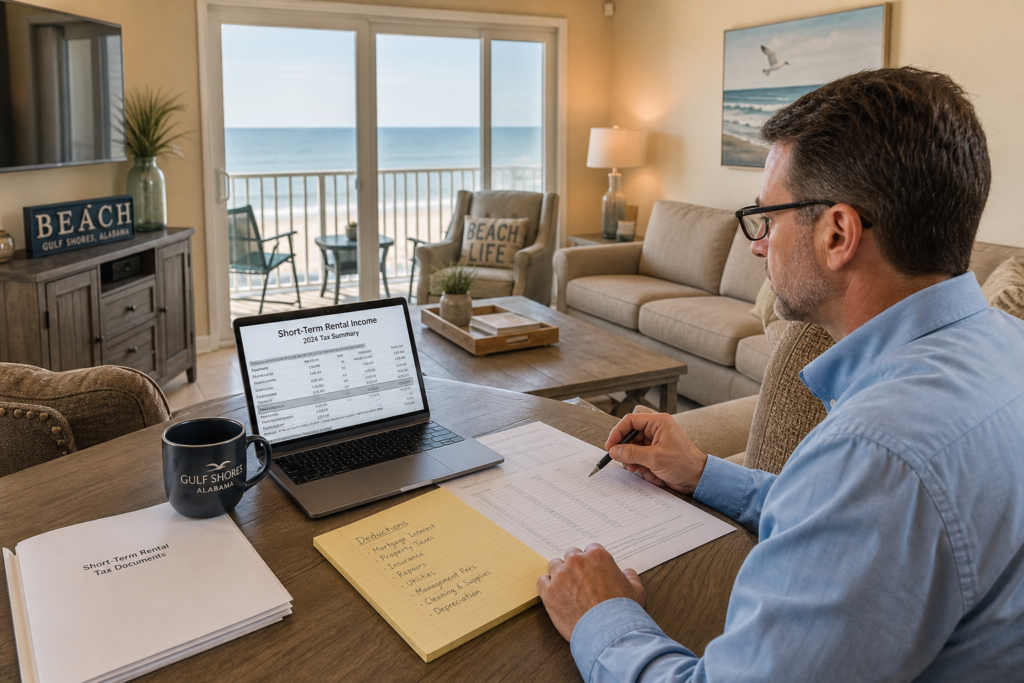
Gulf Shores Airbnb Taxes (2026 Guide): State, Local & Federal Rules Explained
Understanding gulf shores airbnb taxes starts with one crucial fact: Gulf Shores sits in Baldwin County, Alabama short-term rental tax help, not Florida. As a result, hosts face Alabama lodging taxes, local licenses, and federal income tax rules. This 2026 guide clears up the confusion. Furthermore, it shows you exactly which taxes apply, who collects them, and how to stay compliant.
Table of Contents
- Key Takeaways
- What Taxes Apply to Gulf Shores Airbnbs in 2026?
- Why Is Gulf Shores in Alabama, Not Florida?
- How Much Lodging Tax Do Gulf Shores Hosts Charge?
- Does Airbnb Collect and Remit Taxes for You?
- How Are Gulf Shores Airbnb Profits Taxed Federally?
- How Do You Register and Stay Compliant in 2026?
- Uncle Kam in Action
- Next Steps
- Related Resources
- Frequently Asked Questions
Key Takeaways
- Gulf Shores is in Alabama; Florida tax rules never apply here.
- Rentals under 180 days trigger lodging tax and a required license.
- Airbnb collects some taxes; however, hosts still remit certain local taxes.
- Federal income tax rules depend on your average guest stay length.
- Proactive 2026 planning protects deductions and prevents costly penalties.
What Taxes Apply to Gulf Shores Airbnbs in 2026?
Quick Answer: Gulf Shores Airbnb hosts face three tax layers in 2026. These include Alabama lodging taxes, local licenses, and federal income tax on profits.
Successfully managing gulf shores airbnb taxes means understanding a stacked system. Each layer has its own rules, rates, and filing schedule. Moreover, missing any one layer creates compliance risk. Therefore, smart hosts map all three before their first booking.
First, transient occupancy taxes apply to short stays. Second, the City of Gulf Shores requires a business license and rental registration. Third, the IRS taxes your net rental income. As a result, real estate investors must plan for both transaction taxes and income taxes.
The Three Tax Layers at a Glance
Here is a clear breakdown of who charges what. Consequently, you can see exactly where each dollar goes.
| Tax Type | Level | Who Collects |
|---|---|---|
| Lodging (Transient) Tax | State + County + City | Guest pays; host or Airbnb remits |
| Business License | City of Gulf Shores | Host registers directly |
| Federal Income Tax | Federal (IRS) | Host reports on tax return |
Why the 180-Day Rule Matters
Alabama treats rentals under 180 continuous days as transient. Consequently, lodging tax applies to these short stays. In contrast, leases of 180 days or longer avoid lodging tax entirely. Therefore, most Airbnb and Vrbo bookings clearly fall into the taxable category. According to the Alabama Department of Revenue lodgings tax rules, this threshold defines your obligation. Working with a Tax Preparation Near Me in Alabama specialist keeps you on the right side of this line.
Pro Tip: Track every guest’s stay length. This documentation proves which rentals qualified as transient for 2026.
Why Is Gulf Shores in Alabama, Not Florida?
Quick Answer: Gulf Shores sits in Baldwin County, Alabama. Therefore, Florida taxes and Florida county rules never apply to your rental.
Many online guides confuse Gulf Shores with Florida beach markets. However, this mistake creates serious compliance errors. Gulf Shores lies on Alabama’s Gulf Coast, near Orange Beach and Fort Morgan. As a result, you follow Alabama and Baldwin County rules exclusively.
This distinction affects everything. For example, Alabama has no Florida-style “tourist development tax.” Instead, Alabama uses a state lodgings tax plus local add-ons. Furthermore, registration happens through Alabama’s My Alabama Taxes portal, not any Florida system.
Common Jurisdiction Mistakes to Avoid
Out-of-state investors often copy Florida checklists. Nevertheless, this approach fails for Gulf Shores. Here are the most frequent errors.
- Registering for the wrong state’s tax portal entirely.
- Applying Florida county “bed tax” rates by mistake.
- Ignoring the City of Gulf Shores business license rule.
- Missing Baldwin County’s specific lodging tax jurisdiction.
Serious real estate investor tax strategies depend on getting the jurisdiction right. Otherwise, you file the wrong forms and face penalties. The official City of Gulf Shores government website confirms all local requirements.
Did You Know? Alabama’s Gulf Coast lodging tax rate differs from inland Alabama. The Gulf region carries a higher state rate.
How Much Lodging Tax Do Gulf Shores Hosts Charge?
Quick Answer: Combined lodging taxes in Gulf Shores reach roughly 13% in 2026. This stacks state, county, and city rates together.
Gulf Shores lodging tax combines several layers. First, Alabama charges a state lodgings tax on Gulf Coast counties. Next, Baldwin County adds its own rate. Finally, the City of Gulf Shores applies a municipal lodging tax. As a result, your guests pay a blended rate near 13% on 2026 bookings.
These rates change occasionally. Therefore, always confirm current 2026 percentages with each taxing authority. Rates can also differ inside city limits versus unincorporated Baldwin County. Consequently, your exact rate depends on your property’s precise location.
Sample Lodging Tax Calculation
Let’s walk through a real 2026 example. Assume a guest books five nights at $250 per night. The taxable room charge equals $1,250 before taxes.
| Line Item | Amount (2026) |
|---|---|
| Room charge (5 nights x $250) | $1,250.00 |
| Lodging tax (approx. 13%) | $162.50 |
| Total guest pays | $1,412.50 |
The lodging tax is not your income. Instead, you collect it and remit it to authorities. Therefore, never treat that $162.50 as profit. Smart short-term rental tax planning keeps these funds separate from your operating cash.
Filing Frequency and Deadlines
Alabama generally requires monthly lodging tax filings. However, low-volume hosts may qualify for quarterly returns. Regardless, most Gulf Shores hosts file monthly through the state portal. As a result, you should build a recurring filing routine into your calendar.
Pro Tip: File even zero-revenue months if required. Skipping filings can trigger penalties and account holds.
Does Airbnb Collect and Remit Taxes for You?
Quick Answer: Airbnb often collects state and some local taxes automatically. However, hosts may still owe certain city taxes directly.
Airbnb has agreements to collect some Alabama lodging taxes. Consequently, the platform adds tax to guest checkout and remits it. Nevertheless, this coverage is not always complete. In many cases, city-level taxes still require direct host remittance.
Furthermore, Vrbo and direct bookings may follow different rules. Therefore, you cannot assume every platform handles everything. As a result, you must verify exactly which taxes each platform collects for your property.
Platform-Collected vs Host-Remitted Taxes
This table shows the typical split. However, always confirm your specific situation. The Airbnb tax collection help center lists current jurisdictions.
| Tax | Often Airbnb-Collected | Often Host-Remitted |
|---|---|---|
| Alabama state lodgings tax | Yes | Sometimes |
| Baldwin County lodging tax | Varies | Often |
| City of Gulf Shores tax | Sometimes | Often |
Why You Still Need to Register
Even when Airbnb remits taxes, registration still matters. First, the city requires a business license regardless of platform. Second, you may still file returns showing zero direct liability. Therefore, platform collection does not eliminate your registration duties. Consequently, treat Airbnb collection as help, not a complete solution.
Did You Know? Double-remitting is common when hosts panic. Verify platform coverage first to avoid paying twice.
How Are Gulf Shores Airbnb Profits Taxed Federally?
 Free Tax Write-Off Finder
Quick Answer: The IRS taxes your net rental profit. Your reporting form depends on average guest stay length and services provided.
Lodging taxes are separate from federal income tax. On your federal return, you report rental income minus deductible expenses. However, the correct form depends on how you operate. As a result, short-term rental hosts must understand the average-stay rules.
Generally, hosts report rental income on IRS Schedule E. However, if the average stay is seven days or fewer, different rules apply. In that case, the activity may look like a business rather than passive rental. Consequently, self-employment tax could enter the picture.
The 14-Day and 7-Day Rules Explained
Two federal thresholds matter most for Airbnb hosts. First, the 14-day personal-use rule affects mixed-use properties. Second, the 7-day average-stay test affects your reporting form.
- Rent under 15 days yearly: income may be tax-free.
- Average stay under 7 days: often treated as a business.
- Substantial services provided: Schedule C may apply.
The IRS rules on renting residential property explain these thresholds. Furthermore, self-employed contractor tax guidance helps hosts who cross into business territory. Business owners should also review tax planning for business owners when scaling multiple units.
Powerful Deductions and Depreciation
Airbnb hosts unlock major deductions. For example, you can deduct cleaning, supplies, insurance, and mortgage interest. Additionally, depreciation shelters income powerfully. Under 2026 rules, 100% bonus depreciation applies to qualifying property placed in service. Therefore, cost segregation studies can produce large first-year deductions. Consult a business entity structuring specialist before choosing an LLC or S corp.
Pro Tip: The short-term rental “loophole” can offset W-2 income. Material participation is the key requirement.
How Do You Register and Stay Compliant in 2026?
Quick Answer: Register for state lodging tax, obtain a city business license, and file returns on time. Then track income for federal reporting.
Compliance follows a clear sequence. First, confirm your property qualifies as a short-term rental. Next, register with the state. Then, secure your city license. Finally, set up recurring tax filings. As a result, you avoid penalties and stay audit-ready.
Your First-Week Compliance Checklist
Complete these steps before your first guest checks in. Consequently, you launch fully compliant.
- Register for lodging tax via My Alabama Taxes portal.
- Apply for a City of Gulf Shores business license.
- Obtain any required short-term rental registration.
- Set up a separate bank account for tax funds.
- Confirm which taxes Airbnb collects for your listing.
Ongoing Monthly Compliance Tasks
Compliance never stops after launch. Instead, you maintain routines every month. Furthermore, good records simplify your federal return each spring. The SBA small business tax guide reinforces these habits.
- File and remit lodging taxes by the deadline.
- Log all income, fees, and deductible expenses.
- Renew your business license annually as required.
- Pay quarterly federal estimated taxes if needed.
High earners with multiple properties benefit from advanced planning. Therefore, high-net-worth tax strategies often involve multi-entity structures. Before you reach the Next Steps below, remember that professional Alabama tax preparation services keep every layer coordinated and compliant.
Pro Tip: This information is current as of 8/3/2026. Verify rates with Alabama and Gulf Shores authorities before filing.

Uncle Kam in Action: How a Gulf Shores Host Saved $34,000
Client Snapshot: Meet Danielle, an out-of-state real estate investor from Texas. She purchased a beachfront condo in Gulf Shores as her first short-term rental.
Financial Profile: Danielle earned $180,000 from her W-2 job in 2026. Additionally, her Gulf Shores condo generated $95,000 in gross rental revenue.
The Challenge: Danielle nearly registered for Florida taxes by mistake. Furthermore, she had no plan for depreciation or lodging tax remittance. As a result, she risked double-paying taxes and missing major deductions. She also worried about self-employment tax exposure.
The Uncle Kam Solution: First, our team corrected her jurisdiction and registered her properly in Alabama. Next, we confirmed which taxes Airbnb collected automatically. Then, we structured her filings to avoid double remittance. Most importantly, we ordered a cost segregation study. Consequently, she qualified for 100% bonus depreciation on eligible property placed in service during 2026.
Because her average guest stay was under seven days, she materially participated. Therefore, the short-term rental losses offset her W-2 income directly. This strategy produced a substantial paper loss without hurting cash flow.
The Results: Danielle saved $34,000 in federal taxes for 2026. Moreover, she avoided an estimated $4,200 in duplicate lodging tax remittances. Her investment with Uncle Kam totaled $6,500 for planning and the cost segregation coordination.
Return on Investment: Her combined $38,200 benefit against a $6,500 fee delivered a first-year ROI near 5.9x. See more verified outcomes on our client tax savings results page.
Next Steps
- Confirm your Gulf Shores property jurisdiction is Alabama, not Florida.
- Register for lodging tax and your city business license.
- Verify which taxes Airbnb collects for your listing.
- Book a review with our short-term rental tax advisory team.
- Explore depreciation and entity options before year-end 2026.
Related Resources
- Real Estate Investor Tax Services
- Tax Prep and Filing Services
- Uncle Kam Tax Strategy Blog
- Business Bookkeeping Solutions
Frequently Asked Questions
Does Airbnb collect all my taxes in Gulf Shores?
No, Airbnb often collects state lodging tax automatically. However, city and county taxes may still require direct host remittance. Therefore, always verify your specific jurisdiction coverage first.
Do I need a business license for my Gulf Shores Airbnb?
Yes, the City of Gulf Shores requires a business license. Furthermore, short-term rentals need proper registration. This applies even when Airbnb remits your lodging taxes.
What if I only rent a few days per year?
The federal 14-day rule may apply. If you rent under 15 days yearly, that income can be tax-free. However, lodging tax rules may still apply to short stays.
How do I report Airbnb income on my federal return?
Most hosts use Schedule E for rental income. However, average stays under seven days with substantial services may require Schedule C. Consequently, your form depends on how you operate.
What happens if I did not collect taxes in prior years?
You may owe back taxes plus penalties and interest. Nevertheless, voluntary disclosure often reduces penalties. Therefore, address gaps quickly with a qualified tax professional.
Can short-term rental losses offset my W-2 income in 2026?
Yes, in some cases. If your average stay is under seven days and you materially participate, losses may offset W-2 income. Furthermore, bonus depreciation can amplify those losses.
This information is current as of 8/3/2026. Tax laws change frequently. Verify updates with the IRS, Alabama Department of Revenue, or the City of Gulf Shores if reading this later. This article is educational and not legal or tax advice.
Last updated: August, 2026

