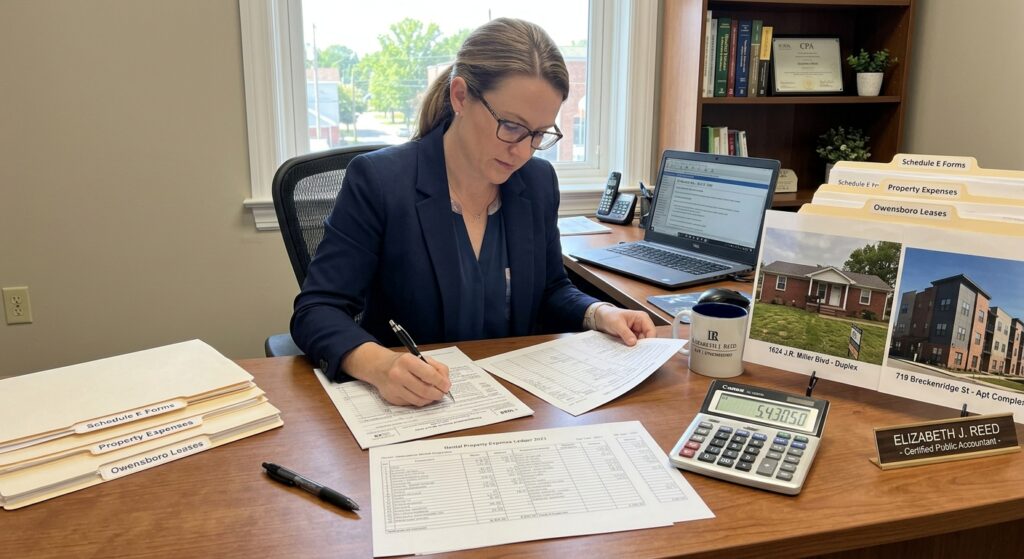
Complete Guide to Schedule E for Rental Income: 2026 Tax Filing Help for Owensboro Property Investors
For Owensboro property investors, understanding Schedule E rental income reporting is essential for maximizing tax deductions and avoiding costly mistakes. Whether you own single-family homes, multi-unit properties, or participate in real estate partnerships, this comprehensive 2026 guide covers everything you need to know about Schedule E filing, deductible expenses, depreciation strategies, and tax optimization techniques.
Table of Contents
- Key Takeaways
- What Is Schedule E and Who Must File It?
- How Do You Report Rental Income on Schedule E?
- What Rental Expenses Can You Deduct on Schedule E?
- How Does Depreciation Work on Schedule E?
- What Business Structure Works Best for Your Rental Properties?
- Understanding Passive Activity Loss Rules on Schedule E
- Uncle Kam in Action
- Next Steps
- Frequently Asked Questions
Key Takeaways
- Schedule E is the IRS form for reporting rental property income and expenses for 2026.
- Deductible expenses include mortgage interest, property taxes, insurance, maintenance, and utilities.
- Depreciation deductions can reduce taxable income significantly for real estate investors.
- Passive activity loss limitations may restrict deductions if your adjusted gross income exceeds thresholds.
- Proper documentation and record-keeping are critical to surviving an IRS audit.
What Is Schedule E and Who Must File It?
Quick Answer: Schedule E is an IRS form used to report supplemental income and loss from rental properties, partnerships, S corporations, estates, and trusts. For 2026, any property owner earning rental income must file Schedule E.
Schedule E serves as the primary vehicle for real estate investors to document rental income and claim allowable deductions. When you own rental property in Owensboro or elsewhere, the IRS requires detailed reporting of every dollar earned and every expense incurred. This form connects directly to your Form 1040 individual income tax return, making it a critical component of your annual filing.
The 2026 Schedule E filing requirements apply to anyone who receives rental income from real property, including single-family homes, apartment buildings, vacation rentals, commercial properties, and land. If you own property with a spouse, you’ll typically file Schedule E together on your joint return. Multiple properties can be reported on a single Schedule E form, or you can use additional schedules if you have more than three properties.
Who Must File Schedule E in 2026?
- Individual rental property owners earning any amount of rental income
- Partners in rental real estate partnerships receiving K-1 forms
- S corporation shareholders reporting rental property income
- Estate and trust beneficiaries with rental property income
- Real estate professionals with substantial rental activity
Schedule E for Owensboro Investors: Local Considerations
Owensboro property investors benefit from understanding Kentucky-specific tax rules alongside federal Schedule E requirements. The Kentucky Department of Revenue closely coordinates with IRS reporting standards, meaning your federal Schedule E filing directly affects your state return. Kentucky recognizes the same depreciation schedules and expense categories as the federal government for 2026, streamlining the reporting process for Owensboro-area investors.
Pro Tip: Keep separate bank accounts for each rental property or use detailed accounting software. This simplifies Schedule E preparation and strengthens your position if audited by the IRS.
How Do You Report Rental Income on Schedule E?
Quick Answer: Report all rental income received on Schedule E Part I, including rent payments, security deposits applied as income, and advance rent payments. Income must be reported in the year received, regardless of when the tenant pays.
For 2026, rental income reporting on Schedule E requires documenting every revenue source associated with your property. This includes monthly rent payments, but also extends to other income often overlooked by new investors. The IRS requires detailed income reporting to prevent underreporting and ensure consistent documentation across your tax return.
Types of Rental Income to Report on Schedule E
- Monthly rent payments from tenants
- Security deposits applied toward unpaid rent (taxable income)
- Advance rental payments received in 2026
- Parking fees, storage rental, or utility reimbursements
- Late fees or penalties paid by tenants
- Income from furnished property rentals (short-term or vacation rentals)
- Lease cancellation fees
Recording Income: Cash Basis vs. Accrual Basis
Most individual rental property owners use the cash basis method for Schedule E reporting. Under this approach, you report income in the year you actually receive payment, not when it’s earned. This provides flexibility but requires careful tracking of payment dates. If you receive rent on January 5, 2027 for December 2026 occupancy, the income is reported on your 2027 Schedule E, not 2026.
The accrual basis method, used primarily by larger operations, requires reporting income when earned regardless of when payment is received. For Owensboro investors with multiple properties, the cash basis method often simplifies compliance while maintaining full transparency with the IRS.
| Income Type | Taxable? | When to Report |
|---|---|---|
| Regular monthly rent | Yes | Year received |
| Security deposits (held intact) | No | Never (not income) |
| Security deposits (applied to rent) | Yes | Year applied |
| Tenant damage payments | Yes | Year received |
| Late fees or penalties | Yes | Year received |
What Rental Expenses Can You Deduct on Schedule E?
Quick Answer: Deductible rental expenses include mortgage interest, property taxes, insurance, utilities, maintenance, repairs, depreciation, and management fees. These expenses reduce your taxable rental income dollar-for-dollar for 2026.
The foundation of successful Schedule E filing involves understanding which expenses reduce your taxable rental income. The IRS allows deductions for ordinary and necessary expenses incurred while maintaining and operating rental property. An expense qualifies if it’s essential to generating rental income and represents a typical cost for property owners in your situation.
Categories of Fully Deductible Schedule E Expenses
- Mortgage Interest: Only the interest portion of mortgage payments qualifies, not principal. Use Form 1098 to verify amounts.
- Property Taxes: State and local taxes on rental real estate are fully deductible without limitation.
- Insurance Premiums: Landlord liability, property damage, and fire insurance policies are deductible.
- Utilities: Gas, electric, water, sewer, and trash services you pay are deductible if not reimbursed by tenants.
- Maintenance and Repairs: Regular upkeep like painting, landscaping, and HVAC service maintenance.
- Property Management Fees: Cost of third-party property managers or management companies.
- Advertising Costs: Online listings, signs, and advertising to find tenants.
- Homeowners Association Fees: HOA assessments for condominiums or common-area properties.
- Professional Fees: Accounting, tax preparation, and legal consultation for rental property matters.
Common Expenses You Cannot Deduct
Several expenses that seem rental-related actually don’t qualify for Schedule E deductions in 2026. Understanding these prohibitions prevents audit risk and ensures compliance. Mortgage principal payments, for instance, reduce equity but don’t appear as deductions—only interest qualifies. Similarly, personal expenses, capital improvements (except through depreciation), and expenses you’re reimbursed for by tenants cannot be claimed.
Pro Tip: Create a detailed spreadsheet tracking each expense category separately. This documentation becomes invaluable if the IRS questions your deductions. Categories like repairs vs. improvements must be clearly distinguished.
How Does Depreciation Work on Schedule E?
 Free Tax Write-Off Finder
Quick Answer: Depreciation allows you to deduct the cost of buildings and improvements over time. For 2026, residential properties depreciate over 27.5 years, creating substantial annual deductions without cash outlay.
Depreciation represents one of the most powerful deductions available to rental property owners on Schedule E. Unlike other business expenses that require actual cash payment, depreciation is a non-cash deduction reflecting the theoretical decline in asset value over time. For Owensboro investors, understanding depreciation mechanics is essential to maximizing 2026 tax savings.
Calculating Residential Property Depreciation
The IRS requires separating depreciable property from land. Land never depreciates because it’s considered to have unlimited useful life. The building structure and improvements, however, depreciate over 27.5 years for residential properties in 2026. This means dividing the building cost (excluding land value) by 27.5 to determine annual depreciation.
Example: You purchase a Owensboro rental home for $300,000. The property assessment shows 80% attributed to the building and 20% to land. Your depreciable basis is $240,000 ($300,000 × 80%). Annual depreciation deduction equals $8,727 ($240,000 ÷ 27.5 years). This deduction reduces your taxable income on Schedule E without requiring any cash payment.
Components of Residential Property Depreciation
- Building Structure: 27.5-year depreciation for residential properties
- Appliances: 5-year depreciation (stove, refrigerator, dishwasher)
- Flooring: Varies; carpeting often 5-7 years, tile and hardwood longer
- Fixtures and Improvements: HVAC systems, roofing, and plumbing have varying rates
- Personal Property: Furniture in furnished properties depreciates faster (3-7 years)
Cost segregation studies offer an advanced strategy for Owensboro investors with higher-value properties. These studies accelerate depreciation by identifying shorter-life property components eligible for faster write-offs, potentially increasing 2026 deductions significantly. Real estate professionals often recommend cost segregation analysis for investment properties exceeding $500,000 in value.
Pro Tip: The Section 179 expensing option allows immediate deduction of certain property improvements, accelerating deductions beyond standard depreciation. Consult a tax professional about whether your improvements qualify for 2026.
What Business Structure Works Best for Your Rental Properties?
Quick Answer: For 2026, Schedule E is most common for individuals, but S Corporations or LLCs taxed as partnerships offer greater deduction flexibility. Your optimal structure depends on income level, number of properties, and liability concerns.
The business structure housing your rental properties fundamentally impacts Schedule E filing and tax liability. While most individual investors file Schedule E directly on their personal 1040 returns, alternative structures offer advantages. Our LLC vs S-Corp Tax Calculator for Financial District, New York investors demonstrates how structure selection affects bottom-line tax savings, though strategies differ for real estate specifically.
Sole Proprietorship (Individual Schedule E Filing)
The simplest structure for Owensboro property owners, individual sole proprietorship reports rental income and expenses directly on Schedule E attached to Form 1040. This approach involves no separate tax entity, no annual filings, and minimal administrative burden. For investors with one or two rental properties earning modest income, Schedule E filing as an individual provides tax-efficient, straightforward reporting.
LLC or Partnership Structures
A limited liability company provides liability protection while allowing flexible taxation. An LLC taxed as a partnership files Form 1065 and issues K-1 statements to owners, who then report their share on Schedule E. This structure offers self-employment tax planning opportunities and additional liability protection compared to individual ownership.
For Owensboro investors with multiple properties or significant rental income exceeding $100,000 annually, LLC or partnership structures often reduce overall tax liability while protecting personal assets from landlord liability claims.
Understanding Passive Activity Loss Rules on Schedule E
Quick Answer: Passive activity rules limit Schedule E deductions if losses exceed $25,000 annually and your modified adjusted gross income exceeds $100,000 for 2026. Real estate professionals with active material participation may avoid these limitations.
The passive activity loss limitation rules, established by the Tax Reform Act of 1986, restrict the ability to use real estate losses against other income sources. For Owensboro investors reporting rental property losses on Schedule E, these rules potentially cap deductible losses in 2026, creating situations where you have negative taxable income on Schedule E but cannot use those losses against salary or business income.
The $25,000 Rental Real Estate Exception
If your modified adjusted gross income is below $100,000 in 2026, you can deduct up to $25,000 in Schedule E rental losses against other income, provided you actively participate in property management decisions. This exception applies to Owensboro property owners who make operational choices, approve tenant selections, or determine rent amounts, even without full-time involvement.
The exception phases out 50 cents per dollar of income exceeding $100,000 through $150,000. Above $150,000 modified adjusted gross income, no losses qualify for the exception unless you’re a real estate professional.
Real Estate Professional Status for 2026
Real estate professionals enjoy unrestricted passive activity deductions on Schedule E without income limitations. To qualify for 2026, you must work more than 750 hours in real estate activities and have real estate represent more than 50% of your business hours. Owensboro investors who actively manage multiple properties, renovate properties, or engage in development activities may qualify for real estate professional status, unlocking significant additional deductions.
Pro Tip: Track your time spent on rental property activities meticulously. Hours spent property hunting, managing maintenance, and handling tenant issues count toward the 750-hour threshold for real estate professional status. Proper documentation is essential for IRS substantiation.

Uncle Kam in Action: How One Owensboro Property Manager Saved $18,400 in Taxes
The Client: Sarah, an Owensboro-based property manager overseeing three rental homes generating approximately $125,000 in annual rental income. She had been filing Schedule E individually, reporting only basic expenses like property taxes and insurance—missing substantial deductible categories entirely.
The Challenge: Sarah’s Schedule E showed taxable rental income of $65,000 after basic deductions. However, she was missing critical deductions for maintenance and repairs ($8,400 annually), professional accounting fees ($2,500), advertising and vacancy costs ($4,200), and depreciation ($12,000 annually). Her overall approach lacked strategic organization and failed to capitalize on available deductions, resulting in excessive tax liability on her 2025 return.
The Uncle Kam Solution: We conducted a comprehensive Schedule E review, categorizing every potential deduction across her three properties. We established separate accounting for each property, implemented a depreciation study identifying property components eligible for accelerated depreciation, and restructured her rental activity as an LLC taxed as a partnership for 2026. This structure provided additional self-employment tax flexibility while preserving rental loss deductions within passive activity rules.
The Results: Sarah’s 2026 Schedule E showed taxable rental income of only $35,900—a reduction of $29,100 in taxable income. At her marginal tax rate, this resulted in federal income tax savings of $7,312. The LLC structure eliminated approximately $2,644 in self-employment taxes, and Kentucky state tax savings added $8,444, for a total first-year tax reduction of $18,400. The implementation cost of $1,200 represented a 15:1 return on investment in the first year alone.
Sarah’s experience demonstrates why professional guidance on Schedule E preparation proves invaluable. Our client results showcase similar transformations for real estate investors across the country. What seemed like complex tax planning actually boiled down to understanding which deductions applied to her specific situation and properly documenting them on Schedule E.
Next Steps
Now that you understand Schedule E fundamentals, take these concrete actions before year-end 2026 to maximize your rental property deductions. We’re here to help Owensboro property investors optimize their Owensboro tax preparation strategy throughout the year, not just at filing time.
- Conduct a Schedule E Audit: Review 2025 Schedule E and identify missed deductions using our comprehensive expense checklist. Many investors discover overlooked deductions worth thousands annually.
- Implement Proper Record-Keeping: Set up separate bank accounts for each property or use accounting software like QuickBooks to track income and expenses by category automatically.
- Evaluate Your Business Structure: Determine whether your current rental structure maximizes deductions and provides adequate liability protection. Schedule E filing as an individual works for some investors; others benefit from LLC or partnership structures.
- Document Property Components: Have a cost segregation specialist identify building components eligible for accelerated depreciation. This investment often pays for itself in the first year through enhanced deductions.
- Schedule a Tax Planning Consultation: Work with a tax strategy professional to integrate your Schedule E deductions with your overall tax situation, ensuring maximum benefit from real estate losses while managing passive activity limitations.
Frequently Asked Questions
Can I deduct my mortgage principal payments on Schedule E?
No. Schedule E allows deductions only for the interest portion of mortgage payments. Principal payments reduce your equity in the property but don’t qualify as deductible expenses. To determine the deductible interest amount, reference IRS Publication 527, which explains proper rental property accounting.
What happens to depreciation I’ve claimed when I sell the property?
Depreciation recapture is significant tax planning consideration. When you sell a rental property, the IRS taxes previously claimed depreciation at 25% (in addition to capital gains tax on appreciation). For Owensboro investors, this recapture tax is substantial. If you claimed $108,000 in depreciation over nine years and sell the property, $27,000 in recapture taxes apply at the 25% rate, in addition to federal income tax on any capital gain. Strategic planning around depreciation and sale timing is critical.
Do I need to file Schedule E if my rental property generated a loss?
Yes, absolutely. You must file Schedule E even if your property generates a loss after deductions. Reporting losses demonstrates good faith effort to operate the property as a legitimate business endeavor. For 2026, rental losses provide valuable deductions within passive activity loss limitations, making Schedule E filing beneficial even when you don’t owe tax on the property itself.
How do I handle Schedule E when my property generates mixed-use income?
Mixed-use properties present complexity. If you rent part of the property to tenants and live in another part, you allocate expenses proportionally. Only the rental portion qualifies for Schedule E deductions. Document the allocation carefully: if 60% of your duplex is rented and 40% is your primary residence, claim 60% of property taxes, utilities, insurance, and depreciation on Schedule E, with the remainder going to your personal return.
Can I deduct improvements to my rental property on Schedule E?
Capital improvements don’t qualify as immediate Schedule E deductions; they must be depreciated over appropriate useful lives. Replacing an entire roof or adding a new room are capital improvements depreciable over 27.5 years for residential properties. Repairs maintaining property condition, like fixing a leaky roof or repainting, are immediately deductible on Schedule E. The distinction determines whether expenses reduce 2026 taxable income immediately or over decades.
What documentation do I need to support Schedule E deductions?
The IRS requires comprehensive documentation supporting every Schedule E deduction. Maintain records including receipts for repairs and maintenance, insurance policy statements showing property and coverage dates, property tax assessment notices, mortgage statements for 2026, utility bills, and property management agreements. Digital documentation through bank statements and credit card records showing property-related transactions provides strong audit support. Organize these documents by category: maintenance, utilities, insurance, taxes, and miscellaneous expenses. Without supporting documentation, Schedule E deductions become vulnerable during audits.
How does the Section 179 expensing option work on Schedule E?
Section 179 expensing allows immediate deduction of certain property placed in service during 2026, rather than depreciating over time. For rental properties, Section 179 often applies to personal property like appliances, flooring, and fixtures. The deduction limit for 2026 is $1,160,000 for total property with a $4,600,000 investment cap. For Owensboro investors making capital improvements, Section 179 expensing accelerates deductions, increasing immediate tax savings compared to standard depreciation schedules.
This information is current as of April 20, 2026. Tax laws change frequently. Verify updates with the IRS or a tax professional if reading this later.
Last updated: April, 2026

