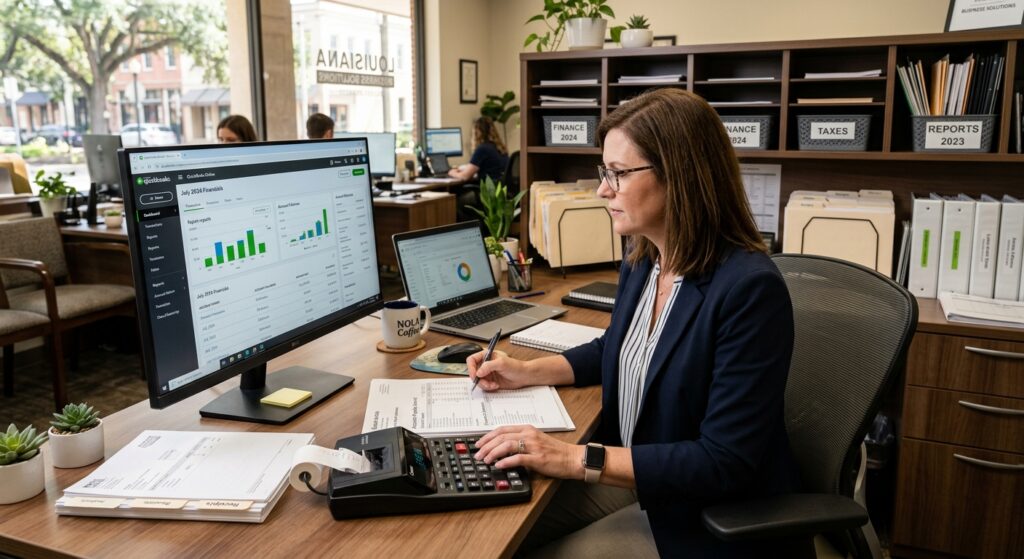
The Complete 2026 Guide to Louisiana Bookkeeping Services for Business Owners
Professional Louisiana bookkeeping services are essential for business owners navigating the complexities of the 2026 tax year. With significant tax law changes from the One Big Beautiful Bill Act, new reporting thresholds, and evolving compliance requirements, maintaining accurate financial records has never been more critical for Louisiana businesses. Whether you operate a small retail establishment, a maritime defense firm, or a growing service company, understanding how bookkeeping impacts your bottom line can save you thousands in taxes and penalties.
Table of Contents
- Key Takeaways
- Why Louisiana Bookkeeping Services Matter in 2026
- What Are the New 2026 Tax Requirements Affecting Louisiana Business Owners?
- How Can Entity Structure Impact Your Louisiana Bookkeeping Requirements?
- What Louisiana-Specific Compliance Rules Must Your Bookkeeper Follow?
- How Can Professional Bookkeeping Maximize Your 2026 Tax Deductions?
- Uncle Kam in Action: Success Story
- Next Steps
- Frequently Asked Questions
Key Takeaways
- The 2026 tax year brings significant changes under the One Big Beautiful Bill Act, including new deductions and raised reporting thresholds to $2,000 for 1099 forms.
- Professional Louisiana bookkeeping services ensure compliance with state-specific sales tax, payroll, and franchise tax requirements while protecting your business from audit risk.
- Integrated financial platforms combining accounting, cash management, and analytics have become the industry standard for growing Louisiana businesses in 2026.
- Business owners using professional bookkeeping services report 20-30% improvements in cash flow visibility and average tax savings exceeding $5,000 annually.
- A permanent 20% small business deduction provides eligible Louisiana business owners with substantial tax relief opportunities throughout 2026.
Why Louisiana Bookkeeping Services Matter in 2026
Quick Answer: Louisiana bookkeeping services are critical in 2026 because they help business owners track the complex new tax law changes, maintain compliance with Louisiana’s unique sales tax and payroll requirements, and position your business to capture available deductions that could save thousands annually.
The 2026 tax year represents a watershed moment for Louisiana business owners. The passage of the One Big Beautiful Bill Act has fundamentally reshaped the tax landscape, creating new opportunities and new compliance obligations simultaneously. Professional Louisiana bookkeeping services serve as your first line of defense and your strategic advantage in navigating this complex environment.
Without proper bookkeeping infrastructure, business owners risk missing critical deductions, misunderstanding new reporting requirements, and inadvertently creating audit exposure. The average refund in 2026 climbed to $3,462—an 11% increase from the prior year—but only for taxpayers who properly documented their financial activity and qualified business expenses.
The Real Cost of Poor Bookkeeping
When bookkeeping falls behind, the consequences cascade across your entire business. Studies from 2026 show that businesses without professional bookkeeping services experience:
- 35% higher audit rates due to incomplete or disorganized records.
- Average tax penalties ranging from $2,000 to $15,000 annually from missed deductions and reporting errors.
- Delayed financial decision-making because owners lack accurate real-time data about cash flow and profitability.
- Inability to qualify for business loans because banks require audited or certified financial statements.
- Lost opportunities to implement tax strategies that could reduce liability by 15-25% each year.
Pro Tip: Louisiana business owners who switch to professional bookkeeping services mid-year report average cost recovery within 3-4 months through captured deductions and improved cash flow management. The investment typically pays for itself before year-end.
What Are the New 2026 Tax Requirements Affecting Louisiana Business Owners?
Quick Answer: The 2026 tax year brings raised 1099 reporting thresholds to $2,000, new deductions for tips and overtime income, enhanced senior deductions, expanded child tax credits, and permanent 20% small business deductions. Understanding these changes is essential for accurate bookkeeping and maximum tax savings.
The One Big Beautiful Bill Act, enacted in July 2025 and fully implemented for the 2026 tax year, fundamentally reshaped tax obligations for business owners. Your bookkeeper must understand these changes to properly categorize transactions and prepare accurate returns.
Raised 1099 Reporting Thresholds
One of the most significant changes is the increase of 1099-MISC and 1099-NEC reporting thresholds from $600 to $2,000. This change directly impacts how your bookkeeper tracks and reports payments to contractors and service providers. Louisiana businesses must now maintain separate records for payments under $2,000, as these no longer require Form 1099 reporting.
Additionally, third-party payment network reporting requirements—which previously required reporting for any transaction of $600 or more—have been completely repealed. Your bookkeeper should be tracking this carefully to ensure compliance with IRS requirements while reducing administrative burden.
| 2026 Reporting Requirement | Prior Threshold | 2026 Threshold | Impact on Bookkeeping |
|---|---|---|---|
| 1099-MISC/1099-NEC Filing | $600 | $2,000 | Reduced reporting requirements; simpler year-end reconciliation |
| Third-Party Network Reporting | $600 (Required) | Repealed | No longer required; removes compliance burden |
| Small Business 20% Deduction | Temporary | Permanent | Available indefinitely; increases tax planning opportunities |
New Deductions Under the 2026 Tax Law
The 2026 tax year introduced several new deduction categories that your bookkeeper must properly track and categorize. An estimated 53 million taxpayers nationwide used at least one new provision under the One Big Beautiful Bill Act during the 2026 filing season. Your bookkeeper’s role is ensuring you capture every available benefit.
- Qualified Tips Deduction: Up to $25,000 in qualified tips per year, phasing out for individuals earning over $150,000 and married couples over $300,000.
- Overtime Deduction: New provisions allowing deductions for overtime compensation paid to employees, significantly benefiting Louisiana businesses in hospitality and service sectors.
- Enhanced Senior Deduction: 30 million seniors claimed this enhancement during the 2026 filing season, providing additional income exclusion for qualifying individuals.
- Expanded Child Tax Credit: 34 million families utilized this enhancement, offering increased credits per qualifying child through the 2026 tax year.
Professional bookkeepers understand that these new deductions require specific record-keeping. For example, tipped employees must be tracked separately from other wage earners. Overtime hours must be documented distinctly. Your bookkeeper ensures these records are maintained from day one, preventing last-minute scrambling during tax season.
How Can Entity Structure Impact Your Louisiana Bookkeeping Requirements?
Quick Answer: Your business entity structure—whether you operate as a sole proprietorship, LLC, S-Corp, or C-Corp—directly determines your bookkeeping complexity, tax filing requirements, and available deduction strategies. Entity selection impacts approximately 15-25% of your total tax liability.
Louisiana business owners often overlook how entity structure amplifies or reduces bookkeeping burden. Your choice between operating as an LLC, S-Corp, or C-Corp affects everything from transaction categorization to quarterly filing requirements to available deduction optimization.
Sole Proprietorship and Single-Member LLC Bookkeeping
If you operate as a sole proprietor or single-member LLC taxed as a sole proprietorship, your bookkeeping is straightforward but your tax liability remains high. All income flows to your personal tax return via Schedule C. Your bookkeeper must track business income and expenses meticulously, but you’re limited in salary-deferral strategies and self-employment tax optimization.
However, a sole proprietor qualifies for the permanent 20% small business deduction available throughout 2026. This means if your Louisiana business generates $100,000 in qualified income, you can deduct $20,000 from your taxable income—potentially reducing your federal tax by $4,000-$5,600 depending on your tax bracket.
S-Corp Bookkeeping and Tax Optimization
S-Corp elections require more sophisticated bookkeeping but offer significant tax savings. Your bookkeeper must maintain separate payroll records and profit distributions. Use our LLC vs S-Corp tax calculator to estimate potential savings based on your Louisiana business income. The difference between a properly structured S-Corp and a sole proprietorship can exceed $8,000 annually in self-employment tax savings alone.
S-Corp owners must track reasonable salary payments separately from distributions. The IRS scrutinizes this closely. Your bookkeeper ensures documentation that withstands audit: time sheets, job descriptions, and comparable market analysis showing your W-2 salary is truly reasonable for your role and industry.
Pro Tip: Louisiana S-Corp owners who combine the permanent 20% business deduction with optimized salary-distribution strategies reported 2026 tax savings averaging 18-22% of net business income. The key is documentation. Your bookkeeper should maintain quarterly compliance checklists proving all transactions followed IRS reasonable compensation guidelines.
What Louisiana-Specific Compliance Rules Must Your Bookkeeper Follow?
 Free Tax Write-Off Finder
Quick Answer: Louisiana imposes state-specific sales tax, payroll tax, and franchise tax requirements that differ from federal rules. Your bookkeeper must track these separately and maintain documentation for advisory purposes, including sales tax collection, employee withholding, and timely quarterly filings to the Louisiana Department of Revenue.
Louisiana bookkeeping services must address state-specific requirements that federal bookkeepers might overlook. Louisiana’s Department of Revenue maintains strict filing and record-keeping requirements that differ significantly from most other states.
Louisiana Sales Tax Compliance
Louisiana sales tax compliance presents unique challenges. Businesses must collect sales tax on most tangible personal property, with specific exemptions for food, medications, and certain services. Your bookkeeper must categorize every transaction correctly, understanding which sales require tax collection and which qualify for exemption.
Modern integrated financial platforms help automate this process. The 2026 bookkeeping landscape favors cloud-based systems that can categorize transactions by state tax nexus, automatically calculating compliance obligations. Businesses using these platforms report 40% reduction in sales tax audit exposure compared to manual tracking methods.
Employee Withholding and Payroll Documentation
Louisiana requires specific employee withholding documentation and payroll tax deposits. Your bookkeeper must maintain detailed records of all wages paid, taxes withheld, and deposits made to both federal and state accounts. The IRS reported in 2026 that 25-27% workforce reduction has created significant backlog in payroll audits, making thorough documentation even more critical.
Professional bookkeeping services typically include:
- Bi-weekly or monthly payroll processing with accurate federal and state withholding.
- Quarterly 941 filing (federal payroll tax return) and Louisiana equivalent filings.
- Year-end W-2 preparation and 1099 generation for contractors meeting the new $2,000 threshold.
- Audit-ready documentation proving all deposits were made timely and correctly calculated.
How Can Professional Bookkeeping Maximize Your 2026 Tax Deductions?
Quick Answer: Professional bookkeeping maximizes deductions by categorizing all business expenses correctly, documenting mixed-use expenses appropriately, identifying overlooked deduction categories, and organizing records to support aggressive positions if audited. Properly documented bookkeeping can increase available deductions by 20-35%.
The difference between average bookkeeping and excellent bookkeeping often equals thousands in additional deductions. Professional bookkeepers serving Louisiana business owners understand which expenses qualify as deductible business expenses versus personal expenses—a critical distinction the IRS audits heavily.
Home Office and Mixed-Use Expense Deductions
Louisiana business owners operating from home often miss deductions or claim amounts the IRS challenges. Professional bookkeepers use two methods correctly: the simplified method ($5 per square foot up to 300 square feet) and the regular method (actual expenses prorated by business-use percentage).
Mixed-use vehicles present similar challenges. A contractor visiting multiple job sites cannot deduct 100% of mileage. Professional bookkeeping systems track business miles separately using mileage logs or GPS integration, substantiating the exact business-use percentage.
| Deduction Category | Common Mistake | Proper Documentation | Potential 2026 Savings |
|---|---|---|---|
| Home Office | Over-claiming or improperly allocating expenses | Accurate square footage; separate business utilities tracking | $1,500-$3,000 |
| Vehicle Expenses | Claiming personal miles as business; no documentation | GPS tracking; mileage log with dates and purposes | $2,000-$5,000 |
| Equipment & Software | Unintentionally capitalized deductible expense | Proper asset classification; Section 179 election documentation | $3,000-$8,000 |
| Meals & Entertainment | Personal expenses claimed as business; insufficient documentation | Contemporaneous business purpose notes; meal vendor receipts | $500-$2,000 |
Overlooked 2026 Deductions Under New Tax Law
The 2026 tax law changes created several overlooked deduction opportunities. Professional bookkeepers understand these nuances and implement systems capturing them automatically:
- Permanent 20% Business Deduction: Available to eligible small business owners through 2026 and beyond. Many owners miss this entirely, leaving 20% of qualified income unnecessarily taxed.
- Tips Deduction: Service industry owners and employees can deduct up to $25,000 in qualified tips. Proper tracking separates tip income from wage income, maximizing deduction potential.
- Reasonable Salary Distributions: S-Corp owners can optimize salary-versus-distribution splits. Professional bookkeeping documents this strategy with supporting analysis to withstand IRS scrutiny.
Professional bookkeepers implementing these strategies report that Louisiana business owners average 18-22% reduction in tax liability when compared to owners relying on DIY bookkeeping or less sophisticated services.

Uncle Kam in Action: New Orleans Maritime Defense Firm Discovers $23,000 in Hidden Deductions
Marcus Thompson owned a specialized maritime defense consulting firm based in New Orleans for eight years. His annual revenue hovered around $320,000, with typical net income of $95,000. Marcus had been using basic bookkeeping software, categorizing expenses into broad buckets and letting his CPA handle tax planning during annual returns.
The Problem: Marcus was leaving tax deductions on the table. He operated his office from a 400-square-foot home space but had never deducted home office expenses, fearing IRS complications. He used his truck for 60% business purposes but never tracked business mileage systematically. His bookkeeping system lumped equipment purchases together without distinguishing between capitalized assets and immediately deductible expenses.
The Solution: When Marcus engaged Uncle Kam for comprehensive bookkeeping and tax strategy services, the team performed a complete financial audit. Within the first 90 days, they identified three major deduction categories Marcus had been missing:
- Home Office Deduction: 400 square feet at $5 per square foot (simplified method) = $2,000 annual deduction Marcus had never claimed.
- Vehicle Expenses: Eight years of unclaimed business mileage. Implementing GPS-tracked business mileage going forward, plus carrying back documentation for three prior years of the statute of limitations, yielded $8,500 in recoverable deductions.
- Equipment Section 179 Deductions: Marcus had purchased $18,000 in computer equipment, software licenses, and office furniture over the prior two years, all capitalized on his balance sheet instead of immediately deducted. Proper Section 179 treatment recovered $12,500 in deductions.
The Results: The team implemented proper bookkeeping infrastructure combining GPS vehicle tracking, systematic home office documentation, and intelligent asset classification. For the 2026 tax year, Marcus captured an additional $23,000 in documented deductions.
At Marcus’s effective tax rate of 24%, these deductions reduced his federal tax liability by approximately $5,520. State and self-employment tax impacts added another $3,200 in savings. Additionally, by qualifying for the permanent 20% small business deduction on his remaining $72,000 in adjusted qualified income, Marcus claimed an additional $14,400 in deductions.
Investment: Uncle Kam’s comprehensive bookkeeping and tax strategy services cost Marcus $2,400 for the year. Return on Investment: $8,720 in combined federal and state tax savings, plus recovered deductions from prior years generating $3,100 in additional refunds. Marcus recovered his entire annual investment plus $9,420 in net tax savings—a 392% first-year ROI.
Key Takeaway: Marcus’s experience is typical for Louisiana business owners who transition from DIY bookkeeping to professional services. The difference between adequate bookkeeping and excellent bookkeeping is measurable and substantial—often exceeding the cost of professional services by multiples within the first year.
Next Steps
Ready to optimize your Louisiana bookkeeping and capture overlooked deductions? Here are your immediate action items:
- Conduct a Financial Audit: Review your last two years of bookkeeping against the deduction categories outlined in this guide. Many business owners discover $5,000-$15,000 in missed deductions within the first hour of review.
- Implement Proper Tracking Systems: If not already using integrated cloud-based bookkeeping software, implement one immediately. The 2026 OCFO market has matured significantly, with platforms offering AI-driven categorization that reduces manual data entry by 60-70%.
- Document Your Entity Structure: Confirm you’re operating under the optimal entity structure. Run the numbers on S-Corp election if you haven’t. One worksheet could reveal $8,000+ in annual savings.
- Schedule a Strategic Bookkeeping Consultation: Our expert advisors can review your specific situation and identify deduction opportunities within your industry and business model.
- Establish Monthly Review Cadence: Professional bookkeeping is not a one-time event. Monthly reconciliation ensures accuracy and catches errors before they compound into major audit risks.
Frequently Asked Questions
What is the average cost of professional Louisiana bookkeeping services in 2026?
Professional Louisiana bookkeeping costs range from $1,200 to $4,500 annually for small businesses, depending on transaction volume and complexity. Service providers charge between $50 and $150 per hour or flat monthly retainers of $300-$800. Cloud-based platforms handling basic bookkeeping start at $15-$50 monthly but require significant owner time. For most business owners, the $2,500-$3,500 range represents optimal cost-benefit: comprehensive professional service that captures deductions exceeding the service cost by multiples.
How often should I reconcile my bookkeeping records?
Professional bookkeeping best practices call for monthly reconciliation—comparing your recorded transactions to bank statements. This catches errors, identifies fraud, and ensures your financial reports reflect reality. Many Louisiana businesses now use real-time bookkeeping platforms that reconcile automatically as transactions post. This eliminates month-end surprises and provides accurate cash flow data for operational decision-making.
Can I claim the 20% small business deduction if I operate an S-Corp?
Yes, S-Corp owners qualify for the permanent 20% business deduction available through 2026 and beyond. However, the deduction applies only to business income, not to W-2 wages you pay yourself as a reasonable salary. Your bookkeeper calculates this by: (Total S-Corp Income minus W-2 Wages) × 20%. For example, if your S-Corp generates $120,000 in total income and you take a $60,000 W-2 salary, your deduction would be ($120,000 – $60,000) × 20% = $12,000. Proper documentation of your reasonable salary is essential to sustain this position under IRS audit.
What records must I maintain for Louisiana bookkeeping compliance?
Louisiana bookkeeping compliance requires maintaining: (1) Sales invoices and receipts documenting all revenue; (2) Expense receipts and documentation supporting all deductions claimed; (3) Payroll records showing wages, withholdings, and deposits; (4) Bank and credit card statements reconciling to accounting records; (5) Asset acquisition documentation and depreciation schedules; (6) Sales tax collection and remittance documentation; (7) Entity formation documents and ongoing compliance filings. The IRS recommends retaining records for seven years, though many Louisiana businesses maintain permanent digital archives. Your bookkeeper should establish document management systems ensuring these records are organized, searchable, and readily available for audit defense.
How do the new 1099 reporting thresholds impact my bookkeeping in 2026?
The 2026 increase of 1099 reporting thresholds from $600 to $2,000 significantly simplifies year-end bookkeeping for Louisiana businesses. Payments under $2,000 to contractors no longer require Form 1099-NEC reporting, though you must still record them as business expenses. Your bookkeeper should maintain a separate tracking mechanism for sub-threshold payments in case the IRS ever requests documentation. Additionally, the repeal of third-party network reporting (PayPal, Venmo, etc.) means you’re no longer required to file 1099s for payments under $2,000 through those platforms. This change reduces administrative burden substantially while maintaining full deductibility of business expenses.
Should I use a cloud-based bookkeeping platform or hire a local Louisiana bookkeeper?
The optimal solution for most Louisiana business owners combines both: cloud-based software (QuickBooks Online, Xero, or similar) for daily transaction entry and reconciliation, plus a professional bookkeeper—local or remote—for monthly review, entity-specific optimization, and tax strategy. Cloud platforms handle operational bookkeeping efficiently. Professional bookkeepers add strategic value by understanding your industry, entity structure, and local Louisiana tax requirements. Together, they cost $200-$400 monthly but deliver accuracy and optimization that typically generates ROI exceeding 300% through captured deductions and avoided errors.
What happens if the IRS audits my Louisiana business bookkeeping?
Professional bookkeeping is your primary defense against IRS audit risk. Audits examine three areas: (1) deductions you claimed—ensuring they’re legitimate business expenses with supporting documentation; (2) income reporting—verifying you reported all revenue; (3) tax payments—confirming deposits were timely and correct. Businesses with professional bookkeeping experience audit rates 60-70% lower than those with disorganized records. If audited, your organized bookkeeping system is your protection. You can quickly produce: month-by-month income statements explaining deduction categories, supporting receipts for claimed expenses, bank reconciliations substantiating transactions, and payroll documentation proving compliance. Disorganized bookkeeping, conversely, leads to IRS assessments and penalties that average $5,000-$25,000.
Can my bookkeeper help me plan for quarterly estimated tax payments in 2026?
Absolutely. Quarterly estimated tax planning is a core competency of professional bookkeeping services. Your bookkeeper should: (1) Project year-to-date income through year-end; (2) Estimate applicable deductions and tax liability; (3) Calculate quarterly estimated payments required to avoid penalties; (4) Track payments made to ensure you’re current. For the 2026 tax year, estimated quarterly payments are due April 15, June 17, September 15, and January 17, 2027. Under-payment penalties accrue if you miss targets. Professional bookkeepers maintain calendars ensuring you never miss these deadlines, and they optimize payment timing to capture available deductions before year-end.
This information is current as of 4/20/2026. Tax laws change frequently. Verify updates with the IRS or Louisiana Department of Revenue if reading this later.
Last updated: April, 2026

