
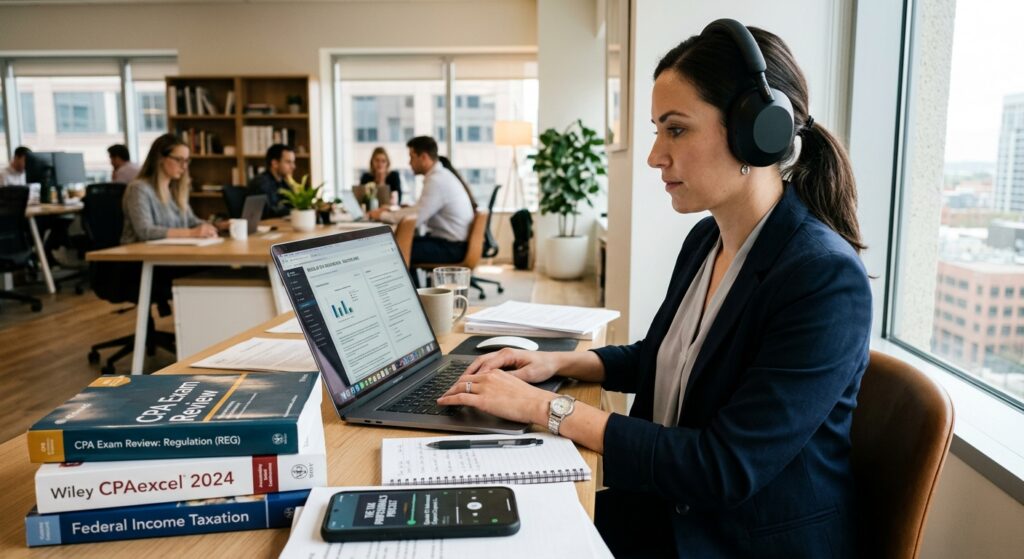
Best Accounting Podcasts for Exam Prep: 2026 Guide
Preparing for accounting certifications in 2026 requires more than textbooks and practice exams. The best accounting podcasts for exam prep offer flexible, expert-driven learning that fits your schedule. As AI reshapes the profession and CPA licensing rules evolve, strategic exam preparation combined with advisory skill development positions tax professionals for long-term success.
Table of Contents
Used by 2,400+ tax professionals
- Key Takeaways
- What Makes the Best Accounting Podcasts for Exam Prep in 2026?
- Why Should Tax Professionals Use Podcasts for Certification Prep?
- What Are the Top Accounting Podcasts for CPA Exam Preparation?
- How Can Enrolled Agents Use Podcasts to Pass the EA Exam?
- What Podcasts Cover AI and Emerging Technologies for Accounting Exams?
- How Do Podcasts Support Ongoing CPE and Professional Development?
- What Are the Common Mistakes When Using Podcasts for Exam Study?
- Uncle Kam in Action: How One EA Passed the Exam While Building an Advisory Practice
- Next Steps
- Frequently Asked Questions
- Related Resources

Key Takeaways
- Podcasts offer flexible exam prep for busy professionals.
- 2026 CPA exams now include AI and technology-focused questions.
- CPA licensing now requires 120 credit hours plus work experience.
- Combining exam prep with advisory training accelerates career growth.
- The best podcasts cover both technical content and practice management strategies.
What Makes the Best Accounting Podcasts for Exam Prep in 2026?
Quick Answer: The best accounting podcasts for exam prep combine technical expertise, current exam coverage, and flexible learning formats. They address 2026 changes including AI integration and updated CPA licensing requirements.
As the accounting profession undergoes rapid transformation in 2026, exam preparation must evolve beyond traditional study methods. The AICPA has confirmed that certification exams now integrate questions on artificial intelligence, data analytics, and emerging technologies. This shift reflects employer expectations: entry-level accountants must demonstrate both technical knowledge and technological proficiency.
The best accounting podcasts for exam prep offer several critical advantages for tax professionals pursuing certifications. First, they provide on-demand learning that fits irregular schedules. Unlike rigid classroom courses, podcasts allow you to study during commutes, workouts, or administrative tasks. Second, they feature expert practitioners who translate complex concepts into practical applications. Third, they update content regularly to reflect current IRS guidance and exam changes.
Core Features of Effective Exam Prep Podcasts
Successful podcasts share common characteristics. They break complex topics into digestible segments, typically 20-45 minutes per episode. They provide structured learning paths that align with exam blueprints. They incorporate real-world examples that demonstrate how concepts apply in practice. Most importantly, they address both the “what” and the “why” behind accounting principles.
In 2026, over 40 states have amended CPA licensing laws to require 120 credit hours plus additional work experience, down from the previous 150-hour requirement. This change, documented by the Minnesota Society of CPAs, creates new opportunities for candidates to enter the profession faster. However, it also increases the importance of supplemental learning resources like podcasts to bridge knowledge gaps.
2026 Exam Changes Require Updated Study Strategies
The Wall Street Journal reports that accounting programs are scrambling to update curricula to prepare students for AI-integrated exams. Universities like Texas Tech now offer faculty innovation grants to encourage professors to incorporate artificial intelligence into lesson plans. This academic shift reflects exam content changes that candidates must understand.
Podcasts specializing in exam preparation have responded by adding episodes on technology topics. These include anomaly detection in audits, generative AI applications in tax planning, and ethical considerations around automated decision-making. The IMA recently launched an AI in Finance Micro-credential that covers similar material, signaling the profession’s direction.
Pro Tip: Choose podcasts that explicitly address 2026 exam changes. Generic content from 2024 or earlier may not cover AI-related questions or updated CPA licensing pathways.
Why Should Tax Professionals Use Podcasts for Certification Prep?
Quick Answer: Podcasts maximize study efficiency by enabling multitasking. You absorb content during otherwise unproductive time, reinforcing concepts through repeated exposure while managing a full client load.
Tax professionals face unique challenges when pursuing certifications. Unlike traditional students, you’re studying while managing client deadlines, continuing education requirements, and practice development. The best accounting podcasts for exam prep solve this time constraint by converting downtime into productive study sessions.
The Science of Audio Learning
Research supports audio learning as an effective retention strategy. When you hear concepts explained by experts, you engage different cognitive pathways than reading alone. The conversational format of podcasts makes complex topics more accessible. Furthermore, you can replay difficult sections multiple times without the stigma of asking an instructor to repeat information.
Audio learning particularly benefits exam preparation because it reinforces memorization through repetition. Many successful candidates report listening to the same episodes multiple times, each iteration strengthening neural pathways associated with the content. This spaced repetition technique aligns with proven study methodologies.
Building Advisory Skills While Studying
The most strategic approach combines certification preparation with tax advisory skill development. While generic exam prep focuses solely on passing tests, forward-thinking professionals seek content that builds both credentials and client service capabilities. Podcasts discussing real-world tax planning strategies serve dual purposes: they illustrate exam concepts while teaching practical advisory techniques.
For example, a podcast episode explaining cost segregation studies helps you understand depreciation rules for the exam. It also demonstrates how to position this high-value service to real estate investor clients. This integrated learning approach accelerates your transition from compliance-focused preparer to strategic advisor, a shift that significantly increases earning potential.
| Study Method | Time Efficiency | Retention Rate | Advisory Skill Building |
|---|---|---|---|
| Traditional Textbooks | Requires dedicated time | Moderate (single exposure) | Limited |
| Video Courses | Requires screen time | High (visual learning) | Moderate |
| Podcasts | Multitasking enabled | High (repetition possible) | High (practitioner insights) |
| Practice Exams | Requires dedicated time | High (application testing) | Limited |
What Are the Top Accounting Podcasts for CPA Exam Preparation?
Quick Answer: Leading CPA exam podcasts include Another71, NINJA CPA Review, and exam-focused episodes from major review providers. However, the best strategy combines technical exam prep with advisory-focused content.
The CPA exam represents the gold standard for accounting credentials. In 2026, the exam continues to evolve, with the AICPA emphasizing higher-order skills like analysis, evaluation, and technology application. This means rote memorization alone no longer guarantees success. You need resources that teach conceptual understanding and practical application.
Exam-Specific Podcast Resources
Another71 Podcast has built a strong following by addressing the emotional and strategic aspects of exam preparation. Episodes cover study scheduling, dealing with failure, and maintaining motivation during long preparation periods. The conversational format normalizes the challenges candidates face, creating a supportive learning community.
NINJA CPA Review offers bite-sized audio content designed for quick review sessions. These micro-lessons target specific exam topics, allowing you to focus on weak areas. The format works particularly well for final review stages when you need rapid reinforcement of previously learned material.
Major review course providers including Becker, Wiley, and Roger CPA Review produce supplemental podcast content. These typically accompany their primary courses and provide additional context, mnemonics, and test-taking strategies. While valuable, they work best as supplements rather than standalone study tools.
Integrating Technical Knowledge with Advisory Skills
The limitation of exam-only content is that it prepares you to pass a test, not necessarily to excel in practice. The most successful tax professionals supplement exam prep with podcasts covering proactive tax strategy and client advisory techniques. This dual approach ensures you’re building a sustainable, profitable practice while earning credentials.
For example, while studying partnership taxation for the REG section, listen to podcasts discussing real-world partnership structures for real estate investors. This contextualizes abstract exam concepts within practical client scenarios, improving both retention and professional competence. You’re not just memorizing pass-through entity rules; you’re understanding how to apply them to save clients money.
Pro Tip: Create themed study weeks where you combine exam content with related advisory topics. Study business entity taxation while listening to episodes on entity structuring strategies for clients.
How Can Enrolled Agents Use Podcasts to Pass the EA Exam?
Quick Answer: EA exam podcasts should focus on tax code updates, IRS procedures, and representation techniques. Combine technical study with content on building a specialized tax practice.
The Enrolled Agent designation authorizes unlimited practice rights before the IRS. The EA exam tests comprehensive tax knowledge across individual, business, and representation practice areas. Unlike the CPA exam’s broader accounting focus, the EA exam dives deep into federal taxation, making it particularly relevant for tax specialists.
EA-Specific Learning Resources
While fewer podcasts target EA preparation specifically, several general tax podcasts provide excellent supplemental content. The IRS itself produces educational content through its Tax Professional portal, including audio summaries of new guidance and regulatory changes. These official resources ensure you’re studying the most current interpretations.
National Association of Tax Professionals (NATP) and National Association of Enrolled Agents (NAEA) both offer member podcasts covering technical topics and practice management. These resources serve double duty: they reinforce exam concepts while providing continuing education credits after you pass.
Understanding 2026 Tax Law Changes
For 2026, EA candidates must understand the One Big Beautiful Bill Act (OBBBA) implications. This legislation raised 1099 reporting thresholds from $600 to $2,000 effective January 1, 2026, as documented in Thomson Reuters analysis. The exam will test knowledge of these updated thresholds and state conformity issues.
Additionally, candidates should understand recent cannabis rescheduling from Schedule I to Schedule III, effective April 22, 2026. The IRS announced forthcoming guidance on federal tax consequences, making this a likely exam topic. Podcasts covering emerging tax issues help you stay ahead of exam content updates.
The AICPA submitted nearly 200 recommendations for the 2026-2027 IRS Priority Guidance Plan, including matters related to OBBBA, Trump accounts, and research expensing. Understanding these priority areas gives exam candidates insight into likely test content.
| EA Exam Part | Coverage | Relevant Podcast Topics |
|---|---|---|
| Part 1: Individuals | Individual income tax, deductions, credits | Self-employed taxes, itemized deductions, tax planning strategies |
| Part 2: Businesses | Business entities, payroll, excise tax | Entity structuring, S Corp elections, business deductions |
| Part 3: Representation | Practice and procedures, ethics | IRS representation, collections, audit defense |
What Podcasts Cover AI and Emerging Technologies for Accounting Exams?

Quick Answer: Technology-focused accounting podcasts from major publications now regularly cover AI applications, automation, and data analytics topics appearing on 2026 exams.
The integration of artificial intelligence into accounting practice represents the most significant professional shift since computerized tax software. In 2026, exam content increasingly reflects this reality. The IMA launched its AI in Finance Micro-credential specifically to address skill gaps in anomaly detection, generative AI applications, ethics, and governance.
Leading Technology-Focused Podcasts
Accounting Today’s podcast regularly features episodes on artificial intelligence adoption in tax and accounting firms. Recent coverage includes discussions of major firms like KPMG entering alliances with AI providers such as Anthropic. These real-world applications demonstrate concepts that appear on certification exams.
The Journal of Accountancy podcast covers technology trends from a practitioner perspective. Episodes explain how AI affects audit procedures, risk assessment, and internal controls—all topics tested on CPA exam sections. The content bridges theoretical knowledge with practical implementation.
Wall Street Journal’s CFO Journal podcast, while not exam-specific, provides valuable context on how technology transforms finance and accounting roles. Understanding these broader trends helps candidates answer scenario-based exam questions about emerging issues.
AI Topics Appearing on 2026 Exams
Universities are racing to update accounting curricula to address AI integration, as reported in extensive WSJ coverage. This academic scramble reflects exam content evolution. Key AI topics now appearing on certification exams include:
- Data analytics applications in audit sampling and testing
- Automation of routine reconciliation and compliance tasks
- Ethical considerations around AI-generated tax positions
- Risk assessment in AI-driven financial reporting systems
- Professional skepticism when reviewing AI outputs
Successful candidates understand both the capabilities and limitations of AI tools. Exams test judgment: when is AI appropriate, when does it require professional oversight, and what are the disclosure requirements for AI-assisted work? Podcasts exploring these questions prepare you for practical exam scenarios.
How Do Podcasts Support Ongoing CPE and Professional Development?
Quick Answer: Many accounting podcasts qualify for CPE credit. They provide flexible continuing education while keeping you current on tax law changes and practice management strategies.
Certification is not the endpoint—it’s the beginning of ongoing professional development. CPAs, EAs, and other credentialed professionals must complete continuing education requirements to maintain licenses. In 2026, many states require specific technology and ethics CPE hours, creating demand for convenient learning formats.
CPE-Eligible Podcasts and Programs
Professional associations increasingly offer CPE-eligible podcast content. The AICPA’s podcast series covers technical updates, ethics, and practice management, with episodes qualifying for specific CPE categories. You listen at your convenience, then complete brief assessments to earn credit.
State CPA societies produce localized content covering state-specific tax issues and regulations. For example, California CPAs can find podcasts addressing state conformity with federal law changes, FTB procedures, and unique California credits and deductions. This targeted content ensures compliance with state-specific CPE requirements.
Private providers like Thomson Reuters and Bloomberg Tax offer subscription-based podcast libraries with integrated CPE tracking. These platforms document your learning hours automatically, simplifying compliance reporting. The content quality tends to be high, featuring nationally recognized experts.
Building a Profitable Tax Advisory Practice
The most valuable continuing education goes beyond technical compliance to address practice growth. Podcasts covering client acquisition, pricing strategies, and advisory service delivery teach skills that directly increase revenue. This business-focused education rarely appears in traditional CPE courses but proves essential for successful practice owners.
For example, learning to position proactive tax planning as a high-value service transforms your practice economics. Instead of competing on price for tax preparation, you deliver strategic advisory services commanding premium fees. Podcasts featuring successful practitioners provide blueprints you can adapt to your market.
Understanding tools like comprehensive tax planning software allows you to deliver unlimited client assessments without per-analysis fees. This capability, combined with skills learned through strategic podcasts, positions you to scale advisory services profitably.
What Are the Common Mistakes When Using Podcasts for Exam Study?
Quick Answer: Common mistakes include passive listening without active reinforcement, relying solely on podcasts without practice problems, and using outdated content that doesn’t reflect current exam changes.
While podcasts offer tremendous flexibility, they require strategic use to maximize effectiveness. Understanding common pitfalls helps you avoid wasted study time and ensures your efforts translate to exam success.
Passive vs. Active Learning
The biggest mistake is treating podcasts as background noise. Passive listening while focused on other tasks provides minimal retention. Effective podcast study requires active engagement: taking notes, pausing to process concepts, and immediately reviewing related practice problems.
Create a structured approach. Listen to a podcast segment, then immediately apply concepts through practice questions. This active reinforcement solidifies learning far better than passive consumption. Many successful candidates report using 15-20 minute podcast segments followed by 30-40 minutes of application work.
Balancing Audio Learning with Other Methods
Podcasts should supplement, not replace, comprehensive exam preparation. They work best for:
- Initial concept introduction before deep study
- Reinforcement of previously learned material
- Final review in the days before the exam
- Understanding practical applications of theoretical concepts
However, podcasts cannot replace practice problems, simulations, or written study materials. Exams test application ability, not just conceptual understanding. You need hands-on problem-solving practice to develop the skills exams actually measure.
Ensuring Content Currency
Tax law changes constantly. Content from 2024 may not reflect 2026 reality. Before relying on any podcast, verify publication dates and check whether updates address recent legislative changes. The OBBBA threshold increase, cannabis rescheduling, and CPA licensing reforms all occurred recently, so older content may mislead.
Cross-reference podcast content with official sources. When a podcast claims specific dollar thresholds or rules, verify against current IRS publications. This habit protects you from outdated information while building research skills valuable in practice.
| Common Mistake | Solution | Implementation |
|---|---|---|
| Passive listening only | Active engagement with notes | Pause after each concept to summarize in writing |
| No practice problems | Immediate application | Complete 10 practice questions after each episode |
| Outdated content | Verify publication dates | Check episode dates and cross-reference with IRS.gov |
| No structured schedule | Create study calendar | Assign specific episodes to exam topics and dates |
Uncle Kam in Action: How One EA Passed the Exam While Building an Advisory Practice
Jennifer, a 34-year-old tax preparer in Massachusetts, faced a common dilemma: she wanted to earn her EA credential but couldn’t afford to stop working during tax season. With 200 seasonal clients generating $120,000 in annual revenue, she needed a study approach that fit her irregular schedule.
Jennifer discovered that the best accounting podcasts for exam prep allowed her to study during her 45-minute commute and while completing routine data entry tasks. However, she took a strategic approach beyond typical exam preparation. While studying EA exam content, she simultaneously listened to episodes about proactive tax planning and advisory service delivery.
Her integrated learning strategy yielded remarkable results. She passed all three EA exam parts on her first attempt within six months. More importantly, she immediately applied advisory concepts learned from podcasts to her practice. Within the first year after certification, she transitioned 40 clients from compliance-only to advisory relationships.
Jennifer now charges an average of $3,500 per advisory client for comprehensive tax planning services. This generated $140,000 in new advisory revenue during her first year as an EA—a figure exceeding her entire previous annual income. Her investment in comprehensive tax planning tools cost $2,400 annually, delivering a first-year ROI of over 5,700%.
The key to Jennifer’s success was recognizing that certification alone doesn’t transform a practice. By combining exam preparation with business development learning through carefully selected podcasts, she built both credentials and capabilities simultaneously. She now mentors other EAs on scaling advisory practices while maintaining work-life balance.
Pro Tip: Don’t wait until after certification to learn advisory skills. Integrate practice-building education throughout your exam preparation so you’re ready to capitalize on your credential immediately.
Next Steps
Passing certification exams represents only the first step toward building a thriving advisory practice. Consider these action items:
- Subscribe to 3-5 accounting podcasts covering both technical content and practice management
- Create a structured study schedule integrating podcast learning with practice problems
- Explore comprehensive tax planning software with unlimited assessments to deliver high-value advisory services
- Join professional associations offering CPE-eligible podcast content
- Book a strategy session to discuss how to transition from compliance to advisory: https://unclekam.com/book-strategy-session/
The most successful tax professionals view certification as the foundation for advisory practice, not the destination. By combining exam preparation with strategic business development, you position yourself for sustainable growth and premium fee realization.
Frequently Asked Questions
Can podcasts alone prepare me for the CPA or EA exam?
No, podcasts work best as supplemental resources. You need comprehensive study materials, practice problems, and simulations. However, podcasts maximize time efficiency by allowing study during commutes and routine tasks. They reinforce concepts through repetition and provide practical context for theoretical material. Use podcasts for 20-30% of study time alongside traditional methods.
How do I verify podcast content reflects 2026 exam changes?
Check episode publication dates and verify that content addresses recent legislative changes like OBBBA threshold increases and cannabis rescheduling. Cross-reference claims with current IRS publications. Follow podcasts from major accounting organizations that commit to regular content updates. The AICPA and state CPA societies typically maintain current content.
Which podcast format works best for exam preparation?
Episodes between 20-45 minutes work best for focused learning sessions. Shorter segments allow targeted study of specific topics. Conversational formats with expert interviews tend to be more engaging than lecture-style presentations. Look for podcasts that include examples and scenarios rather than pure theory. The best formats encourage active thinking rather than passive listening.
Should I focus on exam-specific podcasts or broader professional content?
The optimal strategy combines both. Use exam-specific content for technical preparation and test-taking strategies. Add broader professional content covering tax planning, client advisory, and practice management. This dual approach ensures you’re building a sustainable career, not just passing a test. Aim for 60% exam-specific and 40% practice-building content.
How long should I study using podcasts before taking the exam?
Study timelines vary based on your background and available time. Most successful candidates integrate podcast learning over 3-6 months. Use podcasts consistently throughout your preparation rather than cramming before the exam. The spaced repetition approach—listening to the same content multiple times over weeks—produces better retention than intensive last-minute review.
Can I earn CPE credits by listening to accounting podcasts?
Many podcasts from professional associations and major providers qualify for CPE credit. You typically listen to the content, then complete a brief assessment to earn credits. Check with your state board regarding acceptable CPE formats. The AICPA, NASBA, and state CPA societies all offer CPE-eligible podcast programs. This allows you to maintain credentials through flexible, self-paced learning.
What’s the biggest advantage of podcast learning over traditional study methods?
Time flexibility represents the primary advantage. You convert otherwise unproductive time—commutes, workouts, household tasks—into study sessions. This efficiency allows working professionals to prepare for exams without sacrificing client service or personal time. Additionally, the conversational podcast format makes complex topics more accessible than dense textbooks.
How do I take effective notes while listening to podcasts?
Use voice-to-text apps to capture key points during activities like driving. When possible, pause after major concepts to write brief summaries. Focus on capturing examples and application techniques rather than transcribing entire episodes. Review notes immediately after listening while content is fresh. Many learners create digital flashcards from podcast notes for spaced repetition review.
Related Resources
- Build a High-Ticket Tax Advisory Practice
- Tax Planning Software with Unlimited Client Assessments
- The MERNA Method for Strategic Tax Planning
- Comprehensive Tax Strategy Guides
- Tax Strategies for Self-Employed Professionals
Last updated: May, 2026
This information is current as of 5/22/2026. Tax laws change frequently. Verify updates with the IRS or relevant regulatory bodies if reading this later.

