
AI Tax Planning Tools for CPAs: 2026 Guide
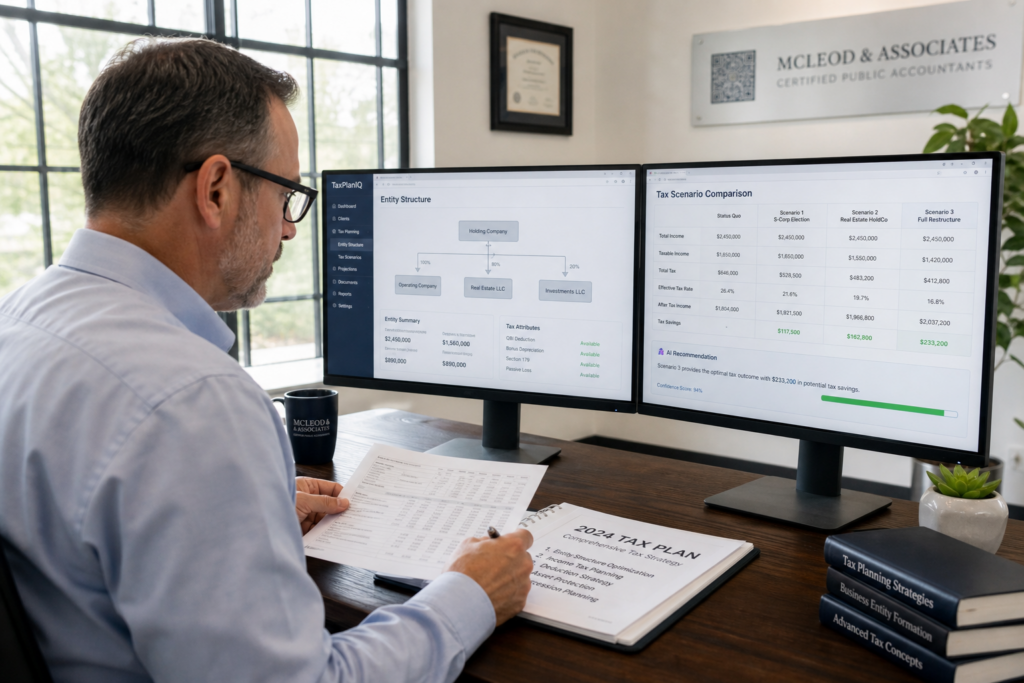
For the 2026 tax year, AI tax planning tools for CPAs have moved from experimental technology to essential infrastructure. With the IRS reducing staff by 27% while expanding AI-powered enforcement, tax professionals face a critical choice: adopt intelligent automation to compete, or fall behind firms delivering faster, more comprehensive client services. This guide shows you exactly how to implement AI safely, scale your advisory practice, and position your firm for sustained growth in an increasingly automated profession.
Table of Contents
Used by 2,400+ tax professionals
- Key Takeaways
- What Are AI Tax Planning Tools for CPAs?
- Why Are CPAs Adopting AI Tax Planning Tools in 2026?
- What Are the Biggest Risks of Using AI Tax Planning Tools?
- How Should CPA Firms Implement AI Governance Policies?
- What AI Tax Planning Features Matter Most in 2026?
- How Can CPAs Use AI to Scale Advisory Services?
- Uncle Kam in Action: How a Mid-Sized CPA Firm Scaled to $2M in Advisory Revenue
- Next Steps
- Frequently Asked Questions
- Related Resources
Key Takeaways
- AI tax planning tools automate data collection and scenario modeling, freeing CPAs for high-value advisory work in 2026.
- Written AI governance policies and staff training are mandatory to avoid Circular 230 penalties and professional sanctions.
- The IRS cut staff by 27% while expanding AI enforcement, raising audit readiness stakes for all practitioners.
- Top firms use AI to shift capacity from compliance to recurring advisory revenue models with higher margins.
- Human oversight remains essential; AI hallucinations triggered $145,000 in court sanctions in Q1 2026 alone.
What Are AI Tax Planning Tools for CPAs?
Quick Answer: AI tax planning tools for CPAs are software platforms that use artificial intelligence to automate data analysis, tax scenario modeling, and strategy identification. They analyze financial data across multiple entities and jurisdictions to recommend specific tax-saving opportunities.
The accounting profession reached an inflection point in 2026. AI tax planning tools for CPAs evolved from experimental add-ons to core infrastructure. These platforms now handle tasks that previously consumed dozens of staff hours per client.
Modern AI tax software performs three essential functions. First, it ingests and normalizes financial data from multiple sources instantly. Second, it models hundreds of tax scenarios simultaneously across different entity structures. Third, it generates client-ready deliverables with strategic summaries and implementation roadmaps.
Leading CPA firms use AI-powered tax advisory platforms to deliver comprehensive planning services that were previously only available from large national firms. The technology democratized sophisticated planning capabilities, making them accessible to firms of all sizes.
Key Capabilities of Modern AI Tax Planning Software
The best platforms integrate several critical features that distinguish them from traditional tax software:
- Entity-Aware Architecture: Analyzes tax implications across 1040s, 1120-S returns, partnerships, and K-1 distributions simultaneously
- Multi-Scenario Modeling: Compares different entity structures, retirement strategies, and timing decisions side-by-side
- Strategy Sequencing: Prioritizes recommendations using frameworks like MERNA (Maximize, Entity, Retirement, Niche, Advanced)
- Document Automation: Generates professional tax plans with compliance documentation and client education materials
- Continuous Monitoring: Tracks legislative changes and alerts practitioners to new planning opportunities throughout the year
What AI Tax Planning Tools Are NOT
Understanding limitations matters as much as understanding capabilities. AI tax planning tools do not replace professional judgment. They augment it. The technology identifies opportunities and quantifies benefits, but CPAs must evaluate appropriateness for each client’s unique circumstances.
These tools also do not eliminate compliance work. They shift capacity from low-margin transactional tasks to high-margin strategic advisory. Successful firms use the freed capacity to deepen client relationships and deliver proactive planning that commands premium fees.
Pro Tip: Evaluate AI tax tools based on their ability to generate unlimited client assessments. Platforms that cap usage or charge per analysis limit your ability to prove value before engagement agreements are signed.
Why Are CPAs Adopting AI Tax Planning Tools in 2026?
Quick Answer: CPAs are adopting AI tools because the IRS reduced staffing by 27% while expanding AI-powered enforcement, creating pressure to deliver faster, more accurate work. Firms also need to shift from low-margin compliance to high-margin advisory to remain competitive.
The 2026 tax landscape transformed dramatically. The Internal Revenue Service that practitioners face today operates fundamentally differently than it did just two years ago. According to the National Taxpayer Advocate’s 2025 Annual Report to Congress, IRS staffing dropped from approximately 102,000 employees in early 2025 to roughly 74,000 by year-end.
This 27% reduction concentrated in experienced enforcement and technical staff. Yet the agency simultaneously expanded its use of artificial intelligence and data analytics for audit selection and enforcement. IRS CEO Frank Bisignano committed to a “digital-first model” in testimony before the Senate Finance Committee on April 15, 2026.
The New IRS Enforcement Reality
The House Appropriations Committee advanced a smaller IRS budget for fiscal 2027 while explicitly expanding the agency’s authority to use AI and data analytics for enforcement. This creates a paradox: fewer agents, more sophisticated detection.
What this means for practitioners is straightforward. Manual processes and reactive planning no longer suffice. Clients need proactive, year-round tax strategy that anticipates IRS scrutiny. AI-powered tools enable this level of service without proportionally increasing headcount.
Client Expectations Have Permanently Shifted
Business owners increasingly expect their CPA to function as a strategic advisor, not merely a compliance provider. They want quantified savings recommendations, entity structure analysis, and multi-year tax projections. Delivering this manually is economically unfeasible for most firms.
Research from the Thomson Reuters 2025 State of the Corporate Tax Department report reveals 58% of corporate tax departments report being under-resourced. This creates opportunity for CPA firms serving business owners who can deliver advisory services efficiently using technology leverage.
The Economics of AI Adoption
Firms that adopt AI tax planning tools report accelerating tax provision processes by 30% to 50% while strengthening internal controls. This efficiency gain translates directly to capacity. The freed hours get redeployed into advisory work that commands 3x to 5x higher billing rates than compliance.
| Service Type | Typical Rate | AI Impact | Net Result |
|---|---|---|---|
| Tax Compliance | $150-250/hour | 30-50% time reduction | Maintain revenue with less capacity |
| Tax Planning (Manual) | $250-350/hour | Often skipped due to time constraints | Unrealized revenue opportunity |
| Advisory (AI-Enabled) | $350-500/hour or value-based | Makes comprehensive planning economically viable | New recurring revenue stream |
The math is compelling. A firm that reallocates just 20 hours per week from compliance to advisory generates an additional $15,000 to $20,000 in monthly revenue at advisory rates. Annually, that’s $180,000 to $240,000 in incremental high-margin income.
What Are the Biggest Risks of Using AI Tax Planning Tools?
Quick Answer: The three biggest risks are AI hallucinations producing incorrect advice, data security breaches, and professional liability under Circular 230 §10.22 for failing to verify AI-generated recommendations before submitting them to the IRS.
AI adoption creates significant professional risk if implemented carelessly. The National Taxpayer Advocate explicitly warned practitioners not to rely solely on AI-generated tax advice. Courts and regulatory bodies treat AI output as work product that requires the same diligence standard as any other professional service.
AI Hallucinations and Fabricated Citations
The most publicized risk involves AI systems generating plausible-sounding but completely fabricated legal citations and tax code references. In the first quarter of 2026 alone, AI-related sanctions across U.S. courts totaled approximately $145,000.
Oregon courts now assess $500 per fabricated citation. The Sixth Circuit case Whiting v. City of Athens resulted in sanctions exceeding $30,000 for counsel who submitted fake AI-generated citations. More significantly, on May 5, 2026, the Supreme Court of Georgia suspended Clayton County Assistant District Attorney Deborah Leslie for six months after discovering AI-generated fabrications in a court filing.
This suspension represents the first reported case in the United States of a professional suspension tied directly to AI-generated fabrications. It establishes clear precedent: professionals bear full responsibility for verifying AI output.
Circular 230 Professional Responsibility
For tax practitioners, the stakes are defined by Treasury Circular 230 Section 10.22, which requires due diligence in preparing returns, advising clients, and representing taxpayers before the IRS. This includes correctness of representations made to the Treasury.
When an AI tool generates a citation, procedural recommendation, or legal analysis, that output becomes a representation the practitioner intends to rely on. Sending it to the IRS without independent verification constitutes a Section 10.22 failure. The technology does not change this fundamental professional duty.
Furthermore, a fabricated authority used to support a return position or IRS representation triggers IRC Section 6694 preparer penalties and Circular 230 §10.51(a)(13) sanctions for false opinions rendered through gross incompetence. These penalties apply regardless of whether the error originated from AI or human mistake.
Data Security and Privacy Concerns
Tax planning necessarily involves sensitive financial data. Kristy McCullough, managing director at Mowery & Schoenfeld Wealth Management, identified data security and privacy as among the most pressing concerns when integrating AI tools: “There are real concerns around data security, privacy, and compliance, specifically where client information is stored and whether these tools can be trusted within a regulated environment.”
Many AI platforms process data through external servers or cloud infrastructure. Practitioners must verify:
- Where client data is stored geographically and which jurisdictions’ laws govern access
- Whether the vendor uses client data to train models that might benefit competitors
- What encryption standards protect data in transit and at rest
- How data is purged when client relationships end
- Whether the vendor carries adequate cybersecurity insurance and indemnification provisions
Pro Tip: Before adopting any AI tax tool, require the vendor to complete a SOC 2 Type II examination. This independent audit verifies controls around security, availability, processing integrity, confidentiality, and privacy.
Over-Reliance and Skill Degradation
A subtler risk involves staff losing fundamental tax knowledge because they rely too heavily on AI recommendations without understanding underlying principles. Junior staff particularly vulnerable to this pattern never develop the judgment required for complex situations where AI tools provide incomplete or misleading guidance.
Leading firms address this through deliberate training programs. They require staff to manually verify AI recommendations during their first six months using the technology. This builds understanding of both the tool’s capabilities and its limitations.
How Should CPA Firms Implement AI Governance Policies?
Quick Answer: Implement a written AI usage policy covering acceptable use cases, mandatory verification procedures, data handling protocols, and documentation requirements. Train all staff on these policies before granting access to AI tools.
Written AI governance policies have become table stakes in 2026. The most successful CPA firms treat AI adoption as a change management initiative that requires the same rigor as any major operational transformation. They recognize this is fundamentally a leadership project, not a technology project.
Essential Components of an AI Governance Framework
A comprehensive AI governance policy addresses six core areas:
- Approved Use Cases: Specify which AI tools are approved for which tasks and who may use them
- Verification Requirements: Define what constitutes adequate verification before relying on AI output
- Data Handling Protocols: Establish rules for what client data may be input into AI systems
- Documentation Standards: Require documentation showing how AI recommendations were verified
- Error Reporting: Create clear procedures for reporting and addressing AI mistakes
- Periodic Review: Schedule quarterly reviews to assess whether policies remain adequate as technology evolves
The Three-Phase Implementation Approach
Leading firms follow a structured rollout that minimizes risk while building competency:
Phase 1: Pilot with Senior Staff (Months 1-2)
Restrict initial access to partners and senior managers. Use the pilot period to identify common errors, develop verification checklists, and refine usage protocols. Document everything learned.
Phase 2: Expand to Supervised Staff (Months 3-4)
Extend access to experienced staff with mandatory senior review of all AI-generated work. Use this phase to develop training materials based on actual use cases encountered.
Phase 3: Firm-Wide Deployment (Month 5+)
Roll out to all staff with comprehensive training and clear escalation procedures for questions. Maintain enhanced review protocols for junior staff.
Training Requirements That Actually Work
Generic AI training fails. Effective training focuses on tax-specific scenarios using the actual tools staff will use daily. Cover these topics explicitly:
- How to identify AI hallucinations and verify tax code citations
- When AI recommendations require additional professional judgment
- How to document verification steps to satisfy professional due diligence requirements
- What to do when AI output contradicts their professional understanding
- Data security protocols specific to client information
Jessica Ott, CCO at PYA Waltman Capital, describes their approach: “We have formed an internal working group of professionals who are tasked with crafting firm standards and evaluating new technologies.” This cross-functional approach ensures policies reflect both technical capabilities and practical workflow realities.
| Governance Element | What It Addresses | Implementation Owner |
|---|---|---|
| Written Usage Policy | Scope, approved uses, restrictions | Managing Partner / COO |
| Verification Protocols | How to confirm AI accuracy | Director of Tax / Quality Control |
| Data Security Standards | What data can be input, storage requirements | IT Director / Compliance Officer |
| Staff Training Program | How to use tools safely and effectively | HR / Professional Development |
| Incident Response | What to do when errors occur | Risk Management / General Counsel |
What AI Tax Planning Features Matter Most in 2026?

Quick Answer: The most valuable features are unlimited client assessments, entity-aware analysis across multiple return types, multi-scenario comparison capabilities, professional deliverable generation, and integration with existing practice management systems.
Not all AI tax planning tools deliver equal value. After analyzing dozens of implementations across CPA firms of varying sizes, five capabilities separate platforms that transform practices from those that merely add complexity.
Unlimited Free Assessments: The Game-Changing Feature
The biggest friction point for CPAs historically was the economics of prospecting. Running comprehensive tax analyses on prospects who might not engage wastes valuable billable time. Many competing platforms cap usage or charge per analysis, forcing firms to ration assessments.
Leading platforms provide unlimited assessments at every pricing tier. This enables firms to run analyses on every prospect to prove value before engagement agreements are signed. It also allows offering free assessments during tax season as value-adds that seed advisory engagements later in the year.
Entity-Aware Architecture for Complete Analysis
Business owners rarely operate through a single entity. They typically have multiple structures: operating companies, holding companies, real estate entities, personal 1040s. Evaluating tax strategies in isolation misses critical interactions and optimization opportunities.
Sophisticated AI platforms analyze the entire entity structure simultaneously. They model how changing one entity’s treatment affects overall tax liability across 1040s, 1120-S returns, partnerships, and K-1 distributions. This holistic view identifies strategies manual analysis would miss.
Multi-Scenario Modeling and Comparison
Clients don’t want a single recommendation. They want to understand trade-offs. Should they elect S-Corp status or remain an LLC? Is a cost segregation study worth the investment? How do different retirement contribution strategies affect both current taxes and long-term wealth?
The best AI tax tools model hundreds of scenarios simultaneously and present results in clear comparison formats. They quantify both immediate tax impact and multi-year projections, enabling data-driven decision-making.
Professional Deliverable Generation
Clients pay premium fees for clarity, not spreadsheets. They want professional documents that explain complex strategies in plain language, quantify benefits, outline implementation steps, and document compliance requirements.
Advanced AI platforms generate client-ready deliverables with strategic summaries, implementation roadmaps, and risk assessments. Many include white-label capabilities so firms can brand documents with their own logos and positioning. This transforms technical analysis into professional advisory products worth $5,000 to $15,000 per engagement.
Integration With Practice Management Systems
Standalone tools create workflow friction. Data must be manually exported from one system and imported into another. Recommendations live in separate files from client communications. Updates require touching multiple platforms.
Integrated platforms connect directly with practice management software, CRMs, and document management systems. This eliminates duplicate data entry, centralizes client information, and ensures the entire team sees updated tax strategies without manual coordination.
Pro Tip: Evaluate AI tax planning platforms the same way you evaluate practice management software. Schedule hands-on demos with actual client scenarios. Ask how long implementation takes and what support is included.
How Can CPAs Use AI to Scale Advisory Services?
Quick Answer: Use AI to automate data collection and initial analysis, freeing capacity for client consultation and strategic recommendations. Package comprehensive tax plans as value-based engagements rather than hourly billing to capture the full economic value delivered.
The transition from compliance provider to trusted advisor represents the most significant opportunity in public accounting today. AI tax planning tools provide the leverage needed to make this shift economically viable for firms of all sizes.
The Three-Tier Advisory Service Model
Successful firms structure advisory services in three tiers that match client sophistication and complexity:
Foundation Tier: Annual Tax Strategy Review ($2,500-5,000)
Every client receives a comprehensive annual review identifying immediate tax-saving opportunities. AI tools generate the initial analysis. CPAs review, refine, and present recommendations in a structured consultation. This tier establishes advisory as standard, not optional.
Growth Tier: Quarterly Advisory ($7,500-15,000 annually)
Business owners with growing complexity benefit from ongoing quarterly planning. This includes entity structure optimization, proactive estimated payment calculations, legislative change monitoring, and year-end planning. AI handles continuous monitoring and flags planning opportunities throughout the year.
Premium Tier: Strategic Advisory ($25,000+ annually)
High-net-worth individuals and sophisticated business owners require comprehensive wealth and tax planning that coordinates entity structures, estate planning, succession strategies, and family office functions. This tier delivers CFO-level strategic guidance supported by AI-powered analytics.
Value-Based Pricing Enabled by AI
Hourly billing caps advisory revenue at the number of hours worked. Value-based pricing ties fees to economic impact delivered. When you identify $50,000 in annual tax savings, a $7,500 advisory fee represents tremendous value—a 6.7x return in year one alone.
AI makes value-based pricing economically viable. The software quantifies savings precisely, documents recommendations professionally, and reduces the time investment required to deliver comprehensive planning. This alignment of interests—where you profit by delivering measurable client value—builds stronger, more sustainable client relationships.
Building a Recurring Revenue Advisory Practice
The ultimate goal is predictable, recurring advisory revenue that smooths cash flow and increases firm valuation. Quarterly and monthly advisory arrangements create this predictability. According to research by leading practice management consultants, firms with 40% or more of revenue from recurring advisory engagements command valuation multiples 50-75% higher than compliance-focused practices.
AI tools support this model by automating the routine monitoring and analysis that makes ongoing advisory economically efficient. The software continuously scans for legislative changes, monitors client financial data for planning triggers, and generates quarterly review materials. CPAs focus their time on strategic consultations and relationship management.
| Advisory Tier | Annual Fee Range | AI Role | CPA Focus |
|---|---|---|---|
| Foundation (Annual Review) | $2,500-5,000 | Initial analysis and scenario modeling | Review, refine, present |
| Growth (Quarterly Advisory) | $7,500-15,000 | Continuous monitoring, quarterly analysis | Strategic guidance, implementation oversight |
| Premium (Strategic Advisory) | $25,000+ | Complex multi-entity modeling, wealth planning analytics | CFO-level strategic partnership |
Uncle Kam in Action: How a Mid-Sized CPA Firm Scaled to $2M in Advisory Revenue Using AI Tax Planning Tools
The Client: Mitchell & Associates, a 12-person CPA firm in suburban Chicago, had built a solid compliance practice serving 180 small business clients. Annual revenue plateaued at $1.8M with 75% coming from tax preparation and bookkeeping. Partners worked 65-hour weeks during tax season but struggled to command premium fees.
The Challenge: Managing partner Sarah Mitchell recognized their firm competed solely on price in an increasingly commoditized compliance market. She wanted to transition to advisory services but lacked both the capacity and systematic process to deliver tax planning at scale. Previous attempts to offer planning services manually proved economically unviable—comprehensive analyses consumed 8-12 hours per client, making it impossible to serve the entire client base profitably.
The Uncle Kam Solution: Sarah discovered Uncle Kam’s tax advisory operating system in March 2025. Unlike traditional tax software, Uncle Kam provided three integrated components: AI-powered planning software with unlimited free assessments, structured weekly coaching on selling and pricing advisory services, and a built-in marketplace routing qualified advisory leads.
Mitchell & Associates implemented Uncle Kam’s MERNA framework—a systematic approach to strategy sequencing that prioritizes Maximize deductions first, then Entity structure, Retirement planning, Niche strategies, and Advanced techniques last. This gave her team a repeatable process instead of starting from scratch with each client.
The firm began offering free tax assessments to existing clients during the 2025 tax season using Uncle Kam’s unlimited assessment feature. The AI software analyzed each client’s complete financial picture across all entities and identified an average of $12,000 in annual tax savings per business owner client. Sarah’s team reviewed and refined these recommendations, then scheduled 30-minute consultations to present findings.
For clients who wanted to implement the recommendations, Mitchell & Associates offered a $4,500 annual advisory package covering implementation guidance, quarterly reviews, and year-end planning. The Uncle Kam platform generated professional, branded deliverables that justified the premium pricing—clients paid for clarity and results, not hours.
The Results: Within 18 months, Mitchell & Associates transformed their practice economics. They enrolled 87 clients (48% of their business owner base) into advisory services generating $391,500 in first-year advisory revenue. By month 24, advisory revenue reached $810,000 annually—a new recurring revenue stream with 65% gross margins compared to 35% on compliance work.
More importantly, the firm’s capacity improved dramatically. AI-automated data analysis reduced time per comprehensive tax plan from 8-12 hours to 2-3 hours of CPA review and client consultation time. This efficiency enabled the firm to serve more clients without proportionally increasing headcount. By their second year using Uncle Kam, total firm revenue exceeded $2.8M with advisory representing 45% of revenue—the firm’s valuation increased an estimated 60% based on recurring revenue multiples.
Key Success Factors: Sarah credits three elements: Uncle Kam’s unlimited assessment feature that enabled risk-free prospecting, the MERNA framework that provided a repeatable process, and most critically, the weekly coaching that taught her team how to price and sell advisory services confidently. “The software is powerful, but the system—software plus training plus leads—is what actually transformed our practice,” Sarah notes. Partner compensation increased 40% while average workweek hours during tax season dropped from 65 to 52. See more success stories at Uncle Kam’s client results page.
Return on Investment: Mitchell & Associates invested $24,000 in Uncle Kam licensing and training during year one. They generated $391,500 in first-year advisory revenue directly attributable to the platform. That represents a 16.3x return on investment in year one, with compounding returns as advisory clients renew annually.
Next Steps
AI tax planning tools for CPAs have evolved from optional enhancement to competitive necessity in 2026. Firms that adopt this technology thoughtfully—with proper governance, training, and strategic focus—position themselves to thrive in an increasingly automated profession. Those that delay face growing competitive pressure from firms delivering faster, more comprehensive services at scale.
Here are your immediate action items:
- Schedule a strategic planning session with your leadership team to assess your current advisory capabilities and capacity constraints
- Research and demo at least three AI tax planning platforms using actual client scenarios from your practice
- Draft a preliminary AI governance policy covering acceptable use cases and verification requirements before any implementation
- Calculate the economic opportunity: identify 20 clients who would benefit from advisory services and project potential revenue at $4,500-7,500 each
- Book a strategy session at Uncle Kam’s consultation page to explore how top firms are implementing AI-powered advisory at scale
The firms winning in 2026 aren’t those with the most sophisticated technology. They’re the ones that made deliberate structural decisions about pricing, positioning, and workflow that enabled them to deliver the high-value work clients actually hired them for. AI provides the leverage to make this transition economically viable.
This information is current as of 6/4/2026. Tax laws and technology capabilities change frequently. Verify updates with the IRS and software vendors if reading this later.
Frequently Asked Questions
Are AI tax planning tools actually accurate enough to trust?
Modern AI tax planning tools achieve high accuracy when properly implemented and verified. However, they require human oversight. The National Taxpayer Advocate explicitly warned practitioners not to rely solely on AI-generated advice. Leading platforms report 95%+ accuracy for standard scenarios, but CPAs must verify outputs before client delivery. Treatment of AI recommendations as suggestions requiring professional review—not final answers—ensures both accuracy and compliance with Circular 230 due diligence standards.
How much do AI tax planning tools cost for CPA firms?
Pricing varies significantly based on features, firm size, and user count. Entry-level platforms start around $3,000-5,000 annually for solo practitioners. Mid-tier solutions serving small to medium firms range from $10,000-25,000 annually. Enterprise platforms with advanced features, unlimited users, and integration capabilities run $30,000-75,000+ annually. Calculate ROI by projecting advisory revenue enabled: a firm adding just 15 advisory clients at $5,000 each generates $75,000 in incremental revenue—often exceeding the software investment multiple times over.
What’s the implementation timeline for AI tax planning software?
Expect a three-to-six-month full implementation timeline. Month one typically involves technical setup, integration configuration, and initial training. Months two through three focus on pilot testing with senior staff and policy refinement. Months four through six cover firm-wide rollout, ongoing training, and process optimization. However, many firms begin generating value within the first 30-45 days by running analyses for select clients during the pilot phase. The key is treating implementation as change management, not just software deployment.
Can smaller CPA firms compete using AI tax planning tools?
Absolutely—AI levels the playing field. Small firms gain access to analytical capabilities previously available only at national firms. The technology enables comprehensive tax planning delivery without proportionally increasing headcount. Many successful implementations involve firms with 3-10 professionals. The key advantage is agility: smaller firms implement faster, train staff more thoroughly, and adapt processes more easily than larger organizations. AI actually benefits smaller practices more because it provides larger proportional capacity increases.
What happens if AI makes a mistake that causes client problems?
Professional liability remains with the CPA, not the software vendor. Your malpractice insurance and Circular 230 obligations apply equally to AI-assisted work. This is precisely why written governance policies and verification procedures are essential. Document your review process thoroughly. If a mistake occurs despite proper verification, treat it like any professional error: correct it immediately, communicate transparently with the client, notify your insurer if material, and update your verification procedures. Most quality platforms include errors and omissions provisions, but these supplement rather than replace your professional responsibility.
How do clients react to knowing AI was involved in their tax planning?
Client reception depends entirely on how you position it. Frame AI as technology that enables more thorough analysis and faster identification of opportunities they might otherwise miss. Emphasize that you review and verify all recommendations—they’re paying for your judgment enhanced by powerful analytical tools. Most clients respond positively when they see comprehensive, professional deliverables identifying substantial tax savings. The proof is in results delivered, not the technology used. Many firms simply describe their process as “advanced tax planning analytics” without specifically highlighting AI unless clients ask.
Do AI tax planning tools work for all types of tax practices?
AI delivers the most value for practices serving business owners, high-income professionals, and real estate investors—clients with complex situations and meaningful tax planning opportunities. The technology is less impactful for practices focused solely on individual 1040 preparation for wage earners. However, even primarily individual-focused practices can identify advisory opportunities by analyzing which clients have side businesses, rental properties, or investment income that merit strategic planning. The key is matching tool capabilities to your target client profile and growth strategy.
What’s the biggest mistake firms make when implementing AI tax tools?
Treating AI adoption as a technology project rather than a practice transformation initiative. Firms that succeed assign leadership ownership, develop comprehensive governance policies, invest in proper training, and redesign workflow and pricing models. Firms that struggle simply license software and expect staff to figure it out. The second biggest mistake is failing to capture the economic value through proper pricing. If you use AI to deliver better services faster but continue hourly billing, you’ve increased efficiency but not profitability. Value-based pricing aligned with client outcomes is essential to realizing AI’s full economic potential.
How do I convince partners to invest in AI tax planning technology?
Build a business case focused on practice economics and competitive positioning. Quantify current capacity constraints and lost revenue from clients you can’t serve advisory. Calculate incremental revenue potential: 20 advisory clients at $5,000 each equals $100,000 in new revenue against software costs of $15,000-25,000. Present the competitive threat: firms adopting AI deliver faster, more comprehensive services and capture clients seeking modern advisory relationships. Finally, propose a limited pilot with clear success metrics before firm-wide rollout. This reduces perceived risk and builds internal champions through demonstrated results.
Related Resources
- Uncle Kam Tax Planning Software: Complete Advisory Operating System
- The MERNA Method: Strategic Tax Planning Framework for CPAs
- Tax Advisory Services: How to Transition from Compliance to Advisory
- Client Success Stories: Real Results from CPA Firms Using AI Tax Planning
- Tax Strategy Blog: Latest Insights on AI, Advisory Services, and Practice Growth
Last updated: June, 2026

