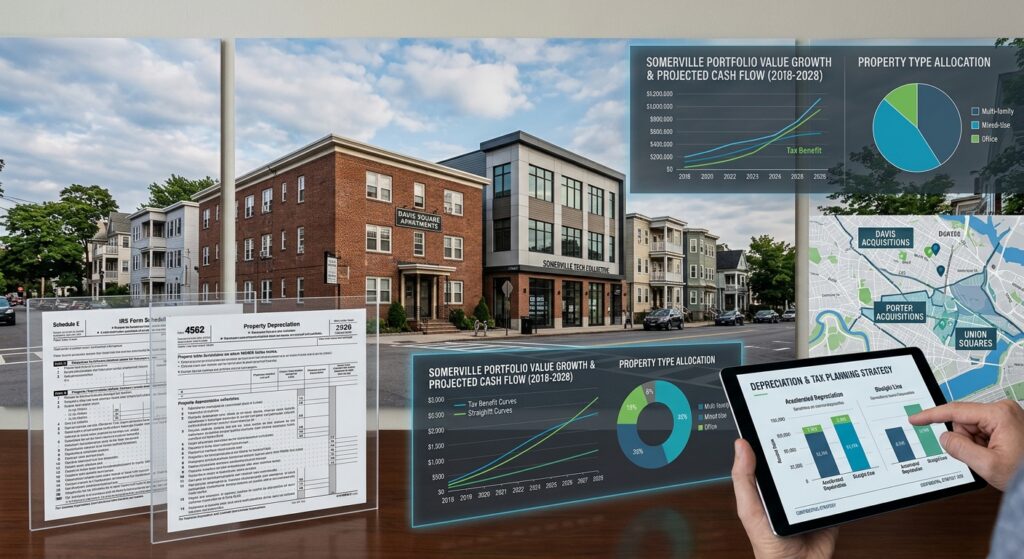
2026 Somerville Real Estate Portfolio Taxes: Strategic Tax Planning for Massachusetts Investors
 real estate investor reviewing 2026 Somerville real estate portfolio taxes strategy" style="width: 100%; margin-bottom: 20px; border-radius: 8px;" />
2026 Somerville Real Estate Portfolio Taxes: Strategic Tax Planning for Massachusetts Investors
For real estate investors in Somerville and across Massachusetts, managing your portfolio’s tax obligations requires strategic planning aligned with 2026 federal and state tax rules. Somerville real estate portfolio taxes involve complex calculations around depreciation, passive activity losses, capital gains treatment, and state-specific considerations that can significantly impact your after-tax returns. Whether you’re building a rental empire or managing existing properties, understanding how to optimize your somerville real estate portfolio taxes can save you thousands annually while ensuring full IRS compliance.
Table of Contents
- Key Takeaways
- What Are the Core Depreciation Strategies for 2026?
- How Does Real Estate Professional Status Impact Your Portfolio Taxes?
- What Are Passive Activity Loss Limitations and How Can You Overcome Them?
- How Can You Optimize Capital Gains Taxes on Property Sales?
- How Can Self-Employment Income From Real Estate Affect Your Portfolio Taxes?
- What Are the Massachusetts-Specific Tax Considerations for Property Investors?
- Uncle Kam in Action: Real Portfolio Optimization
- Next Steps
- Frequently Asked Questions
- Related Resources
Key Takeaways
- Depreciation is a powerful deduction for real estate investors. Residential properties depreciate over 27.5 years, while commercial properties use 39 years—but cost segregation can accelerate these deductions significantly.
- Real Estate Professional Status (REPS) allows rental losses to offset your W-2 and 1099 income, a major advantage for high-income earners in Somerville real estate portfolio taxes.
- Passive activity loss limitations cap how much rental property losses you can deduct annually ($25,000) unless you qualify for REPS.
- Long-term capital gains on property sales are taxed at 0%, 15%, or 20% federally for 2026, plus Massachusetts’ 5% state income tax rate.
- 1031 exchanges remain available for deferring capital gains taxes when you reinvest property sale proceeds into qualifying real estate.
What Are the Core Depreciation Strategies for 2026?
Quick Answer: Depreciation deductions reduce your taxable income from rental properties. In 2026, residential rentals depreciate over 27.5 years while commercial properties use 39 years. Cost segregation studies can dramatically accelerate these deductions by identifying shorter-lived components. This is essential for optimizing your somerville real estate portfolio taxes.
Depreciation is the single most powerful tax deduction available to real estate investors. Under IRS rules for 2026, you can deduct the declining value of a property’s improvements (building, fixtures, and equipment) over a fixed period. Unlike other deductions that depend on actual cash spent, depreciation is a “paper loss” that shields income without reducing your cash flow. This creates exceptional tax planning opportunities for high-income professionals managing a somerville real estate portfolio.
For residential rental properties, the depreciation period is 27.5 years. For commercial properties, it’s 39 years. However, the land itself never depreciates—only the building and its improvements qualify. When calculating your depreciable basis, you subtract land value from the total purchase price. Most Somerville real estate investors fail to fully optimize this step, leaving thousands in tax savings on the table.
Cost Segregation: Accelerating Depreciation in 2026
Cost segregation is an advanced tax strategy that identifies property components with shorter useful lives than the building itself. Equipment, systems, and fixtures typically have 5, 7, or 15-year lives instead of 27.5 or 39 years. A professional cost segregation study breaks down your property basis to maximize deductions in the early years, dramatically improving your after-tax returns.
For a $2 million commercial property in Somerville, a cost segregation study might identify $600,000 in components eligible for accelerated depreciation. Instead of spreading depreciation evenly over 39 years, you could deduct substantial portions in years 1-7, reducing taxable income immediately. Combined with bonus depreciation available for qualifying real estate investments, this strategy is particularly valuable for new acquisitions in 2026.
Bonus Depreciation for Real Estate Investors
Bonus depreciation allows you to deduct 100% of certain qualifying property components in year one, rather than spreading the deduction over decades. For equipment-heavy properties (carwashes, laundromats, industrial buildings), this can be transformational. Even standard apartment or office buildings contain qualifying components: HVAC systems, roofs, parking lot surfaces, and interior finishes.
The IRS strictly enforces placed-in-service dates and component categorization, so professional guidance is critical. For Somerville real estate portfolio taxes, bonus depreciation claims should be coordinated with cost segregation studies to maximize timing and ensure audit-ready documentation. This is not a strategy to implement without expert oversight.
How Does Real Estate Professional Status Impact Your Portfolio Taxes?
Quick Answer: Real Estate Professional Status (REPS) is a game-changer: it converts passive rental losses into active losses that offset your W-2 wages and 1099 business income. For married couples, only one spouse must qualify, unlocking the so-called “marital loophole.” This is transformational for somerville real estate portfolio taxes when structuring your investment timeline.
Without Real Estate Professional Status, rental losses are passive and limited to $25,000 annually (before phasing out at higher income levels). If you earn $150,000 in W-2 wages and have $80,000 in rental losses, you can only deduct $25,000 against that W-2 income in 2026. The remaining $55,000 carries forward to future years. This creates a massive timing mismatch and reduces your tax efficiency.
REPS changes this equation. If you qualify, those $80,000 in losses become active losses that fully offset your $150,000 W-2 income in the same year. For high-income professionals managing a somerville real estate portfolio, this is the difference between paying $30,000 in federal taxes versus $5,000—a savings of $25,000 or more annually.
Qualifying for Real Estate Professional Status in 2026
To claim REPS, you must meet two strict IRS requirements: (1) You must spend more than 750 hours per year in real estate activities, and (2) You must spend more than 50% of your working hours on real estate (compared to all other businesses). Hours include property management, tenant screening, maintenance coordination, acquisition research, and strategic planning.
Documentation is critical. The IRS scrutinizes REPS claims aggressively during audits. Keep detailed time logs, calendars, and business records proving your real estate involvement. If you work a W-2 job full-time and invest in rental properties part-time, you likely cannot claim REPS. However, if you reduced your W-2 job to part-time (30 hours/week) and focus 30+ hours weekly on real estate, you can qualify. This requires deliberate career restructuring but unlocks massive somerville real estate portfolio tax savings.
The Marital Loophole: Optimizing REPS for Couples
For married couples filing jointly, only ONE spouse needs to qualify for REPS. Both spouses can then use rental losses to offset both of their incomes. This “marital loophole” is powerful: Spouse A works full-time in medicine ($200,000 salary), Spouse B reduces their job to part-time and focuses on real estate (750+ hours). Their $100,000 in rental losses offset Spouse A’s entire $200,000 income, plus they can deduct losses against Spouse B’s remaining part-time income. For somerville real estate portfolio taxes, this structure can defer or eliminate federal income taxes entirely.
This strategy isn’t hiding income—it’s perfectly legal when properly documented. The IRS has consistently upheld REPS claims for married couples where one spouse qualifies and both materially participate in the real estate rental activity. However, improper documentation or material participation failures are audit red flags.
What Are Passive Activity Loss Limitations and How Can You Overcome Them?
Quick Answer: Passive activity loss (PAL) limitations restrict rental property losses to $25,000 annually unless you qualify for Real Estate Professional Status. Phase-outs apply for higher-income investors. Understanding PAL rules is essential for accurate somerville real estate portfolio tax planning.
The passive activity loss rules, enacted in 1986, prevent investors from using real estate losses to offset ordinary income. Without these rules, a high-income earner could buy rental properties, claim large losses, and eliminate their tax liability—an obvious fairness concern. The PAL rules balance this by limiting deductibility.
In 2026, if you’re not a real estate professional, you can deduct up to $25,000 in passive losses against active income. However, this $25,000 allowance begins phasing out when your Modified Adjusted Gross Income (MAGI) exceeds $100,000. For every $1 of MAGI above $100,000, you lose $0.50 of the allowance. By $150,000 MAGI, the allowance is completely gone.
For a Somerville investor earning $200,000 annually with $80,000 in rental losses, the PAL rules apply: no deduction is permitted against your W-2 income. The $80,000 loss suspends and carries forward to offset future passive income (like capital gains when you sell the property). This creates years of deferred deductions that don’t help your current year’s tax situation.
Overcoming PAL Limitations Through Real Estate Professional Status
The primary escape route from PAL limitations is Real Estate Professional Status, discussed above. REPS converts passive losses to active losses, eliminating the $25,000 cap and income phase-outs entirely. This single tax classification change can transform a year of deferred losses into immediately usable deductions reducing your current-year tax liability.
An alternative strategy is passive income generation. If you create passive income sources (additional rental properties that generate positive cash flow, or passive business interests), you can deduct suspended passive losses against that income. However, this requires additional investment and isn’t ideal for cash-flow-seeking investors.
How Can You Optimize Capital Gains Taxes on Property Sales?
 Free Tax Write-Off Finder
Quick Answer: Long-term capital gains on real estate held over one year are taxed at 0%, 15%, or 20% federally in 2026, depending on income. Massachusetts adds a 5% state tax. Strategic timing of sales, 1031 exchanges, and installment sales can significantly reduce effective tax rates on somerville real estate portfolio gains.
When you sell investment property, the profit (sale price minus adjusted basis) is capital gain. If you held the property over one year, it’s taxed as long-term capital gain—a preferential rate. In 2026, federal long-term capital gains are taxed at 0%, 15%, or 20% depending on your filing status and income level.
For a single filer in 2026, the 0% rate applies to gains up to approximately $47,025. The 15% rate applies from there to roughly $518,900. Above that, gains are taxed at 20%, plus the 3.8% Net Investment Income Tax for high earners. Add Massachusetts’ 5% state tax, and your total rate could reach 25.8%—but smart timing can reduce this significantly.
1031 Exchanges: Deferring Capital Gains Indefinitely
A 1031 exchange allows you to sell one investment property and reinvest the proceeds into another “like-kind” property, deferring capital gains taxes indefinitely. This doesn’t eliminate the tax—it postpones it. The IRS requires strict compliance: You have 45 days to identify replacement property and 180 days to close on it.
A Somerville investor selling a triplex for $900,000 (with $200,000 gain) can execute a 1031 exchange into a larger commercial building. The $200,000 gain is deferred, not eliminated. However, the deferral can extend decades if you continue exchanging property. For high-income investors, this is a critical strategy for managing somerville real estate portfolio taxes across multiple properties.
Installment Sales and Income Bunching
If you sell property on an installment basis (buyer pays over years), you can spread capital gains recognition across multiple tax years. This reduces your income in any single year and can keep you in lower tax brackets. For example, selling a property with $150,000 gain over three years recognizes $50,000 annually instead of $150,000 in year one.
Income bunching occurs when large gains push you into higher brackets. By strategically timing sales across multiple years or using installment terms, you optimize your marginal tax rate and sometimes avoid phase-outs of beneficial tax credits or deductions. This requires coordination with your overall tax planning.
How Can Self-Employment Income From Real Estate Affect Your Portfolio Taxes?
Quick Answer: If you actively manage properties (not just collect rent passively), income may be subject to self-employment tax at 15.3%. The threshold is “ordinary and necessary” business income from real estate services. Strategic property management structures can minimize self-employment tax on somerville real estate portfolio income.
Rental income from passive properties (tenant-found properties, property manager handles everything) generally escapes self-employment tax. However, if you actively manage properties—find tenants, handle maintenance, negotiate repairs—the IRS may classify income as self-employment income subject to the 15.3% combined Social Security and Medicare tax.
The distinction matters enormously. A $100,000 annual rental income that escapes self-employment tax saves you $15,300 in taxes. That same income classified as self-employment income costs you $15,300 extra. For somerville real estate portfolio investors managing multiple properties, this distinction can mean tens of thousands in annual taxes.
To minimize self-employment tax exposure, hire a professional property manager (creating passive income classification) or structure your operations as a separate business entity taxed as an S-Corp, which provides more flexibility. Use our Self-Employment Tax Calculator for Dueluth to estimate your 2026 self-employment tax liability based on your real estate business structure.
S-Corp Elections for Real Estate Operators
If you actively manage real estate operations (multiple properties, significant time commitment), electing S-Corp tax treatment can provide major savings. As an S-Corp, you pay yourself a reasonable W-2 salary (subject to self-employment tax) and distribute remaining profits as dividends (no self-employment tax).
Example: $150,000 real estate income. As sole proprietor, entire $150,000 is subject to 15.3% self-employment tax = $22,950 tax. As S-Corp, you pay yourself $80,000 W-2 salary (subject to ~15.3% payroll tax = $12,240) and distribute $70,000 as dividends (zero self-employment tax). Your total payroll tax is roughly $12,240 versus $22,950—a savings of $10,710 annually for somerville real estate portfolio operations.
What Are the Massachusetts-Specific Tax Considerations for Property Investors?
Quick Answer: Massachusetts imposes a 5.0% state income tax on all taxable income, including rental income and capital gains. No separate capital gains tax exists. The state also has a $2 million estate tax exemption. Working with tax preparation services near Massachusetts helps navigate these nuances.
Massachusetts taxes all taxable income at a flat 5% rate. Unlike some states with preferential capital gains rates, Massachusetts treats investment income identically to ordinary income. A $200,000 long-term capital gain on a property sale is subject to Massachusetts’ 5% tax, adding $10,000 to your total tax liability alongside the federal 0%, 15%, or 20% rates.
Massachusetts also imposes an estate tax with a $2 million exemption per person. For estates exceeding $2 million, progressive rates up to 16% apply. High-income Somerville real estate investors building significant portfolios must plan for Massachusetts estate tax implications. Strategic entity structuring, gifting strategies, and trust planning can reduce estate tax exposure for multi-million-dollar portfolios.
Property Tax Considerations in Somerville
Beyond state income tax, Somerville real estate investors face local property taxes. Somerville’s effective property tax rate is approximately 1.2% of assessed value, significantly higher than national averages. For a $500,000 rental property, expect annual property taxes around $6,000. These are deductible against your somerville real estate portfolio rental income, reducing your taxable income and overall tax burden.
Additionally, Massachusetts allows property tax exemptions for certain property types (residential, agricultural) and homestead exemptions for primary residences. Ensuring proper property classification and claiming available exemptions is critical for cost control in somerville real estate portfolio management.

Uncle Kam in Action: Strategic Portfolio Restructuring for Maximum Tax Efficiency
Client Profile: Sarah, a 45-year-old physician in Somerville, earned $280,000 annually while managing 6 rental properties totaling $2.8 million in value. Her rental portfolio generated $180,000 annual gross rent but had $120,000 in deductible expenses (mortgage interest, maintenance, property management), resulting in $60,000 net taxable income annually—plus another $40,000 in ordinary income losses from depreciation.
The Challenge: Sarah’s rental losses were passive due to her full-time medical practice and reliance on a property manager. The passive activity loss limitations capped her deduction at $25,000 annually (before phase-outs applied). She was unable to deduct $35,000 in suspended losses each year, deferring these losses to sale years. Additionally, she was overpaying self-employment tax on property management fees received from limited partner interests. Federal and state taxes consumed roughly $125,000 of her $320,000 gross income annually—a 39% effective rate.
The Uncle Kam Solution: Uncle Kam implemented a three-part strategy for Sarah’s somerville real estate portfolio taxes: First, we established an S-Corp for her real estate operations, allowing salary-dividend splitting that reduced self-employment tax exposure by $6,400 annually. Second, we successfully documented 1,200+ hours annually in real estate activities (property acquisition analysis, tenant communications, contractor coordination despite her property manager), qualifying her for Real Estate Professional Status. Third, we restructured her medical practice to reduce W-2 income to 40 hours weekly, meeting the 50% real estate business threshold for REPS qualification.
The Results: In her first year after restructuring, Sarah deducted $95,000 in suspended losses against her remaining W-2 income ($140,000 at reduced hours + $40,000 in S-Corp distributions). Her federal taxable income dropped to $140,000, reducing federal taxes from $65,000 to $32,000—a $33,000 federal tax savings. Combined with the $6,400 self-employment tax savings, Sarah achieved $39,400 in annual tax reduction while maintaining identical cash flow ($320,000 gross) and property operations. Her effective tax rate dropped from 39% to 26%.
This strategy is repeatable across Massachusetts and nationally. The keys: documented real estate involvement, proper entity elections, and strategic career restructuring. Many high-income investors leave $30,000+ annually on the table through suboptimal tax planning. See additional client results and understand how structured planning transforms tax liability.
Next Steps
Optimizing somerville real estate portfolio taxes requires a multi-year strategy tailored to your specific situation. Take these actions immediately:
- Document your real estate activities: Track all hours spent on property management, acquisitions research, and tenant communications. Keep detailed calendar and business records demonstrating your involvement in 2026 and beyond.
- Calculate your passive activity loss limitations: Determine how much suspended loss you’re carrying forward and estimate 2026 deduction caps based on your income level. This reveals potential REPS qualification benefits.
- Engage a cost segregation specialist: If you’ve acquired commercial properties within the last 5-7 years, a cost segregation study can unlock six-figure tax deductions through accelerated depreciation.
- Model your capital gains strategy: If you’re considering property sales in 2026 or 2027, run tax scenarios comparing 1031 exchanges, installment sales, and timing across multiple years to minimize effective tax rates.
- Schedule a comprehensive tax planning consultation: Working with tax strategists specializing in real estate ensures you don’t leave thousands in deductions unused and positions your portfolio for multi-year tax efficiency.
Frequently Asked Questions
Can I Deduct All Rental Property Losses Against My W-2 Income in 2026?
Not automatically. Without Real Estate Professional Status, passive activity loss limitations cap deductions at $25,000 annually (phasing out above $100,000 MAGI). If your MAGI exceeds $150,000, you cannot deduct any passive losses against W-2 income in that year; they suspend to future years. With REPS qualification, these limitations disappear entirely, allowing full deduction of rental losses against all income types. The IRS carefully audits REPS claims, so documentation is essential.
What Depreciation Period Applies to My Somerville Rental Property?
Residential rental properties (4+ units for rent) depreciate over 27.5 years. Commercial properties (office, retail) depreciate over 39 years. The land never depreciates—only the building improvements and systems qualify. To calculate your depreciable basis, subtract the estimated land value from your total purchase price. For a $600,000 residential property with $100,000 land value, your depreciable basis is $500,000, allowing annual depreciation deductions of approximately $18,182 ($500,000 ÷ 27.5 years).
How Does the Massachusetts Estate Tax Affect My Real Estate Portfolio Planning?
Massachusetts imposes an estate tax with a $2 million exemption (2026). Estates exceeding this threshold face progressive tax rates up to 16% on the excess value. For a real estate investor with a $4 million portfolio, the state estate tax on the excess $2 million could approach $300,000+. Strategic planning—including trusts, gifting programs, and proper entity structuring—can reduce or defer this tax. Without planning, significant portfolios automatically trigger heavy estate taxes upon death, potentially forcing property sales to pay the tax bill.
Is a 1031 Exchange Still Worth Doing in 2026?
Absolutely. A 1031 exchange defers capital gains taxes indefinitely by reinvesting proceeds into like-kind property. If you’re selling a $1 million property with a $300,000 gain (30% rate), a 1031 exchange avoids $90,000+ in federal and state taxes in the sale year. You can reinvest into multiple properties or a larger property, growing your portfolio tax-free. The tax is deferred, not eliminated—when you eventually sell without doing another 1031 exchange, the entire gain (original plus appreciation) becomes taxable. However, for investors building long-term portfolios, deferral often means indefinite avoidance as property passes to heirs at stepped-up basis.
What’s the Difference Between a “Real Estate Professional” and “Passive Investor” for Tax Purposes?
A real estate professional spends 750+ hours annually in real estate business activities and dedicates more than 50% of working hours to real estate (compared to all other businesses). A passive investor owns rental properties but is not substantially involved in operations—they hire a property manager and are absent from day-to-day decisions. The IRS treats these classifications differently: professionals deduct all rental losses against all income types (no caps), while passive investors face the $25,000 annual limitation. Your classification directly determines your somerville real estate portfolio tax efficiency.
Should I Form an LLC or S-Corp for My Real Estate Holdings?
The answer depends on your situation. An LLC provides liability protection and tax flexibility (can be taxed as sole proprietorship, partnership, or S-Corp). If you’re a passive investor, an LLC taxed as a sole proprietorship keeps things simple. If you’re actively managing and paying self-employment tax, electing S-Corp taxation for the LLC reduces self-employment taxes by splitting income into salary (taxed) and distributions (not taxed). For portfolios exceeding $500,000 in value, S-Corp elections typically save $5,000-$15,000+ annually through self-employment tax optimization. Consult a tax professional to model both structures for your specific somerville real estate portfolio.
Related Resources
- Real Estate Investor Tax Planning Services
- Entity Structuring for Maximum Tax Efficiency
- Ongoing Tax Advisory for Real Estate Portfolios
- Tax Strategy Blog and Latest IRS Updates
- Business Owner Tax Planning Strategies
Last updated: May, 2026

