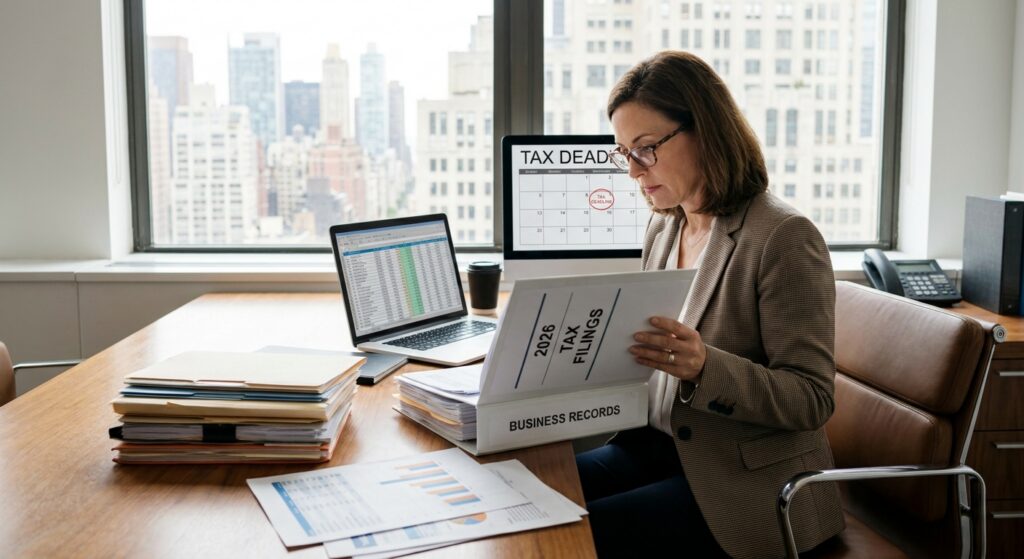
The Complete Guide to Finding the Best Tax Preparer in Manhattan for 2026

The Complete Guide to Finding the Best Tax Preparer in Manhattan for 2026
Finding the best tax preparer in Manhattan requires more than just a quick Google search. For 2026, with new tax deductions under President Trump’s “One Big Beautiful Bill Act,” complex self-employment tax rules, and potential Manhattan-specific tax considerations, business owners and high-net-worth individuals need specialized expertise to navigate the new landscape. This guide walks you through exactly what to look for, from credentials that matter to red flags you should avoid, and how to find a tax professional who truly maximizes your savings.
Table of Contents
- Key Takeaways
- What Credentials Matter for Manhattan Tax Preparers?
- Understanding the Different Types of Tax Preparers
- What Should You Expect to Pay?
- What Tax Strategies Should Your Manhattan Preparer Implement?
- Red Flags: What to Avoid When Choosing a Tax Preparer
- When Should You Switch Tax Preparers?
- Uncle Kam in Action: A Real Manhattan Success Story
- Next Steps
- Frequently Asked Questions
Key Takeaways
- The best tax preparer in Manhattan holds either a CPA license or EA credential and specializes in your business type.
- 2026 tax laws have created confusion—44% of taxpayers are unsure about new deduction eligibility.
- Self-employed workers face 15.3% self-employment tax; S-Corp elections can save thousands annually.
- Avoid preparers who promise unrealistic refunds or guarantee you’ll “beat the IRS”.
- Year-round tax planning beats reactive filing; the best tax preparer in Manhattan thinks quarterly, not just annually.
What Credentials Matter for Manhattan Tax Preparers?
Quick Answer: Look for a Certified Public Accountant (CPA) or Enrolled Agent (EA). These professionals must pass rigorous exams, maintain education credits, and are regulated by state boards and the IRS respectively.
When searching for the best tax preparer in Manhattan, understanding credentials is your first defense against unqualified preparers. Not all tax preparers are created equal, and Manhattan’s high-income clientele deserves professionals held to the highest standards.
CPA (Certified Public Accountant) Credentials
A CPA is the gold standard in tax preparation and accounting. To earn the CPA designation in New York, professionals must complete a bachelor’s degree (or equivalent) in accounting or a related field, accumulate 150+ hours of college education (most require a full master’s degree), pass the four-part CPA exam, and gain one year of verified work experience under a licensed CPA. Once licensed, CPAs must maintain continuing professional education (CPE) credits annually to keep their license active.
For Manhattan residents, CPAs are particularly valuable because they can represent clients before the IRS, provide litigation support, and give strategic business advice beyond just filing taxes. Many CPAs specialize in specific industries—real estate, tech, healthcare, or e-commerce—so finding one with expertise in your business type is crucial.
EA (Enrolled Agent) Credentials
An Enrolled Agent (EA) is a tax specialist licensed by the IRS to represent taxpayers in all matters before the agency. Unlike CPAs, EAs don’t need an accounting degree; instead, they must pass the three-part IRS Special Enrollment Examination (SEE) or have worked for the IRS for at least five years. EAs must also complete 72 hours of continuing education every three years.
EAs often cost less than CPAs while providing excellent tax preparation and representation services. For self-employed professionals, freelancers, and small business owners in Manhattan who need focused tax expertise without the premium pricing, an EA can be an excellent choice.
Credentials to Avoid or Verify Carefully
Be cautious of preparers who hold no professional credentials beyond “tax preparer” or “bookkeeper.” While tax preparers (unlicensed) can prepare returns, they cannot represent you before the IRS. Similarly, bookkeepers focus on record-keeping, not tax strategy. A tax preparer lacking CPA or EA credentials may be perfectly competent for simple returns, but they’re not qualified for complex business taxation, entity structuring, or IRS disputes—all critical for Manhattan’s high-income earners.
Understanding the Different Types of Tax Preparers
Quick Answer: Choose between a solo practitioner (personalized, lower cost), a small firm (balanced expertise), a mid-size firm (specialized services), or a large national firm (extensive resources, higher fees).
The best tax preparer in Manhattan comes in different shapes and sizes. Your choice depends on your complexity, budget, and preferences for personalized service versus extensive resources.
Solo Practice CPAs and EAs
Solo practitioners typically offer highly personalized service and direct access to your tax professional. They often cost 20-30% less than firms because they have lower overhead. However, during tax season, solo practitioners may be busy, and they may lack specialists for complex issues like international taxation or business structuring.
Small Tax Firms (2-10 Professionals)
Small firms offer a good balance. They have multiple professionals to share the workload, provide some specialization, and maintain personal relationships. Many Manhattan small firms specialize in real estate investors, business owners, or high-net-worth individuals. They typically cost 15-50% more than solo practitioners but less than large firms.
Large National Firms
Big firms (the “Big Four” or other national players) offer extensive resources: forensic accounting, business valuation, international tax planning, and litigation support. However, larger firms often charge premium fees, may assign junior staff to routine work, and may feel impersonal. They’re ideal for ultra-high-net-worth individuals and complex multi-entity structures but may be overkill for most business owners.
What Should You Expect to Pay?
Quick Answer: Manhattan tax preparer costs range from $1,500-$5,000+ for business owners, depending on complexity, firm size, and specialization. Hourly rates are typically $150-$400/hour.
Cost is a major factor when selecting the best tax preparer in Manhattan, but the cheapest option is rarely the best value. Here’s what 2026 pricing looks like across different service types and preparer types.
| Tax Preparer Type | Simple 1040 + Schedule C | Business Return (1120-S) | Complex/HNW |
|---|---|---|---|
| Solo CPA/EA | $1,200-$2,000 | $2,000-$4,000 | $3,500-$6,000+ |
| Small Firm (2-10) | $1,500-$3,000 | $3,000-$6,000 | $5,000-$12,000+ |
| Large National Firm | $2,500-$4,000 | $5,000-$15,000 | $10,000-$50,000+ |
Manhattan’s market is expensive. Urban areas command premiums of 20-40% over national averages due to higher overhead, rent, and client concentration. A solo EA in Manhattan charging $250/hour for tax prep may be comparable in value to a solo EA charging $175/hour elsewhere.
Pro Tip: Ask about bundled year-round tax planning. A preparer charging $4,000 for annual filing but including quarterly planning may save you more through proactive strategy than one charging $2,500 for reactive-only filing. In 2026, with new deductions confusing 44% of taxpayers, proactive guidance is invaluable.
What Tax Strategies Should Your Manhattan Preparer Implement?
 Free Tax Write-Off Finder
Quick Answer: The best tax preparer in Manhattan proactively plans S-Corp elections, maximizes retirement contributions ($24,500 in solo 401k for 2026), and leverages new deductions under the One Big Beautiful Bill Act.
Finding the best tax preparer in Manhattan isn’t just about filing your return—it’s about a professional who understands your business and implements year-round strategies to minimize tax liability legally. Here are the critical strategies your Manhattan tax preparer should discuss with you in 2026.
Self-Employment Tax Mitigation for Freelancers and Solo Business Owners
If you’re self-employed in Manhattan, you’re paying 15.3% self-employment tax (12.4% Social Security up to $184,500 in 2026, plus 2.9% Medicare). On $100,000 of net income, that’s $15,300 in self-employment taxes alone—before any federal income tax.
The best tax preparer in Manhattan will explore S-Corp election for clients earning $50,000-$60,000+ annually. By electing S-Corp status, you split income between a reasonable W-2 salary (subject to payroll tax) and distributions (not subject to self-employment tax). Example: $100,000 in business income as an S-Corp with a $60,000 salary and $40,000 distribution saves $4,960 annually in Social Security taxes ($40,000 × 12.4%). You can use our Small Business Tax Calculator to model these scenarios for your specific situation.
Maximizing Retirement Contributions in 2026
For 2026, self-employed professionals can contribute up to $24,500 as an employee to a solo 401(k), plus employer contributions up to 25% of compensation (with a $360,000 annual compensation limit). If you’re age 50 or older, you can add a catch-up contribution of $8,000 (or $11,250 if you’re 60-63). This is tax-deferred income that reduces your current tax burden while building retirement savings.
A quality Manhattan tax preparer will integrate retirement contributions into your quarterly tax planning, ensuring you’re maximizing tax-advantaged savings without surprising yourself with a shortfall at year-end.
Leveraging New 2026 Deductions Under the One Big Beautiful Bill Act
President Trump’s “One Big Beautiful Bill Act,” effective 2026, introduced new deductions that created confusion among 44% of taxpayers. The best tax preparer in Manhattan will help you understand and claim applicable deductions, including the new senior deductions, enhanced educator expense deductions, and expanded business deductions for specific industries. Your preparer should proactively audit your situation quarterly to ensure you’re capturing all eligible deductions.
Red Flags: What to Avoid When Choosing a Tax Preparer
Quick Answer: Avoid preparers who promise unrealistic refunds, don’t ask for detailed financial records, pressure you into aggressive deductions, or lack verifiable credentials.
The IRS reports that scams targeting confused taxpayers spike during tax season, especially in 2026 when many are unsure about new deduction eligibility. Here are the biggest red flags when vetting tax preparers in Manhattan:
- Promises of unrealistic refunds: “I’ll get you $15,000 back guaranteed” before reviewing your financial details.
- Lack of credential verification: They can’t provide proof of CPA or EA status, or don’t have an IRS tax identification number.
- No documentation requested: A legitimate preparer requires detailed income statements, expense records, and business records before filing.
- Aggressive deduction claims: “You can claim this even though you don’t qualify” or suggestions to over-value business expenses.
- Cash-only fees: Legitimate firms provide invoices and professional records; cash-only arrangements indicate they may lack accountability.
- No representation agreement: The best tax preparer in Manhattan signs a representation agreement with you outlining fees, scope, and liability.
- Can’t explain the return: They won’t walk you through their recommendations or answer questions about deduction rationale.
Pro Tip: Verify CPA credentials directly through the New York State Society of CPAs or EA credentials through the National Association of Enrolled Agents. Don’t rely on their word alone.
When Should You Switch Tax Preparers?
Quick Answer: Switch if your preparer lacks credentials, doesn’t provide year-round planning, misses deductions, charges unreasonably, or can’t explain their recommendations clearly.
The best tax preparer in Manhattan earns your continued business by delivering value year after year. Here are signs it’s time to find a new professional:
- You’re consistently leaving money on the table due to missed deductions or unoptimized structures.
- Your preparer avoids quarterly planning and only contacts you in March.
- You’ve been audited or received IRS corrections that your preparer should have caught.
- Your business complexity has outgrown their expertise (e.g., you expanded internationally or opened a second entity).
- They can’t explain their work clearly or become defensive when questioned.
- Your fees have increased dramatically without corresponding increases in service or value.

Uncle Kam in Action: A Real Manhattan Success Story
Meet Sarah Chen: A freelance digital marketing consultant earning $180,000 annually in Manhattan. Sarah had been filing her taxes using an online platform, claiming standard deductions and minimal business expenses. She paid roughly $28,000 in annual self-employment taxes ($180,000 × 15.3% × 0.93 after SE tax deduction consideration).
When Sarah engaged with Uncle Kam for business owner tax strategies, the analysis revealed several missed opportunities:
- S-Corp Election: By electing S-Corp status, Sarah could pay herself a $110,000 W-2 salary (reasonable for her industry) and take $70,000 as distributions. This reduced self-employment taxes by approximately $8,680 annually ($70,000 × 12.4%).
- Solo 401(k) Contributions: Uncle Kam helped Sarah establish a solo 401(k) and contribute $24,500 in 2026 employee deferrals plus $17,500 in employer contributions ($70,000 W-2 salary × 25%), totaling $42,000 in tax-deferred retirement savings.
- Business Expense Optimization: Sarah’s home office (25% of her apartment) qualified for $6,000 in deductions. Professional development courses, software subscriptions, and equipment purchases she hadn’t tracked added another $8,500.
- 2026 New Deductions: Under the One Big Beautiful Bill Act, Sarah qualified for expanded business deductions for digital services that she hadn’t claimed previously, saving another $2,200 in taxes.
The Results: Sarah’s first year with professional tax strategy resulted in:
- $8,680 in reduced self-employment taxes (S-Corp election)
- $11,400 in deferred federal income taxes (retirement contributions)
- $3,570 in additional federal income tax savings (business deductions + new deductions)
- Plus $42,000 in retirement savings she wasn’t making before
Total First-Year Tax Savings: $23,650
Sarah’s Uncle Kam tax strategist charged $4,200 for comprehensive tax planning, entity structuring, and filing, representing a 462% return on investment in the first year alone. More importantly, the strategy is now built into her ongoing quarterly planning, so she’ll continue reaping these savings year after year.
Sarah’s story illustrates why finding the best tax preparer in Manhattan isn’t an expense—it’s an investment that pays dividends immediately and compounds over time.
Next Steps
Ready to find your best tax preparer in Manhattan? Here’s your action plan:
- Step 1 – Verify Credentials: Ask candidates for their CPA or EA credentials and verify them directly with the state or IRS.
- Step 2 – Request a Consultation: Schedule 15-30 minute consultations with 2-3 candidates. Ask about their experience with your business type and their approach to year-round planning.
- Step 3 – Get a Proposal: Request a written proposal with detailed fees, scope of services, and what’s included in planning versus separate expenses.
- Step 4 – Check References: Ask for 2-3 client references (they may be bound by confidentiality, so expect limited details) or online reviews from platforms like Google or professional associations.
- Step 5 – Start Small: For your first engagement, you might request just tax planning and filing for 2026 to evaluate the relationship before committing to ongoing quarterly services.
- Step 6 – Schedule a Tax Strategy Review: Contact Uncle Kam’s business tax strategists for a complimentary review of your current tax situation and opportunities to save in 2026 and beyond.
Frequently Asked Questions
Is a CPA better than an EA for the best tax preparer in Manhattan?
Not necessarily. Both CPAs and EAs can represent you before the IRS and prepare complex returns. CPAs have broader business advisory capabilities and can provide audit and consulting services beyond taxation. EAs specialize purely in tax matters and often cost less. For most small business owners and freelancers in Manhattan, an experienced EA is equally qualified and may offer better value. Choose based on expertise and fit rather than credentials alone.
How much can I save with an S-Corp election?
Savings depend on your income and the reasonable salary you can justify. On $100,000 in net self-employment income, taking $60,000 as salary and $40,000 as distributions saves approximately $4,960 in Social Security taxes annually. On $200,000+ income, savings can exceed $12,000+ per year. However, S-Corp elections involve additional compliance costs (payroll processing, quarterly filings), typically $1,000-$2,000 annually, so they’re most beneficial above $60,000 in net income.
When should I switch from a tax preparer to a full CPA firm?
Switch when your business becomes complex enough to require ongoing advisory services beyond annual filing. Typical triggers include: multiple business entities, international operations, significant real estate holdings, substantial investment income, or professional liability concerns. Most freelancers and small business owners can thrive with a skilled EA or sole-practice CPA; the best tax preparer in Manhattan scales with your business.
Can a tax preparer help me with an IRS audit?
CPAs and EAs can represent you before the IRS during audits and appeals. Unlicensed tax preparers typically cannot. If audit risk is a concern, working with a CPA or EA is essential. Your representative can respond to IRS inquiries, provide substantiation, and negotiate on your behalf, which can save significant time and stress.
What documents should I provide to the best tax preparer in Manhattan?
Provide your preparer with all income documentation (1099s, W-2s, business income statements), expense records (receipts, invoices, statements), loan and mortgage documents, investment statements, business tax records from previous years, and documentation of any business structure changes. Organized records streamline the process, reduce costs, and minimize errors. Your preparer should provide a detailed checklist of required documents before your engagement.
How often should I meet with my tax preparer?
The best tax preparer in Manhattan will suggest quarterly check-ins. These meetings review estimated payments, discuss upcoming deductions, adjust withholdings if necessary, and ensure you’re on track toward your tax goals. If your situation is simple and relatively static, annual meetings may suffice. However, if your income fluctuates or your business structure changes, quarterly planning prevents surprises and maximizes savings opportunities.
What is the One Big Beautiful Bill Act and how does it affect my 2026 taxes?
Passed in July 2025, this legislation introduced new deductions and tax benefits for 2026, including tax-free tips and overtime, expanded senior deductions, and enhanced business deductions for specific industries. However, 44% of taxpayers are confused about eligibility. The best tax preparer in Manhattan will audit your situation quarterly to ensure you’re claiming all applicable new deductions and staying compliant with the updated rules.
Is the best tax preparer in Manhattan always local?
Not necessarily. Many excellent firms operate virtually and serve Manhattan clients remotely. A CPA or EA with deep expertise in your industry or business type may be more valuable than a geographically local generalist. That said, some clients prefer in-person relationships or have complex situations requiring face-to-face meetings. Consider both local and remote options; the best fit depends on your preferences and needs.
Last updated: April, 2026

