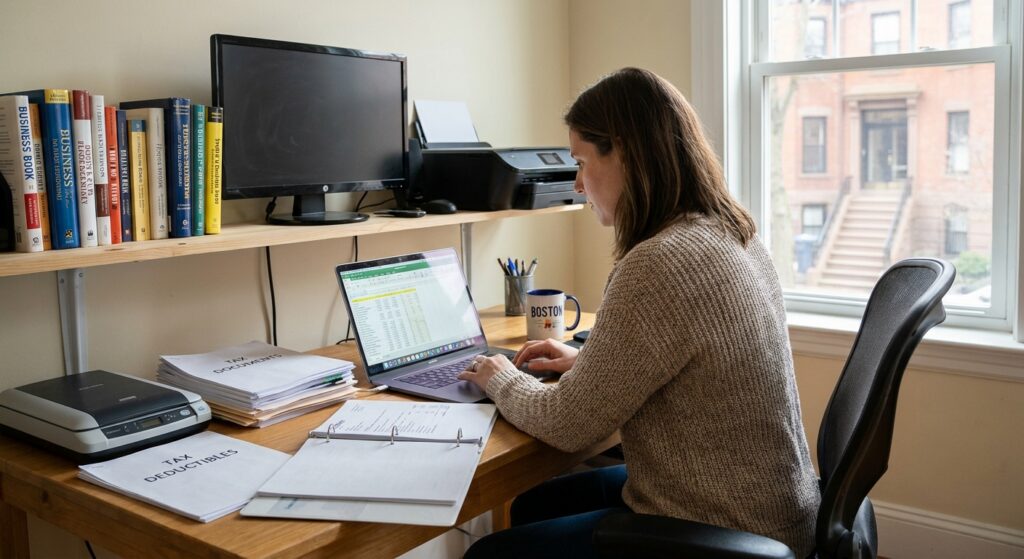
The Complete Guide to Boston Freelancer Taxes for 2026: Maximize Your Deductions and Minimize Tax Liability
The Complete Guide to Boston Freelancer Taxes for 2026: Maximize Your Deductions and Minimize Tax Liability
As a Boston freelancer, understanding your 2026 tax obligations is critical to protecting your income and building a sustainable business. With federal self-employment taxes, Massachusetts state income taxes, and estimated quarterly payments all weighing on your bottom line, many freelancers overpay or miss important deductions. This guide covers everything you need to know about Boston freelancer taxes for 2026, including federal and state requirements, deduction strategies, and actionable steps to reduce your tax burden while staying fully compliant with IRS regulations.
Table of Contents
- Key Takeaways
- Understanding Self-Employment Tax for Freelancers
- Massachusetts State Income Tax Requirements
- Common Deductions Boston Freelancers Overlook
- Quarterly Estimated Payments: Staying Ahead
- What Are the Tax Advantages of Forming an LLC or S-Corp?
- Maximizing Retirement Contributions as a Freelancer
- Uncle Kam in Action
- Next Steps
- Frequently Asked Questions
Key Takeaways
- Boston freelancers pay 15.3% self-employment tax on net earnings for 2026.
- Massachusetts charges a flat 5.85% state income tax on freelance earnings.
- Quarterly estimated tax payments are required if you expect to owe $1,000 or more.
- Forming an LLC or S-Corp can save thousands in taxes through income splitting and deduction strategies.
- Home office, equipment, software, and education expenses are fully deductible business costs.
Understanding Self-Employment Tax for Freelancers
Quick Answer: Boston freelancers pay 15.3% self-employment tax on net earnings after deducting half the tax itself. This covers both Social Security and Medicare portions for 2026.
Self-employment tax is the most significant tax burden for Boston freelancers. Unlike traditional employees who split payroll taxes with employers, you pay the entire self-employment tax obligation from your net freelance income. For 2026, the self-employment tax rate remains 15.3% of your net self-employment income after adjustments.
This 15.3% breaks down into two components: 12.4% for Social Security and 2.9% for Medicare. However, you can deduct half of your self-employment tax when calculating your adjusted gross income (AGI), which reduces your overall federal income tax liability.
How Self-Employment Tax Is Calculated
To understand your 2026 self-employment tax obligation, you need to start with your net business income. Report all freelance earnings on Schedule C, then deduct allowable business expenses. Your net profit from Schedule C becomes the basis for self-employment tax calculation on Schedule SE. The IRS allows you to deduct 92.35% of your net earnings for SE tax purposes, plus the deduction of half your self-employment tax.
Pro Tip: Keep meticulous business expense records. Every legitimate deduction reduces your net income subject to self-employment tax, creating compounding tax savings.
Social Security Earnings Cap for 2026
The Social Security portion of self-employment tax (12.4%) applies only to earnings up to the annual threshold for 2026. Once you exceed the wage base limit, you no longer pay the 12.4% Social Security tax on additional earnings. However, the 2.9% Medicare tax applies to all your net self-employment income with no upper limit. This is crucial for high-earning Boston freelancers who should track their income carefully.
Massachusetts State Income Tax Requirements
Quick Answer: Massachusetts charges a flat 5.85% income tax on all freelance earnings for 2026, with no deductions for self-employment taxes. This is one of the key reasons to consider advanced tax planning strategies as a Boston freelancer.
Massachusetts has a flat 5.85% income tax rate that applies to all residents and freelancers, regardless of income level. Unlike federal income tax, which uses progressive tax brackets, Massachusetts does not offer graduated rates. Every dollar of freelance income above your standard deduction is taxed at the same 5.85% rate.
To calculate your Massachusetts state income tax, you start with your federal taxable income and apply state-specific adjustments. The standard deduction for 2026 is $13,150 for single filers and $26,300 for married filing jointly, providing a baseline exemption before state income tax applies.
Federal vs. Massachusetts Deductions
One important distinction: Massachusetts does not allow a deduction for self-employment taxes when calculating state income tax. You pay 5.85% state tax on your full net business income before deducting the self-employment tax. This means your combined federal and state tax burden on freelance income is substantial and requires strategic planning.
Pro Tip: Boston freelancers earning over $75,000 annually should consult a tax professional about forming an LLC or S-Corp to optimize state and federal tax liability.
Common Deductions Boston Freelancers Overlook
Quick Answer: Most Boston freelancers miss 20-30% of available deductions, leaving thousands in taxes unnecessarily paid. Home office, software subscriptions, professional development, and equipment are all fully deductible business expenses for 2026.
The IRS allows you to deduct all ordinary and necessary expenses incurred while running your freelance business. The challenge is knowing what qualifies and documenting it properly. Many Boston freelancers leave significant deductions on the table by not understanding what the IRS considers deductible.
Home Office Deduction
If you have a dedicated space in your Boston home used exclusively for your freelance work, you can claim the home office deduction. The IRS offers two methods for calculating this deduction. The simplified method allows $5 per square foot (up to 300 square feet, yielding a maximum $1,500 deduction). The regular method requires calculating your home’s operating expenses proportionally based on office space percentage.
The regular method is often more beneficial for freelancers with larger dedicated offices. You deduct a percentage of rent, utilities, internet, insurance, repairs, and depreciation based on your office’s square footage compared to your total home size. For example, a 150 sq ft office in a 1,500 sq ft home allows 10% of eligible home expenses as deductions.
Equipment and Technology Expenses
All equipment purchased specifically for your freelance business is deductible. This includes computers, monitors, keyboards, software subscriptions, printers, scanners, and other technology tools. Items over $2,500 may require depreciation over multiple years, but smaller equipment and software can often be expensed immediately under Section 179 of the tax code for 2026.
- Laptop and desktop computers
- Project management and accounting software
- Internet and phone services (business portion)
- Cloud storage and backup services
- Video conferencing and collaboration tools
Did You Know? Boston freelancers can deduct the cost of professional courses, certifications, and training directly related to their business. This includes design courses, coding bootcamps, and industry certifications.
Quarterly Estimated Payments: Staying Ahead
Quick Answer: If your 2026 freelance income is likely to exceed $400 after expenses, you must file quarterly estimated tax payments to avoid penalties and interest charges from the IRS.
As a Boston freelancer, you don’t have an employer withholding taxes from your paychecks. Instead, the IRS requires you to pay estimated taxes four times per year. These quarterly payments are due in April, June, September, and January of the following year.
Calculating Your Quarterly Estimated Tax
To calculate your estimated tax payments, project your 2026 freelance income and subtract expected business expenses. Multiply this net income by your combined federal (22-37% depending on bracket) and Massachusetts (5.85%) tax rates, then add self-employment tax (15.3%). Divide this total by four for your quarterly payment.
For 2026, if you expect to owe $1,000 or more in taxes, estimated quarterly payments are required. The IRS charges penalties and interest if you don’t pay enough throughout the year. A safer approach is using the “2026 tax return safe harbor” method, which bases your quarterly payment on 90% of your current year income or 100% of your prior year tax liability.
2026 Estimated Payment Dates
 Free Tax Write-Off FinderFind every write-off you’re leaving on the tableSelect your profile or type your situation — you’ll go straight to your resultsWho are you?
- Q1 (Jan-Mar): Due April 15, 2026
- Q2 (Apr-Jun): Due June 15, 2026
- Q3 (Jul-Sep): Due September 15, 2026
- Q4 (Oct-Dec): Due January 18, 2027
Pro Tip: Set up automatic transfers to a separate savings account each month to ensure your quarterly estimated payments are always ready. This prevents cash flow problems and late payment penalties.
What Are the Tax Advantages of Forming an LLC or S-Corp?
Quick Answer: Forming an S-Corp can save Boston freelancers $5,000-$15,000 annually through income splitting and reasonable salary strategies, while an LLC provides liability protection and flexibility in tax treatment for 2026.
Free Tax Write-Off FinderPro Tip: Set up automatic transfers to a separate savings account each month to ensure your quarterly estimated payments are always ready. This prevents cash flow problems and late payment penalties.
Quick Answer: Forming an S-Corp can save Boston freelancers $5,000-$15,000 annually through income splitting and reasonable salary strategies, while an LLC provides liability protection and flexibility in tax treatment for 2026.
One of the most powerful tax strategies for Boston freelancers is changing their business entity structure. While sole proprietorships (operating as a self-employed individual) offer simplicity, they expose you to higher self-employment taxes and personal liability. An LLC or S-Corp election can provide significant advantages.
S-Corp Income Splitting Strategy
When you elect S-Corp treatment, you pay yourself a “reasonable salary” on which you pay self-employment taxes (15.3%). The remaining profit can be distributed as dividends, which avoid self-employment tax. For example, if your freelance business generates $100,000 in profit, you might pay yourself a $60,000 salary (subject to SE tax) and take a $40,000 dividend distribution (not subject to SE tax).
The key is defining “reasonable” salary. The IRS requires your salary to reflect the work you perform. However, many Boston freelancers can justify paying themselves a reasonable salary substantially lower than total profit, creating significant tax savings.
Example Calculation: A Boston freelancer earning $100,000 yearly can use our LLC vs S-Corp Tax Calculator to estimate potential S-Corp savings. Many freelancers discover they can save $8,000-$12,000 annually in self-employment taxes through proper structuring.
LLC Benefits for Boston Freelancers
An LLC provides liability protection separating your personal assets from business liabilities. If a client sues, your personal home and savings are protected. Additionally, an LLC can be taxed as either a sole proprietorship (for simplicity) or as an S-Corp (for tax optimization). This flexibility allows you to change strategies as your income grows.
Maximizing Retirement Contributions as a Freelancer
Quick Answer: Boston freelancers can contribute up to 20% of net self-employment income to a SEP-IRA or Solo 401(k) for 2026, providing both retirement savings and immediate tax deductions.
One of the most overlooked tax deductions for Boston freelancers is retirement contributions. The IRS allows self-employed individuals to establish and fund retirement plans that provide substantial tax deductions while building long-term wealth.
SEP-IRA vs Solo 401(k) Comparison
| Feature | SEP-IRA | Solo 401(k) |
|---|---|---|
| 2026 Contribution Limit | 20% of net SE income, max $69,000 | $23,500 employee + 20% employer, max $69,000 |
| Setup Complexity | Simple, minimal paperwork | More complex, annual reporting required |
| Loan Provisions | Not available | Can borrow up to $50,000 |
| Best For | Freelancers seeking simplicity | High-income freelancers wanting flexibility |
New 2026 Retirement Opportunities
Starting in 2027, the federal government is launching the Saver’s Match program for freelancers and small business owners who don’t have access to employer retirement plans. This program provides up to $1,000 in federal matching contributions for qualified savers, effectively doubling your retirement savings impact for lower and moderate-income freelancers.
Pro Tip: Even if you have a Solo 401(k) or SEP-IRA, track your income carefully for 2027 to determine Saver’s Match eligibility, which requires income under $35,500 for single filers or $71,000 for married couples.

Uncle Kam in Action: Boston Freelancer Transforms Tax Strategy
Sarah, a Boston-based marketing consultant, was operating as a sole proprietor and paying an estimated $32,000 annually in combined federal and Massachusetts taxes on her $120,000 freelance income. She felt trapped, knowing her effective tax rate was over 26% but unsure how to reduce it legally.
After consulting with an Uncle Kam advisor, Sarah restructured her freelance business as an LLC taxed as an S-Corp. The strategy involved: (1) paying herself a reasonable salary of $72,000 (subject to self-employment tax), (2) taking the remaining $48,000 as a profit distribution (not subject to SE tax), (3) claiming a $15,000 home office deduction, and (4) maximizing business expense deductions.
Under her new structure, Sarah reduced her self-employment tax by roughly $5,600 (15.3% on the $48,000 distribution). Combined with increased business expense deductions worth $3,200 in tax savings, Sarah’s first-year tax savings totaled $8,800. Her investment of $600 in LLC formation and S-Corp elections yielded a 1,467% return on investment in year one.
More importantly, Sarah’s new business structure provided liability protection. She established a SEP-IRA and contributed $20,000 that year (tax-deductible), further reducing her taxable income. Over five years, this strategy is projected to save Sarah over $38,000 in taxes while building retirement savings.
Next Steps
Take action on your 2026 Boston freelancer tax strategy today:
- Track all business expenses: Set up a system to record every deductible expense using accounting software.
- Calculate quarterly estimates: Use your 2025 tax return to estimate 2026 quarterly payments due April, June, September, and January.
- Evaluate entity structure: Determine if forming an LLC or establishing an S-Corp through a Massachusetts tax preparation specialist could reduce your liability.
- Maximize retirement contributions: Open a SEP-IRA or Solo 401(k) and contribute at least 10% of net income.
- Schedule a consultation: Connect with a tax professional for a complete 2026 tax strategy review.
Frequently Asked Questions
What is the self-employment tax rate for Boston freelancers in 2026?
The 2026 self-employment tax rate is 15.3%, consisting of 12.4% for Social Security (up to the wage base limit) and 2.9% for Medicare (no limit). You can deduct half of your self-employment tax when calculating your adjusted gross income, reducing your federal income tax burden.
Do I need to file quarterly estimated taxes if I earn less than $20,000 annually?
If you expect to owe $1,000 or more in taxes for 2026, you must file quarterly estimated payments regardless of income level. Many freelancers earning $20,000 still owe over $1,000 in combined self-employment and income taxes, making quarterly payments mandatory. Consult a tax professional to determine your specific threshold.
Can I deduct my home office if I don’t have a separate room?
The IRS requires your home office space to be used “regularly and exclusively” for business. This typically means a dedicated room or clearly delineated area used only for work. A portion of your dining room table would not qualify, but a home office corner exclusively used for freelance work might if properly documented.
What business expenses can Boston freelancers deduct in 2026?
The IRS allows deduction of all ordinary and necessary business expenses. Common deductible items for freelancers include: professional software and subscriptions, equipment (computers, phones, printers), office supplies, professional development and training, client travel, website hosting and domain registration, insurance (business liability), accounting and legal services, and utilities (home office portion).
Should I form an S-Corp if I earn $60,000 annually?
At $60,000 annual income, S-Corp benefits are modest (typically $1,500-$2,500 in annual savings). When you factor in additional accounting costs for S-Corp compliance (often $1,500-$3,000 annually), the benefit may be minimal. For income under $80,000, focusing on maximizing deductions and retirement contributions often provides better value than entity restructuring.
Can I deduct my entire internet bill as a business expense?
You can only deduct the business percentage of your internet bill. If you use the internet 60% for business and 40% for personal use, you can deduct 60% of your bill. Maintain detailed records documenting your business vs. personal use percentage. The IRS closely scrutinizes this deduction, so conservative estimates backed by documentation are advisable.
What happens if I miss a quarterly estimated tax payment deadline?
Missing a quarterly payment may result in IRS penalties and interest. However, the penalty is calculated on the shortfall amount for the specific quarter, not your entire tax bill. If you miss a payment, file Form 1040-ES for the missed quarter as soon as possible. You can also catch up at tax time, though paying during the year is preferable.
Is freelance income from multiple clients taxed differently?
No. All freelance income from any source is combined and reported on Schedule C as net self-employment income. It doesn’t matter if you have one client or fifty; the total is subject to the same self-employment tax (15.3%) and income tax rates. However, keeping expenses organized by client can simplify accounting and tax preparation.
Related Resources
- Complete Self-Employed Tax Planning Guide
- 2026 Tax Strategy for Freelancers and Contractors
- LLC vs S-Corp: Which Business Entity Structure Is Right for You?
- Tax Planning for Business Owners
- Work with a Tax Advisor for Personalized Planning
Last updated: May, 2026
Compliance Notice: This information is current as of 5/4/2026. Tax laws change frequently. Verify updates with the IRS or a Massachusetts tax professional if reading this later in the year.

