
Texas Tax Conformity Federal Changes 2026: Complete Compliance Guide for Tax Professionals
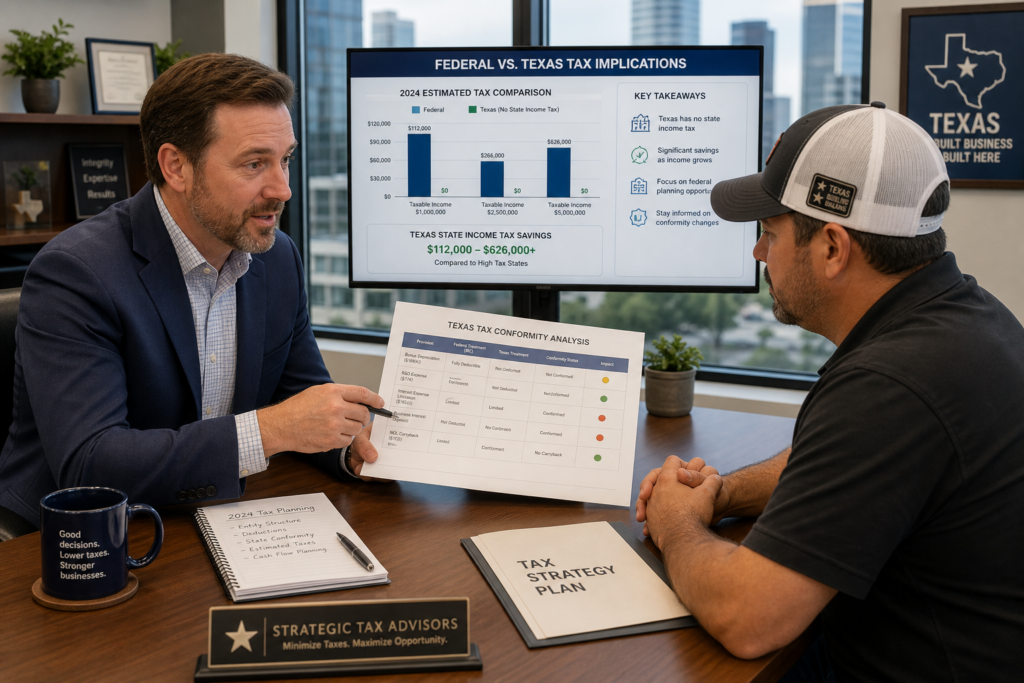
For the 2026 tax year, understanding Texas tax conformity federal changes 2026 is critical for tax professionals advising businesses and high-income clients. Texas maintains no state income tax but aligns selectively with federal provisions through its franchise tax system. With major federal legislation effective in 2026, including provisions from the One Big Beautiful Bill Act and evolving IRS compliance requirements, tax advisors must navigate complex conformity issues to protect clients and capture planning opportunities.
Table of Contents
Used by 2,400+ tax professionals
- Key Takeaways
- What Are the Key Federal Tax Changes Affecting Texas Businesses in 2026?
- How Does Texas Franchise Tax Conform to Federal Changes?
- What Is the FATCA Deadline and Why Does It Matter for Texas Professionals?
- How Should Texas Tax Pros Advise Clients on Bonus Depreciation Changes?
- What Are the Compliance Risks with State-Federal Divergence?
- Uncle Kam in Action: Texas Manufacturing Client
- Next Steps
- Frequently Asked Questions
- Related Resources

Key Takeaways
- Texas has no state income tax but selectively conforms to federal changes through franchise tax calculations.
- FATCA certification deadline of July 1, 2026 affects financial institutions and multinational entities in Texas.
- The One Big Beautiful Bill Act restores 100% bonus depreciation for 2026.
- Federal R&D expensing changes create immediate deduction opportunities for Texas businesses in 2026.
- Tax professionals must track both federal and franchise tax implications for accurate client planning.
What Are the Key Federal Tax Changes Affecting Texas Businesses in 2026?
Quick Answer: The One Big Beautiful Bill Act signed July 4, 2025 brings major changes effective for 2026. Key provisions include restored 100% bonus depreciation, immediate R&D expense deductions, and modified international tax rules.
Federal tax legislation for 2026 creates significant planning opportunities for Texas businesses. The IRS implemented several provisions from the One Big Beautiful Bill Act that directly impact business owners, real estate investors, and high-income professionals operating in Texas. Understanding these changes is essential for tax professionals developing proactive strategies.
Major 2026 Federal Tax Law Changes
For the 2026 tax year, federal changes affect both individual and business owners across multiple areas. The restoration of bonus depreciation represents one of the most significant opportunities.
- Bonus Depreciation: Restored to 100% for qualified property placed in service during 2026
- R&D Expenses: Immediate expensing now allowed for domestic research and development costs
- Interest Limitation: Modified rules under Section 163(j) provide additional deduction capacity
- Retirement Contributions: 401(k) employee deferral limit increased to $24,500 for 2026
- International Provisions: Transition from GILTI to NCTI effective for 2026 tax year
Retirement Plan Limit Increases for 2026
Contribution limits for retirement accounts increased for 2026. Tax professionals should update client contribution strategies accordingly. The 401(k) employee deferral limit rose to $24,500, up from $23,500 in 2025. Catch-up contributions for participants age 50 to 59 and 64 or older remain at $8,000. The overall annual additions ceiling stands at $72,000 before catch-ups for 2026.
Pro Tip: Texas business owners can maximize 2026 retirement contributions through Solo 401(k) plans. Combined employee and employer contributions can reach up to $72,000 annually for qualifying individuals.
How Federal Changes Flow Through to Texas Businesses
While Texas imposes no state income tax, federal changes affect Texas businesses through multiple channels. Tax planning strategies must account for federal obligations, franchise tax implications, and interstate commerce considerations. Our Texas Tax Guide provides detailed analysis of these intersections for professional advisors.
Texas businesses with operations in multiple states face particularly complex planning scenarios. Federal conformity issues arise when other states adopt or reject federal tax base changes. Therefore, tax professionals serving multi-state Texas-based clients must track conformity legislation across all relevant jurisdictions.
How Does Texas Franchise Tax Conform to Federal Changes?
Quick Answer: Texas franchise tax uses federal taxable income as a starting point but applies its own modifications. The state selectively adopts federal provisions, creating planning opportunities and compliance challenges.
Understanding Texas tax conformity federal changes 2026 requires analyzing how the Texas Comptroller applies federal tax law to franchise tax calculations. Texas maintains a modified gross receipts tax called the franchise tax, which applies to most business entities doing business in the state.
Texas Franchise Tax Calculation Methods
The Texas franchise tax allows businesses to calculate tax liability using the lower of two methods. This creates strategic planning opportunities when federal changes affect the taxable margin calculation.
| Calculation Method | Formula | Federal Conformity Impact |
|---|---|---|
| Margin: Total Revenue | Total revenue minus $1 million deduction | Minimal federal impact |
| Margin: Cost of Goods Sold | Total revenue minus COGS | Federal inventory rules apply |
| Margin: Compensation | Total revenue minus compensation (capped at $450,000 per person) | Federal W-2 definitions used |
| Margin: 70% Revenue | Total revenue × 70% | No federal conformity |
Selective Federal Conformity Areas
Texas adopts specific federal definitions for franchise tax purposes. However, the state maintains flexibility to reject or modify federal provisions. For 2026, tax professionals must understand which federal changes Texas recognizes.
- Cost of goods sold calculations generally follow federal rules
- Compensation definitions align with federal W-2 reporting
- Bonus depreciation changes may not flow through to franchise tax
- R&D expense treatment requires separate Texas analysis
- Federal entity classification elections are respected
Multi-State Business Considerations
Texas businesses operating in multiple states must navigate varying conformity approaches. As noted by tax policy experts, states continue exploring alternative revenue generation methods. Some states impose gross receipts taxes or excise taxes that differ significantly from traditional income tax models. For Texas-based businesses expanding into other states, understanding these differences is crucial for accurate tax planning and compliance.
Additionally, entity structuring decisions made at the federal level can create unexpected state tax consequences. Tax professionals must evaluate whether federal elections like S corporation status or partnership classifications produce optimal results across all jurisdictions.
What Is the FATCA Deadline and Why Does It Matter for Texas Professionals?
Quick Answer: The Foreign Account Tax Compliance Act (FATCA) requires responsible officer certifications for the period ending December 31, 2025 to be submitted by July 1, 2026.
The FATCA compliance deadline represents a critical obligation for Texas tax professionals advising financial institutions, trusts, investment entities, or multinational clients. Missing this deadline triggers significant penalties and increased IRS scrutiny.
Who Must File FATCA Certifications?
Foreign financial institutions and other affected entities operating in or through Texas must submit responsible officer certifications. The certification confirms that internal controls function properly and that the entity complied with FATCA requirements during the certification period.
- Foreign financial institutions with U.S. account holders
- Investment entities managed by financial institutions
- Trusts with foreign beneficiaries or foreign trustees
- Multinational corporations with intercompany financing arrangements
- Insurance companies offering investment-linked products
Compliance Requirements and Deadlines
The July 1, 2026 deadline is firm. Tax professionals should begin preparation immediately if clients have not yet addressed this requirement. Proper documentation and internal control verification take significant time.
| Action Item | Timeline | Responsible Party |
|---|---|---|
| Review internal controls | Complete by May 15, 2026 | Responsible Officer |
| Gather supporting documentation | Complete by June 1, 2026 | Compliance Department |
| Prepare certification statement | Complete by June 15, 2026 | Tax Professional/Legal Counsel |
| Submit certification to IRS | No later than July 1, 2026 | Authorized Signatory |
Pro Tip: Tax professionals should schedule client meetings in May 2026 to review FATCA compliance. Waiting until June creates unnecessary deadline pressure and increases error risk.
Texas-Specific FATCA Considerations
Texas hosts significant international business activity through Houston’s energy sector, Dallas-Fort Worth’s corporate headquarters, Austin’s technology industry, and San Antonio’s military contracting. Financial institutions serving these industries must ensure robust FATCA compliance programs. Furthermore, proactive tax advisory services can help clients avoid penalties and maintain good standing with the IRS.
How Should Texas Tax Pros Advise Clients on Bonus Depreciation Changes?

Quick Answer: The One Big Beautiful Bill Act restored 100% bonus depreciation for qualified property placed in service during 2026. This creates significant tax savings opportunities for businesses making capital investments.
Bonus depreciation restoration represents one of the most valuable provisions in recent tax legislation. Texas businesses can immediately deduct the full cost of qualifying assets placed in service during 2026, rather than depreciating them over multiple years.
Qualifying Property Requirements
Not all business assets qualify for bonus depreciation. Tax professionals must verify that contemplated purchases meet all requirements before advising clients to rely on immediate expensing.
- Property must be new to the taxpayer (used property may qualify in limited circumstances)
- Original use must commence with the taxpayer after September 27, 2017
- Property must be placed in service during the 2026 tax year
- Qualified property includes machinery, equipment, computers, and vehicles
- Qualified improvement property for nonresidential real property qualifies
- Certain listed property faces additional restrictions
Strategic Timing Considerations
The restoration of 100% bonus depreciation for 2026 creates year-end planning opportunities. Businesses considering major equipment purchases should evaluate whether accelerating acquisitions into 2026 produces optimal tax results. However, tax professionals must balance immediate deductions against future depreciation benefits and potential changes in tax rates or business income levels.
Real Estate Investor Applications
Texas real estate investors can leverage bonus depreciation through cost segregation studies. These engineering-based studies identify property components that qualify for accelerated depreciation, converting slow 27.5-year or 39-year depreciation into immediate deductions through bonus depreciation.
For example, a commercial property acquisition in 2026 might generate $500,000 in bonus depreciation deductions from personal property components identified through cost segregation. This immediate tax benefit can significantly improve after-tax returns on real estate investments.
What Are the Compliance Risks with State-Federal Divergence?
Quick Answer: When states diverge from federal tax law, businesses face increased compliance complexity, potential double taxation, and higher professional fees. Texas businesses with multi-state operations face these risks acutely.
Understanding Texas tax conformity federal changes 2026 requires analyzing compliance risks that arise when state and federal rules diverge. While Texas has no income tax, Texas-based businesses operating in other states face complex conformity issues.
Common Divergence Scenarios
Tax professionals must identify conformity mismatches early in the planning process. Common scenarios include states that reject federal provisions for bonus depreciation, R&D expense treatment, or international tax changes. Additionally, some states impose gross receipts taxes or excise taxes that operate independently from federal income tax rules.
Documentation and Record-Keeping Requirements
Divergent conformity creates additional documentation burdens. Businesses must maintain separate records showing adjustments required for each jurisdiction. Tax software must accommodate these differences, and tax preparation processes become more complex and time-consuming.
Audit Risk Factors
State-federal divergence increases audit risk in multiple ways. Auditors from different jurisdictions may challenge the same transaction from different perspectives. Errors in tracking basis differences or conformity adjustments trigger penalties. Furthermore, aggressive positions taken on federal returns may not translate to state returns if the state has not adopted the underlying provision.
Pro Tip: Implement a conformity tracking matrix for multi-state clients. Document federal provisions, state adoption status, and required adjustments for each jurisdiction. This systematic approach reduces errors and demonstrates reasonable cause if questions arise.
Uncle Kam in Action: Texas Manufacturing Client Saves $180,000 Through Strategic Conformity Planning
A Houston-based manufacturing company with $12 million in annual revenue approached Uncle Kam in early 2026 facing a significant tax planning challenge. The company planned to purchase $1.5 million in new equipment and expand operations into three additional states. The CFO wanted to understand how federal tax changes and multi-state conformity issues would affect their 2026 tax liability.
The Challenge: The client operated in Texas, Louisiana, Oklahoma, and planned expansion into Arkansas and New Mexico. Each state had different conformity rules for bonus depreciation, R&D expenses, and apportionment. Previous tax advisors had not addressed state-specific planning, resulting in overpayments in prior years. The client needed comprehensive analysis of federal changes and state-by-state implications.
The Uncle Kam Solution: Our tax strategy team implemented a multi-layered approach addressing Texas tax conformity federal changes 2026 and multi-state exposure:
- Accelerated equipment purchases into Q4 2026 to capture full 100% bonus depreciation
- Restructured R&D activities to maximize immediate federal deductions
- Analyzed conformity positions in Louisiana and Oklahoma where partial bonus depreciation applied
- Implemented cost segregation study on Texas headquarters to identify additional deductions
- Established entity structure for new state operations minimizing franchise tax exposure
The Results: The comprehensive planning strategy delivered exceptional outcomes for 2026:
- Total Tax Savings: $180,000 across federal and state returns
- Investment: $18,000 in Uncle Kam advisory fees
- First-Year ROI: 10x return on investment
- Ongoing Benefits: Optimized entity structure reducing recurring state tax obligations
The client also gained confidence in their multi-state compliance posture. Uncle Kam documented all conformity positions, created a tracking system for ongoing compliance, and trained the internal accounting team on requirements. This proactive approach eliminated audit risk and positioned the company for profitable growth.
Ready to achieve similar results for your clients? Explore our comprehensive client success stories or contact our team to discuss strategic planning opportunities.
Next Steps
Tax professionals must take action now to address Texas tax conformity federal changes 2026 for their client base. The following steps ensure comprehensive planning and compliance:
- Review all Texas business clients for FATCA certification requirements before July 1, 2026
- Analyze capital expenditure plans to optimize bonus depreciation benefits for 2026
- Evaluate R&D activities for immediate expense deduction opportunities under new rules
- Update tax projection models to reflect restored bonus depreciation and modified provisions
- Schedule strategy sessions with high-value clients to discuss proactive tax planning for 2026
Consider partnering with Uncle Kam to access cutting-edge planning tools and expertise. Our platform provides tax professionals with the resources needed to deliver high-value advisory services and grow recurring revenue. Book a strategy session to explore how we can support your practice.
Frequently Asked Questions
Does Texas conform to all federal tax law changes for 2026?
No, Texas selectively conforms to federal provisions through its franchise tax system. While Texas has no state income tax, the franchise tax calculation references federal definitions for cost of goods sold and compensation. However, Texas maintains flexibility to reject specific federal provisions. Tax professionals must verify Texas conformity status for each material federal change.
What happens if Texas businesses miss the July 1, 2026 FATCA deadline?
Missing the FATCA certification deadline triggers significant consequences. The IRS may impose penalties, increase audit scrutiny, and potentially terminate the entity’s FATCA agreement. In severe cases, withholding agents may be required to withhold 30% on certain payments. Tax professionals should ensure all affected clients address this deadline well before July 1, 2026.
How does 100% bonus depreciation affect Texas franchise tax calculations?
Bonus depreciation’s impact on Texas franchise tax depends on which calculation method produces the lowest tax. The cost of goods sold method may not be affected, as Texas follows specific COGS rules. However, businesses using the 70% revenue method see no impact. Tax professionals should model all calculation methods to determine optimal franchise tax results for 2026.
Can Texas businesses still elect out of bonus depreciation for 2026?
Yes, businesses can elect out of bonus depreciation if beneficial. This election makes sense when current-year income is low and future-year income is expected to be higher, or when businesses want to preserve depreciation deductions for future tax brackets. The election must be made on a timely filed return and applies to all qualified property in the same class.
What documentation should Texas tax professionals maintain for conformity positions?
Comprehensive documentation includes copies of federal and state tax law provisions, conformity analysis memoranda, calculation worksheets showing adjustments, and contemporaneous notes explaining positions taken. For multi-state clients, maintain a jurisdiction-by-jurisdiction matrix tracking conformity status for major provisions. This documentation demonstrates reasonable cause if positions are challenged and supports professional liability defense.
How should tax pros bill for complex conformity analysis work?
Value-based pricing works best for strategic conformity planning. Rather than hourly billing, establish fixed fees based on client size, complexity, and value delivered. For example, charge $5,000-$15,000 for comprehensive multi-state conformity analysis that saves clients six figures. This approach aligns compensation with results and builds recurring advisory revenue. Consider bundling conformity analysis with year-end planning packages.
What are the biggest risks for Texas businesses with multi-state operations?
The primary risk is assuming all states follow federal tax law. Texas businesses expanding into California, New York, or other high-tax states often face unexpected tax bills when those states reject federal provisions. Additionally, nexus determination becomes complex when businesses have employees, inventory, or sales in multiple states. Tax professionals should conduct thorough nexus and conformity reviews before clients expand operations.
Related Resources
- Tax Strategy Services for Business Owners
- Tax Advisory Solutions for High-Value Clients
- Entity Structuring Optimization
- The MERNA Method: Comprehensive Tax Planning Framework
- Tax Strategy Blog: Latest Updates and Planning Insights
Last updated: June, 2026
This information is current as of 6/3/2026. Tax laws change frequently. Verify updates with the IRS or state comptroller if reading this later.

