
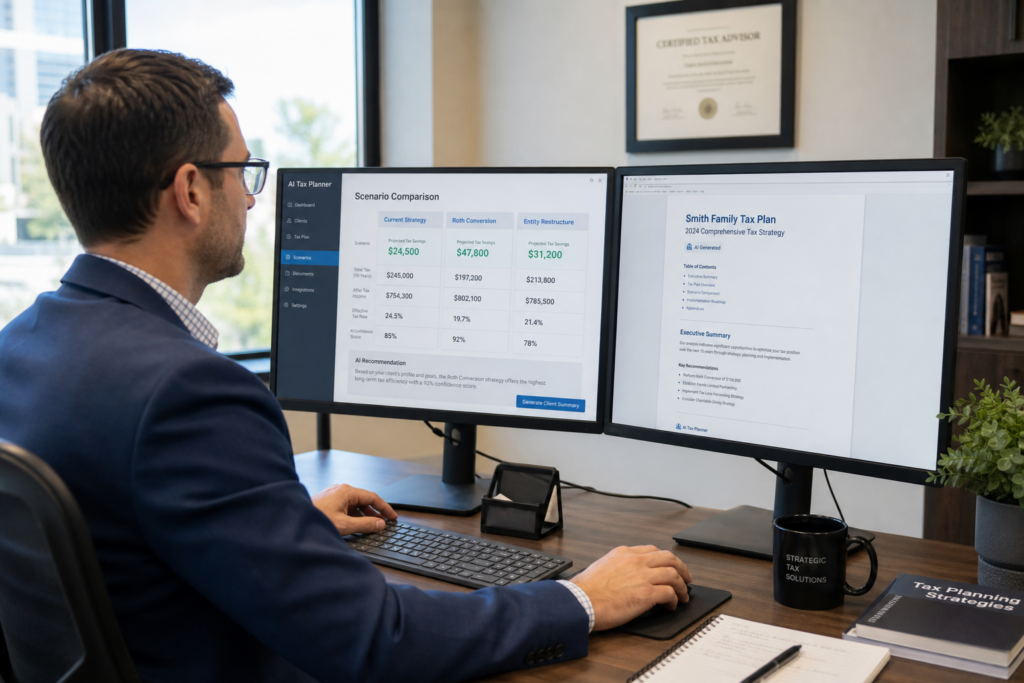
Tax Planning Software for Pros: 2026 Complete Guide
For the 2026 tax year, tax planning software has become essential for tax professionals seeking to deliver superior client results while scaling their advisory practice. AI-driven scenario modeling, entity optimization, and automated workflow tools distinguish modern platforms from legacy tax preparation systems. This guide provides tax professionals with everything needed to select and implement software that drives revenue growth and client satisfaction.
Table of Contents
Used by 2,400+ tax professionals
- Key Takeaways
- What Is Tax Planning Software and Why Do Tax Pros Need It in 2026?
- How Does AI Improve Tax Planning and Scenario Modeling?
- What Workflow Automation Features Should Tax Professionals Prioritize?
- How Does Entity Optimization Work in Modern Tax Software?
- What Integrations Matter Most for Tax Advisory Practices?
- How Do You Ensure Compliance and Data Security in 2026?
- What ROI Can Firms Expect from Tax Planning Software?
- Uncle Kam in Action: CPA Firm Increases Revenue by 287%
- Next Steps
- Frequently Asked Questions
- Related Resources

Key Takeaways
- Tax planning software with AI capabilities reduces planning time by 40% for 2026
- Entity-aware platforms model multi-entity scenarios across 1040s, 1120-Ss, and K-1s simultaneously
- Workflow automation eliminates manual errors and creates client-ready deliverables automatically
- 2026 compliance requires IRC Section 7216 adherence and robust data security protocols
- Modern platforms support unlimited assessments to convert prospects before engagement agreements
What Is Tax Planning Software and Why Do Tax Pros Need It in 2026?
Quick Answer: Tax planning software helps professionals identify tax-saving strategies, model scenarios, and generate client deliverables. For 2026, AI-powered platforms have become essential as client expectations rise and manual planning proves too time-intensive.
Tax planning software differs fundamentally from tax preparation software. While preparation tools focus on compliance and filing returns, planning software identifies proactive strategies that reduce tax liability. For 2026, the distinction has become critical as tax advisory services command premium fees while tax preparation faces commoditization pressure.
The 2026 tax landscape presents unique challenges for professionals. During the 2026 filing season, approximately 45% of individual tax returns filed claimed one or more new deductions from the Working Families Tax Cuts. These include tax breaks on tips, overtime, car loan interest, and benefits for senior citizens. Tax professionals who rely solely on preparation software miss strategic planning opportunities worth an average of $3,200 per client, according to IRS data released in June 2026.
Core Capabilities That Define Professional Tax Planning Software
Professional-grade tax planning software for 2026 must deliver several core capabilities that directly impact revenue generation and client retention. These capabilities separate advisory-focused platforms from basic calculators.
- Multi-year projection modeling that accounts for tax law changes beyond 2026
- Entity structure comparison across LLCs, S Corps, C Corps, and partnerships
- Strategy libraries covering 300+ tax reduction strategies current for 2026
- Client-ready deliverable generation with branded formatting options
- Integration with existing tax preparation and practice management systems
Why 2026 Marks the Tipping Point for Software Adoption
Several converging factors make 2026 the critical year for tax professionals to adopt advanced planning software. First, client sophistication has increased dramatically. Business owners research tax strategies online and arrive at appointments with specific questions about entity optimization, retirement planning, and advanced deductions.
Second, the competitive landscape has shifted. According to accounting industry research published in June 2026, firms offering proactive tax strategy services report 58% higher revenue per client than preparation-only practices. Third, AI technology has matured to deliver reliable results. Tax research AI usage doubled from 2025 to 2026, with professionals reporting significant time savings without accuracy concerns.
Pro Tip: Tax professionals transitioning from hourly to value-based pricing find planning software essential for justifying premium fees. Clients pay for outcomes, not time spent, making visual scenario comparisons invaluable.
How Does AI Improve Tax Planning and Scenario Modeling?
Quick Answer: AI analyzes complex tax scenarios in seconds rather than hours. For 2026, AI-driven platforms identify optimization opportunities across multiple entities, retirement vehicles, and deduction strategies simultaneously while ensuring compliance with current tax law.
Artificial intelligence transforms tax planning from a manual, time-intensive process into a strategic advantage. Traditional scenario modeling requires tax professionals to manually calculate variations, update spreadsheets, and verify compliance for each alternative. AI-powered tax planning software automates this entire workflow while maintaining accuracy standards that meet professional requirements.
In 2026, AI capabilities have advanced significantly beyond simple calculations. Modern platforms use contextual analysis to recommend strategies based on client-specific factors including industry, entity structure, income sources, and long-term business goals. This contextual awareness eliminates the generic recommendations that plagued earlier planning tools.
Entity-Aware Scenario Modeling Across Multiple Tax Returns
The most significant AI advancement for 2026 involves entity-aware architecture. Business owners often operate multiple entities—an S Corp for active business income, LLCs for real estate holdings, and personal 1040 returns for investment income. Legacy planning tools analyze each entity in isolation, missing optimization opportunities that span entity boundaries.
AI-driven platforms evaluate the entire entity portfolio simultaneously. They model how changing distributions from one S Corp affects qualified business income deductions on the 1040, how retirement contributions impact multiple entity structures, and how timing strategies across entities maximize overall tax savings. This holistic approach identifies opportunities that manual analysis misses.
Consider a client with $500,000 in S Corp income and $200,000 in rental property income. AI scenario modeling evaluates hundreds of combinations: varying reasonable compensation levels, adjusting retirement contributions across entities, timing income recognition, and optimizing depreciation schedules. The platform identifies the combination delivering maximum tax savings while maintaining IRS compliance for 2026 regulations.
The MERNA Framework for Strategy Sequencing
Advanced tax planning software organizes strategies using proven frameworks rather than presenting random recommendations. The MERNA methodology—Maximize Deductions, Entity Structure, Retirement, Niche, Advanced—provides a structured approach that tax professionals can explain to clients clearly.
For 2026, this framework proves particularly valuable given the new deductions available under the Working Families Tax Cuts. AI systems using MERNA first identify all available deductions, then optimize entity structure to maximize those deductions, followed by retirement planning that coordinates with entity choices, industry-specific strategies, and finally advanced techniques like cost segregation or Augusta Rule applications.
| MERNA Phase | 2026 Focus Areas | AI Analysis Capability |
|---|---|---|
| Maximize Deductions | Working Families Tax Cuts, home office, vehicle, meals | Identifies all applicable 2026 deductions based on client profile |
| Entity Structure | LLC vs S Corp, C Corp considerations, multi-entity optimization | Models tax impact across entity types with current 2026 rates |
| Retirement | 401(k), SEP-IRA, defined benefit plans, Roth conversions | Calculates contribution limits and tax benefits for multiple scenarios |
| Niche Strategies | Industry-specific deductions, real estate strategies, R&D credits | Matches client industry to applicable strategies from 300+ library |
| Advanced | Cost segregation, Augusta Rule, captive insurance, installment sales | Evaluates complex strategies with multi-year tax impact projections |
Pro Tip: When presenting AI-generated scenarios to clients, lead with the MERNA framework. Clients appreciate seeing strategies organized by implementation priority rather than an overwhelming list of disconnected recommendations.
What Workflow Automation Features Should Tax Professionals Prioritize?
Quick Answer: Workflow automation eliminates repetitive tasks, reduces errors, and frees professionals to focus on high-value advisory work. For 2026, prioritize automated data import, calculation verification, deliverable generation, and compliance checking.
Workflow automation represents the difference between tax planning software that saves time and software that creates more work. Firms report spending up to 40% less time on annual planning deliverables when using automation-focused platforms, according to industry surveys conducted in early 2026.
The most valuable automation features directly address time-consuming manual processes. These include automatic import of prior-year tax data, real-time calculation of complex scenarios, automatic generation of client-ready reports, and built-in compliance verification against current 2026 tax regulations.
Automated Data Import and Integration Architecture
Manual data entry creates bottlenecks and introduces errors. Professional tax planning software for 2026 must integrate seamlessly with existing systems to eliminate redundant data entry. This includes direct connections to tax preparation software, accounting systems, and practice management platforms.
Advanced platforms use API connections that automatically pull current-year tax return data, prior-year comparisons, and ongoing bookkeeping information. This real-time data access enables scenario modeling based on actual numbers rather than estimates, improving accuracy and client confidence in recommendations.
- Direct integration with major tax preparation platforms eliminates manual transfer
- Automated recognition of entity types and income sources from imported data
- Real-time synchronization ensures scenarios reflect current financial information
- Validation rules flag inconsistencies between imported data and manual entries
Client Deliverable Generators and Customization Options
Tax professionals spend significant time translating complex scenarios into client-friendly presentations. Modern planning software automates this process by generating professional deliverables that require minimal customization. For 2026, clients expect visual comparisons, clear explanations, and actionable implementation roadmaps.
The best platforms offer customizable templates that maintain your firm’s branding while automatically populating client-specific data, scenario comparisons, strategy recommendations, and implementation timelines. These deliverables transform raw calculations into marketing tools that demonstrate value and justify premium advisory fees.
Advanced deliverable features for 2026 include executive summaries optimized for non-technical audiences, detailed technical appendices for sophisticated clients, visual scenario comparisons using charts and graphs, implementation checklists with assigned responsibilities, and multi-year projection summaries showing cumulative tax savings.
How Does Entity Optimization Work in Modern Tax Software?
Quick Answer: Entity optimization software models tax outcomes across different business structures. For 2026, this includes comparing LLCs, S Corps, C Corps, and partnerships while accounting for self-employment taxes, QBI deductions, and state tax implications.
Entity structure decisions represent some of the highest-value recommendations tax professionals make. The difference between operating as a sole proprietorship versus an S Corporation can save clients tens of thousands annually. Professional tax planning software quantifies these differences using 2026 tax rates and regulations.
For business owners, entity optimization involves more than simple calculations. Software must account for self-employment tax savings, reasonable compensation requirements for S Corps, qualified business income deductions, state tax implications, and long-term considerations including exit planning and estate planning. The IRS S Corporation guidance provides specific requirements that compliant software must incorporate.
LLC vs S Corp Modeling with Reasonable Compensation Analysis
The most common entity optimization scenario involves comparing LLC taxation versus S Corporation election. LLCs offer simplicity and flexibility but subject all business income to self-employment tax. S Corporations provide self-employment tax savings on distributions but require reasonable salary payments and additional compliance burdens.
Professional software automates the reasonable compensation analysis by referencing industry benchmarks, considering owner responsibilities, and ensuring IRS compliance. For 2026, this analysis must account for the expanded deductions available under the Working Families Tax Cuts and their interaction with S Corp structures.
| Entity Type | Self-Employment Tax | QBI Deduction | Compliance Complexity |
|---|---|---|---|
| Single-Member LLC (Disregarded) | 15.3% on all business income | Available up to 20% of qualified income | Low – Schedule C filing |
| S Corporation | 15.3% only on W-2 salary portion | Available on distributions (with limitations) | Medium – Form 1120-S, payroll requirements |
| C Corporation | None (corporate entity pays tax) | Not applicable to C Corps | High – Double taxation, Form 1120, complex rules |
Multi-Entity Strategies for Real Estate and Operating Businesses
Sophisticated clients often benefit from multi-entity structures that separate operating businesses from real estate holdings, isolate liability, and optimize tax treatment for different income types. Tax planning software must model these complex arrangements accurately.
For example, real estate investors operating both fix-and-flip businesses and rental properties may use an S Corp for active business income and separate LLCs for passive rental income. Software must calculate self-employment tax savings on the S Corp, passive activity loss limitations on rentals, and optimal income allocation between entities for 2026.
Pro Tip: When presenting multi-entity strategies, always include a visual entity structure chart in your deliverable. Clients understand organizational diagrams far better than verbal explanations of complex ownership arrangements.
What Integrations Matter Most for Tax Advisory Practices?

Quick Answer: Essential integrations include tax preparation software, accounting platforms, CRM systems, and document management tools. For 2026, seamless data flow between systems eliminates duplicate entry and ensures scenario accuracy.
Integration capabilities determine whether tax planning software enhances your workflow or creates additional work. Standalone systems that require manual data entry and separate deliverable creation waste time and introduce errors. Professional platforms integrate deeply with your existing technology stack.
For 2026, tax professionals should prioritize software that offers native integrations or robust API connections to major tax preparation platforms, accounting systems like QuickBooks and Xero, practice management and CRM tools, and document management systems. These integrations enable automated workflows from client data collection through scenario modeling to final deliverable presentation.
Tax Preparation Software Integration Requirements
The most critical integration connects planning software to your tax preparation platform. This integration should automatically pull completed tax return data, enabling scenario modeling based on actual filed information rather than estimates. For 2026, this includes current-year returns, prior-year comparisons, and multi-year trend analysis.
Advanced integrations also push planning recommendations back into preparation software. When you identify a strategy for next year, the integration should create reminders, flag required forms, and ensure implementation during the following tax season. This closed-loop workflow prevents strategies from being recommended but never implemented.
Practice Management and CRM System Synchronization
Tax advisory represents a recurring revenue opportunity, not a one-time service. Integration with practice management and CRM systems enables systematic advisory outreach, tracks client planning cycles, and identifies cross-sell opportunities. For 2026, successful firms use these integrations to automate planning engagement workflows.
Integration features should include automatic client record updates when planning engagements complete, task creation for strategy implementation follow-up, revenue tracking for advisory versus compliance services, and automated scheduling for annual planning reviews. These capabilities transform advisory from ad-hoc services into predictable recurring revenue.
How Do You Ensure Compliance and Data Security in 2026?
Quick Answer: Compliance requires IRC Section 7216 adherence, SOC 2 certification, and robust data encryption. For 2026, verify that software providers maintain U.S.-based data storage and processing with transparent security protocols.
Data security and compliance represent non-negotiable requirements for tax professionals. Client tax information requires the highest protection standards, and regulatory requirements continue expanding in 2026. Tax planning software must meet professional standards for data handling, storage, and access control.
The IRS disclosure requirements under IRC Section 7216 specifically govern tax return information usage. For 2026, planning software must obtain proper consent before using client data, maintain audit trails of all data access, restrict data usage to authorized purposes, and implement technical safeguards against unauthorized disclosure.
Required Security Certifications and Standards
Professional tax planning software should maintain SOC 2 Type II certification demonstrating independent verification of security controls. This certification proves the vendor implements appropriate security measures for client data protection. Additionally, software should comply with IRS Publication 4557 safeguarding requirements.
- SOC 2 Type II certification with annual audits and public reports
- IRS Publication 4557 compliance for tax return information safeguarding
- Encryption for data in transit (TLS 1.3) and at rest (AES-256)
- U.S.-based data centers with restricted physical and logical access
- Multi-factor authentication required for all user access
AI Governance and Data Usage Transparency
As AI capabilities expand in tax planning software, understanding how vendors use client data for AI training becomes critical. Professional-grade platforms must maintain clear policies prohibiting the use of client tax data for model training without explicit consent. For 2026, this represents an emerging compliance requirement as AI usage accelerates.
According to industry research from June 2026, tax departments report that AI governance frameworks lag behind AI capability deployment. Firms should require vendors to provide transparent documentation of AI model training data sources, explicit commitments against using client data for training, and human review processes for AI-generated recommendations.
Pro Tip: Request a copy of your vendor’s written information security plan before signing contracts. Reputable providers publish these documents and welcome security discussions with professional users.
What ROI Can Firms Expect from Tax Planning Software?
Quick Answer: Firms implementing professional tax planning software report 2x to 5x first-year ROI through increased advisory revenue, higher client retention, and reduced planning time. For 2026, typical implementations achieve positive ROI within 90 days.
Return on investment from tax planning software manifests through multiple channels beyond simple time savings. While efficiency gains matter, the primary ROI drivers involve revenue expansion through premium advisory services, client retention through demonstrated value, and practice differentiation in competitive markets.
For 2026, firms charging $3,000 to $7,500 for comprehensive tax planning engagements need only 3 to 5 planning clients to recover typical software costs. However, the compounding benefits extend beyond year one as planning becomes a recurring annual service rather than one-time project work.
Direct Revenue Impact from Advisory Service Expansion
Tax planning software enables firms to systematically offer advisory services to their entire client base rather than limiting planning to largest clients. Automated assessments identify planning opportunities for every client, creating upsell conversations during tax season and throughout the year.
Firms report converting 15% to 25% of compliance-only clients to annual planning engagements within the first year of software implementation. This conversion represents substantial revenue increases without proportional increases in labor costs. For a firm with 200 compliance clients at $1,500 average fees, converting just 20% to $4,500 planning clients adds $120,000 in annual revenue.
| ROI Component | Typical Range | Time to Realization |
|---|---|---|
| New advisory revenue per client | $2,500 – $7,500 annually | First engagement (30-90 days) |
| Client conversion rate improvement | 40-60% higher close rate | Immediate with prospect assessments |
| Time savings per planning engagement | 3-5 hours per client | Immediate upon implementation |
| Client retention rate increase | 15-25% improvement | Measured annually |
Competitive Positioning and Client Retention Benefits
Tax planning software provides tangible differentiation in marketing and client acquisition. Firms offering complimentary tax assessments using professional software convert prospects at significantly higher rates than firms relying solely on consultation meetings. The visual deliverables and specific dollar savings create compelling before-and-after comparisons.
Client retention improves when tax professionals proactively identify savings opportunities rather than reactively preparing returns. For 2026, clients expect their tax professional to function as a strategic advisor, not just a compliance technician. Software enables this positioning shift without requiring firms to hire additional senior staff.
Uncle Kam in Action: CPA Firm Increases Revenue by 287%
Sarah Martinez operated a successful tax preparation practice in Phoenix generating $180,000 annually from 175 compliance clients. She recognized the commoditization pressure on tax prep and wanted to transition into high-value advisory services. However, manually creating tax plans consumed 8-10 hours per client, making scalable advisory economically impossible.
In January 2026, Sarah implemented comprehensive tax planning software with unlimited client assessments, AI-powered scenario modeling, and professional deliverable generation. She began offering complimentary tax assessments to all existing clients and new prospects, using the software to identify specific savings opportunities.
The results exceeded expectations. Within six months, Sarah converted 42 compliance clients to annual advisory engagements at $4,500 each. She also closed 18 new advisory clients from prospect assessments. The software reduced her planning time from 8 hours to 2.5 hours per engagement while improving deliverable quality and client satisfaction.
By year-end 2026, Sarah’s practice generated $520,000 in revenue—a 287% increase from the previous year. Her advisory revenue represented $270,000 of the total, with the balance from compliance services. The software investment of $8,400 delivered a first-year ROI of 3,114%, not including the practice valuation increase from recurring advisory revenue.
Most importantly, Sarah now spends 70% of her time on strategic advisory work versus 90% on compliance previously. Client retention improved to 96%, and referrals doubled as clients received demonstrable value beyond basic tax preparation. Sarah’s practice transformation demonstrates the revenue potential when tax professionals leverage modern planning software to scale advisory services systematically.
See more success stories like Sarah’s at our client results page.
Next Steps
Transitioning from compliance-focused practice to advisory-driven firm requires the right technology foundation. Tax planning software serves as the operating system enabling scalable, profitable advisory services that clients value and pay premium fees to receive.
- Evaluate your current planning process and identify time-consuming manual tasks
- Request demonstrations from multiple vendors focusing on 2026 compliance features
- Verify security certifications, data handling policies, and integration capabilities
- Calculate potential ROI based on your client base and advisory pricing strategy
- Explore comprehensive advisory solutions that combine software with training and support
Ready to transform your practice with tax planning software that drives real results? Book a strategy session to discover how the right platform can increase your advisory revenue while reducing planning time. Visit https://unclekam.com/book-strategy-session/ to schedule your consultation.
Frequently Asked Questions
What is the difference between tax planning software and tax preparation software?
Tax preparation software focuses on compliance—accurately completing tax returns and filing with tax authorities. Tax planning software identifies proactive strategies to reduce future tax liability. For 2026, preparation software includes platforms like Drake, Lacerte, and ProSeries. Planning software analyzes scenarios, models entity structures, and generates strategy recommendations. Most professionals need both types of software serving different purposes in their practice.
How accurate are AI-powered tax planning recommendations?
Professional AI tax planning platforms achieve accuracy rates exceeding 97% when properly configured with current 2026 tax law. However, accuracy depends on data quality and proper professional oversight. Leading platforms include human review processes where experienced tax professionals verify AI recommendations before client delivery. During the 2026 tax season, one major platform reported only 3% of users claiming their accuracy guarantee, demonstrating high reliability when human expertise combines with AI capabilities.
What software integrations are essential for tax advisory practices?
Essential integrations include tax preparation platforms for data import, accounting systems like QuickBooks for ongoing financial data, practice management tools for workflow automation, and CRM systems for client relationship tracking. For 2026, prioritize native integrations over manual exports. API-based connections ensure real-time data synchronization and eliminate duplicate data entry. Software lacking robust integrations creates more work rather than reducing it.
How much should tax professionals charge for planning engagements?
Tax planning fees for 2026 typically range from $2,500 to $7,500 for comprehensive annual engagements, depending on client complexity. Simple scenarios involving one entity and straightforward deductions support $2,500 to $3,500 fees. Multi-entity structures with real estate holdings and advanced strategies justify $5,000 to $7,500. Price based on value delivered rather than time invested. Software enables efficient delivery of high-value recommendations supporting premium pricing.
Can small firms compete with large firms using tax planning software?
Tax planning software levels the competitive playing field dramatically. Small firms access the same AI capabilities, scenario modeling tools, and professional deliverables previously available only to large firms. For 2026, software enables solo practitioners to deliver sophisticated planning that matches Big Four quality. The key advantage shifts from staff size to client relationship quality and responsiveness. Small firms often provide superior client experience even while matching technical capabilities through software leverage.
What security certifications should I look for in tax software vendors?
Require SOC 2 Type II certification demonstrating independent security audits. Verify IRC Section 7216 compliance for tax return information handling. Confirm U.S.-based data storage and processing to avoid international data transfer risks. Request documentation of encryption standards (minimum TLS 1.3 for data in transit, AES-256 for data at rest). For 2026, also verify the vendor’s AI governance policies and prohibitions against using client data for model training without explicit consent.
How long does it take to implement tax planning software?
Implementation timelines vary by platform complexity and firm size. Cloud-based solutions with strong onboarding support enable productive use within 1-2 weeks. Full integration with existing systems typically requires 30-60 days. For 2026, prioritize vendors offering structured onboarding programs including training, template setup, and integration configuration. Fastest ROI occurs when implementation happens outside tax season, allowing staff adequate training time before peak workload periods.
Do I need separate software for different client types?
Comprehensive platforms handle multiple client types including self-employed individuals, business owners, real estate investors, and high-net-worth clients within one system. However, specialized needs may require niche tools. For 2026, most firms benefit from one primary planning platform with broad capabilities rather than multiple systems. Integration complexity increases with each additional software tool. Evaluate whether a comprehensive solution meets 90% of needs before considering specialized supplements.
How do I convert compliance clients to planning clients?
Offer complimentary tax assessments to existing clients using your planning software. Present specific dollar savings opportunities identified by the assessment. Create urgency by tying recommendations to 2026 tax deadlines or upcoming law changes. Position planning as a yearly service rather than one-time project. Follow up assessment delivery with a scheduled call to discuss implementation. Track conversion rates and refine your presentation based on results. Most successful firms convert 15-25% of compliance clients in year one.
Related Resources
- The MERNA Method for Structured Tax Strategy Delivery
- Entity Structuring Services for Multi-Entity Optimization
- Tax Strategy Blog for Professional Tax Advisors
- Business Solutions Including Automation and Financial Systems
Last updated: June, 2026
This information is current as of 6/9/2026. Tax laws change frequently. Verify updates with the IRS or relevant tax authorities if reading this later.

