
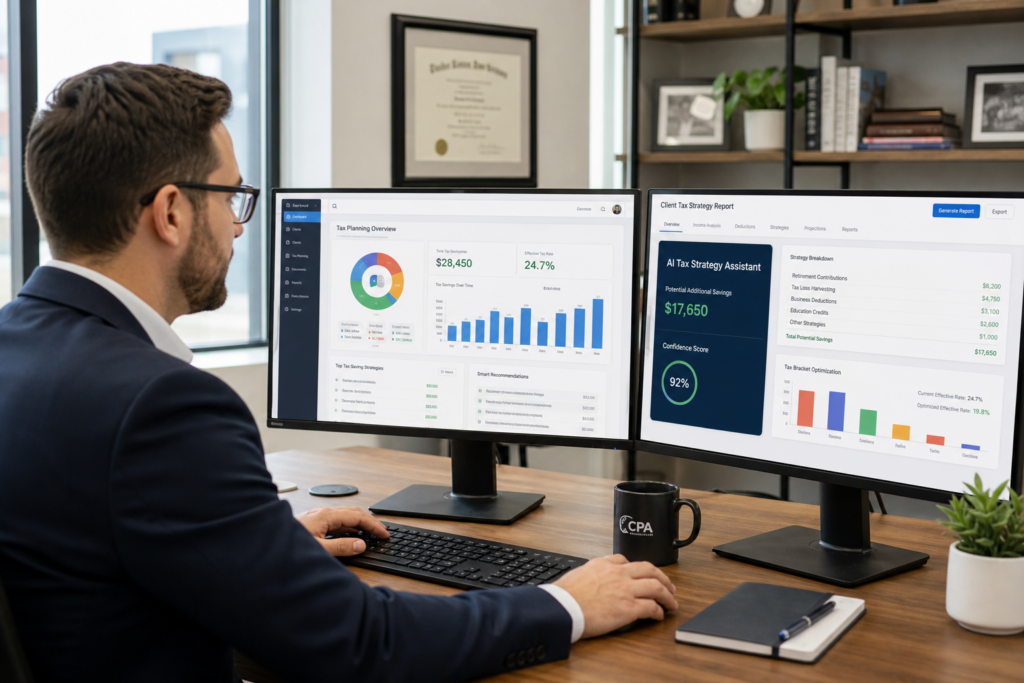
Tax Planning Software for CPAs and EAs: 2026 Guide
Tax planning software for CPAs and EAs has evolved dramatically in 2026, with 60% of practitioners now adopting AI-powered tools to deliver faster, more accurate advisory services. For tax professionals looking to scale beyond compliance and build profitable advisory practices, choosing the right platform is no longer optional—it’s the foundation of modern practice growth. This guide explores how the latest technology helps CPAs and Enrolled Agents deliver measurably better client outcomes while increasing firm profitability.
Table of Contents
Used by 2,400+ tax professionals
- Key Takeaways
- What Features Should CPAs Look for in Tax Planning Software?
- How Is AI Transforming Tax Planning Software in 2026?
- What Are the Compliance Requirements for Tax Planning Software?
- How Do You Evaluate ROI When Selecting Tax Planning Software?
- What Integration Capabilities Matter Most for CPAs?
- How Does Software Help Transition to Advisory Services?
- Uncle Kam in Action: How One CPA Firm Scaled Advisory Revenue
- Next Steps
- Frequently Asked Questions
- Related Resources

Key Takeaways
- AI adoption in tax software jumped from 33% to 60% in 2026, doubling practitioner efficiency
- Modern platforms must support scenario modeling, entity-aware analysis, and client-ready deliverables
- IRC Section 7216 compliance and U.S.-based data processing are mandatory for professional software
- Advisory-focused software drives 3x-5x ROI by enabling higher-value engagements
- Integration with practice management systems reduces double-entry and improves accuracy
What Features Should CPAs Look for in Tax Planning Software?
Quick Answer: CPAs need software with multi-scenario analysis, entity-aware calculations, unlimited client assessments, automated deliverables, and seamless integration with existing tax preparation platforms.
The tax planning software landscape has shifted dramatically in 2026. According to data from the IRS, the agency processed 271.4 million returns in fiscal year 2025, collecting over $5.3 trillion in revenue. As compliance complexity grows, CPAs and Enrolled Agents need technology that goes beyond basic tax preparation to deliver true planning value.
Core Capabilities Every Platform Must Have
Professional-grade tax advisory software in 2026 must support comprehensive strategy identification across multiple tax entities. The best platforms analyze 1040 individual returns alongside 1120-S corporate structures, Schedule C businesses, and K-1 distributions simultaneously. This entity-aware architecture ensures strategies work across your client’s entire financial picture.
Additionally, scenario modeling capabilities are critical. Clients want to see “what-if” projections before committing to entity restructuring or major strategic decisions. Software that can instantly compare LLC versus S Corp tax implications, or model the five-year impact of cost segregation, wins more advisory engagements.
Assessment Volume and Pricing Models
A critical differentiator in 2026 is assessment pricing. Many legacy platforms charge per analysis or cap the number of client assessments you can run annually. However, this creates friction when you want to run preliminary analyses on prospects before they become clients.
Leading platforms now offer unlimited assessments. This enables CPAs to demonstrate value during consultations, run multiple scenarios per engagement, and use planning tools as a year-round client retention strategy rather than rationing software credits.
Pro Tip: Choose software that allows unlimited free assessments. This lets you prove value to prospects before engagement agreements are signed, dramatically improving close rates for advisory services.
Deliverable Quality and Client Experience
Clients don’t pay for spreadsheets—they pay for clarity. Professional software must generate polished, client-ready deliverables with executive summaries, implementation roadmaps, and risk assessments. The deliverable should position you as a strategic advisor, not a data processor.
Look for platforms that produce branded PDF reports you can customize with your firm’s logo and color scheme. These reports should translate complex tax code into plain language that business owners can understand and act upon.
How Is AI Transforming Tax Planning Software in 2026?
Quick Answer: AI adoption among tax practitioners doubled to 60% in 2026, enabling automated strategy identification, contextual decision-making, and accuracy guarantees that were impossible just two years ago.
Artificial intelligence has moved from experimental to essential in tax planning software for CPAs and EAs. Research from BlueJ and CPA.com shows that 60% of practitioners now use AI tools—nearly double the 33% adoption rate from 2025. Furthermore, an additional 32% plan to adopt AI within the next few years.
Agentic AI and Contextual Analysis
The breakthrough in 2026 is what technologists call “agentic AI”—systems that don’t just process data but make logical decisions based on context. For example, Magnetic’s AI agent launched this year can handle complex scenarios like home office deductions by understanding not just the numbers but the underlying business use case.
According to Accounting Today, Magnetic offers an accuracy guarantee: if their AI-prepared return contains an error resulting in a $10 or more change to final tax liability, the entire return is free. During the Spring 2026 tax season, only 3% of users claimed this guarantee—demonstrating remarkable accuracy.
Strategy Identification at Scale
Modern AI doesn’t just identify obvious deductions. The best systems evaluate hundreds of potential strategies across multiple tax years, ranking them by potential impact and implementation complexity. This allows CPAs to focus on high-value opportunities rather than manually searching through code sections.
AI-powered platforms can instantly identify opportunities like Augusta Rule rental strategies, qualified business income deductions under Section 199A, cost segregation candidates, and entity structure optimization—often finding $50,000+ in annual savings per client.
Compliance and Data Security Requirements
Not all AI is created equal from a compliance perspective. Professional-grade platforms must meet IRS standards for data protection, including IRC Section 7216 compliance governing taxpayer information confidentiality. The software should process all data on U.S.-based infrastructure with U.S.-based reviewers.
Additionally, transparent platforms publish written information security plans and guarantee they do not train AI models on customer data. This protects both your clients’ confidentiality and your professional liability exposure.
| AI Feature | 2026 Standard | Business Impact |
|---|---|---|
| Strategy Identification | 300+ strategies evaluated per return | Finds opportunities human review misses |
| Accuracy Guarantee | 97% error-free rate (Magnetic data) | Reduces professional liability exposure |
| Turnaround Time | 2.5 days average delivery | Increases capacity without hiring |
| Human Review | U.S.-based EA/CPA oversight | Maintains professional standards |
What Are the Compliance Requirements for Tax Planning Software?
Quick Answer: Professional tax software must comply with IRC Section 7216 data protection standards, maintain audit trails for all AI decisions, and process taxpayer data exclusively on U.S. infrastructure.
Compliance requirements for tax planning software for CPAs and EAs have intensified in 2026, particularly following the IRS restructuring that created the Tax Professional Management Office in June 2026. This new office consolidates oversight of the Return Preparer Office and the Office of Professional Responsibility, signaling increased scrutiny of technology vendors.
IRC Section 7216 and Data Protection
Section 7216 of the Internal Revenue Code governs the use and disclosure of taxpayer information by return preparers. Any software platform that touches client tax data must implement controls ensuring preparers cannot improperly disclose or use that information for purposes other than return preparation.
Best-in-class platforms publish detailed information security plans explaining how they safeguard data at rest and in transit. They should also guarantee that client information is never used to train AI models, as this could constitute unauthorized use under Section 7216.
Audit Trail Requirements
When AI makes decisions affecting tax positions, those decisions must be auditable. According to Thomson Reuters research, every decision made by an AI agent in the compliance process should be documented with rationale, timestamps, and reviewer sign-offs preserved at each step.
This isn’t merely a best practice—it’s essential when the IRS audits a return three years later. You need to demonstrate why specific positions were taken and what analysis supported those positions. Software without comprehensive audit trails creates unnecessary risk for business owner clients and the practitioners serving them.
2026 Legislative Changes Affecting Software
The One Big Beautiful Bill Act (OBBBA), passed in July 2025 and implemented during the 2026 filing season, introduced several provisions affecting tax software capabilities. According to IRS data, 45% of individual returns filed in 2026 claimed one or more of the new Working Families Tax Cuts, including deductions for tips, overtime, car loan interest, and benefits for senior citizens.
Software platforms must stay current with these legislative changes. The average refund on returns claiming these new deductions exceeded $3,200 in 2026—representing real money that outdated software could miss. Your platform should update automatically when Congress passes tax law changes, not require manual patches months later.
Pro Tip: When evaluating vendors, ask how quickly they implemented the Working Families Tax Cuts provisions for the 2026 filing season. This reveals their responsiveness to legislative changes.
How Do You Evaluate ROI When Selecting Tax Planning Software?
Quick Answer: Measure ROI by comparing software costs against increased advisory revenue, time saved on manual analysis, and client retention improvements. Top platforms deliver 3x-5x first-year returns.
Return on investment for tax strategy software extends beyond simple subscription costs. The real question is: how much additional advisory revenue can you generate, and how many more clients can you serve without expanding your team?
Advisory Revenue Impact
CPAs who transition from pure compliance to advisory services typically charge $3,000-$8,000 per planning engagement. If your software enables you to close just two additional advisory clients per month, that’s $72,000-$192,000 in annual revenue. Even at a $10,000 annual software cost, the ROI is substantial.
Moreover, planning clients stay longer. While tax preparation clients shop on price annually, advisory clients value the ongoing relationship and strategic guidance. This dramatically improves lifetime client value and stabilizes cash flow.
Time Savings and Capacity Expansion
Manual tax planning analysis can consume 4-8 hours per client when researching strategies, running calculations, and preparing deliverables. AI-powered software reduces this to 30-60 minutes. For a firm conducting 100 planning engagements annually, that’s 400-750 hours recovered—equivalent to hiring an additional staff member without the $60,000-$80,000 salary expense.
These time savings compound when you consider that freed capacity allows you to serve more clients without weekend work or burnout. Many CPAs report serving 30-50% more clients after implementing modern planning software.
Client Retention and Referral Rates
Software that produces professional deliverables positions you differently in clients’ minds. You’re no longer the person who files their return once yearly—you’re their trusted financial advisor. This shift dramatically improves retention and drives organic referrals.
Firms using comprehensive planning platforms report client retention rates above 95% versus the industry average of 70-80%. When you’re saving clients $30,000-$100,000 annually in taxes, they don’t leave for a $200 cheaper preparer.
| ROI Factor | Typical Impact | Annual Value |
|---|---|---|
| New Advisory Revenue | 2 additional clients/month @ $5,000 | $120,000 |
| Time Savings | 6 hours saved × 100 clients | 600 hours (equivalent to $45,000 labor) |
| Improved Retention | 10% fewer client losses | $15,000-$30,000 |
| Software Investment | Annual subscription | ($8,000-$15,000) |
| Net First-Year Benefit | Conservative estimate | $170,000+ |
What Integration Capabilities Matter Most for CPAs?

Quick Answer: Essential integrations include tax preparation software, practice management systems, client portals, and document management platforms. Seamless data flow eliminates double-entry and reduces errors.
Tax planning software for CPAs and EAs doesn’t exist in a vacuum. It must connect seamlessly with your existing technology stack to avoid creating data silos and manual workarounds that waste time and introduce errors.
Tax Preparation Platform Connectivity
The most critical integration is with your core tax preparation software. Planning recommendations mean nothing if they can’t be efficiently implemented at filing time. Leading platforms can import data from major prep software and export planning scenarios back for final preparation.
Some advanced systems operate at the operating system level, automating keystrokes and navigation the same way a human preparer would. This eliminates dependency on vendor APIs that can break when software updates occur. According to Magnetic’s documentation, this approach works with any tax software your firm already uses.
Practice Management and Client Communication
Integration with practice management systems like Karbon, Canopy, or TaxDome streamlines workflow. When a client books a planning consultation, relevant data should automatically flow into your planning software. When the analysis is complete, the deliverable should automatically attach to the client record without manual file transfers.
Client portal integration is equally important. Modern clients expect to access their planning reports, track implementation progress, and message you with questions through a secure portal. Software that requires emailing PDFs feels outdated and creates security risks.
Document Management and E-Signature
Tax planning often requires client engagement letters, disclosure forms, and acknowledgment of recommendations. Integration with e-signature platforms (DocuSign, Adobe Sign, or similar) accelerates engagement kickoff and documentation.
Similarly, document management integration ensures all client source documents, analysis worksheets, and final deliverables are centrally stored and linked to the appropriate client file. This is essential for audit defense years later when you need to reconstruct why specific recommendations were made.
How Does Software Help Transition to Advisory Services?
Quick Answer: Planning software provides the infrastructure, training, and client acquisition tools needed to scale from compliance-focused tax prep to high-value advisory engagements.
Transitioning from tax preparation to tax advisory represents one of the most significant practice transformations CPAs undertake. The right software doesn’t just provide tools—it provides the complete operating system for running an advisory practice. This is where platforms like Uncle Kam’s advisory operating system differentiate themselves from point solutions.
Beyond Software: Training and Support
Knowing tax code isn’t the same as selling advisory services. Many CPAs struggle not with technical knowledge but with positioning, pricing, and marketing their expertise. Comprehensive platforms include training on the business of advisory—how to price engagements, structure proposals, conduct value-based consultations, and scale delivery.
For example, Uncle Kam provides weekly live coaching specifically on advisory business development, not just tax technical education. This addresses the reality that most CPAs don’t lack tax knowledge—they lack client acquisition and monetization strategies.
The Unlimited Assessment Advantage
The single biggest barrier to advisory growth is proving value before engagement. Prospects are skeptical—they want to see what you can find before committing $5,000-$10,000 to a full planning engagement. Software with unlimited free assessments removes this friction entirely.
You can run preliminary analyses during initial consultations, showing specific dollar amounts the prospect could save. This transforms the sales conversation from “trust me, planning is valuable” to “here’s exactly how I’ll save you $43,000 next year.” Close rates on advisory engagements increase dramatically when you lead with specific value quantification.
Built-In Client Acquisition
The most innovative platforms in 2026 don’t just help you serve existing clients better—they help you acquire new advisory clients. Uncle Kam’s built-in marketplace routes pre-qualified advisory opportunities directly to certified practitioners. This solves the “I have the software but no one to sell planning to” problem that stalls many advisory practices.
This marketplace approach is unique among tax planning software for CPAs and EAs. While competitors leave marketing entirely to practitioners, integrated systems recognize that advisory success requires both software capability and client demand.
Pro Tip: When evaluating platforms, ask: “What support do you provide for client acquisition and engagement sales?” Software-only solutions leave you to figure out marketing alone.
Uncle Kam in Action: How One CPA Firm Scaled Advisory Revenue by $180,000
Sarah Chen, a CPA in Denver, operated a traditional compliance-focused practice with 120 tax preparation clients generating approximately $240,000 in annual revenue. She struggled with seasonal cash flow gaps and client price sensitivity. In January 2026, she implemented Uncle Kam’s advisory operating system to transition her practice toward year-round planning engagements.
The Challenge: Sarah recognized that pure compliance work was becoming commoditized. Clients increasingly compared her solely on price, and several left for online DIY platforms. She wanted to offer higher-value services but didn’t know how to identify strategies efficiently, price engagements, or market advisory services to her existing client base.
The Uncle Kam Solution: Sarah enrolled in Uncle Kam’s platform, which provided three critical components she couldn’t get from point solutions. First, the AI-powered software with unlimited assessments let her run preliminary analyses on every client during the 2026 tax season, identifying those with $15,000+ savings potential. Second, the weekly business coaching taught her how to structure $4,500-$6,000 planning engagements and present value-based proposals. Third, the built-in marketplace connected her with six new advisory prospects outside her existing client base.
Implementation: During the 2026 filing season, Sarah used the software to analyze every client return. She identified 28 clients with substantial planning opportunities and scheduled follow-up consultations. Using the professional deliverables generated by the platform, she successfully closed 22 advisory engagements at an average fee of $5,200. Additionally, she closed four of the six marketplace leads for planning work.
The Results: Sarah generated $135,200 in new advisory revenue from existing clients plus $24,800 from marketplace leads—$160,000 in total new revenue. Her software investment was $12,000 for the year. More importantly, she smoothed out seasonal cash flow by spreading advisory engagements throughout the year rather than concentrating all revenue in tax season. Her first-year ROI exceeded 13:1, and she retained 100% of the clients she provided planning services to.
As Sarah explained: “Uncle Kam wasn’t just software—it was the complete operating system I needed to transform my practice. The unlimited assessments proved value to skeptical clients, the training taught me how to sell advisory services, and the marketplace gave me new clients I’d never have found otherwise. I’m now building a real advisory practice, not just preparing returns.”
Learn more about how Uncle Kam helps practitioners build profitable advisory practices at our client results page.
Next Steps
Selecting the right tax planning software for CPAs and EAs is one of the most impactful practice decisions you’ll make in 2026. Here’s how to move forward:
- Audit your current practice economics to establish baseline metrics for advisory revenue, client retention, and time spent per engagement
- Request demonstrations from 3-4 platforms, specifically asking about unlimited assessments, AI capabilities, training programs, and client acquisition support
- Verify compliance credentials including IRC Section 7216 compliance, data security practices, and audit trail capabilities
- Calculate projected ROI based on realistic assumptions about new advisory clients and time savings
- Book a strategy session with Uncle Kam to explore how an integrated advisory operating system can accelerate your practice growth at unclekam.com/book-strategy-session
The CPAs and EAs building the most valuable practices in 2026 aren’t just adding software—they’re transforming their entire service model from reactive compliance to proactive strategy. The technology, training, and client acquisition infrastructure now exists to make this transition predictable and profitable.
Frequently Asked Questions
Is tax planning software worth the investment for small firms?
Absolutely. Small firms actually benefit most because planning software creates leverage without hiring additional staff. If you close just 15-20 advisory engagements annually at $4,000-$6,000 each, you generate $60,000-$120,000 in new revenue while your software costs $8,000-$15,000. The ROI heavily favors small practices that can’t afford to hire expensive planning specialists.
How secure are AI-powered tax platforms?
Professional-grade platforms meet stringent security standards including IRC Section 7216 compliance. Leading providers process all data on U.S.-based infrastructure, employ U.S.-based reviewers, and publish written information security plans. However, not all platforms are equal—verify security credentials before selecting a vendor. Ask specifically whether they train AI models on customer data, as this practice creates confidentiality risks.
What’s the difference between tax prep software and planning software?
Tax preparation software records what already happened and completes compliance forms. Tax planning software models future scenarios, identifies savings strategies, and produces recommendations before tax positions are executed. Planning software looks forward while prep software looks backward. The most effective practices use both—preparation software for compliance and planning software for advisory.
How long does it take to implement planning software?
Technical implementation is typically 1-3 days for data migration and system setup. However, the real implementation timeline is learning to sell and deliver advisory services, which takes 3-6 months. This is why comprehensive platforms that include business coaching and sales training deliver faster results than software-only solutions. Uncle Kam practitioners typically close their first advisory engagements within 30-60 days.
Can planning software handle multi-state tax situations?
Yes, professional platforms support multi-state analysis. This is increasingly important as remote work creates tax nexus in multiple jurisdictions. The best software calculates state tax implications alongside federal strategies, ensuring recommendations work holistically across all filing obligations. For example, an S Corp salary recommendation must consider state unemployment taxes, not just federal savings.
Do I need different software for individual versus business planning?
The best platforms handle both within a single system using entity-aware architecture. This is critical because most business owners need integrated planning across their 1040 personal return, 1120-S corporate return, and any pass-through entities. Software that segregates individual and business planning misses the interconnected strategies that deliver the largest savings. Look for platforms that analyze the entire client financial picture simultaneously.
How do I price advisory engagements using planning software?
Value-based pricing works best. Run a preliminary assessment showing the client’s potential savings, then price your engagement as 10-20% of first-year tax savings. For example, if your analysis identifies $50,000 in annual tax reduction opportunities, you can confidently charge $5,000-$10,000 for the planning engagement. This anchors your fee to tangible value rather than hourly rates, dramatically improving close rates and profitability.
What happens when tax laws change mid-year?
Quality platforms update automatically when Congress passes legislation. For example, the Working Families Tax Cuts provisions from the 2025 OBBBA Act were implemented in planning software before the 2026 filing season began. Choose vendors with demonstrated track records of rapid legislative updates. Ask how quickly they incorporated the OBBBA provisions—this reveals their responsiveness. Platforms that require manual patches or take months to update create liability exposure when you miss new opportunities.
Related Resources
- Build a Profitable Tax Advisory Practice
- The MERNA Method: Framework for Strategic Tax Planning
- CPA Success Stories: How Practitioners Scaled Advisory Revenue
- Comprehensive Tax Planning Guides for Professionals
Last updated: June, 2026
This information is current as of 6/10/2026. Tax laws change frequently. Verify updates with the IRS or FTB if reading this later.

