
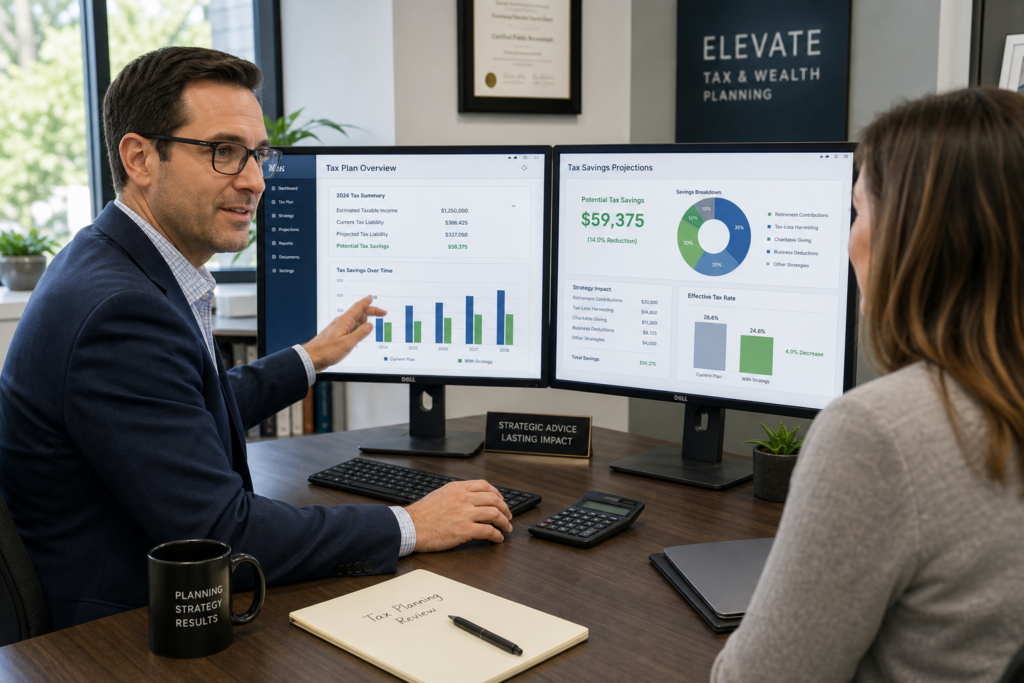
Tax Planning Software for CPAs: 2026 Guide
For the 2026 tax year, tax planning software for CPAs has become essential infrastructure for firms transitioning from compliance-focused tax preparation to high-value advisory services. Modern platforms combine AI-driven scenario modeling, unlimited client assessments, and compliance automation to help CPAs deliver measurable tax savings while building scalable, profitable practices. With the IRS processing over 271 million returns annually and new legislation like the One Big Beautiful Bill Act reshaping the tax landscape, CPAs need software that supports both technical precision and strategic client engagement.
Table of Contents
Used by 2,400+ tax professionals
- Key Takeaways
- What Makes Tax Planning Software Different from Tax Prep Software?
- What Features Should CPAs Prioritize in 2026?
- How Does AI Enhance Tax Planning Software in 2026?
- What Compliance Requirements Matter for Tax Planning Software?
- How Can CPAs Calculate ROI from Tax Planning Software?
- What Implementation Challenges Should CPAs Expect?
- Uncle Kam in Action: How a Mid-Sized CPA Firm Scaled Advisory Revenue by 340%
- Next Steps
- Frequently Asked Questions
- Related Resources

Key Takeaways
- Tax planning software for CPAs focuses on proactive strategy, not just compliance.
- Modern platforms offer unlimited assessments, eliminating per-client usage costs that limit prospect conversion.
- AI-powered tools now deliver client-ready deliverables with scenario modeling and implementation roadmaps.
- 2026 compliance requires IRC Section 7216 adherence and Circular 230 professional standards.
- Top-performing CPA firms achieve 3-5x ROI within 12 months through advisory upsells.
What Makes Tax Planning Software Different from Tax Prep Software?
Quick Answer: Tax prep software handles historical compliance and return filing. Tax planning software focuses on forward-looking strategy, multi-year projections, and measurable tax savings opportunities.
The distinction between tax preparation and tax planning represents a fundamental shift in how CPAs serve clients. Preparation software processes prior-year data and ensures accurate filing. Planning software identifies future savings opportunities across entity structures, deductions, and strategic timing decisions.
For 2026, this difference matters more than ever. The IRS processed 162.8 million individual returns in fiscal year 2025, with 45% of 2026 filers claiming new deductions from the Working Families Tax Cuts. CPAs using traditional prep software miss these planning conversations entirely. However, those using dedicated tax planning software can model scenarios before year-end, demonstrating value that justifies premium advisory fees.
Core Functional Differences
Tax preparation platforms excel at data input, form generation, and e-filing. They answer the question: “What do I owe?” Tax planning platforms answer: “How can I legally reduce what I owe?” This shift transforms the CPA from order-taker to strategic advisor.
Modern tax planning software for CPAs includes scenario modeling engines that test multiple strategies simultaneously. For example, a platform might compare S Corp election savings against QBI deduction optimization while factoring in state tax implications and retirement contribution limits. The software quantifies each approach, producing client-ready deliverables that show implementation steps and projected ROI.
Business Model Implications
Preparation work typically generates flat fees tied to form complexity. Planning work commands retainer relationships or project-based fees reflecting the value created. A CPA who identifies $40,000 in annual tax savings can reasonably charge $8,000 to $12,000 for implementation—a margin impossible with compliance-only services.
The software itself reflects this economic reality. Preparation tools charge per return filed. Planning platforms increasingly offer unlimited assessments, recognizing that CPAs need to run multiple prospect analyses before engagements close. This pricing model aligns with how successful tax advisory practices actually operate.
Pro Tip: Use planning software during prospect meetings to demonstrate value before engagement. Free assessments convert 40% better than proposals alone.
What Features Should CPAs Prioritize in 2026?
Quick Answer: Prioritize unlimited assessments, entity-aware modeling, professional deliverables, integrated training, and compliance with 2026 IRS regulations including IRC Section 7216.
Not all tax planning software for CPAs delivers equal value. The 2026 market includes platforms ranging from basic calculators to comprehensive advisory operating systems. Understanding which features drive actual practice growth separates effective investment from expensive shelfware.
Unlimited Client Assessments
Traditional planning software charges per analysis or caps monthly usage. This creates perverse incentives: CPAs avoid running assessments on prospects who might not convert, missing opportunities to prove value. Leading 2026 platforms eliminate this friction by offering unlimited free assessments at every subscription tier.
The business case is compelling. A CPA firm with 50 existing clients and 200 annual prospects can run assessments on every prospect without incremental cost. This enables value-first sales conversations where the software demonstrates savings before the engagement contract is signed. Firms using this approach report 38-45% higher close rates on advisory services.
Entity-Aware Architecture
Real clients operate multiple entities simultaneously. A business owner might have a primary S Corp, a holding company, rental properties in an LLC, and personal investments generating K-1 income. Basic planning software treats each entity in isolation. However, sophisticated platforms model the entire portfolio together, identifying cross-entity strategies that simple calculators miss.
For 2026, this matters because optimal strategies often span entity boundaries. Cost segregation in the LLC might generate passive losses that offset active S Corp income. Retirement contributions split between entities maximize deductions while satisfying IRS testing requirements. Software that cannot model these interactions leaves substantial savings on the table.
Professional Client Deliverables
Clients do not pay premium fees for spreadsheets. They pay for clarity, confidence, and actionable implementation guidance. The best tax planning software for CPAs produces branded PDF deliverables with executive summaries, strategy explanations, implementation timelines, and risk assessments.
These deliverables should require minimal CPA editing. The software automatically generates client-ready language explaining complex strategies in plain English. Furthermore, it sequences recommendations using frameworks like MERNA (Maximize deductions, Entity structure, Retirement, Niche strategies, Advanced planning) that help clients understand both immediate actions and multi-year roadmaps.
Integrated Training and Support
Software alone does not build an advisory practice. CPAs need training on how to sell planning services, price engagements, and manage client expectations. Leading platforms include live coaching, pricing frameworks, and marketing templates as part of the subscription—not afterthoughts.
This distinction separates tools from operating systems. A tool helps you calculate savings. An operating system helps you attract clients, close engagements, deliver results, and scale the practice. For CPAs transitioning from compliance to advisory, this support infrastructure often matters more than the software features themselves.
2026 Compliance and Data Security
The IRS created the Tax Professional Management Office in June 2026, consolidating oversight of the Return Preparer Office and Office of Professional Responsibility. This reorganization emphasizes enforcement of Circular 230 professional standards and IRC Section 7216 data protection requirements.
Tax planning software must comply with Section 7216, which governs how tax return information is used and disclosed. Platforms should publish written information security plans, process data on U.S. infrastructure, and provide clear documentation of compliance measures. In 2026, this is not optional—it is table-stakes for professional credibility.
| Feature Category | Why It Matters for CPAs | 2026 Best Practice |
|---|---|---|
| Unlimited Assessments | Eliminates cost barriers to prospect conversion | Run analyses on every prospect before engagement |
| Entity-Aware Modeling | Identifies cross-entity savings opportunities | Model entire client portfolios simultaneously |
| Professional Deliverables | Justifies premium pricing through polished output | Use branded PDFs with implementation roadmaps |
| Integrated Training | Supports practice development beyond technical work | Leverage coaching on sales and pricing strategies |
| Compliance Features | Protects professional credentials and client data | Verify IRC 7216 compliance and U.S. data hosting |
How Does AI Enhance Tax Planning Software in 2026?
Quick Answer: AI automates scenario analysis, generates client-ready strategic summaries, and identifies overlooked strategies by processing hundreds of tax code interactions instantly.
Artificial intelligence transformed tax planning software for CPAs in 2026. Early platforms required manual input and produced raw calculations. Modern AI-powered systems analyze documents, recommend strategies, and produce implementation guidance without extensive manual configuration.
Automated Strategy Identification
Traditional planning software presents a menu of strategies for CPAs to manually evaluate. AI-enhanced platforms analyze client data and automatically identify the highest-value opportunities based on income patterns, entity structures, and expense profiles.
For example, a platform might detect that a client with $280,000 in Schedule C income would save $12,400 annually through S Corp election, while also qualifying for home office deductions and retirement contributions that maximize QBI benefits. The AI sequences these strategies using optimization frameworks, presenting a comprehensive plan rather than isolated tactics.
Document Processing and Data Extraction
In 2026, AI agents can read tax documents including handwritten notes and margin annotations. This technology eliminates manual data entry for planning analyses. CPAs upload prior-year returns, K-1s, and financial statements; the AI extracts relevant data and populates scenario models automatically.
Leading platforms include accuracy guarantees on AI-processed data. One provider offers full refunds if AI-generated returns contain errors exceeding $10 in tax liability changes. This level of precision makes AI-assisted planning viable for professional practices where accuracy is non-negotiable.
Client Communication Generation
Perhaps the most valuable AI application is generating client-ready strategic summaries. The software converts complex tax calculations into plain-English explanations that clients can understand and act upon. Additionally, it produces implementation timelines, risk assessments, and answers to common client questions.
This capability addresses a major bottleneck in advisory practices. CPAs spend hours translating technical analysis into client presentations. AI handles this translation automatically, freeing CPAs to focus on relationship management and strategic conversations rather than document formatting.
Pro Tip: AI-generated deliverables should require minimal editing. If you spend more than 15 minutes customizing output, the software is not truly AI-enhanced.
Compliance Monitoring and Updates
Tax laws change constantly. The One Big Beautiful Bill Act passed in July 2025 introduced new deductions affecting 45% of 2026 individual returns. AI-powered software automatically updates strategy libraries and recalculates scenarios when legislation changes, ensuring recommendations remain current.
This feature provides competitive advantage. CPAs using outdated software miss new opportunities or recommend strategies invalidated by recent legislation. In contrast, those using AI-updated platforms stay current without manual research, delivering better client outcomes with less effort.
What Compliance Requirements Matter for Tax Planning Software?
Quick Answer: CPAs must ensure software complies with IRC Section 7216 data protection, Circular 230 professional standards, and IRS e-file security requirements.
Regulatory compliance is not optional for tax planning software for CPAs. The IRS Tax Professional Management Office, created in June 2026, actively enforces professional standards. Furthermore, violations can result in sanctions, suspensions, or disbarment from practice.
IRC Section 7216: Data Protection Requirements
Section 7216 governs how tax return preparers use and disclose client information. Tax planning software must implement specific safeguards including data encryption, access controls, and prohibition against using client data for software training without explicit consent.
When evaluating platforms, CPAs should verify that all data processing occurs on U.S. infrastructure, all human reviewers are U.S.-based professionals, and the vendor publishes a written information security plan. These requirements are not suggestions—they are legal obligations that protect both client confidentiality and professional credentials.
Circular 230: Professional Conduct Standards
Circular 230 establishes practice standards for tax professionals. Software-generated advice must meet the same standards as manually-prepared guidance. This includes maintaining competence, exercising due diligence, and providing accurate information to clients.
CPAs remain professionally responsible for software output. If planning software recommends an aggressive position that fails IRS scrutiny, the CPA faces potential sanctions even though software generated the recommendation. Therefore, platforms should include documentation features that demonstrate reasonable basis for positions taken and allow CPAs to review assumptions before client delivery.
E-File Security and Authentication
While planning software differs from preparation software, many platforms integrate with e-file systems. These integrations must comply with IRS Publication 1345 security requirements including multi-factor authentication, secure transmission protocols, and audit logging.
CPAs should verify that software vendors maintain IRS-approved security protocols. This includes annual security reviews, penetration testing, and incident response plans. In an era of increasing cyber threats, these protections safeguard both client data and firm reputation.
| Compliance Area | Key Requirements | Verification Steps |
|---|---|---|
| IRC Section 7216 | Data encryption, U.S. infrastructure, no unauthorized use | Request written security plan and data hosting documentation |
| Circular 230 | Competence, due diligence, reasonable basis for positions | Review assumption transparency and position documentation |
| E-File Security | Multi-factor auth, secure transmission, audit logs | Confirm IRS Publication 1345 compliance certification |
How Can CPAs Calculate ROI from Tax Planning Software?

Quick Answer: Measure ROI by tracking advisory engagement revenue, time saved per analysis, and client retention improvements. Top firms achieve 3-5x returns within 12 months.
Tax planning software for CPAs represents a business investment, not just a technical tool. Calculating return on investment requires examining both direct revenue generation and indirect efficiency gains that enable practice scaling.
Direct Revenue Impact
The primary ROI driver is advisory service revenue. A CPA firm charging $5,000-$15,000 per planning engagement needs only 2-3 new clients annually to justify most software investments. However, firms typically convert 15-25% of existing compliance clients to advisory services within the first year.
Calculate this conservatively: A 50-client firm converts 10 clients (20%) to $6,000 planning engagements, generating $60,000 in new revenue. Even after accounting for delivery time, this represents substantial profit on software costs typically ranging from $3,000-$12,000 annually.
Time Efficiency Gains
Manual tax planning analysis requires 4-8 hours per client including research, calculations, and deliverable preparation. Quality software reduces this to 1-2 hours through automation and template deliverables. This efficiency compounds across multiple clients.
Consider a CPA billing $300 per hour who completes 25 planning engagements annually. Saving 5 hours per engagement frees 125 billable hours worth $37,500. This time can be redirected to additional client work, business development, or personal time—all valuable outcomes.
Client Retention and Referrals
Planning services create stickier client relationships than compliance work alone. Clients who receive ongoing strategic guidance exhibit 30-40% higher retention rates and generate 2-3x more referrals than compliance-only clients.
While harder to quantify, this referral engine produces compounding returns. Each satisfied planning client refers 1-2 qualified prospects annually. Furthermore, these referred prospects convert at higher rates because they arrive pre-sold on the CPA’s advisory value.
Practice Valuation Impact
Advisory-focused practices command higher multiples in firm sales. Compliance practices typically sell for 0.8-1.2x gross revenue. Additionally, practices with 30%+ advisory revenue sell for 1.5-2.0x gross revenue because recurring planning relationships are more valuable than seasonal tax preparation.
For CPAs approaching retirement or considering succession, software that facilitates advisory transformation directly increases practice value. A $500,000 gross revenue practice shifting from 1.0x to 1.7x multiple gains $350,000 in sale price—far exceeding any software investment.
Pro Tip: Track software ROI quarterly using metrics: new advisory clients, average engagement fee, hours saved, and client retention rate. Adjust strategy based on data.
What Implementation Challenges Should CPAs Expect?
Quick Answer: Common challenges include staff training, workflow integration, pricing advisory services appropriately, and managing client expectations during the transition from compliance to advisory relationships.
Adopting tax planning software for CPAs involves more than technical deployment. Successful implementation requires organizational change, skill development, and business model adaptation. Understanding common obstacles helps firms prepare effective solutions.
Staff Adoption and Training
CPAs trained in compliance work sometimes struggle shifting to strategic advisory conversations. The software provides calculations, but staff must learn to present findings confidently and guide clients through implementation decisions.
Successful firms invest in soft skills training alongside technical software training. This includes sales fundamentals, pricing psychology, and client communication techniques. Platforms that include coaching on these business skills accelerate adoption compared to software-only solutions.
Pricing Strategy Development
Many CPAs underprice advisory services because they lack reference points. Compliance work has established market rates. However, planning work should be priced based on value delivered, not hours invested.
A common framework charges 10-20% of first-year tax savings for implementation. A client saving $30,000 annually pays $3,000-$6,000 for the initial plan plus optional ongoing advisory retainers. This value-based pricing requires confidence in software accuracy and clear communication of deliverables.
Workflow and Technology Integration
Planning software must integrate with existing practice management systems, document storage, and client portals. Disconnected systems create double-entry work and reduce efficiency gains.
Evaluate integration capabilities during vendor selection. API connections to popular practice management platforms streamline data flow. Additionally, cloud-based systems enable collaborative work and remote access—critical features for modern distributed teams.
Client Communication and Expectation Management
Clients accustomed to compliance-only relationships may not immediately understand the value of proactive planning. CPAs must educate clients about the difference between preparation and planning, demonstrating ROI through specific examples.
Leading firms use software-generated assessments as marketing tools. They run free analyses showing potential savings, then propose paid implementation engagements. This “show before sell” approach overcomes skepticism and demonstrates tangible value upfront.
| Implementation Challenge | Impact on Practice | Recommended Solution |
|---|---|---|
| Staff Training | Slow adoption, underutilization of features | Choose platforms with integrated coaching and support |
| Pricing Strategy | Revenue left on table, unprofitable engagements | Use value-based pricing tied to client savings (10-20%) |
| Technology Integration | Double data entry, workflow friction | Verify API integrations with existing systems before purchase |
| Client Education | Low conversion from compliance to advisory | Offer free assessments showing specific savings opportunities |
Uncle Kam in Action: How a Mid-Sized CPA Firm Scaled Advisory Revenue by 340%
Thompson & Associates, a 12-person CPA firm in suburban Philadelphia, generated $1.8 million in annual revenue primarily from tax compliance and bookkeeping when managing partner David Thompson attended an industry conference in early 2025. There he learned about the advisory opportunity and began researching tax planning software for CPAs.
The firm’s challenge was typical: strong client relationships but minimal advisory revenue. They completed 280 individual and 65 business returns annually but rarely engaged in proactive planning beyond basic year-end conversations. Thompson recognized this left substantial revenue and client value on the table.
After evaluating multiple platforms, Thompson selected an advisory operating system that offered unlimited assessments, AI-powered strategy identification, and integrated business coaching. The firm invested $8,400 annually and committed three months to staff training and workflow development.
The implementation strategy was methodical. Thompson identified 50 high-potential clients with business income exceeding $150,000. During the 2026 tax filing season, staff ran complimentary planning assessments for each client, presenting findings during appointment discussions. The software identified an average of $18,600 in potential annual savings per client.
Of the 50 assessments, 23 clients (46%) engaged for paid implementation at an average fee of $7,200. This generated $165,600 in new advisory revenue in year one. Furthermore, the firm expanded the approach to prospects, using free assessments as lead magnets for business development. This added 14 new planning clients at similar fees.
By the end of the first year, Thompson & Associates had generated $266,400 in advisory revenue—a 340% increase from their minimal prior-year planning fees. The firm’s total revenue grew to $2.1 million, with advisory work representing 13% of the mix. More importantly, advisory clients exhibited 92% retention versus 73% for compliance-only relationships.
The ROI calculation was compelling: $8,400 software investment plus approximately $15,000 in training time generated $266,400 in new revenue. After accounting for delivery time (averaging 6 hours per engagement), the firm netted approximately $180,000 in incremental profit—a 770% first-year return.
Thompson credits the unlimited assessment model as the key differentiator. “We could demonstrate value before asking for payment. Additionally, the professional deliverables justified our pricing. Clients saw polished, branded plans with clear implementation steps. This made $7,000 fees feel like bargains compared to the $18,000-$30,000 in savings we identified.”
The firm now targets 40% advisory revenue within three years and has hired two additional staff to support planning work. They actively refer colleagues to similar platforms and participate in the vendor’s client success community to share best practices with other transitioning firms.
Next Steps
Selecting and implementing tax planning software for CPAs requires careful evaluation and strategic planning. Consider these action items:
- Audit your current client base to identify high-potential candidates for advisory services
- Request demonstrations from platforms offering unlimited assessments and professional deliverables
- Verify compliance with IRC Section 7216 and Circular 230 requirements before purchase
- Develop a value-based pricing framework for advisory engagements (typically 10-20% of first-year savings)
- Schedule a strategy session with experienced advisors to discuss your specific practice transition goals
The transition from compliance to advisory represents a fundamental practice evolution. Tax planning software provides the technical foundation, but success requires business model adaptation, staff development, and confident client communication. Firms that invest in comprehensive platforms with integrated training and support systems achieve faster, more sustainable results than those focusing on software features alone.
For CPAs ready to scale advisory services in 2026, the opportunity has never been clearer. Clients need proactive tax guidance, regulatory changes create planning opportunities, and technology makes delivery scalable. The question is not whether to adopt tax planning software, but which platform best supports your specific practice goals and client base.
Frequently Asked Questions
What is the typical cost of tax planning software for CPAs in 2026?
Professional tax planning software ranges from $3,000 to $15,000 annually depending on features and firm size. Entry-level platforms with limited assessments start around $3,000 per year. Comprehensive advisory operating systems with unlimited analyses, AI features, integrated training, and marketplace access typically cost $8,000-$12,000 annually. Enterprise solutions for large firms may exceed $15,000 but include multi-user licenses and dedicated support.
How long does it take to implement tax planning software effectively?
Most firms require 60-90 days for effective implementation. This includes initial software training (10-15 hours), staff development on advisory sales techniques (20-30 hours), workflow integration (15-20 hours), and pilot testing with 5-10 clients. Firms using platforms with structured onboarding programs achieve proficiency faster than those relying solely on self-guided learning. Plan to run your first 10-15 analyses under vendor guidance before independent deployment.
Can solo practitioners justify the investment in tax planning software?
Yes, solo practitioners often see the highest percentage ROI. A solo CPA converting just 8-10 existing clients to $5,000 planning engagements generates $40,000-$50,000 in new revenue. Additionally, software reduces analysis time from 6-8 hours to 1-2 hours per client, making advisory work scalable even without staff. Solo practitioners should prioritize platforms with strong automation and professional deliverables to maximize time efficiency.
How do I transition existing compliance clients to advisory relationships?
Start with complimentary assessments during regular appointment meetings. Run analyses showing specific savings opportunities, then offer paid implementation as a separate engagement. Frame advisory services as optional enhancements, not replacements for compliance work. Use language like: “I noticed opportunities to reduce your tax burden by approximately $22,000 annually. Would you like me to develop an implementation plan?” Most clients convert when they see concrete numbers tied to their situations.
What ongoing training do CPAs need after initial software implementation?
Successful advisory practices require continuous skill development in three areas: technical tax updates (15-20 hours annually), sales and pricing strategies (10-15 hours annually), and software feature updates (5-10 hours annually). Leading platforms include ongoing coaching and community access as part of subscriptions. Additionally, CPAs should budget time for peer learning through user groups and case study reviews to refine delivery approaches.
How does tax planning software handle multi-state clients?
Quality platforms include comprehensive state tax modules that model income allocation, reciprocity agreements, and state-specific credits and deductions. For clients with income in multiple states, the software calculates optimal sourcing strategies and identifies opportunities like strategic domicile planning or entity jurisdiction selection. Verify that platforms include all states relevant to your client base before purchase, as some vendors charge extra for state-specific modules.
What role does tax planning software play in firm succession planning?
Advisory-focused practices command significantly higher valuations than compliance-only firms. Implementing tax planning software 3-5 years before anticipated succession builds recurring advisory relationships that increase practice value. Furthermore, software-standardized processes make practices easier for buyers to operate post-acquisition. Document your advisory workflows, client conversion rates, and engagement profitability metrics to demonstrate the sustainability of advisory revenue streams to potential purchasers.
Related Resources
- Tax Strategy Services for CPAs
- Understanding the MERNA Tax Planning Framework
- Complete Business Solutions for Accounting Firms
- Latest Tax Planning Strategies and Updates
This information is current as of 6/10/2026. Tax laws change frequently. Verify updates with the IRS or relevant regulatory bodies if reading this later.
Last updated: June, 2026

