
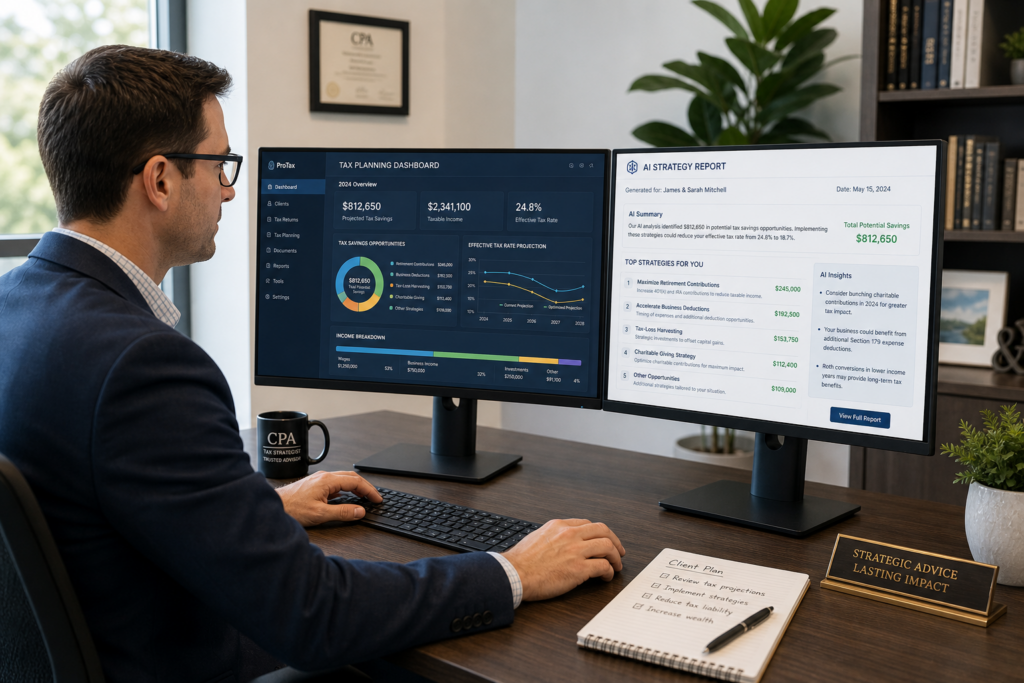
Tax Planning Software for CPAs: 2026 Guide to Choosing the Right Platform
For the 2026 tax year, CPAs face a critical decision that directly impacts their firm’s profitability and client satisfaction. Tax planning software for CPAs has evolved from basic calculation tools into sophisticated AI-powered advisory platforms. However, with two-thirds of firms expecting revenue growth and $143 billion in U.S. client revenue at risk from poor technology choices, selecting the right platform matters more than ever.
Table of Contents
- Key Takeaways
- What Is Tax Planning Software and Why Do CPAs Need It?
- How Has AI Changed Tax Planning Software in 2026?
- What Features Should CPAs Prioritize When Selecting Software?
- What Are the 2026 Compliance Requirements for Tax Planning Software?
- How Do Leading Tax Planning Platforms Compare?
- What Pricing Models Work Best for Growing Firms?
- How Can CPAs Maximize ROI from Tax Planning Software?
- Uncle Kam in Action: How One CPA Firm Scaled Advisory Revenue
- Next Steps
- Frequently Asked Questions
- Related Resources

Key Takeaways
- AI-powered tax planning software helps CPAs scale advisory services while maintaining compliance with 2026 IRS guidelines
- Firms shifting to value-based pricing for advisory work report significantly stronger profit margins than those billing hourly
- Unlimited assessment capabilities enable CPAs to prove value before engagement, increasing client conversion rates
- Professional-grade platforms must meet Circular 230 due diligence requirements for AI-generated tax advice
- Integration with client portals and training resources differentiates complete advisory systems from basic calculation tools
What Is Tax Planning Software and Why Do CPAs Need It?
Quick Answer: Tax planning software for CPAs enables proactive strategy identification, scenario modeling, and professional deliverable creation. It transforms reactive compliance work into high-margin advisory services, addressing the profession’s shift toward year-round client engagement.
Tax planning software differs fundamentally from tax preparation tools. While preparation software handles compliance and filing, planning platforms identify savings opportunities across multiple tax years. For 2026, this distinction matters more than ever as firms face commoditization pressure on basic compliance services.
According to the Thomson Reuters Institute’s 2026 State of Tax Professionals Report, nearly two-thirds of tax firms expect revenue growth this year. However, profit margins remain stagnant for firms that haven’t transitioned from hourly compliance billing to value-based advisory pricing.
The Economic Case for Tax Planning Technology
CPAs who implement robust tax planning software report several measurable benefits. First, they can analyze multiple scenarios simultaneously, showing clients the financial impact of different entity structures or timing strategies. Second, professional deliverables position practitioners as strategic advisors rather than administrative processors. Third, automated calculations reduce the time required to model complex strategies.
The shift from preparation to planning represents the profession’s most significant opportunity for sustainable growth. Compliance work faces downward pricing pressure as technology automates routine tasks. Advisory services, however, command premium fees because they require expertise, judgment, and strategic thinking that technology alone cannot provide.
Why 2026 Marks a Turning Point
Several factors make 2026 particularly critical for technology decisions. The IRS introduced preliminary AI guidelines for tax practitioners in June 2026, establishing compliance standards for AI-enhanced tax advice. Firms that delay technology adoption risk falling behind competitors who have already integrated AI-powered planning into their service offerings.
Additionally, client expectations have evolved. Business owners and high-income earners expect their CPAs to provide proactive tax strategies throughout the year, not just during filing season. Software enables this year-round engagement model without proportionally increasing labor costs.
Pro Tip: Leading firms use tax planning software to run complimentary assessments for prospects, proving value before the engagement begins. This approach converts at significantly higher rates than traditional proposal-based selling.
For CPAs building or scaling an advisory practice, the right tax advisory platform becomes the foundation for predictable revenue growth. Rather than hoping clients will pay for planning advice, technology enables practitioners to demonstrate tangible savings opportunities with specific dollar figures and implementation roadmaps. CPAs comparing options can review dedicated tax planning software for CPAs resources to understand how different platforms support advisory growth.
How Has AI Changed Tax Planning Software in 2026?
Quick Answer: AI integration in 2026 tax planning software accelerates strategy identification, automates scenario comparisons, and generates professional deliverables. However, practitioners remain responsible for verifying accuracy and exercising professional judgment under Circular 230 requirements.
The integration of artificial intelligence into tax planning software for CPAs represents the most significant technological shift in the profession since electronic filing. In 2026, AI capabilities extend far beyond basic automation, fundamentally changing how practitioners identify and implement tax strategies.
Pattern Recognition and Strategy Identification
Modern AI-powered platforms analyze client financial data to identify applicable strategies from databases containing hundreds of planning techniques. Rather than manually reviewing each potential strategy, CPAs can leverage AI to surface the most relevant opportunities based on client-specific factors including income sources, business structure, and state residency.
For example, when analyzing a business owner with $400,000 in S corporation income, AI systems can simultaneously evaluate reasonable compensation requirements, qualified business income deduction optimization, retirement contribution strategies, and entity structure alternatives. This comprehensive analysis would require hours of manual calculation but can now be completed in minutes.
The IRS Guidelines Framework
The IRS AI guidelines released in June 2026 establish clear standards for practitioners using AI tools. Key requirements include thorough review of AI-generated content, verification of citations and calculations, secure data handling protocols, and documentation of AI usage and verification processes. These guidelines clarify how existing Circular 230 obligations apply to AI-enhanced tax practice.
Importantly, the guidelines emphasize that AI should augment rather than replace professional judgment. Tax professionals cannot simply accept AI outputs without verification. Every fact, citation, and calculation must be reviewed for accuracy before being presented to clients or included in IRS submissions.
Fiduciary-Grade AI Standards
Thomson Reuters research identifies what they term “Fiduciary-Grade AI” as the appropriate standard for professional services. This designation requires several characteristics:
- Built on authoritative, domain-specific content from verified tax sources
- Rigorous privacy and security protecting confidential taxpayer information
- Subject-matter expertise embedded in algorithms and training data
- Transparent, verifiable outputs allowing practitioners to trace conclusions
- Access to real-time human support when clarification is needed
These standards address a critical concern identified in recent research showing that approximately one-third of tax professionals are using unsanctioned AI tools. Such tools may not provide adequate security, accuracy verification, or audit trails required for professional tax practice.
The $143 Billion Implementation Gap
Research from Thomson Reuters warns that up to $143 billion in client revenue is at risk in the United States alone from firms that fail to effectively implement AI. This staggering figure reflects client expectations for AI-driven efficiency and value. When firms cannot deliver on these expectations, clients increasingly seek providers who can.
Furthermore, talent considerations matter. Approximately 24% of tax professionals indicate they would consider leaving their current firm within two years if it fails to deliver on AI promises. This creates both a client acquisition opportunity and a talent retention challenge for firm leaders.
Pro Tip: When evaluating AI features, prioritize platforms that provide clear audit trails showing how conclusions were reached. This transparency is essential for both IRS compliance and defending strategies during examinations.
The evolution of tax planning software with unlimited assessments demonstrates how AI enables new business models. Firms can run unlimited prospect analyses without worrying about per-use fees, fundamentally changing the economics of new client acquisition.
What Features Should CPAs Prioritize When Selecting Software?
Quick Answer: Prioritize multi-entity scenario modeling, professional deliverable generation, client portal integration, unlimited assessment capabilities, and comprehensive training resources. These features separate full advisory platforms from basic calculation tools.
Not all tax planning software for CPAs provides the same capabilities. Feature sets vary dramatically across platforms, and understanding which capabilities matter most helps practitioners avoid investing in tools that cannot scale with their practice.
Multi-Entity Architecture and Cross-Portfolio Analysis
Sophisticated clients rarely operate through a single tax entity. Business owners typically have individual returns, S corporation or partnership returns, and sometimes multiple entities for asset protection or operational reasons. Planning software must analyze strategies across this entire portfolio simultaneously.
For instance, a real estate investor might have rental properties held in LLCs, a management company structured as an S corporation, and personal investment accounts. Effective planning requires understanding how strategies in one entity affect overall tax liability. Entity-aware software automatically accounts for these relationships.
Professional Deliverable Generation
Clients pay for clarity, not spreadsheets. The ability to generate professional, branded deliverables distinguishes advisory platforms from calculation tools. Quality deliverables include executive summaries, detailed strategy explanations, implementation roadmaps, and risk assessments.
These documents serve multiple purposes. They communicate value to clients, provide implementation guidance, document the advice provided, and create a reference point for follow-up conversations. Firms charging $5,000 or more for comprehensive tax plans need deliverables that justify these fees.
Strategy Sequencing and Prioritization
Identifying 40 potential strategies helps no one if the client becomes overwhelmed. Advanced platforms use frameworks to sequence strategies logically. For example, the MERNA framework sequences strategies across Maximize Deductions, Entity Structure, Retirement, Niche strategies, and Advanced techniques.
This sequencing helps clients understand which strategies to implement immediately, which require additional planning, and which provide the greatest return on effort. Rather than presenting a disorganized list, practitioners can walk clients through a logical progression.
Integration Capabilities
Tax planning software should integrate with existing practice management systems. Key integrations include:
- Tax preparation software for importing current and prior year data
- Client portals for sharing plans and gathering information securely
- Document management systems for organizing supporting documentation
- CRM platforms for tracking advisory opportunities and engagement status
- E-signature solutions for executing engagement letters and acknowledgments
Platforms that require extensive manual data entry create workflow friction that limits adoption. Seamless data flow between systems enables practitioners to focus on analysis and client communication rather than administrative tasks.
Scenario Modeling and What-If Analysis
Effective tax planning requires comparing alternatives. Software should enable rapid modeling of different scenarios. For example, comparing S corporation election versus remaining an LLC, evaluating different salary levels, or modeling the impact of selling a business in different tax years.
The best platforms allow side-by-side comparisons showing total tax liability, cash flow impact, and net after-tax benefit for each scenario. This visual comparison helps clients understand the financial implications of different strategic choices.
Pro Tip: Test software with a complex existing client before purchasing. Many platforms excel at simple scenarios but struggle with multi-state, multi-entity situations that sophisticated clients present.
The comprehensive approach to tax strategy development requires tools that can handle complexity while maintaining ease of use. Practitioners should prioritize platforms that can grow with their practice rather than requiring replacement as client sophistication increases.
What Are the 2026 Compliance Requirements for Tax Planning Software?
Quick Answer: The 2026 IRS guidelines require practitioners to verify all AI outputs, maintain secure data handling protocols, document AI usage, and ensure confidentiality safeguards comply with IRC sections 6713 and 7216. Human review remains mandatory for all client-facing deliverables.
Compliance requirements for tax planning software for CPAs have evolved significantly in 2026. The IRS guidelines released in June establish clear standards that practitioners must follow when using AI-enhanced tools.
Circular 230 Due Diligence Standards
Section 10.22 of Circular 230 requires practitioners to exercise due diligence in preparing tax documents and determining the correctness of representations made to clients and the IRS. This obligation extends to AI-generated content. Practitioners cannot simply accept software outputs as accurate without verification.
Specifically, practitioners must verify facts, check citations to tax authority, confirm calculations, and evaluate whether conclusions logically follow from the facts and law. AI serves as a tool to accelerate analysis, not a substitute for professional judgment.
Data Security and Confidentiality Requirements
IRC sections 6713 and 7216(a), along with Section 10.51(a)(15) of Circular 230, govern how practitioners handle taxpayer information. When using tax planning software, practitioners must ensure robust confidentiality safeguards are in place. This includes:
- Using only secure, enterprise-approved AI platforms with encryption
- Avoiding public or unsecured AI tools for sensitive client data
- Implementing access controls limiting who can view client information
- Understanding vendor data retention and usage policies
- Establishing breach response procedures documented in writing
Willful mishandling of taxpayer information through AI may lead to disciplinary actions under Circular 230. Practitioners should confirm that software vendors maintain appropriate security standards and do not use client data to train algorithms or for other purposes.
Firm-Level Policy Requirements
Section 10.36 of Circular 230 requires firm management to implement adequate procedures ensuring compliance. For AI and tax planning software, this means establishing written policies covering approved tools, permitted uses, required review procedures, and staff training requirements.
Effective AI policies typically address which software tools are approved for client work, what types of client information may be entered into systems, what verification steps are required before sharing outputs with clients, who is responsible for reviewing AI-generated content, and how the firm documents that review occurred.
Written Advice Standards
Section 10.37 governs written tax advice, including advice delivered via email or software-generated documents. Practitioners must base advice on reasonable factual and legal assumptions, consider all relevant facts, use reasonable efforts to identify pertinent facts, not rely unreasonably on client representations, and relate applicable law to the specific facts.
These requirements apply regardless of whether AI assisted in preparing the advice. The practitioner signing the document or sharing it with a client remains fully responsible for its accuracy and completeness.
Pro Tip: Maintain a verification checklist documenting what was reviewed before sharing AI-generated content with clients. This documentation demonstrates compliance with due diligence requirements if questions arise later.
When selecting business solutions that include tax planning capabilities, verify that vendors understand and support these compliance requirements. The best platforms build verification workflows directly into their software rather than leaving compliance entirely to the practitioner.
How Do Leading Tax Planning Platforms Compare?
Quick Answer: Leading platforms differ primarily in assessment limits, training resources, and business model. Some charge per analysis, limiting prospect screening. Others provide unlimited assessments with advisory training and marketplace access, supporting the full advisory lifecycle.
The tax planning software for CPAs market includes several established platforms, each with distinct positioning. Understanding these differences helps practitioners select tools aligned with their practice development goals.
Platform Comparison Framework
When evaluating platforms, consider several dimensions beyond basic features. Usage economics, training support, implementation assistance, and ongoing development matter as much as current capabilities.
| Evaluation Criteria | Usage-Limited Platforms | Advisory Operating Systems |
|---|---|---|
| Assessment Economics | Per-analysis fees or credit limits | Unlimited free assessments |
| Training Resources | Technical product training | Advisory business development coaching |
| Client Acquisition | Practitioner responsible for all marketing | Built-in marketplace with inbound opportunities |
| Implementation Model | Software delivery only | Full advisory lifecycle support |
The Assessment Economics Problem
Traditional platforms charge per analysis or limit monthly usage. This creates a fundamental friction in new client acquisition. Practitioners hesitate to run analyses on prospects who may not convert, effectively limiting their ability to demonstrate value before engagement.
In contrast, platforms offering unlimited assessments change the acquisition economics. Practitioners can analyze every prospect, providing tangible savings projections during initial conversations. This approach converts at substantially higher rates because prospects see specific dollar amounts rather than generic claims about planning value.
Beyond Software: The Advisory Operating System
The most significant platform differentiation in 2026 is the emergence of complete advisory operating systems. These platforms recognize that software alone does not build an advisory practice. Practitioners also need training on pricing, packaging, selling, and delivering advisory services.
Advisory operating systems typically include three components. First, comprehensive planning software with unlimited assessments and professional deliverables. Second, structured training on the business of advisory, including sales processes, engagement pricing, and practice marketing. Third, marketplace access providing inbound advisory opportunities rather than requiring practitioners to generate all leads independently.
Strategic Framework Integration
Some platforms incorporate proprietary frameworks for strategy sequencing. For example, systems using the MERNA framework organize strategies across Maximize Deductions, Entity Structure, Retirement, Niche strategies, and Advanced techniques. This structured approach helps practitioners present findings logically rather than overwhelming clients with unorganized lists.
Entity-aware architecture represents another differentiator. Sophisticated platforms understand relationships between multiple entities owned by the same taxpayer, automatically modeling strategies across the entire portfolio. Basic platforms require separate analyses for each entity, missing opportunities that span multiple returns.
Pro Tip: Evaluate platforms based on your current practice stage. Solo practitioners launching advisory services need different support than established firms scaling existing advisory offerings.
For practitioners serving business owners and real estate investors, platform selection should emphasize multi-entity capabilities and industry-specific strategy libraries. These client segments present the most complex planning opportunities and generate the highest advisory fees.
What Pricing Models Work Best for Growing Firms?

Quick Answer: Value-based and fixed-fee pricing for advisory work consistently produce stronger margins than hourly billing. Firms charging $3,000 to $10,000 for comprehensive tax plans report significantly better profitability than those billing advisory services hourly alongside compliance work.
Pricing strategy for advisory services represents one of the most important decisions affecting firm profitability. The Thomson Reuters 2026 report identifies advisory services as both the most in-demand category and the lowest-margin one when billed hourly. This represents a pricing problem, not a demand problem.
The Hourly Billing Trap
Many CPAs initially bill advisory work hourly because it feels familiar and safe. However, hourly billing for advisory services creates several problems. First, it penalizes efficiency gained through technology and experience. Second, it makes pricing unpredictable, causing sticker shock when bills arrive. Third, it focuses client attention on time spent rather than value delivered.
Consider a scenario where tax planning software for CPAs enables a practitioner to identify $50,000 in annual tax savings for a business owner in two hours. Billing this at $400 per hour produces $800 in revenue. The client receives $50,000 in ongoing annual benefit for $800, an excellent deal for them but poor economics for the practitioner.
Value-Based Pricing Framework
Value-based pricing ties fees to the benefit delivered. A common approach uses a percentage of first-year tax savings, typically ranging from 10% to 25% depending on engagement complexity and implementation support included.
Using the previous example, 15% of $50,000 in savings equals $7,500. The client still receives tremendous value, capturing $42,500 in net benefit while paying for strategy development. The practitioner receives appropriate compensation for expertise rather than just time.
Fixed-Fee Packages
Many successful advisory practices use tiered fixed-fee packages. This approach provides pricing predictability while capturing value. Common tiers include:
| Package Level | Typical Fee Range | Scope |
|---|---|---|
| Foundation Plan | $2,500 – $4,000 | Single entity, basic strategies, written deliverable |
| Comprehensive Plan | $5,000 – $8,000 | Multi-entity, advanced strategies, implementation support |
| Executive Plan | $10,000 – $25,000 | Complex entities, estate planning integration, ongoing advisory |
Fixed fees work particularly well when combined with software that accelerates analysis. The efficiency gains from technology flow to the practitioner’s bottom line rather than reducing billable hours.
Hybrid Models for Implementation Support
Some practices use hybrid pricing combining fixed fees for plan development with monthly retainers for implementation support and ongoing monitoring. This model provides recurring revenue while maintaining clear pricing for initial strategy work.
For example, a firm might charge $6,000 for comprehensive plan development plus $500 monthly for quarterly check-ins, strategy updates, and implementation tracking. This produces $12,000 in annual revenue per advisory client compared to perhaps $2,000 to $3,000 from compliance work alone.
Pro Tip: Present pricing after demonstrating specific savings opportunities. When clients see $40,000 in potential savings, a $5,000 fee feels reasonable. Present price first, and it feels expensive regardless of value delivered.
For practitioners exploring value-based approaches, understanding entity structuring services provides a natural entry point. Entity optimization typically delivers measurable savings, making value-based pricing conversations straightforward.
How Can CPAs Maximize ROI from Tax Planning Software?
Quick Answer: Maximize ROI by using software throughout the prospect qualification process, integrating planning into compliance workflow, training all client-facing staff, and measuring both time savings and revenue per client impact.
Purchasing tax planning software for CPAs represents an investment that should produce measurable returns. However, software alone does not guarantee results. Implementation approach and utilization discipline determine actual ROI.
Lead Qualification and Conversion
The highest-ROI application of planning software occurs during prospect conversations. Rather than generic capability presentations, practitioners can run real-time analyses showing specific savings opportunities. This transforms abstract claims into concrete dollar amounts.
For example, when a business owner prospect mentions their S corporation status, the practitioner can quickly model reasonable compensation optimization, retirement contribution strategies, and QBI deduction maximization. Within 15 minutes, the conversation shifts from “We provide tax planning services” to “Here are three strategies that could save you $28,000 next year.”
Integration with Compliance Workflow
Many firms treat planning as a separate service requiring separate engagement. This creates additional sales friction. Instead, integrate planning into standard compliance workflow. When preparing returns, identify advisory opportunities and present planning options as natural next steps.
For instance, when reviewing a client’s return and noticing significant self-employment tax, immediately model potential savings from S corporation election. Present this during the return review meeting as an opportunity requiring planning engagement rather than as free advice.
Team Training and Adoption
Software provides value only when used consistently. This requires training all client-facing staff, not just partners. Staff accountants reviewing returns should be trained to identify planning opportunities and flag them for partner review.
Create simple checklists of common planning opportunities by client type. For example, business owners with over $100,000 in income should be evaluated for entity optimization, retirement planning, and equipment expensing strategies. Real estate investors should be assessed for cost segregation, short-term rental classification, and 1031 exchange planning.
Measuring Success Metrics
Track specific metrics to evaluate software ROI:
- Prospect-to-client conversion rate before and after software implementation
- Average revenue per client for planning clients versus compliance-only clients
- Time required to complete comprehensive plans before and after software adoption
- Number of planning engagements sold per quarter
- Advisory revenue as percentage of total firm revenue
These metrics provide objective evidence of software impact and identify areas requiring additional focus.
Leveraging Marketplace Opportunities
Some platforms include built-in marketplaces connecting practitioners with prospective clients seeking advisory services. These marketplaces solve the client acquisition challenge that limits many advisory practices. Rather than relying solely on referrals, practitioners gain access to pre-qualified prospects actively seeking planning services.
Marketplace opportunities typically include business owners, real estate investors, and high-income professionals who have completed initial assessments and seek practitioner assistance implementing strategies. This dramatically shortens the sales cycle compared to traditional referral-based acquisition.
Pro Tip: Set a firm-wide goal of running at least one planning analysis per week. Consistent usage builds staff confidence and ensures the software becomes part of standard practice operations.
Practitioners should explore how to effectively book consultations with qualified prospects. Many successful firms use strategy session offerings to convert prospects into advisory clients through structured discovery processes.
Uncle Kam in Action: How One CPA Firm Scaled Advisory Revenue by 300%
Jennifer Martinez, CPA, operated a successful solo practice in Phoenix generating $180,000 annually from tax preparation and bookkeeping services. Like many practitioners, she recognized that advisory services represented growth opportunity but struggled to gain traction. Prospects expressed interest in planning, but few converted when she presented proposals with hourly billing estimates.
The Challenge
Jennifer’s primary obstacle was prospect conversion. She could explain planning benefits conceptually, but lacked tools to demonstrate specific savings opportunities during initial conversations. Without tangible projections, prospects viewed planning as discretionary rather than essential. She also worried about per-analysis costs limiting her ability to screen prospects freely.
The Uncle Kam Solution
Jennifer implemented Uncle Kam’s advisory operating system in January 2026. The platform provided unlimited free tax assessments, enabling her to analyze every prospect without usage concerns. She could now run real-time analyses during discovery calls, showing business owners and real estate investors specific dollar amounts they could save through strategic planning.
Beyond the software, Uncle Kam’s weekly coaching taught Jennifer how to price and package advisory services using value-based models rather than hourly billing. She learned to present fixed-fee comprehensive plans ranging from $4,500 to $8,500 based on engagement complexity. The AI Tax Plan Generator produced professional deliverables that justified these premium fees.
The Results
Within nine months, Jennifer’s results were remarkable:
- Advisory Revenue: $156,000 from 24 planning engagements
- Total Firm Revenue: $336,000 (87% increase)
- Investment: $12,000 in software and training
- First-Year ROI: 1,200% ($156,000 advisory revenue / $12,000 investment)
- Average Planning Fee: $6,500 per engagement
- Prospect Conversion Rate: Increased from 15% to 62%
Jennifer attributed her success to three factors. First, unlimited assessments eliminated friction in prospect conversations. She could freely demonstrate value without worrying about per-use costs. Second, the structured training taught her how to price and sell advisory services confidently. Third, the built-in marketplace provided qualified prospects beyond her existing referral network.
The most surprising benefit was time efficiency. The MERNA framework organized strategies logically, and the AI plan generator produced professional deliverables in minutes. What previously required eight to twelve hours of manual work now took two to three hours, enabling Jennifer to serve more clients without hiring additional staff.
Jennifer’s story demonstrates what’s possible when tax planning software for CPAs is part of a complete advisory operating system rather than standalone calculation tool. The combination of technology, training, and client acquisition support created sustainable practice transformation. For more success stories, visit Uncle Kam’s client results.
Next Steps
Selecting tax planning software for CPAs represents a strategic decision affecting firm profitability and growth trajectory. Consider these action items:
- Request demonstrations from platforms offering unlimited assessments and professional deliverables, including specialized tax planning software tools for CPAs
- Evaluate whether platforms provide advisory business training beyond technical product instruction
- Test scenario modeling capabilities with complex multi-entity client situations
- Verify compliance with 2026 IRS AI guidelines including Circular 230 requirements
- Explore platforms offering marketplace access for client acquisition support
Ready to transform your compliance practice into a high-margin advisory business? Book a strategy session to explore how Uncle Kam’s advisory operating system can help you scale profitably.
This information is current as of 6/27/2026. Tax laws change frequently. Verify updates with the IRS or professional advisors if reading this later.
Frequently Asked Questions
What is the difference between tax preparation and tax planning software?
Tax preparation software focuses on compliance and accurate filing of returns. It handles data entry, calculations, and e-filing for completed tax years. Tax planning software for CPAs analyzes future scenarios to identify savings opportunities before transactions occur. Planning software models different entity structures, timing strategies, and tax law applications to minimize liability proactively. Preparation looks backward at completed transactions, while planning looks forward to optimize future decisions.
How much should I charge for tax planning services created with software?
Successful practices typically charge $3,000 to $10,000 for comprehensive tax plans depending on complexity. Base pricing on value delivered rather than time spent. A common approach uses 10% to 25% of first-year tax savings for complex engagements. For example, if planning identifies $40,000 in annual savings, a $6,000 to $8,000 fee is justified. Fixed-fee packages work well, with foundation plans at $2,500 to $4,000 and comprehensive multi-entity plans at $5,000 to $8,500.
Do I need separate software for different client types like business owners versus real estate investors?
Comprehensive platforms handle multiple client types within a single system. Look for software with industry-specific strategy libraries rather than purchasing separate tools. Business owners require entity optimization, retirement planning, and compensation strategies. Real estate investors need cost segregation analysis, short-term rental classification, and 1031 exchange planning. Quality platforms include strategies for both client types plus high-income W-2 professionals and self-employed individuals. Entity-aware architecture that models relationships across multiple entities matters more than client type specialization.
How long does it take to implement tax planning software in my practice?
Basic technical implementation typically takes one to two weeks. Learning the software requires two to four weeks of regular use. Building confidence to sell advisory services takes longer, usually eight to twelve weeks. The longest implementation component is changing practice operations from hourly compliance billing to value-based advisory pricing. This cultural shift requires three to six months for most firms. Platforms providing structured training accelerate this timeline compared to software-only solutions that leave business model transition to practitioners.
What compliance requirements apply to AI-powered tax planning software in 2026?
The IRS issued AI guidelines in June 2026 clarifying Circular 230 application to AI tools. Practitioners must verify all AI outputs including facts, citations, and calculations. Secure data handling protocols are required under IRC sections 6713 and 7216(a). Firms need written policies covering approved AI tools, required review procedures, and staff training. AI should augment professional judgment, not replace it. Documentation of verification processes is essential. Use only enterprise-approved platforms with confidentiality safeguards. Public AI tools are inappropriate for sensitive client data.
Can I use tax planning software to generate leads, or is it only for existing clients?
Tax planning software for CPAs works exceptionally well for prospect qualification and conversion. Platforms offering unlimited assessments enable practitioners to analyze prospects freely during discovery conversations. This transforms generic capability presentations into specific dollar projections showing savings opportunities. Conversion rates increase substantially when prospects see tangible benefit projections rather than abstract planning claims. Some platforms include built-in marketplaces connecting practitioners with pre-qualified prospects actively seeking advisory services. This solves client acquisition challenges that limit many advisory practices.
What ROI should I expect from tax planning software investment?
Well-implemented software typically generates 5X to 15X first-year ROI. If software costs $8,000 annually and you sell four comprehensive plans at $6,000 each, that’s $24,000 in new revenue for 3X ROI. Practices focusing on prospect conversion and value-based pricing achieve higher returns. Track metrics including prospect conversion rate, average planning fee, time required per engagement, and advisory revenue as percentage of firm revenue. ROI improves in subsequent years as implementation effort decreases and advisory pipeline builds. The highest returns come from platforms providing training and client acquisition support beyond basic software functionality.
Should solo practitioners invest in tax planning software or wait until the firm is larger?
Solo practitioners benefit significantly from planning software because it enables premium service offerings without adding staff. A solo practice generating $150,000 from compliance work can add $100,000 in advisory revenue using software to accelerate analysis and deliverable creation. The efficiency gains matter more for solo practitioners than large firms with staff leverage. Choose platforms with unlimited assessments so prospect screening doesn’t incur variable costs. Look for complete advisory operating systems providing training on pricing, selling, and delivering planning services. These capabilities help solo practitioners launch advisory offerings successfully rather than struggling alone.
Related Resources
- Comprehensive Tax Strategy Services for CPAs
- Building a Profitable Tax Advisory Practice
- Understanding the MERNA Strategy Framework
- Latest Tax Planning Insights and Strategies
Last updated: June, 2026
Ready to Turn Tax Planning Software into a Growth Engine?
Uncle Kam is designed for tax professionals who want to turn AI-powered tax planning into a scalable advisory business. The platform combines MERNA-certified strategy engines, unlimited tax assessments, branded deliverables, and a built-in marketplace that connects CPAs and EAs with high-value business owners and investors. Learn how the Uncle Kam marketplace helps tax pros transition to advisory without spending years building systems from scratch.
To see how this can work inside a specific firm, speak directly with an Uncle Kam growth strategist. Review current service mix, map out an advisory revenue target, and get a step-by-step implementation plan tailored to team capacity and ideal client profile. Book a Free Strategy Session to explore whether the Uncle Kam ecosystem is the right operating system for the next stage of the practice.

