
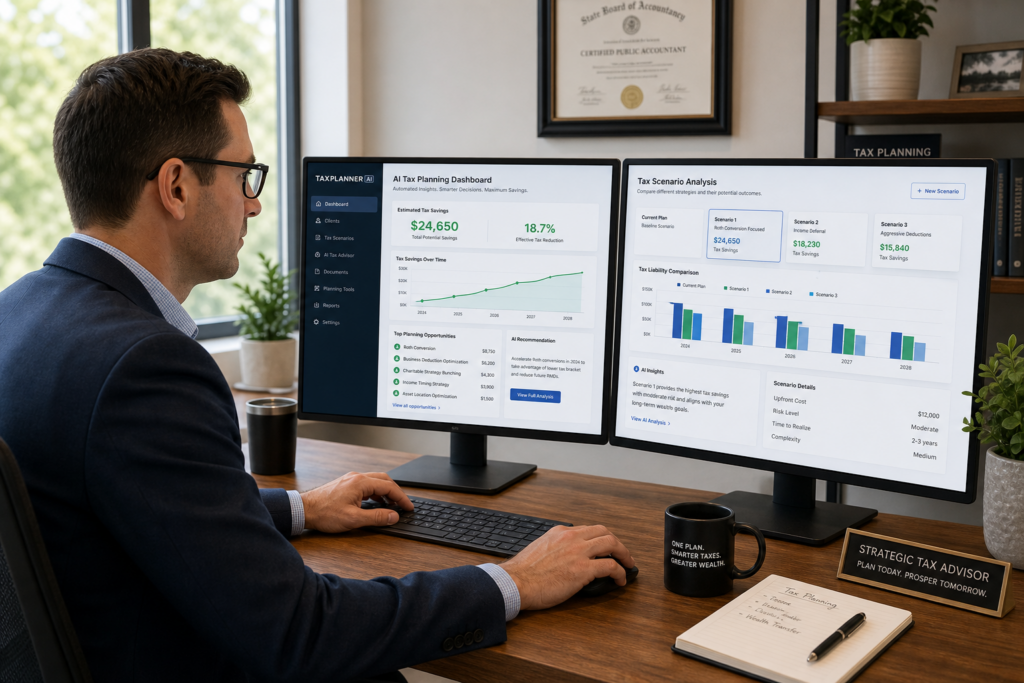
Tax Planning Software for CPAs: 2026 Guide
For the 2026 tax year, tax planning software for CPAs has evolved beyond basic compliance tools. Modern platforms now integrate AI-powered analysis, client-ready deliverables, and advisory workflows that help CPAs transition from reactive preparation to proactive planning. With 91% of auditors reporting AI tools are faster than traditional methods, choosing the right tax planning software for CPAs determines which firms scale profitably and which get left behind.
Table of Contents
- Key Takeaways
- Why Does Traditional Tax Software Fail Modern CPAs?
- What Features Define the Best Tax Planning Software for CPAs in 2026?
- How Does AI Transform Tax Advisory Delivery?
- What Security and Compliance Requirements Matter in 2026?
- How Should CPAs Evaluate Tax Software ROI?
- What Integration Capabilities Are Essential?
- Uncle Kam in Action: How a 12-Person CPA Firm Added $240K in Advisory Revenue
- Next Steps
- Frequently Asked Questions
- Related Resources

Key Takeaways
- Tax planning software for CPAs in 2026 must include AI-powered scenario modeling and unlimited client assessments
- 91% of tax professionals report AI tools deliver faster results than traditional research methods
- Integrated platforms eliminate 80+ hours per quarter of manual data reconciliation work
- Top-performing firms use software with built-in client acquisition and training systems
- Security compliance requires real-time identity verification and fraud prevention tools for 2026
Why Does Traditional Tax Software Fail Modern CPAs?
Quick Answer: Traditional tax software focuses on compliance preparation rather than advisory planning. These tools lack scenario modeling, client-ready deliverables, and the unlimited assessment capacity CPAs need to scale high-margin advisory services profitably in 2026.
The accounting profession faces a capacity crisis. Most tax planning software for CPAs was built for a different business model—one where firms made money preparing returns rather than delivering strategic advice. In 2026, that model no longer works.
According to recent industry analysis, 58% of tax departments report chronic under-resourcing, which limits their capacity for strategic work. Traditional software compounds this problem by treating every analysis as a billable project rather than a value-add opportunity.
The Credit Limitation Problem
Legacy platforms cap usage or charge per analysis. This creates a dangerous dynamic where CPAs avoid running assessments on prospects because each analysis depletes their software credits. Consequently, firms can’t prove value before signing engagements, leading to lower close rates and missed revenue.
For the 2026 tax year, the most successful tax advisory practices use platforms that provide unlimited assessments at every pricing tier. This removes friction from the sales process and allows CPAs to demonstrate expertise before prospects commit.
Disconnected Data Creates Hidden Costs
Many tax departments built their technology stack around separate point solutions. One vendor handles compliance, another manages provision work, and Excel bridges the gaps. This architecture wastes massive amounts of professional time.
Research shows disconnected tax systems consume 80+ hours per quarter on manual data reconciliation. Every dollar amount must be verified across platforms, every client update requires triple entry, and every calculation introduces error risk. Moreover, senior staff spend their time moving data instead of analyzing it.
Pro Tip: Calculate your current reconciliation cost by multiplying quarterly reconciliation hours by your average staff billing rate. Most firms discover they’re spending $30,000 to $60,000 annually on tasks that integrated platforms automate completely.
Missing the Advisory Opportunity
Traditional tax preparation software identifies potential savings but doesn’t help CPAs sell or deliver advisory services. There’s no training on positioning advisory work, no marketplace for acquiring advisory clients, and no system for converting compliance relationships into high-ticket planning engagements.
As a result, CPAs with the right technical knowledge struggle to transition into advisory billing. They can see the opportunities but lack the business infrastructure to capitalize on them profitably.
What Features Define the Best Tax Planning Software for CPAs in 2026?
Quick Answer: The best 2026 platforms combine unlimited client assessments, AI-powered scenario modeling, entity-aware architecture, professional deliverable generation, and built-in advisory training. These features transform tax planning software for CPAs from a compliance tool into a complete advisory operating system.
Selecting tax planning software for CPAs requires understanding which capabilities directly impact revenue growth and client outcomes. In 2026, the feature gap between compliance-focused tools and advisory-focused platforms has never been wider.
Unlimited Assessment Capacity
The single most important feature is unlimited, free client assessments at every pricing tier. This capability fundamentally changes how CPAs prospect, close, and serve clients. With unlimited assessments, you can run analyses on every prospect to prove value before they buy, offer complimentary reviews during tax season to identify upsell opportunities, and provide value-add assessments to existing clients without margin erosion.
Competitors that cap usage or charge per analysis force CPAs to ration their most valuable selling tool. This artificial constraint directly reduces close rates and advisory revenue.
Entity-Aware Architecture with MERNA™ Framework
Tax strategies shouldn’t be evaluated in isolation. The best tax planning software for CPAs uses entity-aware architecture that analyzes entire client portfolios simultaneously across 1040s, 1120-Ss, partnerships, and K-1s.
The MERNA™ framework provides a structured approach to strategy sequencing. It stands for Maximize Deductions, Entity Structure, Retirement, Niche strategies, and Advanced planning. This methodology ensures CPAs don’t recommend cost segregation to a client who would benefit more from S Corp election first.
For 2026, entity-aware modeling is critical because tax brackets have shifted. Married filing jointly taxpayers now stay in the 12% bracket up to $100,800 of taxable income, and the 22% bracket extends to $211,400. Optimal entity structures look different at these thresholds compared to previous years.
AI Tax Plan Generator
Professional deliverables separate $5,000 engagements from $500 ones. Clients don’t pay for spreadsheets—they pay for clarity, confidence, and implementation roadmaps. Therefore, AI-driven tax plan generation converts complex scenario modeling into structured client-ready deliverables.
These systems automatically produce strategic summaries, implementation timelines, risk assessments, and compliance calendars. The output positions CPAs as strategic advisors rather than number crunchers.
| Feature Category | Compliance-Focused Tools | Advisory-Focused Platforms |
|---|---|---|
| Assessment Limits | Capped or pay-per-use | Unlimited at all tiers |
| Multi-Entity Analysis | Single entity focus | Portfolio-wide entity-aware |
| Deliverables | PDF reports or spreadsheets | AI-generated branded plans |
| Training Included | Technical tax education only | Business-building coaching |
| Client Acquisition | None—you handle marketing | Built-in marketplace with leads |
Scenario Modeling and What-If Analysis
Sophisticated tax planning software for CPAs must support real-time scenario comparison. CPAs need to model different entity structures, contribution strategies, and timing decisions side by side to identify optimal approaches.
For example, a business owner earning $250,000 might benefit from different strategies depending on whether they’re married filing jointly or single. The MFJ 12% bracket ceiling of $100,800 creates different planning opportunities than a single filer’s lower threshold.
Built-In Training and Marketplace
Software alone doesn’t build an advisory practice. The most effective platforms include structured training on selling advisory services, pricing high-ticket engagements, positioning value, and scaling delivery without proportional headcount growth.
Additionally, a built-in marketplace that routes pre-qualified advisory leads directly to certified professionals solves the client acquisition problem that kills most advisory transitions. CPAs can focus on delivery while the platform handles lead generation.
Pro Tip: Evaluate whether tax planning software for CPAs includes weekly live coaching on advisory business models. Technical tax knowledge is table stakes. The differentiator is learning how to sell, price, and scale advisory profitably.
How Does AI Transform Tax Advisory Delivery?
Quick Answer: AI eliminates low-value mechanical work and expands CPA capacity without adding headcount. In 2026, autonomous tax preparation processes returns at a fraction of traditional time, freeing professionals for high-margin advisory and client relationship work.
Artificial intelligence represents the most significant capacity expansion tool tax professionals have seen in a generation. However, the impact differs dramatically depending on how firms frame the opportunity.
From Automation to Augmentation
An automation mindset asks, “What tasks can AI replace?” This leads to incremental efficiency and cost savings. In contrast, an augmentation mindset asks, “How can AI multiply professional capacity?” This leads to revenue expansion and advisory growth.
The American Institute of CPAs launched a Tax Transformation initiative in 2026 specifically to help tax professionals emphasize planning and advisory work. The initiative recognizes that AI will handle routine preparation, making the strategic layer more valuable.
According to industry data collected in 2026, 91% of auditors using AI tools report they’re faster than traditional research methods. Furthermore, 77% felt more confident using generative AI after implementation, and 87% believed their firm should make AI tools available to all staff.
Real-World Capacity Gains
CPA firms deploying AI-powered tax planning software for CPAs are seeing measurable results. Sample selection time has dropped from 3 hours to 5 minutes. Document review has fallen from 1 hour to a couple of minutes with defensible analysis. Documentation quality that previously required a full day now generates automatically.
One firm maintained the same revenue with two fewer staff members, demonstrating technology-driven margin protection. The capacity didn’t vanish—it shifted to higher-value work like client advisory, strategic planning, and relationship management.
What AI Handles vs. What CPAs Own
AI excels at mechanical work, first-pass analysis, data reconciliation, form population, and standard calculations. CPAs remain essential for interpreting ambiguous facts, making defensible judgments, communicating risk to clients, understanding client needs at deeper levels, and designing strategy in uncertain environments.
The value hierarchy has shifted. As mechanical work becomes easier and faster, it becomes harder to charge premium rates for basic preparation. High-value friction—the complex judgment and strategic insight only experienced CPAs provide—becomes more visible and more valuable.
| Task Category | AI Capability in 2026 | CPA Essential Role |
|---|---|---|
| Data Entry & Organization | Fully autonomous | Quality verification |
| Tax Law Research | Citation-backed guidance in minutes | Application to client facts |
| Scenario Calculations | Real-time modeling | Strategic recommendations |
| Client Communication | Draft generation | Relationship building & trust |
| Risk Assessment | Pattern identification | Judgment calls & client tolerance |
The Competitive Divide AI Creates
Tax planning software for CPAs that leverages AI effectively creates a winner-take-most dynamic. Firms that deploy capacity gains toward advisory development, relationship management, and higher-caliber staff will pull away from competitors. They’ll capture disproportionate market share because they can deliver better outcomes at better prices.
Firms that treat AI gains as pure efficiency—doing the same work faster for higher profit per partner—miss the strategic opportunity. Consequently, they’ll face margin compression as AI tools become universally available and clients expect lower prices for basic preparation.
The message from 2026 is clear: offshoring added labor, but AI adds capacity. The frontrunner firms that figure out how to deploy that capacity well will look dramatically different by decade’s end.
What Security and Compliance Requirements Matter in 2026?
Quick Answer: For 2026, tax planning software for CPAs must include real-time identity verification, AI-powered fraud detection, encrypted data transmission, and automated compliance monitoring. The IRS now recommends AI systems for identity theft prevention and secure third-party data access.
Security breaches in tax practices carry devastating consequences. Client trust evaporates, professional liability exposure explodes, and regulatory penalties mount. Therefore, security capabilities in tax planning software for CPAs aren’t optional features—they’re foundational requirements.
IRS Modernization Requirements
The IRS Electronic Tax Administration Advisory Committee released 18 recommendations in 2026 to modernize the U.S. tax system. Key security-related directives include upgrading core technology systems and expanding AI use while ensuring transparency, strengthening systems that detect and prevent fraudulent tax refunds, and introducing real-time checks for preparer and firm identification numbers.
Additionally, the IRS now recommends using AI to strengthen identity theft detection. Professionals should be able to verify taxpayer identities quickly to release delayed refunds. This means tax planning software for CPAs must integrate with IRS systems for real-time validation.
Data Privacy and Encryption Standards
Client financial data represents the most sensitive information CPAs handle. Platforms must implement bank-level encryption for data at rest and in transit, multi-factor authentication for all user access, role-based permissions that limit data exposure, and regular third-party security audits with published results.
Moreover, 2026 compliance standards require automated audit trails. Every data access, modification, and export must be logged with timestamps and user identification. This creates accountability and helps firms respond to regulatory inquiries.
Pro Tip: Request the SOC 2 Type II report from any tax planning software vendor you evaluate. This third-party audit verifies security controls and data handling procedures. Vendors who won’t provide this documentation should be eliminated immediately.
Fraud Prevention Systems
Identity theft and tax fraud continue escalating. The best tax planning software for CPAs includes AI-powered anomaly detection that flags unusual patterns, automated validation against IRS databases, and preparer identification verification before filing submissions.
These systems learn normal behavior patterns for each practice and client base. When something deviates—unusual filing locations, inconsistent income patterns, or suspicious return modifications—the software alerts CPAs before filings occur.
Cybersecurity Risk Management
Cloud-based tax planning software for CPAs shifts cybersecurity responsibility to vendors with dedicated security teams. This typically improves security compared to on-premise systems where individual firms must manage updates, patches, and threat monitoring.
However, CPAs must verify vendors maintain current security standards. Ask about penetration testing frequency, incident response procedures, disaster recovery capabilities, and business continuity plans. The right questions reveal whether vendors take security seriously or treat it as a checkbox exercise.
For 2026, regulators expect tax professionals to conduct due diligence on technology vendors. “We didn’t know” is no longer an acceptable defense when vendor security failures compromise client data.
How Should CPAs Evaluate Tax Software ROI?

Quick Answer: Calculate ROI by measuring time saved on preparation, new advisory revenue generated, increased close rates from unlimited assessments, and reduced overhead from eliminated reconciliation work. Top platforms deliver 3x to 5x first-year ROI for advisory-focused CPAs.
Most CPAs evaluate tax planning software for CPAs based solely on subscription cost. This narrow focus misses the strategic value that separates commodity tools from revenue-generating platforms.
Direct Time Savings
Start with measurable efficiency gains. Quality platforms eliminate 80+ hours per quarter of manual reconciliation work. Sample selection drops from 3 hours to 5 minutes. Research that previously consumed 30 to 45 minutes now completes in minutes with citation-backed guidance.
Multiply these time savings by your blended billing rate. A firm charging $250 per hour that reclaims 320 hours annually generates $80,000 in new capacity. That capacity can service additional compliance clients or deliver advisory engagements.
Advisory Revenue Generation
The larger ROI comes from advisory revenue that wasn’t possible before. Platforms with unlimited assessments let CPAs prove value to every prospect. Close rates improve because prospects see concrete tax savings before committing to engagements.
Calculate how many additional advisory clients you could close with unlimited assessment capacity. If your average advisory engagement generates $5,000 and you close five more clients annually, that’s $25,000 in direct revenue attributable to the software.
Additionally, consider the tax planning software that includes built-in client acquisition through a marketplace. These platforms deliver pre-qualified leads, eliminating marketing costs and prospecting time that typically consume 20% to 30% of partner capacity.
Margin Protection Through Technology
Some firms maintain revenue with fewer staff by deploying AI-powered tax planning software for CPAs. One documented case showed a practice maintaining the same revenue with two fewer staff members, representing technology-driven margin protection without backfilling departures.
At $75,000 per staff member including benefits and overhead, reducing headcount by two while maintaining revenue adds $150,000 to annual profit. This represents margin expansion that flows directly to partners or funds growth investments.
| ROI Component | Annual Value Example | How to Calculate |
|---|---|---|
| Time Savings | $80,000 | Hours saved × billing rate |
| New Advisory Revenue | $25,000 | Additional clients × avg. engagement |
| Margin Protection | $150,000 | Eliminated positions × loaded cost |
| Reconciliation Elimination | $40,000 | 80 hrs/qtr × 4 qtrs × billing rate |
| Total Annual Value | $295,000 | Sum all components |
Strategic Value Beyond Numbers
Some benefits resist quantification but drive long-term success. Improved client retention from better service delivery, enhanced firm reputation from professional deliverables, and reduced partner burnout from eliminated low-value work all contribute to sustainable practice growth.
Moreover, platforms that include advisory training help CPAs develop skills that compound over decades. Learning how to sell, price, and scale advisory services creates capabilities that generate returns long after the initial software investment.
Pro Tip: Evaluate tax planning software for CPAs based on payback period rather than total cost. A platform costing $10,000 annually that generates $40,000 in new revenue pays for itself in 3 months. The remaining 9 months represent pure profit contribution.
What Integration Capabilities Are Essential?
Quick Answer: Essential integrations include practice management systems, tax preparation software, accounting platforms, and CRM tools. Connected ecosystems eliminate manual data entry and allow information to flow automatically between compliance, planning, and advisory functions for 2026.
Tax planning software for CPAs doesn’t operate in isolation. Modern practices use multiple platforms for different functions, and disconnected systems create the reconciliation burden that consumes professional time.
Practice Management Integration
Seamless integration with practice management systems ensures client data, engagement tracking, and billing information flow automatically. When a new client enters your practice management system, their profile should populate in your tax planning software without manual re-entry.
This connectivity enables time tracking against tax planning engagements, automated billing based on completed deliverables, and centralized communication history across all client touchpoints.
Tax Preparation Software Connectivity
The most powerful integration connects tax planning directly to tax preparation. Prior-year return data should import automatically into planning scenarios, eliminating manual data entry and reducing error risk. Planning recommendations should flow forward into current-year preparation.
This closed loop ensures strategies identified during planning actually get implemented at filing time. Many good ideas die in the gap between planning conversations and preparation execution. Integration closes that gap.
Accounting Platform APIs
For business owner clients, integration with QuickBooks, Xero, or other accounting platforms allows real-time financial data to inform tax planning. Current-year income projections become more accurate, quarterly estimated tax calculations stay current, and planning scenarios reflect actual business performance rather than stale estimates.
Modern platforms use API connections rather than manual imports. This means data refreshes automatically on schedules you control, ensuring planning always uses the most current information available.
Document Management Systems
Tax planning generates substantial documentation. Scenario analyses, strategy recommendations, implementation checklists, and client communications must be stored securely and retrieved easily. Integration with document management systems ensures everything related to a client’s tax planning lives in one organized location.
This becomes critical during IRS examinations or when clients request historical planning documentation. Integrated systems make retrieval instantaneous rather than a multi-hour archaeological dig through file servers.
Pro Tip: During software evaluation, request a live demonstration of data flowing between your existing systems and the proposed tax planning software. Vendors claiming “full integration” often mean “we can export a CSV file,” which isn’t true integration.
Cloud-Based Architecture Benefits
Cloud-native tax planning software for CPAs offers inherent integration advantages. Multiple users access the same data simultaneously, eliminating version control issues. Updates deploy automatically without IT intervention. Remote teams collaborate seamlessly regardless of physical location.
For 2026, cloud architecture is essentially mandatory. The hybrid work models most firms have adopted simply don’t function well with on-premise software that requires VPN connections and local server maintenance.
Uncle Kam in Action: How a 12-Person CPA Firm Added $240K in Advisory Revenue
Client Snapshot: A regional CPA firm with 12 staff members serving small business owners and professionals struggled to transition from compliance-only services to high-margin advisory work. They had technical expertise but lacked the tools and business model to sell and deliver tax planning profitably.
Financial Profile: Annual firm revenue of $1.8 million, primarily from tax preparation and bookkeeping. They averaged $850 per client with minimal advisory revenue beyond basic quarterly check-ins.
The Challenge: The managing partner recognized advisory represented the firm’s growth path, but multiple obstacles blocked progress. Legacy tax software capped assessments at 50 per year, meaning they couldn’t offer complimentary analyses to prove value. Consequently, close rates for advisory remained under 15%.
Additionally, the firm lacked structured training on positioning and pricing advisory services. Partners knew how to identify tax savings but didn’t know how to package that knowledge into $5,000 to $15,000 engagements clients would actually buy.
The Uncle Kam Solution: The firm implemented Uncle Kam’s tax advisory operating system in January 2026. This platform provided unlimited client assessments at every tier, eliminating the software credit constraint. They began offering complimentary tax planning reviews to every prospect and existing client.
The MERNA™ framework helped staff prioritize strategies systematically. Instead of randomly suggesting ideas, they followed a structured approach that identified maximum-impact opportunities first. The AI Tax Plan Generator converted their analysis into professional deliverables that positioned them as strategic advisors rather than commodity preparers.
Equally important, weekly live coaching taught partners how to sell advisory services. They learned positioning language, pricing models, and objection handling. The built-in marketplace began routing pre-qualified advisory leads directly to the firm, solving their client acquisition problem.
The Results: Within 12 months, the firm added $240,000 in new advisory revenue. Close rates jumped from 15% to 47% because prospects saw concrete tax savings before committing. Average engagement value increased from $850 to $3,200 as the firm shifted from preparation-only to advisory relationships.
Tax Savings for Clients: The firm’s clients collectively saved over $1.2 million in taxes during the first year through strategies the software identified and the firm implemented.
Investment: The firm invested $18,000 in Uncle Kam software and training for the year.
Return on Investment: First-year ROI exceeded 13x, with $240,000 in new revenue generated from an $18,000 investment. More importantly, the firm established a scalable advisory model that continues generating recurring revenue. Managing partner capacity shifted from 70% preparation to 60% advisory, increasing both profitability and job satisfaction.
Explore more success stories at our client results page to see how tax professionals are transforming their practices with the right technology and training.
Next Steps
Selecting the right tax planning software for CPAs determines whether your practice scales profitably or struggles with margin compression. Take these concrete actions to move forward:
- Calculate your current reconciliation cost by tracking hours spent moving data between systems this quarter
- Request SOC 2 Type II security reports from any platform you’re seriously evaluating
- Demand live integration demonstrations showing actual data flow between your existing tech stack and proposed software
- Book a strategy session to discuss your specific practice goals and evaluate whether your current software supports or hinders them
- Review Uncle Kam’s complete advisory operating system to see how unlimited assessments, AI-powered planning, and built-in training create a sustainable advisory model
The tax advisory opportunity in 2026 is substantial, but only for firms with the right infrastructure. Your software choice either accelerates growth or anchors you to an obsolete business model. Choose wisely.
Frequently Asked Questions
What is the typical cost of tax planning software for CPAs in 2026?
Pricing varies dramatically based on capabilities and business model. Compliance-focused platforms typically charge $3,000 to $8,000 annually with additional per-analysis fees. Advisory-focused operating systems like Uncle Kam range from $12,000 to $24,000 annually but include unlimited assessments, AI-powered deliverables, advisory training, and marketplace access. Evaluate cost relative to revenue generation potential rather than absolute subscription price.
How long does it take to implement new tax planning software?
Cloud-based platforms typically require 2 to 4 weeks for full implementation. This includes data migration from existing systems, staff training on new workflows, and integration configuration with your current tech stack. However, you can begin running client assessments within days of account activation. The implementation timeline matters less than ongoing support quality and training resources for 2026 deployments.
Can tax planning software help solo practitioners compete with larger firms?
Absolutely. AI-powered tax planning software for CPAs is the great equalizer because it provides solo practitioners with capabilities that previously required large staff teams. Unlimited assessments let you prove value like big firms, professional AI-generated deliverables match the polish of large firm output, and built-in marketplaces provide lead flow that rivals established firm referral networks. Solo practitioners using advanced platforms often outperform larger firms on client experience and value delivery.
What happens to my data if I switch tax planning software platforms?
Reputable platforms provide data export in standard formats upon request. You should receive CSV exports of client information, PDF archives of generated plans, and documentation of all analyses performed. Before selecting any platform, verify their data portability policy in writing. Cloud-based systems typically offer better data access than legacy on-premise solutions. Never sign contracts that restrict your ability to export your own client data.
How does Uncle Kam’s unlimited assessment model differ from competitors?
Most tax planning software for CPAs caps assessments or charges per analysis, creating artificial scarcity. Uncle Kam provides truly unlimited assessments at every pricing tier because we understand that CPAs need to run analyses on prospects to close engagements and offer value-adds to existing clients without margin erosion. This fundamental difference in business model removes the friction that kills advisory growth at other platforms. You can assess every prospect, every client, and every scenario without worrying about depleting credits.
What training is included with tax planning software platforms?
Training quality separates advisory-focused platforms from compliance-focused tools. Most platforms provide technical training on software features and tax strategies. Uncle Kam uniquely includes weekly live coaching on the business of advisory—how to sell services, price engagements, handle objections, and scale delivery profitably. Technical tax knowledge is table stakes for CPAs. The missing piece is business development training, which Uncle Kam provides as a core platform component for 2026.
Will AI eventually replace the need for CPAs in tax planning?
No. AI handles mechanical work, data organization, research, and calculations. However, CPAs remain essential for interpreting ambiguous facts in client-specific contexts, making defensible judgment calls when tax law is unclear, communicating complex risks in language clients understand, and building trusted relationships that clients rely on for decades. The value hierarchy has shifted: mechanical work becomes less valuable while strategic judgment becomes more valuable. Tax planning software for CPAs augments professional capacity rather than replacing it.
How do I know if my current tax software is holding back practice growth?
Warning signs include: avoiding prospect assessments because you’re rationing software credits, spending significant time reconciling data between disconnected systems, producing deliverables that look homemade rather than professional, lacking systematic training on advisory business development, and having no structured client acquisition channel beyond referrals. If you recognize two or more of these patterns, your software choice is constraining growth rather than enabling it for 2026.
What tax strategies does modern software prioritize for 2026?
For the 2026 tax year, with MFJ taxpayers staying in the 12% bracket up to $100,800 of taxable income, strategic Roth conversions become particularly valuable. S Corp reasonable compensation optimization matters more with IRMAA thresholds at $109,000 single and $218,000 MFJ. The best tax planning software for CPAs automatically adjusts strategy recommendations based on current-year brackets, standard deductions, and phase-out ranges. Legacy software using 2025 or older data will recommend suboptimal strategies.
This information is current as of 6/18/2026. Tax laws change frequently. Verify updates with the IRS or relevant regulatory bodies if reading this later.
Related Resources
- Complete Tax Strategy Planning Services
- Build a Scalable Tax Advisory Practice
- Understanding the MERNA™ Tax Planning Framework
- Entity Structuring for Maximum Tax Efficiency
- Real CPA Firm Success Stories and Results
Last updated: June, 2026

