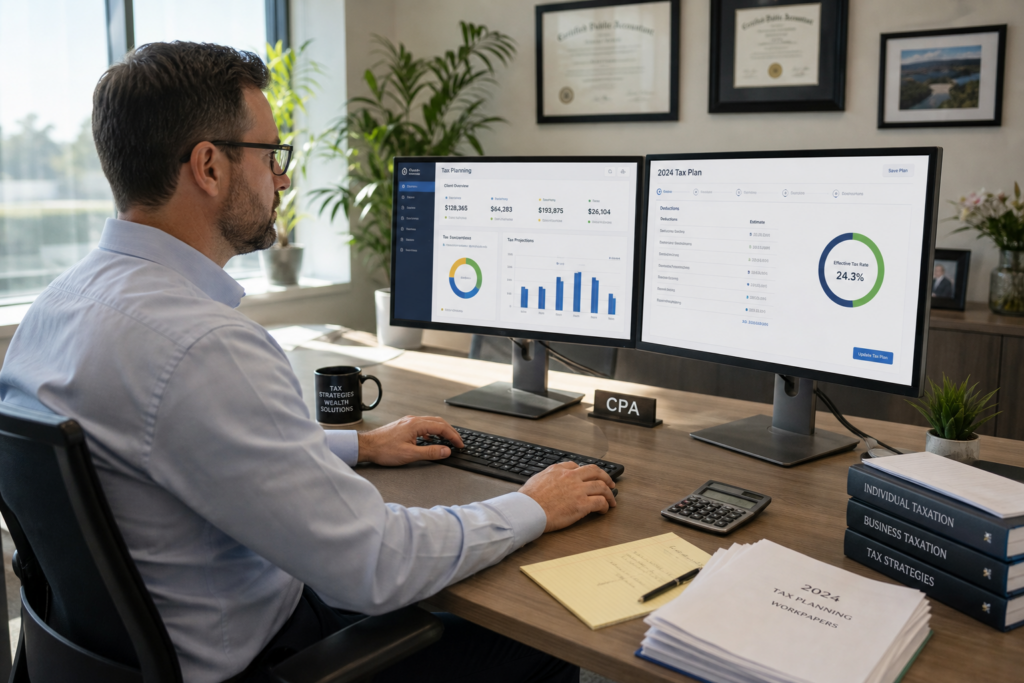
Tax Planning Software for CPAs: 2026 Guide
For the 2026 tax year, CPAs face mounting pressure to deliver proactive tax strategy services while managing increasingly complex client portfolios. The right tax planning software for CPAs doesn’t just automate compliance—it transforms your practice into a high-value advisory operation that commands premium fees and drives measurable client outcomes.
Table of Contents
- Key Takeaways
- What Is Tax Planning Software for CPAs and Why Does It Matter in 2026?
- What Features Separate Advisory Platforms from Compliance Tools?
- How Does AI Integration Impact CPA Workflows in 2026?
- What ROI Should CPAs Expect from Tax Planning Software?
- How Do Leading Platforms Compare for Multi-Client Management?
- What Security and Compliance Standards Must Software Meet?
- How Do You Transition Clients to Advisory Services?
- Uncle Kam in Action: How One CPA Firm Scaled to $500K Advisory Revenue
- Next Steps
- Frequently Asked Questions
- Related Resources
 For Tax Professionals
Build your next chapter in tax advisory.
Explore how Uncle Kam Pro could support the next stage of your practice.
Key Takeaways
- Modern tax planning software for CPAs must support multi-entity scenario modeling for 2026 tax brackets and thresholds.
- AI-powered platforms can reduce plan generation time from 8 hours to under 30 minutes.
- Integrated systems eliminate manual data entry between compliance and planning workflows.
- Professional deliverables justify $3,000-$15,000 advisory fees versus $500-$800 compliance-only pricing.
- Unlimited assessment capabilities prevent per-analysis costs from eroding profit margins on prospect conversions.
What Is Tax Planning Software for CPAs and Why Does It Matter in 2026?
Quick Answer: Tax planning software for CPAs is specialized technology that models tax scenarios, identifies savings opportunities, and generates professional client deliverables—transforming reactive compliance into proactive advisory services that command 5-10x higher fees.
The accounting profession reached an inflection point in 2026. According to the American Institute of CPAs, tax returns will increasingly be prepared with AI assistance. However, this doesn’t diminish the CPA’s role—it elevates it.
Jan Lewis, AICPA Chair, stated at the Engage 2026 conference that while AI assists with tax return preparation, “that does not mean that the tax return comes in and goes out solely with the use of AI without a human in the lead.” The value lies in the advice and guidance CPAs provide during and after return preparation.
The Advisory Imperative
Traditional compliance work, such as filing 1040s, preparing quarterly payments, and handling extensions, faces commoditization pressure. Automation, online services, and AI-powered tools are making basic tax prep accessible at lower price points. Therefore, CPAs must differentiate through advisory services that require professional judgment, strategic thinking, and deep client relationships.
Tax planning software for CPAs bridges this gap. Instead of spending hours manually calculating scenarios in spreadsheets, modern platforms automate the computational work while letting CPAs focus on interpretation, client communication, and strategy refinement. This shift allows practices to serve more clients at higher value points.
2026 Tax Environment Complexity
The 2026 tax landscape presents unique challenges. Married filing jointly taxpayers face a standard deduction of $27,100, with the 12% bracket extending to $24,800 of taxable income, the 22% bracket from $24,800 to $100,800, and the 24% bracket from $100,800 to $211,400. These thresholds create critical planning opportunities around income timing, deduction acceleration, and entity structure optimization.
Retirement contribution limits increased for 2026: $24,500 base for 401(k) plans, plus $8,000 catch-up for those 50 and older, totaling $32,500. High earners aged 60-63 qualify for a super catch-up of $11,250, raising their total to $35,750. Crucially, employees earning over $150,000 in the prior year must route catch-up contributions into Roth 401(k) accounts, which is a forced Roth conversion that impacts multi-year tax planning.
Pro Tip: IRMAA thresholds for 2026 Medicare premiums begin at $109,000 for single filers and $218,000 for married filing jointly. Software must model the two-year lookback effect on premium surcharges.
What Distinguishes Software from Spreadsheets
Spreadsheet-based planning has inherent limitations. As client portfolios grow more complex, including multiple entities, passive income sources, and retirement accounts across different custodians, manual modeling becomes error-prone and time-intensive. Moreover, spreadsheets don’t produce client-ready deliverables that justify premium fees.
Professional tax planning software solves these problems through automation, data integration, and presentation quality. The best platforms update automatically when the IRS publishes new guidance, eliminating the need to manually adjust formulas. They also generate branded reports that communicate complex strategies in client-friendly language.
What Features Separate Advisory Platforms from Compliance Tools?
Quick Answer: Advisory platforms must support multi-entity modeling, unlimited scenario comparison, automated strategy sequencing, professional client deliverables, and integration with existing tax software, which are capabilities that compliance tools lack.
Not all tax software serves the same purpose. Compliance tools focus on accurate return preparation and e-filing. Advisory platforms focus on identifying opportunities and modeling “what-if” scenarios before filing. Understanding this distinction prevents costly purchasing mistakes.
Multi-Entity and Multi-Year Modeling
High-value clients rarely have simple tax situations. A business owner might operate through an S Corporation while holding rental properties in an LLC and maintaining personal investments. Each entity’s income flows differently, with varying deduction rules and planning opportunities.
Effective tax planning software for CPAs must model the entire ecosystem simultaneously. This includes Form 1040 personal returns, Form 1120-S for S Corporations, Schedule E for rental income, and K-1 distributions. Furthermore, the software should project multiple years forward to evaluate strategies like Roth conversions, cost segregation studies, or entity restructuring.
Strategy Library and Sequencing
The most sophisticated platforms include comprehensive strategy libraries covering common and advanced techniques. This might include qualified business income deductions, bonus depreciation, retirement plan contributions, charitable giving strategies, income shifting to family members, and entity election changes.
More importantly, leading solutions sequence strategies based on priority and interdependency. For example, maximizing current-year deductions through cost segregation creates cash flow for retirement contributions, which reduces AGI and potentially qualifies the client for additional credits. The order matters, and manual sequencing invites errors.
Client Portal and Collaboration Features
Modern clients expect digital experiences. Software should provide secure portals where clients can view their plan, track implementation progress, upload documents, and communicate with the CPA team. Real-time collaboration eliminates the back-and-forth of email attachments and version control issues.
Client portals also serve a marketing function. When prospects see a polished, branded planning portal during initial consultations, they immediately perceive higher value than a basic PDF emailed from generic software. This perception supports premium pricing.
Integration with Existing Tax Software
Many practices already use preparation software like Lacerte, ProSeries, Drake, or UltraTax. According to Thomson Reuters research, disconnected systems waste over 80 hours per quarter on manual data reconciliation. Integrated platforms eliminate this waste by automatically pulling data from compliance software into planning modules.
The ideal workflow is to complete the tax return in the existing software, push data to the planning platform with one click, model scenarios, generate the client plan, and document selected strategies that feed back into next year’s return. This closed-loop system maximizes efficiency.
Professional Deliverable Generation
Clients do not pay $5,000-$15,000 for a spreadsheet. They pay for clarity, confidence, and a roadmap. Therefore, tax planning software must produce professional documents that communicate complex tax strategies in accessible language with clear implementation steps.
The best platforms generate multi-section reports including executive summaries, current-year tax projections, multi-year forecasts, strategy explanations with real-world examples, implementation timelines, and risk assessments. These deliverables justify advisory fees and differentiate practices from competitors that deliver compliance-only services.
How Does AI Integration Impact CPA Workflows in 2026?
Quick Answer: AI reduces plan generation time from 8+ hours to under 30 minutes, automatically identifies strategies based on client profiles, and generates first-draft client communications, freeing CPAs to focus on judgment and relationship building.
The AICPA’s Tax Transformation initiative, launched in early 2026, explicitly addresses how CPAs should adapt to AI-enabled advisory operations. The framework helps tax partners evolve from reactive, compliance-focused practices into proactive advisory organizations, where AI handles computational work and CPAs provide strategic guidance.
Automated Strategy Identification
AI-powered tax planning software analyzes client data against hundreds of potential strategies and identifies the most relevant opportunities. For example, when a client’s income exceeds $100,800 (the top of the 12% bracket for 2026), the AI might flag pension maximization strategies, S Corporation election analysis, or income deferral techniques.
This automation eliminates the manual review process, where CPAs scan through strategy checklists. Instead, the software presents a prioritized list of applicable strategies with estimated tax savings. The CPA then applies professional judgment to determine which strategies align with the client’s goals, risk tolerance, and implementation capacity.
Natural Language Plan Generation
Modern AI can draft client-facing explanations of complex strategies. Instead of writing from scratch, CPAs review and refine AI-generated content that explains why a strategy matters, how it works, and what steps to take. This dramatically accelerates deliverable creation.
For instance, AI might generate: “The 2026 taxable income of $95,000 positions this client near the top of the 12% bracket. Contributing an additional $5,800 to a Solo 401(k) would keep taxable income below the $100,800 threshold where the 22% rate begins, saving $1,276 in federal tax.” The CPA verifies accuracy and adds personalized context.
Scenario Modeling at Scale
AI enables instant scenario comparison. A client considering whether to take a $50,000 bonus in December 2026 or January 2027 can see both outcomes immediately, including impacts on AGI, deduction phase-outs, IRMAA premiums, and state tax. CPAs no longer spend hours building comparison spreadsheets.
This speed matters during client meetings. When a question arises, such as “What if we converted $75,000 to Roth this year?”, CPAs can model it on the spot rather than promising to run the numbers and follow up. Immediate answers build confidence and close advisory engagements faster.
Pro Tip: The IRS advisory committee recommended in June 2026 that the agency adopt AI capabilities for modernization. This signals broader acceptance of AI in tax professional workflows.
Quality Control and Professional Oversight
AI augments CPA judgment rather than replacing it. The software might suggest a strategy that technically reduces tax but does not align with the client’s liquidity needs or business goals. The CPA’s professional judgment, which includes understanding the client’s full situation, determines which AI-generated recommendations to implement.
Similarly, AI-generated client communications require review. Tax laws contain nuances and exceptions that AI might miss, and client-specific facts can make general rules inapplicable. The CPA’s responsibility is verifying accuracy, adding context, and ensuring recommendations serve the client’s best interests.
What ROI Should CPAs Expect from Tax Planning Software?
Quick Answer: Practices implementing professional tax planning software typically achieve 5-10x ROI in year one through higher fees, increased capacity, and improved client retention, with many recovering software costs within the first 2-3 advisory engagements.
Software represents an investment, and business owners evaluate investments through return on investment calculations. Tax planning software delivers ROI through three primary mechanisms: revenue growth, efficiency gains, and risk reduction.
Revenue Impact: Advisory Fee Premium
Compliance-only practices typically charge $500-$800 per individual return and $800-$1,500 for business returns. Advisory-focused practices charge $3,000-$7,500 for comprehensive planning engagements, with complex cases reaching $10,000-$15,000. The difference is professional deliverables that justify premium pricing.
Consider a scenario where tax planning software costs $5,000 annually. Converting just three compliance clients to advisory clients at an incremental fee of $4,000 each generates $12,000 in additional revenue, yielding 240% ROI in year one. Most practices convert far more than three clients once they establish advisory capabilities.
| Service Model | Typical Fee Range | Time Investment | Client Perception |
|---|---|---|---|
| Compliance Only | $500-$1,500 | 2-4 hours | Necessary expense |
| Compliance + Basic Planning | $2,000-$4,000 | 6-10 hours | Valued service |
| Comprehensive Advisory | $5,000-$15,000 | 8-15 hours (with software) | Strategic partnership |
Efficiency Gains: Capacity Multiplication
Manual planning consumes 8-20 hours per client when building scenarios in spreadsheets, researching strategies, and drafting recommendations. Software reduces this to 2-4 hours per comprehensive plan. This 5-7x efficiency gain means CPAs can serve more advisory clients without adding staff.
A solo practitioner who previously had capacity for 10 advisory clients annually can scale to 30-40 with software automation. For firms with multiple professionals, this multiplies across the entire team. The capacity expansion directly converts to revenue growth.
Client Retention and Referral Value
Advisory relationships exhibit higher retention rates than compliance-only engagements. When clients see documented tax savings of $15,000, $30,000, or $50,000+ from implemented strategies, they are unlikely to shop around for a cheaper preparer. The lifetime value of these relationships far exceeds initial acquisition costs.
Furthermore, clients who receive comprehensive planning become referral sources. Business owners talk to other business owners about their CPAs, and real estate investors network with other investors. One impressed client can generate 3-5 qualified referrals annually, compounding ROI over time.
Risk Mitigation and Professional Liability
Comprehensive planning software documents recommendations, the analysis supporting them, and the client’s decisions. This documentation protects against malpractice claims by demonstrating that CPAs performed due diligence and communicated options clearly. The risk reduction alone justifies software investment for many practices.
How Do Leading Platforms Compare for Multi-Client Management?

Quick Answer: Platforms differ significantly in pricing models, strategy depth, client limits, and workflow integration, requiring evaluation based on firm size, client complexity, and growth trajectory rather than feature checklists alone.
The market offers numerous options, each with distinct strengths. Understanding these differences prevents choosing software that does not align with a practice’s model. When evaluating tax planning software for CPAs, focus on how the platform supports specific workflows.
Pricing Model Considerations
Software vendors structure pricing in several ways. Per-client models charge for each client plan generated. Subscription tiers offer unlimited plans within usage bands. Credit-based systems sell analysis credits consumed as scenarios are run. Understanding these models prevents unexpected costs.
Per-client pricing can become expensive as practices scale. When running preliminary analyses on prospects to demonstrate value before signing engagements, CPAs are essentially paying for assessments on people who may not become clients. This creates pressure to limit prospect analysis, potentially reducing conversion rates.
Unlimited models eliminate this friction. Assessments can be run on every prospect without worrying about per-analysis costs eating into margins. This encourages more thorough prospect evaluation and supports higher conversion rates. For growing practices, unlimited models often deliver better economics.
Strategy Breadth and Depth
Platform strategy libraries vary dramatically. Basic systems cover common deductions and retirement contributions. Comprehensive platforms include advanced strategies like cost segregation, conservation easements, opportunity zone investments, captive insurance, and international tax planning. The client base determines which breadth is needed.
For example, if a practice serves real estate investors, it needs robust cost segregation modeling, short-term rental tax treatment calculations, and 1031 exchange planning. If clients are predominantly W-2 high earners, strong retirement optimization, charitable giving strategies, and tax-loss harvesting are more critical.
| Platform Feature | Basic Systems | Professional Systems | Enterprise Systems |
|---|---|---|---|
| Strategy Library | 20-50 strategies | 150-300+ strategies | 300+ with custom builder |
| Multi-Entity Support | Limited | Full 1040/1120-S/K-1 modeling | Unlimited entities with consolidation |
| AI Integration | None | Strategy identification | Full plan generation + NLP |
| Client Portal | PDF export only | Branded portal with collaboration | White-label with mobile app |
| Typical Annual Cost | $2,000-$4,000 | $5,000-$12,000 | $15,000-$30,000+ |
Integration and Workflow Efficiency
Standalone systems require manual data entry, copying information from tax returns into planning software. This duplication wastes time and introduces transcription errors. Integrated platforms pull data directly from tax software, eliminating duplicate entry and ensuring accuracy.
Some platforms integrate with practice management software, allowing firms to track advisory engagement progress, automate client communications, and monitor implementation. These workflow integrations compound efficiency gains beyond just the planning module itself.
Scalability for Firm Growth
Consider where the practice will be in 3-5 years. Software that works for 20 advisory clients might break at 100. Enterprise-grade platforms support multi-user access, role-based permissions, client assignment workflows, and standardized methodologies, which are critical features as firms scale beyond founder-dependent delivery.
What Security and Compliance Standards Must Software Meet?
Quick Answer: Tax planning software must meet SOC 2 Type II standards, provide 256-bit encryption, support role-based access controls, and comply with IRS Circular 230 and state-specific confidentiality requirements for client data protection.
Client tax data represents sensitive information protected by multiple regulatory frameworks. CPAs face professional liability for data breaches, making security evaluation a critical software selection criterion. Do not assume all vendors meet necessary standards; verify explicitly.
SOC 2 Type II Certification
SOC 2 Type II audits verify that vendors maintain appropriate security controls over time. This differs from SOC 2 Type I, which only verifies controls exist at a point in time. Type II demonstrates consistent security practices, which is essential for protecting client data.
Request SOC 2 reports during vendor evaluation. Reputable vendors provide these reports to qualified prospects. If a vendor hesitates or claims they do not need SOC 2 certification, consider that a red flag. The cost and effort of achieving certification demonstrates commitment to security.
Encryption and Data Protection
Data must be encrypted both in transit, while moving between the CPA’s computer and the vendor’s servers, and at rest, while stored on servers. Industry standard is 256-bit AES encryption. Additionally, verify that vendors maintain geographically redundant backups with disaster recovery procedures.
Ask about data retention policies. What happens if the subscription is terminated? Can all client data be exported? How long does the vendor retain information after termination? These questions matter for business continuity and regulatory compliance.
Access Controls and Audit Trails
Multi-user firms need role-based access controls. Staff members should only access clients assigned to them, and detailed audit logs should track who viewed or modified each client’s information. These controls protect against unauthorized internal access and provide accountability.
Two-factor authentication should be mandatory for all user accounts. Password requirements should enforce complexity and regular rotation. These basic security hygiene practices significantly reduce breach risk.
Pro Tip: IRS Circular 230 requires CPAs to protect client confidentiality. Using software without adequate security measures could constitute a Circular 230 violation, exposing CPAs to professional sanctions.
Business Continuity and Vendor Stability
Evaluate vendor financial stability. Startups offer innovation but carry risk if they run out of funding. Established vendors provide stability but may lag in feature development. Ideally, look for vendors with multi-year track records, sustainable business models, and demonstrated commitment to the CPA market.
How Do You Transition Clients to Advisory Services?
Quick Answer: Successful transitions start with free assessments demonstrating value, followed by tiered service offerings, proactive education campaigns, and systematic integration of planning conversations into existing compliance touchpoints throughout the year.
Acquiring software does not automatically generate advisory revenue. CPAs must actively transition compliance clients to advisory relationships. This requires marketing, positioning, and systematic client communication. The good news is that the existing client base represents the warmest prospects.
The Free Assessment Strategy
Offer complimentary tax planning assessments to existing clients. Run a preliminary analysis showing potential savings opportunities without full implementation details. Present findings in a 15-20 minute call. Most clients who see legitimate $10,000+ savings opportunities will engage for the comprehensive plan.
This approach works because the CPA demonstrates value before asking for payment. Clients see concrete numbers, such as “We identified $23,000 in potential tax savings,” which makes the advisory fee seem small relative to benefit. Conversion rates typically range from 30-60%, depending on client profile and savings magnitude.
Tiered Service Packaging
Structure services in clear tiers. Basic compliance remains available for price-sensitive clients. Mid-tier packages add quarterly planning check-ins. Premium packages include comprehensive annual planning, quarterly reviews, unlimited consultation, and priority access. This gives clients choice while encouraging upgrades.
Publish transparent pricing for each tier. When clients understand what they receive at each level and how fees correlate to value, they can self-select appropriately. This reduces awkward pricing conversations and positions advisory services as natural progressions rather than upsells.
Year-Round Engagement Touchpoints
Compliance CPAs interact with clients once annually at tax time. Advisory CPAs engage quarterly or monthly. Build touchpoints into service delivery: mid-year planning reviews, third-quarter estimated payment consultations, year-end planning sessions, and post-filing strategy implementation calls.
These touchpoints reinforce value throughout the year, making clients less likely to shop for cheaper alternatives. They also create natural opportunities to identify life changes, such as business growth, real estate purchases, or inheritance, that trigger planning needs.
Education-Based Marketing
Send monthly or quarterly newsletters explaining tax strategies with real examples. Host webinars on topics like “2026 Year-End Tax Planning” or “S Corporation Election Analysis.” Publish blog content addressing common client questions. Education positions the CPA as an expert while subtly demonstrating the sophistication of advisory services.
When clients consume educational content, they become aware of planning opportunities they did not know existed. This awareness generates inbound inquiries, with clients asking whether specific strategies apply to them, which convert at higher rates than cold outreach.
Uncle Kam in Action: How One CPA Firm Scaled to $500K Advisory Revenue
Jessica Martinez, CPA, operated a traditional tax preparation practice in Phoenix serving approximately 180 clients with annual revenue around $280,000. Her business model included individual returns at $650, small business returns at $1,200, plus quarterly bookkeeping for select clients. She worked 70-hour weeks during tax season and struggled to differentiate from online competitors.
In January 2025, Jessica implemented comprehensive tax planning software for CPAs with unlimited client assessments and AI-powered strategy identification. She spent February running free planning assessments for her 50 highest-income clients, identifying an average of $18,000 in potential annual tax savings per client.
By March, 22 clients engaged for comprehensive planning at $5,500 each, generating $121,000 in new advisory revenue. Through 2025, she converted 47 total clients to advisory relationships, adding $258,500 in advisory fees while maintaining her compliance base. Her 2026 projections show $520,000 total revenue, with advisory representing 55% of the mix.
The software investment was $8,400 annually. First-year ROI reached 2,977%. More importantly, Jessica reduced her tax season hours from 70 per week to 50 while earning nearly double her previous income. She attributes success to three factors: unlimited free assessments that proved value before asking for fees, professional deliverables that justified premium pricing, and AI-assisted plan generation that made advisory services scalable.
Jessica’s clients saved an average of $21,000 in 2026 taxes through implemented strategies. Her advisory fee of $5,500 delivered 382% ROI for clients, a value proposition that generates referrals and ensures retention.
Next Steps
For CPAs ready to transform from compliance-focused to advisory-driven, start with these concrete actions:
- Evaluate the current client base and identify the top 30% by income or complexity who would benefit most from planning.
- Request demos from 3-4 software vendors, focusing on workflow integration, strategy breadth, and pricing models that fit the practice size.
- Calculate the target ROI: how many advisory engagements at what fee would justify software investment within 12 months?
- Review the tax advisory services framework to understand how advisory fits into overall practice positioning.
- Develop a transition plan that includes which clients receive assessments first, what the service tiers will be, and how new offerings will be communicated.
The shift from compliance to advisory does not happen overnight, but with proper software infrastructure and systematic client communication, most practices achieve meaningful traction within 3-6 months. The key is starting now; every month without advisory capabilities represents lost revenue and missed opportunities to serve clients at a higher level.
Frequently Asked Questions
Can tax planning software integrate with existing tax preparation software?
Most professional-grade platforms integrate with major tax software like Lacerte, ProSeries, Drake, UltraTax, and CCH ProSystem fx. Integration depth varies; some pull data automatically via API connections, while others use manual import/export workflows. During vendor evaluation, specifically test integration with current software. Seamless data flow prevents duplicate entry and ensures planning scenarios reflect actual return data, which is critical for accuracy and efficiency.
How long does implementation take before advisory revenue can be generated?
Implementation timelines range from 2-8 weeks, depending on platform complexity and team size. Solo practitioners can be operational in 2-3 weeks with basic training and template setup. Multi-professional firms requiring custom workflows, team training, and standardized methodologies might need 6-8 weeks. However, revenue can start before full implementation; many CPAs run their first paid advisory engagements within 3-4 weeks using out-of-box templates while customization continues in parallel. The key is starting with a few pilot clients rather than waiting for perfect setup.
What is the difference between tax planning software and tax preparation software?
Tax preparation software focuses on accurate return completion and IRS e-filing compliance. It captures historical information and produces legally compliant filings. Tax planning software models future scenarios, compares strategies, and produces forward-looking recommendations. Preparation looks backward at what happened, and planning looks forward to what should happen. Most practices need both: preparation for compliance obligations and planning for advisory services. The best workflows use preparation software to capture client data, then flow that data into planning software for strategy development.
Is different software needed for individual versus business tax planning?
Comprehensive platforms handle both within a single system because individual and business taxes are interrelated. For example, S Corporation owners need planning that spans their Form 1120-S business return and their Form 1040 personal return. Salary versus distribution decisions affect both returns. Pass-through deductions, retirement contributions, and entity structure choices all require integrated modeling across return types. Basic platforms might only handle individual planning, limiting the ability to serve business owner clients effectively. Verify multi-entity support during software evaluation if the practice serves or plans to serve business owners.
How can advisory fees be justified to clients used to paying only for tax preparation?
Justification comes from documenting specific dollar savings. Instead of saying “we will optimize taxes,” show that $23,000 in potential savings was identified through S Corporation election and retirement plan optimization. Present advisory fees as percentages of savings; a $5,000 fee delivering $23,000 in savings represents 22% of benefit, or 460% ROI. Use free assessments to prove value before asking for engagement. Once clients see concrete numbers, the fee becomes a minor investment relative to benefit. Professional deliverables also matter; clients paying $5,000 expect more than a PDF, they expect comprehensive reports, implementation support, and ongoing access.
What happens if tax laws change mid-year; does software update automatically?
Reputable vendors push automatic updates when tax laws change, similar to how tax preparation software updates for IRS form revisions. This includes mid-year legislation, new IRS guidance, and revenue procedures affecting calculations. However, update speed varies by vendor. Some push updates within days of law changes; others take weeks. Ask vendors about their update process during evaluation, including how quickly they respond to law changes, whether updates are automatic or require manual installation, and how they communicate changes to users. For 2026 specifically, vendors updated for the new mandatory Roth catch-up rules and SECURE 2.0 provisions affecting high earners.
Can tax planning software be used if the firm specializes in a niche like real estate investors?
Yes, but ensure the platform includes strategies specific to the niche. For real estate investors, robust cost segregation modeling, short-term rental tax treatment under the 7-day/30-day rules, 1031 exchange planning, passive activity loss calculations, and rental property depreciation optimization are necessary. Generic platforms might lack these specialty capabilities. Some vendors offer industry-specific modules or strategy packs. If the practice serves a concentrated niche, prioritize vendors who demonstrate expertise in that area through their strategy library, case studies, and user base. Niche-focused tools often deliver better results than general-purpose platforms for specialized practice areas.
Related Resources
- Tax Strategy Services: Comprehensive Planning for Maximum Savings
- Tax Advisory Services: Building High-Value Client Relationships
- The MERNA Method: Strategic Framework for Tax Planning
- Tax Guides: In-Depth Resources for Professional Development
- Client Results: Real Success Stories from Advisory Practices
This information is current as of 6/18/2026. Tax laws change frequently. Verify updates with the IRS or professional advisors if reading this later.
Last updated: June, 2026

