
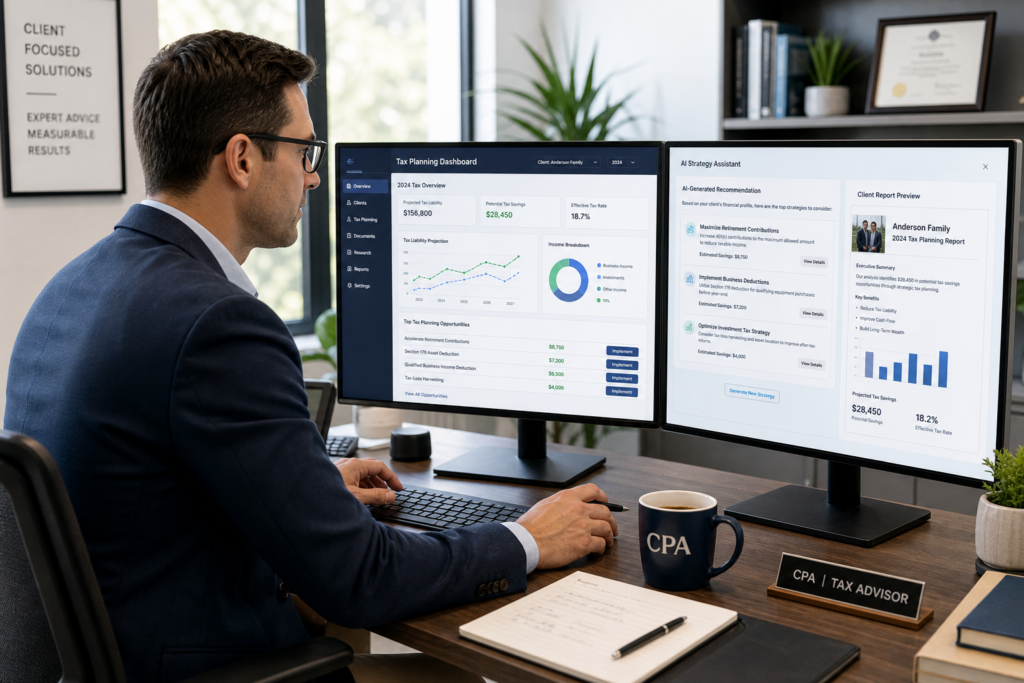
Tax Planning Software for CPAs: 2026 Complete Guide to AI-Powered Tax Advisory
For the 2026 tax year, CPAs face a critical choice. Firms using modern tax planning software for CPAs are delivering higher-value advisory services and commanding premium fees. Those still relying on compliance-only tools are watching competitors capture their best clients. The difference often comes down to technology.
Table of Contents
- Key Takeaways
- What Is Tax Planning Software for CPAs in 2026?
- Why Do CPAs Need Specialized Tax Planning Software?
- What Features Should CPAs Look for in 2026?
- How Do IRS AI Guidelines Affect Tax Software Selection?
- What ROI Can Firms Expect From Tax Planning Software?
- How Does Tax Planning Software Differ From Tax Prep Software?
- What Are the Biggest Mistakes CPAs Make When Choosing Software?
- Uncle Kam in Action: CPA Firm Scales Advisory Revenue
- Next Steps
- Frequently Asked Questions
- Related Resources
Key Takeaways
- Tax planning software for CPAs enables high-margin advisory work that drives revenue growth in 2026
- IRS AI guidelines released June 24, 2026 require practitioners to verify all AI outputs
- Two-thirds of CPA firms expect revenue growth, but margins stall without value-based pricing
- Firms risk losing 24% of talent without effective AI implementation strategies
- The best platforms combine AI automation with scenario modeling and client deliverables
What Is Tax Planning Software for CPAs in 2026?
Quick Answer: Tax planning software for CPAs is a technology platform that enables proactive tax strategy identification, multi-year scenario modeling, and professional client deliverables that justify advisory fees.
The 2026 tax planning software for CPAs landscape looks fundamentally different than it did even two years ago. Modern platforms combine artificial intelligence with deep tax code knowledge to help practitioners move beyond compliance into high-value advisory work.
According to the Thomson Reuters 2026 State of Tax Professionals Report, nearly two-thirds of firms expect revenue to increase over the next 12 months. However, the report also reveals that advisory services remain the profession’s lowest-margin category despite being in highest demand.
Tax planning software for CPAs addresses this margin problem by automating the time-intensive research and calculation work. This allows practitioners to focus on strategic client conversations and relationship building.
The Core Functions of Modern Tax Planning Software
Professional-grade tax planning software for CPAs delivers three essential capabilities. First, strategy identification using AI to analyze client data and recommend applicable tax-saving opportunities. Second, scenario modeling that projects tax outcomes across multiple years and entity structures. Third, professional deliverables that justify advisory fees through clear, client-ready reports.
Many CPAs now use these platforms to support ongoing tax advisory relationships with business owners, real estate investors, and high-income professionals. The software becomes the engine that powers monthly or quarterly planning engagements.
How AI Is Reshaping the Category
On June 24, 2026, the IRS released preliminary AI guidelines for tax practitioners that fundamentally changed how firms should evaluate tax planning software for CPAs. The guidelines emphasize practitioner competence, due diligence, and data security when using AI tools.
The IRS made clear that AI outputs must be verified. Tax professionals cannot simply assume AI-generated advice is accurate. They must check facts, verify citations, and read underlying code sections. This means the best tax planning software for CPAs provides transparent, traceable recommendations rather than black-box outputs.
Pro Tip: Choose tax planning software for CPAs that shows IRS code citations and calculation methodologies for every recommendation. This transparency is now essential for IRS compliance.
Why Do CPAs Need Specialized Tax Planning Software?
Quick Answer: CPAs need specialized software because advisory services are the highest-demand, highest-revenue category, but manual planning doesn’t scale profitably without technology assistance.
The economics of tax advisory work create a fundamental challenge. Clients want comprehensive, proactive planning. They’re willing to pay premium fees for it. However, delivering this service manually requires extensive research time that quickly erodes margins.
Tax planning software for CPAs solves this scalability problem. According to industry data, profit margins across tax firms averaged above 30% throughout 2025. Firms maintaining those margins while growing advisory revenue typically use technology to leverage their practitioners’ time.
The Revenue Growth Imperative
Nearly half of all firms saw profits rise in 2025, and two-thirds expect revenue to increase in the next 12 months. However, the top two revenue drivers—fee increases and organic client acquisition—both have natural ceilings.
Sustainable growth requires moving beyond these transactional levers. Tax planning software for CPAs enables a more profitable growth path through value-based pricing for advisory work. Firms that shift from hourly billing to fixed-fee or value-based pricing for advisory services consistently report stronger margins.
This pricing model only works when you can efficiently deliver consistent results. Modern tax strategy platforms provide the efficiency needed to make value-based pricing profitable.
The Talent Retention Factor
Thomson Reuters research warns that firms risk losing 24% of talent within two years if they fail to deliver on AI implementation. Your team wants to work with modern tools. They want to provide advisory services, not just process compliance work.
Tax planning software for CPAs helps you attract and retain top talent by giving them the tools to do more interesting, impactful work. Staff who can run sophisticated multi-entity scenarios and generate professional deliverables feel more like advisors than processors.
The Client Expectation Shift
Your clients now expect AI-driven value. Up to $143 billion in client revenue is at risk in the U.S. alone as clients move to providers who can demonstrate technology-enabled capabilities.
Business owners, real estate investors, and high-income professionals compare their CPA’s capabilities to what they see from financial advisors and wealth managers. They expect sophisticated planning tools, visual presentations, and multi-year projections. Tax planning software for CPAs helps you meet these expectations.
What Features Should CPAs Look for in 2026?
Quick Answer: The essential features are AI-powered strategy identification, multi-entity scenario modeling, professional client deliverables, transparent calculations with IRS citations, and secure data handling that meets 2026 compliance standards.
When evaluating tax planning software for CPAs in 2026, certain capabilities have become non-negotiable. The platform must deliver both efficiency for your firm and credibility with your clients.
Strategy Coverage and Depth
The best tax planning software for CPAs covers a comprehensive range of strategies across multiple domains. Look for platforms that address maximizing deductions, entity structure optimization, retirement planning, industry-specific strategies, and advanced techniques.
Some platforms offer 50 strategies. Others offer 300+. More isn’t always better, but you need sufficient depth to serve diverse client types. Your business owner clients need different strategies than your real estate investor clients.
Entity-Aware Architecture
Your clients don’t have simple tax situations. They operate S Corps, manage LLCs, hold rental properties, and maintain personal returns. Tax planning software for CPAs must model all these entities simultaneously.
Entity-aware platforms evaluate strategies across 1040s, 1120-Ss, partnerships, and trusts in a single analysis. This comprehensive view is essential for sophisticated planning. You need to see how a strategy recommendation in the S Corp affects the personal return.
Professional Client Deliverables
Clients don’t pay $5,000 for a spreadsheet. They pay for a professional document that clearly explains recommendations, shows projected savings, outlines implementation steps, and addresses potential risks.
The best tax planning software for CPAs generates branded, client-ready reports. These deliverables should include executive summaries, detailed strategy explanations, multi-year projections, and implementation roadmaps. Some platforms also offer white-labeling so the reports appear to come directly from your firm.
2026 Feature Comparison Table
| Feature Category | Essential Requirements | Why It Matters |
|---|---|---|
| AI Strategy Engine | Transparent calculations with IRS citations | Meets June 2026 IRS AI guidelines |
| Scenario Modeling | Multi-year, multi-entity projections | Shows long-term tax impact |
| Client Deliverables | Branded, professional PDF reports | Justifies advisory fees |
| Data Security | Enterprise-grade encryption, SOC 2 compliance | Protects client confidentiality |
| Integration | Connects with tax prep software | Eliminates manual data entry |
Training and Support Infrastructure
Tax planning software for CPAs is only as valuable as your team’s ability to use it effectively. Look for platforms that provide comprehensive onboarding, ongoing training, and responsive support.
Some platforms offer weekly group coaching on the business of advisory—how to sell planning services, how to price engagements, how to structure discovery calls. This business development support can be as valuable as the software itself.
Pro Tip: Evaluate tax planning software for CPAs based on the complete ecosystem, not just the technology. Training, support, and business development resources determine whether you’ll actually build a successful advisory practice.
How Do IRS AI Guidelines Affect Tax Software Selection?
Quick Answer: The June 24, 2026 IRS AI guidelines require practitioners to verify all AI outputs, understand how AI systems work, and maintain secure data handling protocols. This means you must choose tax planning software for CPAs with transparent, traceable recommendations.
The IRS released its preliminary AI guidelines for tax practitioners on June 24, 2026. These guidelines clarify how existing Circular 230 rules apply when using artificial intelligence in tax practice.
The core message is clear: AI doesn’t change your professional obligations. You must still exercise due diligence, maintain competence, protect client information, and provide accurate advice. Tax planning software for CPAs must help you meet these obligations, not create new compliance risks.
The Due Diligence Requirement
Section 10.22 of Circular 230 requires practitioners to exercise due diligence when preparing tax returns and other IRS documents. This means you cannot simply assume AI-generated recommendations are accurate.
For tax planning software for CPAs, this creates a clear requirement. The platform must show you how it arrived at each recommendation. You need to see the underlying calculations, the IRS code sections being applied, and the assumptions being made.
Black-box AI systems that produce recommendations without explanation don’t meet this standard. You need transparent, traceable outputs that you can verify and stand behind.
Competence Includes Understanding the Tool
The IRS guidelines emphasize that practitioners must understand both the law and the technology they use. This includes understanding how AI systems work, recognizing potential for bias or errors, and being able to evaluate whether AI outputs are suitable.
When selecting tax planning software for CPAs, ask vendors to explain how their AI works. What data does it use for training? How does it identify relevant strategies? What quality control processes ensure accuracy?
Data Security and Confidentiality
The IRS guidelines specifically address client information protection. Uploading client tax records into unsecured public tools creates serious privacy and confidentiality problems.
Tax planning software for CPAs must use secure, enterprise-grade infrastructure. Look for SOC 2 compliance, encrypted data transmission, role-based access controls, and clear vendor policies about data usage.
Ask vendors: Does the platform use client data to train AI models? Who has access to client information? What happens in the event of a breach? These questions are now critical for IRS compliance.
Firm-Level AI Policies
The IRS guidelines require firms to establish adequate compliance procedures. This means you need written policies for AI usage that cover which tools are approved, what client information may be entered, what review is required before AI-generated work goes to clients, and how vendors are vetted.
Tax planning software for CPAs should come with implementation guidance that helps you create these policies. Some vendors provide sample policy templates as part of their onboarding process.
What ROI Can Firms Expect From Tax Planning Software?

Quick Answer: Firms typically see 3-5x ROI in the first year through a combination of new advisory revenue, time savings on research and analysis, and increased client retention from higher-value service delivery.
The return on investment from tax planning software for CPAs comes from three distinct sources. First, new revenue from advisory engagements you couldn’t efficiently deliver before. Second, time savings that increase capacity without adding staff. Third, client retention improvements from providing higher-value services.
New Advisory Revenue
Most firms using tax planning software for CPAs charge between $3,000 and $7,500 for comprehensive annual planning engagements. Some charge significantly more for complex multi-entity clients.
If your software subscription costs $5,000 annually, you need just one or two planning clients to cover the cost. Everything beyond that is incremental revenue. Firms typically close 10-20 planning engagements in their first year, generating $50,000 to $100,000 in new revenue.
Time Savings and Capacity Increase
Manual tax planning requires extensive research time. You’re reading code sections, analyzing multiple scenarios, running calculations, and creating client presentations. This work often takes 8-12 hours per client.
Tax planning software for CPAs reduces this to 2-4 hours. The AI handles strategy identification, the scenario modeling runs automatically, and the client deliverable generates with one click. You still review everything and add your professional judgment, but the heavy lifting is automated.
This time savings creates capacity. You can serve more planning clients without hiring additional staff. Or you can redeploy your team’s time to higher-value activities like business development and client relationship management.
Client Retention Improvement
Clients who receive proactive planning are significantly more loyal than compliance-only clients. They see you as a strategic advisor, not just a tax preparer. This perception translates into higher retention rates and more referrals.
Industry data shows that advisory clients have retention rates above 95%, compared to 70-80% for compliance-only relationships. When you consider lifetime client value, this retention improvement represents substantial economic value.
2026 ROI Calculation Framework
| ROI Component | Conservative Estimate | Aggressive Estimate |
|---|---|---|
| New Advisory Revenue (Year 1) | $30,000 (6 clients × $5,000) | $100,000 (20 clients × $5,000) |
| Time Savings Value | $15,000 (100 hours × $150/hr) | $45,000 (300 hours × $150/hr) |
| Retention Improvement Value | $10,000 | $30,000 |
| Total First-Year Benefit | $55,000 | $175,000 |
| Software Investment | $5,000 | $5,000 |
| ROI Multiple | 11x | 35x |
These calculations assume reasonable engagement pricing and implementation effort. Your results will vary based on your market, pricing strategy, and commitment to building an advisory practice.
How Does Tax Planning Software Differ From Tax Prep Software?
Quick Answer: Tax prep software helps you file accurate returns based on what already happened. Tax planning software for CPAs helps you proactively identify strategies to minimize future tax liability and justify advisory fees.
Many CPAs confuse these two categories because they both involve tax calculations. However, they serve fundamentally different purposes and support different business models.
Purpose and Timing
Tax preparation software helps you accurately report what already occurred. You use it after year-end to file returns. It’s backward-looking, compliance-focused, and typically used once annually per client.
Tax planning software for CPAs helps you identify opportunities before they occur. You use it throughout the year to model scenarios and recommend strategies. It’s forward-looking, advisory-focused, and supports ongoing client relationships. Firms providing comprehensive tax services need both types of software.
Output and Deliverables
Tax prep software produces tax returns filed with the IRS. The output is a standardized government form with specific formatting requirements.
Tax planning software for CPAs produces strategy recommendations and client presentations. The output is a professional report that explains opportunities, quantifies savings, and provides implementation guidance.
Pricing and Business Model
Tax prep services are commoditizing. Clients compare pricing, and many view it as a necessary expense rather than strategic investment. Fees are relatively standardized and constrained by market pressure.
Tax planning services command premium pricing. Clients who save $50,000 in taxes happily pay $5,000 for the advice. The value is clear and measurable. Tax planning software for CPAs enables this higher-value business model.
Key Differences Table
| Dimension | Tax Prep Software | Tax Planning Software for CPAs |
|---|---|---|
| Purpose | Compliance and filing | Strategy and advisory |
| Timing | After year-end (backward-looking) | Throughout year (forward-looking) |
| Primary Output | Tax returns for IRS | Client recommendations and scenarios |
| Client Perception | Necessary expense | Strategic investment |
| Typical Pricing | $500-$2,000 per return | $3,000-$7,500 per engagement |
| Frequency of Use | Once per year | Monthly or quarterly |
The most successful firms use both types of software and position them as complementary services. You provide planning throughout the year, then execute the recommended strategies when you prepare the return.
What Are the Biggest Mistakes CPAs Make When Choosing Software?
Quick Answer: The biggest mistakes are focusing only on price instead of ROI, choosing based on features rather than business model fit, and selecting tools without considering the complete implementation ecosystem including training and support.
Mistake 1: Price-First Evaluation
Many CPAs evaluate tax planning software for CPAs primarily on subscription cost. They compare platforms and choose the cheapest option. This approach ignores the fundamental economics of advisory services.
If one platform costs $3,000 annually and another costs $5,000, the difference is $2,000. If the more expensive platform helps you close one additional $5,000 planning engagement through better training or support, it pays for itself. Focus on ROI, not price.
Mistake 2: Feature Overload
Some firms choose tax planning software for CPAs based on having the most features or the longest strategy list. They assume more is better. This often leads to platforms that are difficult to learn and overwhelming to use.
The best platform is the one you’ll actually use consistently. Sometimes a simpler tool with excellent training and support delivers better results than a complex system with every possible feature.
Mistake 3: Ignoring Implementation Support
Tax planning software for CPAs requires significant implementation effort. You need to learn the platform, develop processes, train your team, create pricing strategies, and build marketing materials.
Platforms that provide comprehensive onboarding, weekly coaching, sample pricing guides, and marketing templates dramatically increase your likelihood of success. Those that simply provide login credentials and documentation often see low adoption rates.
Mistake 4: No Lead Generation Strategy
Having tax planning software for CPAs is useless if you don’t have clients who need planning services. Some firms invest in technology but have no systematic way to generate advisory opportunities.
The most effective platforms include built-in lead generation mechanisms. This might be a marketplace that routes pre-qualified prospects to certified practitioners, or it might be marketing automation tools that help you communicate planning opportunities to your existing client base.
Mistake 5: Treating It as Software Instead of Business Transformation
The biggest mistake is viewing tax planning software for CPAs as just another technology purchase. Successful implementation requires changing how you position your firm, how you price your services, and how you structure client relationships.
This is why some platforms position themselves as complete advisory operating systems rather than just software. They provide the technology, the training, the business development support, and the lead generation infrastructure you need to build a scalable advisory practice.
Understanding the complete tax planning software ecosystem helps you make a more informed selection decision.
Uncle Kam in Action: CPA Firm Scales Advisory Revenue 400% in 18 Months
Client Profile: Mid-sized CPA firm in the Midwest with 8 practitioners and $2.4 million in annual revenue. The firm had strong compliance capabilities but minimal advisory revenue.
The Challenge: The managing partner recognized that clients increasingly expected proactive tax planning, not just return preparation. However, delivering planning manually was time-intensive and unprofitable. The firm tried to offer advisory services but couldn’t scale beyond a few high-touch clients.
The Uncle Kam Solution: The firm implemented Uncle Kam’s tax planning software for CPAs in January 2025. The platform provided unlimited free tax assessments, the MERNA framework for comprehensive strategy identification, and AI-generated professional deliverables. Critically, Uncle Kam also provided weekly group coaching on how to sell, price, and deliver advisory services.
Implementation Approach: The firm started by offering free tax assessments to their top 50 clients. These assessments identified an average of $47,000 in potential savings per client. The firm then offered comprehensive planning engagements at $4,500 per client to implement the recommended strategies.
The Results: In the first year, the firm closed 28 planning engagements, generating $126,000 in new advisory revenue. By month 18, they had 45 active planning clients and $202,500 in annual recurring advisory revenue. This represented a 400% increase in advisory revenue.
Financial Impact:
- Total new advisory revenue: $202,500 annually
- Software investment: $6,000 annually
- First-year ROI: 34x return on investment
- Client retention improvement: 12% increase in overall retention rate
- Average client tax savings: $47,000 per engagement
The Managing Partner’s Perspective: “Uncle Kam transformed how we deliver value to clients. We went from being reactive tax preparers to proactive advisors. The unlimited assessments let us prove value before asking for the engagement fee. The professional deliverables justify our pricing. And the weekly coaching taught us how to actually build an advisory practice, not just use software.”
Learn more about how firms are scaling advisory revenue at Uncle Kam Client Results.
Next Steps
If you’re ready to explore tax planning software for CPAs and build a profitable advisory practice, here are your actionable next steps:
- Evaluate your current service mix and identify how much revenue comes from advisory versus compliance
- Calculate your potential ROI using the framework provided in this guide
- Review the IRS AI guidelines to understand compliance requirements for any platform you choose
- Request demos from multiple platforms and specifically ask about training, support, and lead generation
- Book a strategy session with Uncle Kam to see how unlimited assessments and comprehensive training accelerate your advisory practice growth
The firms building the most successful advisory practices in 2026 started by understanding that tax planning software for CPAs is an investment in business transformation, not just a technology purchase. They chose platforms that provided the complete ecosystem needed for success.
Frequently Asked Questions
How much does tax planning software for CPAs typically cost in 2026?
Professional-grade tax planning software for CPAs ranges from $3,000 to $12,000 annually depending on features, user licenses, and support level. Some platforms charge per analysis or per client, while others offer unlimited usage at a flat annual fee. The best value comes from platforms that include comprehensive training and business development support alongside the technology.
Do I need separate software for tax planning and tax preparation?
Yes, these serve different purposes. Tax preparation software handles compliance and return filing. Tax planning software for CPAs identifies proactive strategies and supports advisory services. Most successful firms use both and position them as complementary offerings. Some platforms integrate with popular tax prep software to streamline data flow.
How long does it take to implement tax planning software and start generating advisory revenue?
Most firms complete initial onboarding within 2-4 weeks and close their first advisory client within 30-60 days. Firms with aggressive implementation timelines and strong existing client relationships can move faster. The key is having a lead generation strategy from day one, not just learning the software in isolation.
What if my clients don’t want to pay for tax planning services?
This usually indicates a positioning or communication problem, not a market problem. Clients who save $40,000 in taxes gladly pay $5,000 for the advice. The key is demonstrating value before asking for the fee. Platforms offering unlimited free assessments let you prove savings potential upfront, making the engagement decision much easier for clients.
How do the June 2026 IRS AI guidelines affect which platform I should choose?
The IRS guidelines require you to verify AI outputs and understand how the technology works. This means you should choose tax planning software for CPAs with transparent calculations, visible IRS code citations, and clear methodology explanations. Avoid black-box AI systems that produce recommendations without showing their work. Also prioritize platforms with enterprise-grade data security to meet confidentiality requirements.
Can tax planning software for CPAs serve all client types or is it specialized?
The best platforms are comprehensive enough to serve diverse client types including business owners, real estate investors, self-employed professionals, and high-net-worth individuals. However, some platforms specialize in specific niches. Evaluate strategy coverage based on your actual client mix. If 70% of your clients are business owners, ensure the platform has deep business strategy coverage.
What’s the difference between tax planning software for CPAs and financial planning software?
Financial planning software focuses on investment management, retirement planning, and wealth accumulation strategies. Tax planning software for CPAs focuses specifically on minimizing tax liability through entity structuring, deduction optimization, timing strategies, and tax code provisions. While there’s some overlap, they serve different primary purposes. CPAs should choose platforms built specifically for tax strategy work.
How do I know if my firm is ready to offer advisory services?
If you have existing clients with business income, real estate investments, or complex tax situations, you’re ready. The question isn’t whether you can offer advisory services, but whether you have the tools and training to deliver them profitably. Tax planning software for CPAs provides the leverage you need. Start with your best clients, demonstrate value through assessments, and scale from there.
Related Resources
- Complete Tax Planning Software Platform Guide
- MERNA Tax Strategy Framework for CPAs
- Tax Strategy Blog for Professionals
- Free Tax Planning Calculators
Last updated: June, 2026
This information is current as of 6/27/2026. Tax laws change frequently. Verify updates with the IRS if reading this later.

