
Tax Planning Software for CPAs: 2026 Buyer’s Guide
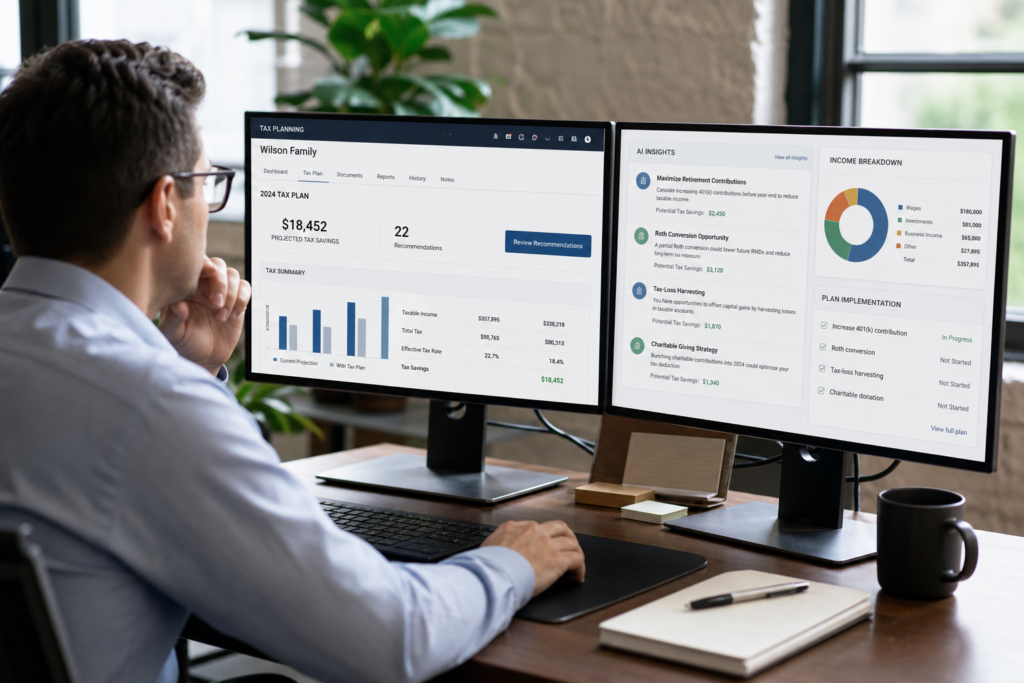
Choosing the right tax planning software for CPAs is now the single biggest lever for firm growth in 2026. The tax code keeps changing fast. As a result, clients want proactive advice, not just a finished return. This guide shows you how to pick tools that scale advisory revenue. Moreover, it explains which features actually move the needle. You will learn what to look for, what to skip, and how to grow a profitable advisory practice with the best proactive tax strategy tools.
Table of Contents
- Key Takeaways
- What Is Tax Planning Software for CPAs?
- What Features Matter Most in 2026?
- How Is AI Changing Tax Planning Software?
- How Do You Choose the Right Tool?
- How Does Software Boost Advisory Revenue?
- Uncle Kam in Action
- Next Steps
- Related Resources
- Frequently Asked Questions

Key Takeaways
- The right software turns tax prep into high-margin advisory revenue.
- Look for entity-aware modeling, AI plan generation, and client-ready deliverables.
- Unlimited free assessments let you prove value before you charge.
- OBBBA changes in 2026 make proactive planning more valuable than ever.
- Software alone is not enough; you also need training and leads.
What Is Tax Planning Software for CPAs?
Quick Answer: Tax planning software for CPAs models future tax scenarios. It finds savings strategies and builds client-ready plans before returns are filed.
Tax planning software helps you look forward, not backward. Tax prep software records what already happened. In contrast, planning software projects what could happen next. As a result, you can find savings while there is still time to act.
These tools run “what-if” scenarios across income, entities, and deductions. Furthermore, they estimate the tax impact of each move. Many business owners want this kind of forward-looking help. In fact, most CPAs who add advisory services see revenue climb.
Planning vs. Preparation: The Key Difference
Preparation is a commodity. Clients shop it on price. Planning, however, is a premium service. Clients pay for insight and savings. Therefore, planning tools protect your margins.
For example, a good tool might spot a missed qualified business income deduction. Under the 2026 rules, the Section 199A deduction stays at a permanent 20%. That single strategy can save a client thousands.
Why 2026 Rewards Proactive Planning
The 2026 tax landscape shifted after the One Big Beautiful Bill Act. Bonus depreciation is now permanent at 100%. In addition, the SALT deduction cap jumped from $10,000 to $40,000. These changes create new planning openings. Consequently, clients need advisors who can act fast.
Business owners searching for smarter tax outcomes benefit most from proactive advice. If you serve entrepreneurs and small business owners, planning software is essential. It helps you show value before tax season ends.
Pro Tip: Run a free assessment on every new prospect. It proves value fast and often closes the advisory sale.
What Features Matter Most in 2026?
Quick Answer: Prioritize entity-aware modeling, a large strategy library, AI plan generation, and professional client-ready reports.
Not all features carry equal weight. Some save you hours. Others just look nice in a demo. Below, I break down what truly matters for the best tax planning software for CPAs.
Entity-Aware Scenario Modeling
Your clients rarely have simple returns. Many hold an S corp, a rental, and a 1040. Therefore, your software must model all entities at once. It should track 1040s, 1120-Ss, and K-1s together. Otherwise, you miss the full picture.
Strong entity structuring analysis also matters here. For instance, moving a sole proprietor to an S corp can cut self-employment tax. Good software shows this side by side.
A Deep Strategy Library
The best tools include hundreds of vetted strategies. For example, they cover cost segregation, the Augusta Rule, and retirement plan design. Uncle Kam offers 300+ strategies inside one platform. As a result, you never run out of ideas for high-income clients.
Client-Ready Deliverables
Clients pay for clarity, not spreadsheets. So your software should produce branded, easy-to-read plans. These reports should include a summary, a roadmap, and clear savings numbers. Consequently, clients see your value at a glance.
Feature Comparison Table
| Feature | Why It Matters | Priority |
|---|---|---|
| Multi-entity modeling | Captures full client picture | High |
| Strategy library size | More savings options | High |
| AI plan generation | Saves hours per plan | High |
| Client-ready reports | Justifies premium fees | High |
| Assessment limits | Affects prospecting cost | Medium |
Pro Tip: Test each tool with a real client file. Demos hide gaps that real data exposes fast.
How Is AI Changing Tax Planning Software?
Quick Answer: AI now drafts full tax plans, reads source documents, and surfaces advisory opportunities from raw IRS data automatically.
Artificial intelligence, or AI, is software that mimics human analysis. In 2026, it reshaped tax planning tools. AI now reads W-2s, 1099s, and K-1s directly. Then it drafts a plan in minutes. As a result, your prep time drops sharply.
The IRS itself now runs 126 active AI projects. In February 2026, it codified AI use in audits under Internal Revenue Manual section 10.24.1. You can review official guidance on the IRS newsroom updates page. Because the IRS uses AI, your firm should too.
AI Plan Generation Saves Hours
Building a plan by hand takes time. AI cuts that work dramatically. For example, Uncle Kam’s AI Tax Plan Generator turns messy data into a clean deliverable. Moreover, it applies the MERNA framework automatically. This sequencing keeps strategies in the right order.
The Judgment Gap AI Cannot Fill
AI is powerful, yet it has limits. It cannot replace your professional judgment. In fact, some clients now bring flawed AI plans to their CPA. Therefore, your role shifts toward review and interpretation. This is where you add lasting value.
Uncle Kam is more than software; it is a full advisory operating system. Selling advisory and delivering advisory are two different jobs. So you need a system that supports both. Explore how a complete tax advisory operating system combines software, training, and leads in one place.
Did You Know? The IRS ran just 10 AI projects two years ago. Today it runs 126. AI is now core to enforcement.
How Do You Choose the Right Tool?

Quick Answer: Match the tool to your firm size, client mix, and growth goals. Then test it with real client data.
There is no single best tool for everyone. Instead, the right choice depends on your goals. A solo CPA has different needs than a large firm. So start with your own practice profile.
Your Evaluation Checklist
Use this checklist before you buy. It keeps your decision objective.
- Does it model multiple entities together?
- How many strategies does it include?
- Are client-ready reports branded and clear?
- Does it cap assessments or charge per plan?
- Does it offer training on selling advisory?
- Does it help you find new clients?
Recommendations by Firm Size
Solo CPAs should prize speed and unlimited assessments. Small firms need strong workflow and team access. Large firms want deep integrations and security controls. Match these needs before you commit.
Ready to see the difference in person? You can book a strategy session and get a live walkthrough. This step often clarifies the whole decision.
Watch the Total Cost
Price is more than a monthly fee. Per-plan charges add up fast. Many tools cap assessments or charge per analysis. Uncle Kam offers unlimited free assessments at every tier. As a result, you can run one on every prospect without cost worry.
Pro Tip: Compare tools on cost per closed client, not per feature. That number reveals true value.
How Does Software Boost Advisory Revenue?
Quick Answer: It lets you charge premium fees for planning, close prospects faster, and serve more clients per hour.
Tax prep revenue is capped by your hours. Advisory revenue is not. Planning software breaks that ceiling. It helps you charge $5,000 or more per plan. Therefore, your income per client rises sharply.
A Simple ROI Example
Suppose your software costs $6,000 per year. You then close 10 advisory clients at $5,000 each. That equals $50,000 in new revenue. As a result, your return is more than 8x. The math favors action.
Prove Value Before You Charge
The biggest friction point is spending credits on prospects who may not buy. Unlimited assessments solve this. You run a free assessment first. Then you show real savings numbers. Consequently, the advisory sale closes itself.
This approach also builds trust with high-income and high-net-worth clients. They see the value before signing. For deeper guidance, review the ongoing tax advisory approach that supports the full engagement.
Software Alone Is Not Enough
Having software is useless without clients to serve. Many tools leave marketing to you. Uncle Kam includes a built-in marketplace instead. It routes pre-qualified advisory leads to certified pros. As a result, you get both the tools and the demand.
| Revenue Model | Typical Fee | Ceiling |
|---|---|---|
| Tax prep only | $300 to $1,500 | Limited by hours |
| Tax planning | $3,000 to $10,000 | High margin |
| Ongoing advisory | $500+ monthly | Recurring revenue |
Uncle Kam in Action: How One Solo CPA Scaled to Advisory
Client Snapshot: Maria is a solo CPA in Ohio. She served mostly small business owners. For years, she filed returns and hoped for referrals.
Financial Profile: Her firm brought in about $180,000 per year. Nearly all of it came from seasonal tax prep. Her income stalled year after year.
The Challenge: Maria wanted higher-value work. However, she lacked a system to find and price advisory. She also feared wasting money on tools she might not use.
The Uncle Kam Solution: Maria adopted tax planning software with unlimited assessments. She ran a free assessment on every existing client. The AI plan generator flagged missed strategies fast. For instance, it found a permanent 20% QBI deduction and a bonus depreciation opportunity for one contractor. Then the weekly coaching taught her how to price and pitch each plan.
The Results: In her first year, Maria closed 14 advisory clients. She charged an average of $4,800 per plan. That added $67,200 in new revenue. Her clients saved a combined $210,000 in taxes. Maria’s investment was under $7,000. As a result, her first-year return topped 9x. Moreover, she now enjoys recurring monthly advisory fees.
Maria’s story is common among firms that go proactive. You can read more real client results and case studies to see the pattern. The lesson is clear. The right system turns prep firms into advisory firms.
Next Steps
Now you know what to look for. Take these steps to move forward with confidence.
- List your top three client types and their needs.
- Test one tool with a real client file this week.
- Run free assessments to build your first plans.
- Explore firm systems and automation tools to scale delivery.
- Book a strategy session to map your advisory growth plan.
Related Resources
- The MERNA Method for Tax Strategy
- Tax Strategy Blog for Professionals
- Tax Prep and Filing Services
- About Uncle Kam
Frequently Asked Questions
Is tax planning software worth it for a solo CPA?
Yes, in most cases. One or two advisory clients often cover the yearly cost. After that, the tool drives pure profit. Solo CPAs also gain back planning hours. As a result, they serve more clients with less stress.
How is tax planning software different from tax prep software?
Prep software records the past. Planning software projects the future. Prep files a return. Planning finds savings before filing. Therefore, planning tools support premium advisory work, not just compliance.
Do I need AI features in my tax planning software?
AI features are now a strong advantage. They cut plan-building time sharply. In addition, they surface opportunities you might miss. However, you still apply the final judgment. AI supports you; it does not replace you.
How long does it take to see a return on investment?
Many CPAs recover the cost within one quarter. It depends on how fast you run assessments. The more prospects you assess, the faster you close plans. Consequently, quick action speeds your return.
Does the 2026 tax law change how I should plan?
Yes, the OBBBA reshaped many rules for 2026. Bonus depreciation is now permanent at 100%. The SALT cap rose to $40,000. Verify current details at IRS.gov before acting. Good software updates these rules for you.
What if I have no clients to sell advisory plans to yet?
Start with your existing prep clients first. Run free assessments to show savings. Then look for tools with a built-in lead marketplace. This gives you both software and demand. As a result, you grow faster from day one.
This information is current as of 7/4/2026. Tax laws change frequently. Verify updates with the IRS if reading this later.
Last updated: July, 2026

