Tax Planning Software: 2026 Guide for CPAs & Tax Pros
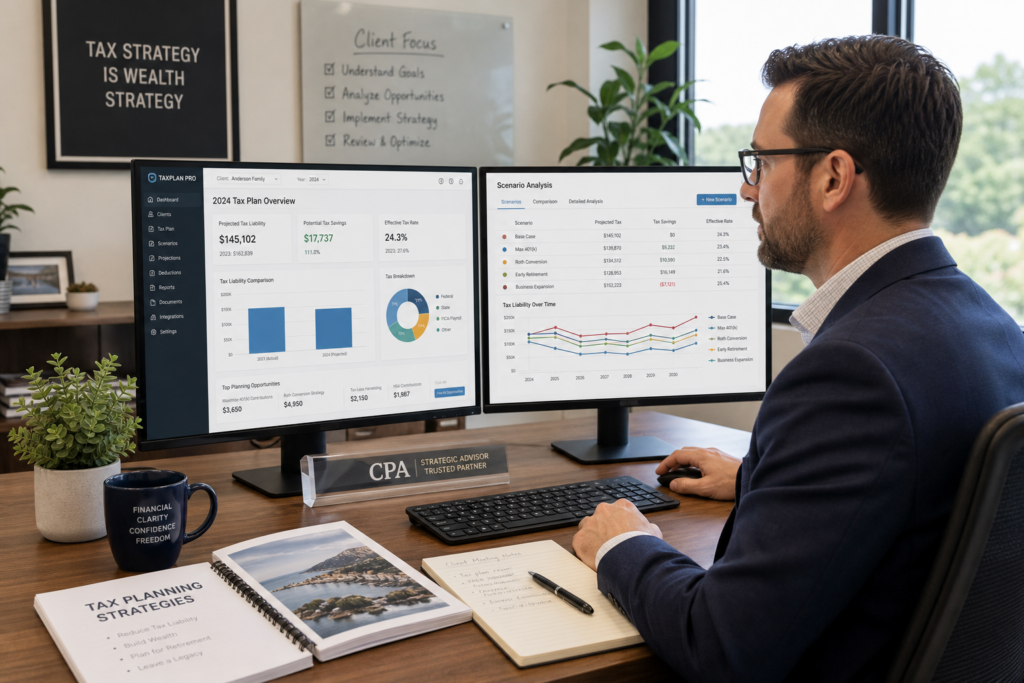
Tax planning software is reshaping how CPAs and tax professionals deliver value to clients in 2026. With artificial intelligence automating compliance work and the IRS modernizing digital infrastructure, tax professionals face a critical choice: adopt technology that enables high-value advisory services or remain anchored to manual processes that limit growth. The AICPA’s Tax Transformation initiative confirms that successful firms are shifting from reactive compliance to proactive planning, with technology as the foundation.
Table of Contents
- Key Takeaways
- What Is Tax Planning Software and Why Does It Matter in 2026?
- How Has AI Changed Tax Planning Software in 2026?
- What Features Should CPAs Prioritize When Selecting Software?
- How Do You Calculate ROI for Tax Planning Software?
- What Are the Implementation Challenges and Solutions?
- How Does Software Support Advisory Transformation?
- Uncle Kam in Action: CPA Firm Triples Advisory Revenue
- Next Steps
- Frequently Asked Questions
- Related Resources
 For Tax Professionals
Build your next chapter in tax advisory.
Explore how Uncle Kam Pro could support the next stage of your practice.
Key Takeaways
- AI-powered tax planning software automates compliance, freeing CPAs for high-value advisory work.
- The 2026 IRS ETAAC report recommends digital transformation and improved technology infrastructure.
- Successful firms achieve 3-5x ROI by converting software efficiency into billable advisory services.
- Essential features include multi-year scenario modeling, entity-aware calculations, and client deliverables.
- The AICPA Tax Transformation initiative guides firms toward proactive, AI-enabled advisory organizations.
What Is Tax Planning Software and Why Does It Matter in 2026?
Quick Answer: Tax planning software helps CPAs analyze client tax scenarios, identify savings opportunities, and generate professional deliverables. In 2026, it’s essential for firms transitioning from compliance-only to advisory-focused practices.
Tax planning software differs fundamentally from tax preparation software. While preparation tools complete returns, planning platforms model future scenarios and optimize strategies. For 2026, this distinction matters more than ever as the profession undergoes a significant transformation.
The IRS Electronic Tax Administration Advisory Committee released its 2026 Annual Report to Congress with 18 recommendations focused on modernization. The report emphasizes digital transformation, AI adoption, and improved data sharing across the tax ecosystem. For tax professionals, this signals a clear direction: technology adoption is no longer optional.
The Market Shift Toward Advisory Services
According to the AICPA’s Tax Transformation initiative, firms are moving from reactive compliance to proactive advisory. Jan Lewis, AICPA chair, confirmed at the Engage 2026 conference that AI will handle basic preparation. However, the human element—providing advice, strategy, and judgment—remains exclusively the CPA’s domain.
Modern tax advisory services require sophisticated tools. Clients expect professionals to answer complex questions such as:
- Should I elect S corporation status or remain an LLC?
- What’s the optimal salary versus distribution ratio for 2026?
- How do qualified business income deductions interact with my entity structure?
- What’s my projected tax liability under different growth scenarios?
Tax planning software provides the analytical firepower to answer these questions with precision and speed.
Legislative Context for 2026
The One Big Beautiful Bill Act (OBBBA), signed July 4, 2025, introduced significant changes affecting 2026 tax planning. Key provisions include restored R&D expense immediate write-offs, new Schedule 1-A for tips and overtime deductions, and expanded qualified opportunity zone incentives. Tax professionals need software that stays current with these legislative changes.
Pro Tip: The July 6, 2026 deadline for retroactive R&D expense amendments creates immediate planning opportunities. Software with built-in R&D calculation modules helps identify eligible clients quickly.
How Has AI Changed Tax Planning Software in 2026?
Quick Answer: AI now automates data entry, identifies applicable strategies, and generates preliminary tax plans. This reduces analysis time from hours to minutes while maintaining CPA oversight and judgment.
Artificial intelligence integration represents the most significant advancement in tax planning software for 2026. The Treasury Department previously published an AI use case inventory that included IRS applications, though this inventory is no longer publicly available as of spring 2026. The ETAAC report calls for transparent AI disclosure frameworks to maintain public trust.
Automated Strategy Identification
Leading platforms now use AI to scan client data and flag relevant planning opportunities automatically. For example, when analyzing a business owner’s financials, AI can identify potential strategies including:
- Cost segregation opportunities for real estate holdings
- Augusta Rule home office rental deductions
- Retirement plan contribution optimization (with 2026 limits: $24,500 base 401(k), $32,500 with catch-up)
- Entity structure optimization opportunities
This automation doesn’t replace professional judgment. As emphasized by the AICPA, the CPA remains “in the lead.” AI handles the computational heavy lifting while professionals apply expertise, consider unique client circumstances, and make final recommendations.
Multi-Year Scenario Modeling
Advanced AI enables simultaneous modeling of multiple tax years. CPAs can compare scenarios such as immediate Roth conversions versus phased conversions over three years. The software calculates not just immediate tax impact but lifetime tax savings, factoring in projected tax bracket changes and required minimum distributions.
For 2026, understanding bracket thresholds is critical. Married filing jointly taxpayers face the 12% bracket up to $100,800 in taxable income, jumping to 22% at $100,800 and 24% at $211,400. Sophisticated software models optimal timing to fill lower brackets before higher rates apply.
Entity-Aware Calculations
Modern platforms integrate data across entity types—1040s, 1120-S returns, partnerships, and K-1s—to provide holistic planning. This matters tremendously for business owners with complex structures. The software automatically factors in interactions such as reasonable compensation requirements, qualified business income deduction phase-outs, and self-employment tax implications.
Pro Tip: Look for platforms that update automatically when tax laws change. The IRS Tax Professional Management Office, effective June 28, 2026, aims to improve coordination. Choose vendors with direct IRS data feeds.
What Features Should CPAs Prioritize When Selecting Software?
Quick Answer: Prioritize comprehensive strategy libraries, client-ready deliverables, integration capabilities, unlimited assessments, and ongoing training support when evaluating tax planning software options.
Not all tax planning software is created equal. Based on analysis of leading platforms and feedback from practicing CPAs, certain features separate productivity enhancers from time wasters.
Comprehensive Strategy Library
The depth and breadth of built-in strategies determines the software’s value. Top platforms include 200-300+ tested strategies covering entity structuring, retirement planning, real estate investor techniques, and advanced wealth preservation. Evaluate whether the platform includes:
- Entity comparison tools (LLC vs. S Corp vs. C Corp)
- Qualified opportunity zone modeling (critical given new 2027 designation rules)
- Cost segregation analysis frameworks
- Charitable giving optimization (including DAF and CRT strategies)
- Multi-state tax planning for complex situations
Professional Client Deliverables
Clients don’t pay $5,000+ for spreadsheets. They pay for clarity and confidence. The best software generates polished, branded PDF reports that include executive summaries, strategy explanations, implementation roadmaps, and risk assessments. These deliverables should be client-ready without extensive manual editing.
When comparing platforms, ask for sample deliverables. High-quality reports enhance perceived value and justify premium pricing for tax strategy services.
Integration and Workflow Efficiency
Software must integrate seamlessly with existing practice management systems. The ETAAC 2026 report emphasizes API-based data sharing. Look for platforms that connect with popular tax preparation software, CRM systems, and document management tools. This eliminates manual data entry and reduces errors.
| Feature Category | Essential Elements | Why It Matters |
|---|---|---|
| Strategy Library | 200+ tested strategies, MERNA framework | Comprehensive coverage for all client types |
| Client Deliverables | Branded PDFs, executive summaries, roadmaps | Justifies premium fees, enhances professionalism |
| Integration | API connections, tax software sync, CRM links | Eliminates duplicate data entry, reduces errors |
| Usage Model | Unlimited assessments, no per-analysis fees | Freedom to analyze prospects without cost anxiety |
| Training & Support | Live coaching, implementation guides, community | Ensures adoption and maximizes ROI |
Unlimited Assessment Capability
Many platforms charge per analysis or impose monthly limits. This creates perverse incentives—you hesitate to run “what-if” scenarios or analyze prospects because each assessment costs money. The most successful firms use tax planning software with unlimited assessments to prove value before engagement agreements are signed. This approach converts more prospects and builds trust.
How Do You Calculate ROI for Tax Planning Software?
Quick Answer: Calculate ROI by comparing software costs against increased revenue from advisory fees, time savings, and client retention. Successful firms typically achieve 3-5x returns in year one.
Software costs range from $2,000 to $15,000+ annually depending on firm size and feature set. However, focusing solely on cost misses the complete picture. The question is not “What does it cost?” but rather “What return does it generate?”
Revenue Generation Model
Consider a solo practitioner or small firm implementing tax planning software. The typical ROI calculation includes three revenue streams:
Direct Advisory Fees: Most CPAs charge $3,000-$8,000 for comprehensive tax planning engagements. If software enables you to deliver five additional planning engagements annually at an average fee of $5,000, that generates $25,000 in new revenue.
Time Savings Conversion: Software reduces analysis time from 8-10 hours to 2-3 hours per client. For a firm billing $250/hour, those 6 saved hours per client represent $1,500 in capacity. Multiply by 20 clients and you’ve freed $30,000 worth of billable time.
Client Retention and Referrals: Firms providing proactive planning advice experience measurably higher retention rates. Industry data suggests advisory-focused firms retain 15-20% more clients than compliance-only practices. The lifetime value of retained clients far exceeds software costs.
| Firm Size | Annual Software Investment | Additional Advisory Revenue (Year 1) | ROI Multiple |
|---|---|---|---|
| Solo/Small (1-3 CPAs) | $3,000-$6,000 | $15,000-$30,000 | 3-5x |
| Mid-Size (4-10 CPAs) | $8,000-$12,000 | $50,000-$100,000 | 4-8x |
| Large (10+ CPAs) | $12,000-$20,000 | $150,000-$300,000 | 7-15x |
Cost Avoidance Factors
Beyond direct revenue, software provides cost avoidance benefits. Manual planning requires extensive research time, spreadsheet building, and quality control reviews. Software eliminates these costs. Additionally, standardized processes reduce malpractice risk by ensuring consistent application of tax law.
Pro Tip: Track conversion rates before and after software implementation. Many firms discover that professional deliverables increase close rates from 60% to 85%+ on planning proposals.
What Are the Implementation Challenges and Solutions?

Quick Answer: Common challenges include staff resistance, workflow integration, and pricing strategy shifts. Success requires leadership commitment, structured training programs, and gradual service model evolution.
Technology adoption fails when firms treat software as a plug-and-play solution. Successful implementation requires deliberate change management.
Overcoming Staff Resistance
Tax professionals who’ve spent careers building Excel models often resist new tools. They view software as a threat rather than an enhancement. Address this through:
- Emphasizing that software handles calculations while CPAs provide judgment and client relationships
- Starting with enthusiastic early adopters to create internal champions
- Demonstrating time savings with specific client examples
- Linking software proficiency to compensation and advancement opportunities
Workflow Integration Best Practices
Don’t attempt to revolutionize your entire practice overnight. Instead, identify specific workflow points where software integration creates immediate value. For example, incorporate planning software into year-end tax review meetings. Use it to model Roth conversion opportunities or entity structure optimization before finalizing returns.
Create standardized templates for common client scenarios (business owners, self-employed professionals, real estate investors). This reduces the learning curve and ensures consistent service delivery.
Pricing and Positioning Shifts
Moving from hourly billing to value-based pricing challenges many CPAs. Software that completes in 3 hours what previously took 10 seems to reduce revenue under hourly models. However, value-based pricing for tax planning focuses on outcomes (tax savings, financial clarity) rather than time invested.
Successful firms package planning services at $3,000-$10,000 fixed fees. The sophisticated deliverables from quality software justify these fees while the efficiency gains improve margins dramatically.
How Does Software Support Advisory Transformation?
Quick Answer: Software enables the shift from reactive compliance to proactive advisory by automating calculations, standardizing deliverables, and freeing capacity for strategic client conversations.
The AICPA’s Tax Transformation initiative, detailed in their 2026 framework, identifies five drivers of transformation. Technology sits at the center. CPA.com released resources in June 2026 to help firms evolve from compliance-focused operations into AI-enabled advisory organizations.
The Advisory Operating System Approach
Leading firms don’t just implement software; they build complete advisory operating systems. This means combining planning technology with structured processes for client acquisition, engagement delivery, and ongoing relationship management. Consider platforms that provide not just software but also training on the business of advisory, pricing models, and client communication frameworks.
For instance, the best advisory operating systems integrate unlimited free client assessments, comprehensive strategy libraries using frameworks like MERNA (Maximize deductions, Entity structure, Retirement, Niche strategies, Advanced planning), and even marketplace features that route qualified advisory leads to certified professionals.
Building Recurring Revenue Models
Software facilitates recurring revenue by making quarterly planning reviews feasible. When software generates updated projections in minutes rather than hours, you can profitably offer quarterly strategy sessions. This transforms one-time planning fees into recurring monthly or quarterly advisory retainers.
High-net-worth clients particularly value this ongoing relationship. Instead of scrambling at year-end, they receive proactive guidance throughout the year as circumstances change. For high-net-worth individuals, this level of service commands premium fees and creates predictable firm revenue.
| Service Model | Without Software | With Software |
|---|---|---|
| Planning Frequency | Annual (time constraints) | Quarterly or as needed |
| Analysis Time | 8-12 hours per client | 2-4 hours per client |
| Client Deliverable | Email or basic memo | Professional branded PDF report |
| Pricing Model | Hourly ($200-$300/hour) | Value-based ($3,000-$10,000 fixed) |
| Annual Capacity | 15-20 planning clients | 50-75 planning clients |
Uncle Kam in Action: CPA Firm Triples Advisory Revenue
Sarah Chen operated a successful compliance-focused CPA practice in suburban Chicago with two partners and four staff members. The firm generated $850,000 in annual revenue, primarily from tax preparation and basic bookkeeping. Like many practitioners, Sarah felt trapped: demand for her time exceeded supply, but raising prices risked losing price-sensitive clients.
The Challenge: Sarah recognized that her highest-value clients—business owners and real estate investors—needed sophisticated planning advice, not just compliance work. However, manual planning took 10-12 hours per client, making it economically unfeasible except for the largest accounts. She was leaving money on the table while working 60-hour weeks.
The Uncle Kam Solution: Sarah’s firm implemented Uncle Kam’s advisory operating system in January 2026. The platform provided unlimited client assessments, allowing the firm to analyze every business owner during their annual tax review meeting. The AI-powered system identified strategies Sarah’s team hadn’t previously considered, including cost segregation opportunities, retirement plan optimization using the 2026 contribution limits ($32,500 for clients over 50), and entity structure improvements.
The MERNA framework—Maximize deductions, Entity optimization, Retirement planning, Niche strategies, Advanced techniques—provided a systematic approach to client analysis. Instead of ad-hoc planning, Sarah’s team followed a repeatable process that ensured comprehensive coverage.
The Results: Within eight months, Sarah’s firm transformed its service model:
- Tax Savings for Clients: The firm identified $1.8 million in combined tax savings across 42 planning engagements
- Advisory Revenue: Generated $210,000 in new planning fees (average $5,000 per engagement)
- Software Investment: Annual platform cost of $9,600
- First-Year ROI: 22x return on software investment
- Time Efficiency: Reduced average planning time from 11 hours to 3.5 hours per client
“The professional deliverables changed everything,” Sarah noted. “When prospects see a 40-page branded tax plan with executive summary, strategy explanations, and implementation timeline, they immediately understand the value. Our close rate on planning proposals jumped from 55% to 88%.”
The firm now positions itself as a tax advisory practice rather than a compliance shop. They’ve raised minimum fees, attracted higher-quality clients, and improved work-life balance despite serving more planning clients. Sarah credits the transformation to having the right technology foundation combined with training on how to sell and deliver advisory services. Learn more about client success stories and proven strategies.
Next Steps
Tax planning software represents a strategic decision that determines your practice trajectory over the next 3-5 years. Take these actions to move forward:
- Evaluate your current advisory revenue as a percentage of total revenue (if below 30%, software becomes critical)
- Request demonstrations from 3-4 leading platforms to compare strategy libraries and deliverable quality
- Calculate your potential ROI using the models above with realistic client volume projections
- Review the MERNA method for systematic tax planning approaches
- Schedule a strategy session to discuss how software fits your practice growth goals at unclekam.com/book-strategy-session
The tax profession is at an inflection point. AI and automation will handle compliance. Your competitive advantage lies in providing strategic advice that software enables but only skilled professionals can deliver. The firms that recognize this reality and act decisively will thrive in the transformed landscape of 2026 and beyond.
Frequently Asked Questions
What’s the difference between tax preparation software and tax planning software?
Tax preparation software (like Drake, Lacerte, ProSeries) completes tax returns based on historical data. Tax planning software analyzes future scenarios, compares strategies, and identifies optimization opportunities before events occur. Preparation looks backward; planning looks forward. Most successful firms need both, using preparation software for compliance and planning software for advisory services.
How long does it take to see ROI from tax planning software?
Most firms achieve positive ROI within 3-6 months. If you implement software in January 2026 and deliver five planning engagements by June at $5,000 each, you’ve generated $25,000 against typical annual costs of $3,000-$10,000. The key is actively marketing planning services rather than waiting for clients to request them. Firms that integrate planning into every business owner review achieve ROI fastest.
Do I need special training to use tax planning software effectively?
Yes, but the learning curve is manageable. Most platforms offer 20-40 hours of initial training covering software mechanics and strategy application. However, the bigger learning requirement involves pricing advisory services, conducting planning meetings, and positioning your value proposition. The best platforms provide business development training alongside software training. Expect 2-3 months to achieve proficiency and 6 months to feel completely comfortable.
Can small firms or solo practitioners justify the investment?
Absolutely. Solo practitioners often achieve the highest ROI percentages because every hour saved translates directly to personal income or capacity for additional clients. A solo CPA delivering just 10 planning engagements at $4,000 each generates $40,000 in revenue against $3,000-$5,000 software costs. The challenge is execution, not economics. Solo practitioners should prioritize platforms with unlimited assessments and strong training support since they lack large teams for knowledge sharing.
How does tax planning software stay current with tax law changes?
Quality platforms update automatically when tax laws change. For 2026, this includes adjustments for OBBBA provisions, updated contribution limits ($24,500 for 401(k) base contributions), and new bracket thresholds (12% bracket ending at $100,800 for MFJ filers). Leading vendors maintain direct feeds from IRS publications and implement changes within days of official announcements. Always verify that platforms commit to real-time updates rather than annual refresh cycles.
What happens if I need to analyze strategies for clients in multiple states?
Comprehensive platforms include multi-state tax planning capabilities. They factor in state income taxes, property taxes, and state-specific rules when comparing strategies. This matters tremendously for remote workers considering relocations or businesses operating across state lines. For 2026, state tax coordination is particularly important given varying responses to federal OBBBA provisions. Some states conform to federal law changes while others decouple, creating planning complexity that software helps navigate.
Is client data secure in cloud-based tax planning software?
Reputable platforms employ bank-level encryption, multi-factor authentication, and regular security audits. The ETAAC 2026 report emphasizes cybersecurity as a critical priority for all tax technology. Look for platforms with SOC 2 Type II compliance, which demonstrates robust security controls. Cloud-based systems often provide better security than on-premise solutions since vendors invest heavily in infrastructure and employ dedicated security teams. Always review vendor security certifications and data handling policies before implementation.
Related Resources
- Tax Advisory Services: Complete Guide for Professionals
- Entity Structuring and Optimization Strategies
- The MERNA Method: Systematic Tax Planning Framework
- Tax Strategy Blog: Latest Updates and Insights
- Free Tax Calculators and Planning Tools
Last updated: June, 2026
This information is current as of 6/20/2026. Tax laws change frequently. Verify updates with the IRS or professional tax advisors if reading this later.

