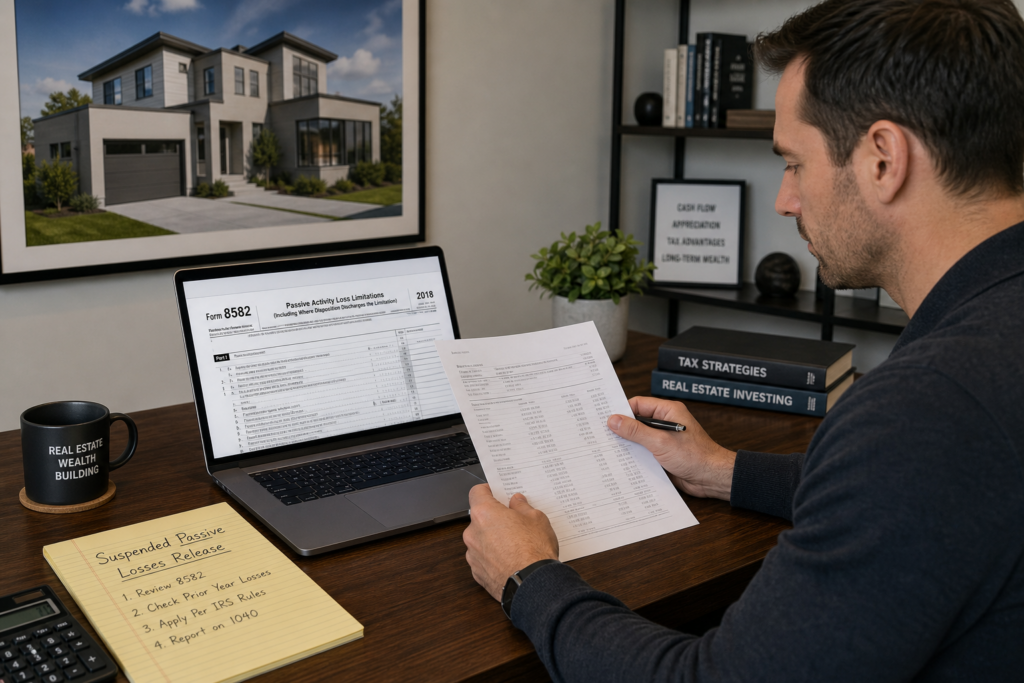
Suspended Passive Losses Release: 2026 Guide
Suspended Passive Losses Release: 2026 Complete Guide for Real Estate Investors
Understanding the suspended passive losses release is one of the most powerful tax moves a real estate investor can make in 2026. Under IRS Publication 925 and IRC Section 469, passive losses from rental properties are often “suspended” — meaning they sit on your return, unable to offset your W-2 or business income. However, a specific set of events can trigger a full suspended passive losses release, turning years of built-up deductions into immediate tax savings. With the One Big Beautiful Bill Act now in effect and 100% bonus depreciation restored for 2026, the stakes for real estate investors have never been higher. Working with an expert team focused on real estate investors can make all the difference.
Table of Contents
- Key Takeaways
- What Are Suspended Passive Losses?
- When Does a Suspended Passive Losses Release Happen?
- What Is the $25,000 Rental Real Estate Allowance?
- How Does Real Estate Professional Status Help?
- How Does the 2026 OBBBA Affect Passive Losses?
- How Do You Report Released Passive Losses on Your Return?
- Uncle Kam in Action: Real Estate Investor Success Story
- Related Resources
- Next Steps
- Frequently Asked Questions
Key Takeaways
- Suspended passive losses release only when you fully dispose of a passive activity.
- The $25,000 rental allowance lets some investors deduct losses each year — if income allows.
- Real estate professional status removes the passive loss limitation entirely for 2026.
- The OBBBA restored 100% bonus depreciation in 2026, generating large passive losses to track.
- Proper strategy and timing can save real estate investors tens of thousands of dollars.
What Are Suspended Passive Losses?
Quick Answer: Suspended passive losses are rental or investment losses the IRS will not let you deduct right now. They are “suspended” because you do not have enough passive income to absorb them. They carry forward to future years — until a release event occurs.
The IRS uses passive activity rules under IRC Section 469 to limit when and how losses from rental properties and passive investments can reduce your other income. Most rental real estate is treated as a passive activity. This means any losses it generates can only offset other passive income — not your salary, business profits, or investment gains.
For example, suppose your rental property generates a $30,000 loss in 2026. However, you earn $200,000 in W-2 wages and have no other passive income. In that case, the full $30,000 becomes a suspended passive loss. It does not reduce your taxable income this year. Instead, it carries forward. Each year, these losses stack up — sometimes reaching six figures for active real estate investors. The suspended passive losses release rules determine exactly when those losses can finally work for you.
How Passive Activity Rules Work in 2026
The IRS groups your income and losses into three categories for 2026:
- Active income: Wages, salaries, self-employment income, and business income in which you materially participate
- Passive income: Rental income and income from activities in which you do not materially participate
- Portfolio income: Interest, dividends, and capital gains from investments
Passive losses can only offset passive income. If your passive losses exceed your passive income, the excess is suspended. The IRS tracks these suspended amounts year after year using IRS Form 8582 (Passive Activity Loss Limitations). As your portfolio grows, so does the pool of suspended losses waiting for a release event. This is why proactive tax strategy planning is essential for real estate investors in 2026.
Why Suspended Losses Matter More Than Ever in 2026
The One Big Beautiful Bill Act (OBBBA), signed into law on July 4, 2025, restored 100% bonus depreciation for qualifying property placed in service in 2026. This is a game-changer for real estate investors. Cost segregation studies on a newly acquired property can now generate hundreds of thousands of dollars in depreciation losses in a single year. However, most of those losses become suspended passive losses — unless you qualify for an exception. Understanding the suspended passive losses release rules in 2026 is therefore more critical than ever before.
Pro Tip: In 2026, a cost segregation study combined with 100% bonus depreciation can generate $200,000 or more in depreciation losses on a single commercial property. Track every dollar carefully on Form 8582 — these losses are waiting to be released.
When Does a Suspended Passive Losses Release Happen?
Quick Answer: A suspended passive losses release happens when you fully and completely dispose of a passive activity. At that point, all previously suspended losses from that activity become deductible — even against your non-passive income.
This is the most important rule in the passive activity world. Under IRS Publication 925, when you sell or otherwise dispose of your entire interest in a passive activity in a fully taxable transaction, every suspended passive loss from that activity is released. Furthermore, you can use these released losses against any type of income — including your W-2 wages, self-employment income, or portfolio gains. This makes the timing of property dispositions a major tax planning lever.
The Three Conditions for a Full Release
For a full suspended passive losses release in 2026, three conditions must be met:
- Complete disposition: You must sell or transfer your entire interest — not just part of it
- Fully taxable transaction: The sale must be a taxable event — not a like-kind exchange under IRC Section 1031
- Arm’s length sale: The sale should generally be to an unrelated third party (related-party sales face special scrutiny)
If you do a 1031 exchange, the suspended losses do not release. They carry over to the replacement property. This is a key strategic trade-off in 2026: deferring capital gains via a 1031 exchange also defers the release of your suspended passive losses. Depending on the size of your suspended loss pool, a taxable sale may actually produce a better after-tax outcome.
Partial Dispositions and Partnership Interests
A partial disposition does not trigger a suspended passive losses release. If you own a four-unit apartment building and sell two units while retaining two, no release occurs. Similarly, if you own a limited partnership interest in a real estate fund and sell half your units, the losses remain suspended. Only a full exit from the activity unlocks the deductions. However, if a passive activity goes completely out of business — even without a sale — that can qualify as a disposition and trigger a release under certain conditions. Consult a tax advisory expert before assuming any event qualifies.
Pro Tip: If you have large suspended passive losses and plan to sell a property in 2026, consider selling in a taxable transaction rather than a 1031 exchange. Run the numbers both ways. The released losses may offset most or all of the resulting capital gain — and then some.
Death as a Release Event
Importantly, death triggers a partial but not full suspended passive losses release. When a taxpayer dies, suspended losses that exceed the step-up in basis on the property are permanently lost. The heirs receive a stepped-up basis and the suspended losses effectively disappear. This makes estate planning around passive activity properties very important. If you hold passive activities with large suspended loss pools, talk to an estate planning specialist so you do not lose decades of deferred losses at death.
What Is the $25,000 Rental Real Estate Allowance?
Quick Answer: The $25,000 rental real estate allowance is a special exception under IRC Section 469(i). It lets qualifying landlords deduct up to $25,000 of rental real estate losses each year — even against their non-passive income. Income limits apply.
Not every rental investor is stuck waiting for a full disposition to use passive losses. The IRS offers a $25,000 “active participation” allowance. This means you can deduct up to $25,000 of net rental losses per year against your ordinary income — as long as you meet the requirements. This is an annual exception to the suspended passive losses rule that can provide meaningful tax relief each year, even without a sale.
Who Qualifies for the $25,000 Allowance in 2026?
For 2026, you qualify for the $25,000 allowance if you meet both of these tests:
- Active participation: You must actively participate in managing the rental — making decisions about tenants, repairs, and lease terms. You do not need to be a hands-on landlord, but you must make management decisions.
- Income limit: Your modified adjusted gross income (MAGI) must be $100,000 or less to claim the full $25,000 allowance for 2026. The allowance phases out between $100,000 and $150,000 MAGI. Above $150,000, no allowance is available.
| 2026 MAGI | Allowable Rental Loss Deduction | Phase-Out Status |
|---|---|---|
| $100,000 or below | Up to $25,000 | Full allowance |
| $100,001 – $149,999 | $25,000 reduced by 50 cents per $1 over $100K | Phase-out range |
| $150,000 or above | $0 | No allowance |
Most high-income real estate investors exceed the $150,000 MAGI threshold and therefore cannot use the $25,000 allowance. Consequently, their rental losses become suspended each year. This is why understanding the full suspended passive losses release rules is so important. You can explore your options through proper tax preparation and filing to ensure every suspended dollar is tracked accurately.
Did You Know? If you are married and file separately, the $25,000 allowance drops to zero. Filing status matters a great deal when it comes to these passive activity rules in 2026.
How Does Real Estate Professional Status Help with Suspended Passive Losses Release?
 Free Tax Write-Off Finder
Quick Answer: Real estate professional (REP) status under IRC Section 469(c)(7) removes the passive activity designation from your rental activities. This allows your rental losses — including previously suspended ones — to offset any type of income without waiting for a disposition.
For qualifying real estate professionals in 2026, the passive activity loss limitations do not apply. Your rental real estate losses are treated as active, non-passive losses. This is the most powerful exception to the suspended passive losses rule available to individual investors. It can allow you to use large depreciation deductions — especially those generated by 100% bonus depreciation in 2026 — to dramatically reduce your tax bill. Explore what this strategy means for you at Uncle Kam’s real estate investor resources.
The Two Requirements for REP Status in 2026
To qualify as a real estate professional for the 2026 tax year, you must pass both of these tests:
- More than 750 hours: You must spend more than 750 hours during 2026 in real estate trades or businesses in which you materially participate.
- More than 50% of working time: Your real estate activities must make up more than 50% of your total personal services time for the year. If you have a full-time job outside of real estate, this test is very difficult to pass.
Additionally, you must materially participate in each rental property. You can use the grouping election to treat all your rental activities as a single activity — which makes material participation easier to achieve across a portfolio. This election should be carefully documented and filed with your return. For investors managing several properties, the Form 8582 grouping election is a critical planning tool.
How REP Status Interacts with Previously Suspended Losses
Even if you qualify as a real estate professional in 2026, losses that were suspended in prior years while you were not a REP remain suspended. They do not automatically release just because your status changed. Those prior-year suspended losses can only be released in the normal ways — either through a qualifying disposition, or through future passive income that exceeds future passive losses. Therefore, many real estate professionals choose to eventually sell properties in taxable transactions to unlock those older suspended pools. Understanding this interaction is central to a complete real estate tax strategy.
Pro Tip: Document every hour you spend on real estate in 2026 with a contemporaneous log. The IRS closely audits REP status claims. A strong hourly log is your best defense — and your ticket to unlimited rental loss deductions.
How Does the 2026 OBBBA Affect Passive Losses for Real Estate Investors?
Quick Answer: The One Big Beautiful Bill Act (OBBBA), signed on July 4, 2025, restored 100% bonus depreciation for 2026. This means investors can fully expense qualifying property in year one — creating large passive losses that may be suspended unless a release strategy is in place.
The OBBBA is one of the most significant tax law changes for real estate investors in years. By restoring 100% bonus depreciation starting in 2026, Congress allows investors who acquire qualifying personal property or conduct cost segregation studies to take massive first-year depreciation deductions. For example, a $1 million commercial building might have $200,000 to $300,000 in components eligible for accelerated depreciation under a cost segregation study. Under the OBBBA, all of that comes off in year one rather than being spread over five to fifteen years.
The Passive Loss Problem with Bonus Depreciation
However, generating a huge depreciation deduction does not automatically save you money. If you are an ordinary rental property owner — not a real estate professional — those losses are passive. They get suspended. Therefore, 100% bonus depreciation in 2026 can create a very large pool of suspended passive losses that sit dormant until a release event. This is why the suspended passive losses release strategy must be integrated into your overall investment plan from day one. Never acquire a property, take massive depreciation, and assume it reduces your tax bill without first analyzing the passive activity implications.
Strategic Planning: Bonus Depreciation Plus a Release Event
The ideal strategy in 2026 is to combine bonus depreciation with a planned release event. Consider this scenario: you buy a rental property in early 2026 for $800,000, conduct a cost segregation study, and generate $250,000 in first-year bonus depreciation losses. Those losses are suspended. You also own another rental property — your first rental — that you purchased ten years ago and have $180,000 in suspended losses from that property. You decide to sell that older property in a taxable sale in late 2026. The suspended passive losses release from that sale can now offset the gain from the sale, plus potentially offset some of your ordinary income. This strategic coordination is how savvy investors reduce six-figure tax bills. Work with a tax advisor who specializes in real estate to plan your dispositions carefully.
| Strategy | 2026 Tax Outcome | Best For |
|---|---|---|
| Taxable sale of passive activity | Full suspended passive losses release — use against any income | Large suspended loss pools, high-income years |
| 1031 exchange | No release — losses carry to replacement property | Capital gain deferral priority |
| REP status election + grouping | Current-year losses flow to ordinary income — no suspension | Full-time real estate investors, 750+ hours |
| $25,000 active participation allowance | Up to $25,000 deducted against ordinary income if MAGI ≤ $100K | Lower-income landlords |
| Carry-forward until passive income | Use against future passive income (e.g., a profitable rental year) | Growing rental portfolios with improving cash flow |
How Do You Report Released Passive Losses on Your Tax Return?
Quick Answer: You report released passive losses on Form 8582 and carry the allowed losses to Schedule E (for rentals) or Schedule D (if connected to a sale). The released amounts then flow to your Form 1040 and reduce your overall tax liability.
When a suspended passive losses release event occurs — such as a full taxable sale — you must report it correctly. The process starts with Form 8582, which is your master tracking form for passive activity losses. Form 8582 lists all your passive activities, the income and losses from each, and the running total of suspended losses. When a release event occurs, Form 8582 shows the suspended losses being freed and directed to the appropriate schedule.
Step-by-Step Reporting Process
Follow these steps to correctly report a suspended passive losses release in 2026:
- Step 1: List the disposed activity on Form 8582, Part IV (Dispositions). Enter the gain or loss from the sale and the total suspended losses from that activity.
- Step 2: The form calculates the net gain or loss after combining the current-year result with the released suspended losses.
- Step 3: Transfer the combined amount to Schedule E (Part I for rental real estate) or the appropriate schedule. If you sold the property, also report the sale on Form 4797 or Schedule D.
- Step 4: The net loss (if any remains after offsetting the gain) flows to Form 1040 and reduces your taxable income from all sources.
This reporting sequence is complex. One common mistake is failing to include the gain from the sale on Form 8582 alongside the released suspended losses. Another mistake is forgetting to carry forward suspended losses from prior-year returns accurately. These errors can result in under-reporting losses or, worse, over-reporting them and triggering an IRS inquiry. Make sure your tax preparation professional reviews your passive activity history before filing. Augusta, Georgia investors can also use our Augusta Self-Employment Tax Calculator to model your overall 2026 tax picture.
Common Mistakes to Avoid When Claiming Released Passive Losses
Real estate investors often make these costly errors when handling passive activity losses:
- Assuming a partial sale qualifies as a complete disposition — it does not
- Forgetting to track suspended losses from partnership K-1s separately from direct rental losses
- Failing to include the sale gain on Form 8582 before applying suspended losses
- Treating a 1031 exchange as a full release event — it is not
- Not updating passive loss records when switching from one filing status to another
- Losing suspended losses at death due to the basis step-up interaction
Pro Tip: Keep a detailed passive activity loss schedule separate from your tax return. Document each property’s suspended loss balance at year-end. When a release event happens, you want to know exactly how much is available — and your CPA will thank you for the record-keeping.

Uncle Kam in Action: Real Estate Investor Uses Suspended Passive Losses Release to Erase a Six-Figure Tax Bill
Client Snapshot: Marcus is a 49-year-old real estate investor based in Augusta, Georgia. He owns five residential rental properties, which he has held for seven to twelve years. He also works as an IT consultant earning $280,000 per year in W-2 income. Marcus is a high earner who has been building up passive losses for years without being able to use them.
The Challenge: Marcus had accumulated $195,000 in suspended passive losses across his rental portfolio. Because his MAGI far exceeded $150,000, he could not use the $25,000 rental allowance. He also did not qualify as a real estate professional — his IT job took up the majority of his working hours. His suspended losses were just sitting on his return, growing slowly year after year. Meanwhile, Marcus wanted to sell his oldest rental property — a duplex he purchased for $180,000 and could now sell for $510,000 — a $330,000 gain.
The Uncle Kam Solution: The Uncle Kam team conducted a full passive activity analysis. First, they confirmed that $88,000 of the $195,000 in suspended losses came specifically from the duplex being sold. They confirmed the sale would be a fully taxable transaction — a complete disposition to an unrelated third party. This meant the entire $88,000 in duplex-specific suspended losses would release in 2026 and offset the sale gain directly. Furthermore, they identified that an additional $107,000 in suspended losses from other properties would also be usable to the extent of remaining passive income generated in 2026. They structured the sale timing to occur in Q4 2026 to give Marcus the best annual tax position.
The Results:
- Tax Savings: The $88,000 suspended passive losses release directly offset $88,000 of the $330,000 capital gain. This saved Marcus approximately $13,200 in federal capital gains taxes (at 15% long-term rate). Additionally, the team structured depreciation recapture offsets to reduce his overall liability by another $9,400. Total savings: approximately $22,600.
- Investment: Marcus paid $3,800 for Uncle Kam’s advisory and tax preparation services.
- ROI: Nearly 6x return on his investment in professional tax strategy.
Marcus also learned that the remaining $107,000 in suspended losses from his other properties will be fully available when those properties are eventually sold — giving him a powerful tool for future tax planning. See more success stories like Marcus’s at Uncle Kam’s client results page.
Related Resources
- Real Estate Investor Tax Strategy Hub
- 2026 Tax Strategy Planning for Property Owners
- Comprehensive Tax Guides for Real Estate Investors
- The MERNA™ Method: Uncle Kam’s Tax Optimization Framework
- 2026 Tax Calendar: Key Deadlines for Real Estate Investors
Next Steps
Do not leave your suspended passive losses sitting dormant. Take action now with these concrete steps for 2026:
- Step 1: Pull your last three tax returns and identify your total suspended passive loss balance on Form 8582.
- Step 2: Identify which properties are candidates for a taxable sale in 2026 — and model the after-tax outcome including the suspended passive losses release.
- Step 3: Evaluate whether you can qualify for real estate professional status in 2026. Start logging your real estate hours immediately.
- Step 4: If you are acquiring new property in 2026, commission a cost segregation study and plan how the resulting losses will be used or carried forward.
- Step 5: Schedule a strategy session with the Uncle Kam tax advisory team to build a complete passive activity plan for 2026 and beyond.
This information is current as of 6/19/2026. Tax laws change frequently. Verify updates with the IRS or a qualified tax professional if reading this later.
Frequently Asked Questions
Can I release suspended passive losses without selling a property?
Yes, in limited situations. If you generate passive income from another passive activity — such as a profitable rental year on a different property — your suspended losses can offset that income. Additionally, if you qualify as a real estate professional, future losses stop being suspended and prior-year losses may be released against passive income. However, the most complete and reliable release method remains a full taxable disposition of the specific activity that generated the losses. There is no shortcut that triggers a full release without a qualifying event. Consult Uncle Kam’s general FAQ resources for more guidance.
What happens to suspended passive losses if I do a 1031 exchange?
A 1031 like-kind exchange is not a fully taxable transaction. Therefore, it does not trigger a suspended passive losses release. Instead, the suspended losses from the relinquished property carry over to the replacement property. They remain suspended until a future release event — typically a taxable sale of the replacement property. This is one reason why some high-net-worth investors prefer taxable sales when they have large suspended loss pools. The released losses can eliminate the capital gain tax that would otherwise be due, making the net tax cost similar to — or even less than — a 1031 exchange in some scenarios. Compare your options with help from Uncle Kam’s high-net-worth investor team.
Does gifting a property trigger a suspended passive losses release?
No. Gifting a passive activity to another person does not trigger a suspended passive losses release. Instead, the suspended losses are added to the donee’s basis in the property. This means the recipient carries the losses embedded in the property’s tax basis — they benefit indirectly from the suspended losses through a higher basis when they eventually sell. However, the donor loses the ability to directly use those suspended losses. This is a key reason why gifting real estate requires careful tax analysis. Outright gifting to family members may cause a permanent loss of valuable passive loss deductions.
Are passive losses from a K-1 treated the same as direct rental losses?
Generally, yes. Passive losses flowing to you through a partnership K-1 are subject to the same IRC Section 469 rules as direct rental losses. They are reported on Schedule E and tracked on Form 8582. However, the release rules are slightly different. For a K-1 passive activity, a full release occurs when you fully dispose of your interest in the partnership — not when the partnership sells an individual property it holds. If the partnership sells one of several properties it owns, your share of the gain and loss is reported on your K-1, but your suspended losses may or may not be released depending on whether this represents a full disposition of your entire interest. Always review K-1s carefully with a tax professional who understands passive activity rules.
How does the 2026 bonus depreciation restoration affect my passive loss strategy?
The OBBBA’s restoration of 100% bonus depreciation in 2026 significantly increases the size of passive losses that real estate investors can generate. A cost segregation study on a new acquisition can now produce $100,000 to $400,000 or more in first-year depreciation — most of which becomes suspended passive losses for investors without REP status. This makes it more important than ever to plan your release strategy upfront. If you are buying in 2026, decide early whether you want to hold long-term (letting losses accumulate) or plan a future taxable sale to release them. A proactive entity structuring strategy can also help you optimize how bonus depreciation losses flow through your portfolio. Always verify current depreciation rules at IRS.gov’s depreciation guidance page.
What if I sell a rental property in a loss year — do my suspended losses still release?
Yes. A complete taxable disposition triggers the full suspended passive losses release regardless of whether you have a gain or loss on the sale in 2026. If you sell at a loss, the sale loss plus the released suspended losses combine and flow through Form 8582 to your Form 1040. The total loss can then offset your ordinary income, subject to the normal tax rules. This is actually a powerful strategy if you want to generate a large deductible loss in a high-income year. Timing the sale to coincide with a year of high wages or business income can maximize the tax benefit of releasing suspended passive losses. Use the Augusta Self-Employment Tax Calculator to estimate how a released loss impacts your overall 2026 tax bill.
Last updated: June, 2026

