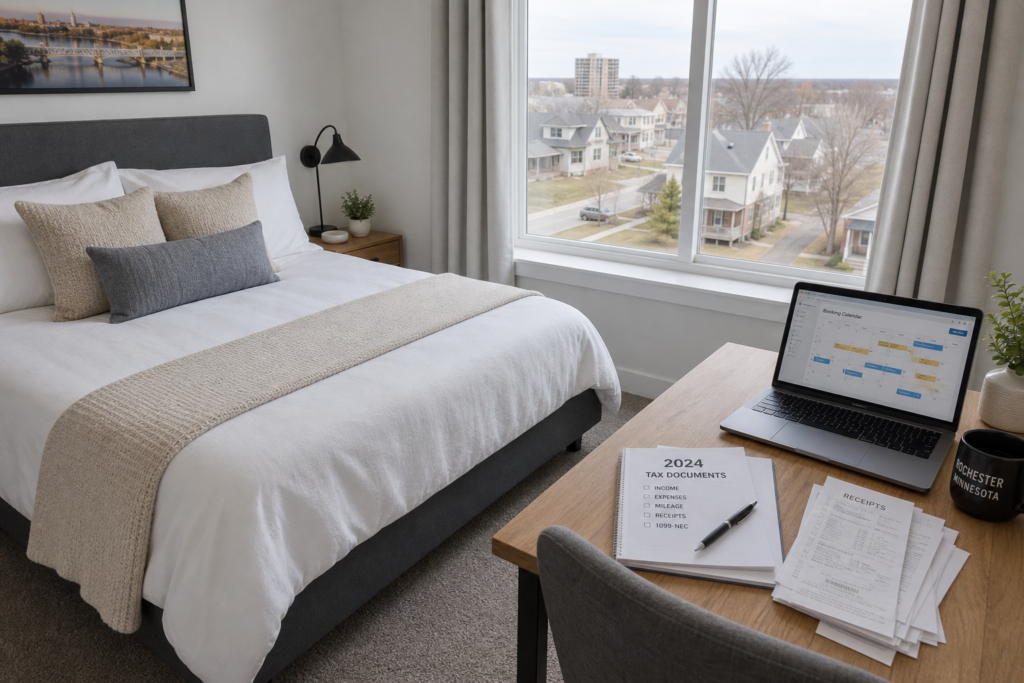
Rochester Short-Term Rental Taxes in 2026: What Hosts Need to Know About Reporting and Deductions

Rochester Short-Term Rental Taxes in 2026: What Hosts Need to Know About Reporting and Deductions
Managing rochester short term rental taxes requires understanding federal, state, and local obligations. Whether you operate a single property or multiple Airbnb and VRBO listings, your 2026 tax obligations start with proper reporting of rental income on Schedule C. This guide covers what you need to know about rochester short term rental taxes, deductible expenses, self-employment tax implications, and tax preparation services in Rochester, Minnesota that can help you maximize your deductions and minimize your overall tax burden.
Table of Contents
- Key Takeaways
- Understanding Short-Term Rental Taxes in Rochester
- How to Report Your Short-Term Rental Income on Federal Taxes
- Minnesota State Tax Obligations for Short-Term Rentals
- What Expenses Can You Deduct on Your Rental Property?
- How Much Self-Employment Tax Will You Owe on Rental Income?
- What Tax Strategies Help Real Estate Investors Save the Most?
- Uncle Kam in Action: Real Results
- Next Steps
- Frequently Asked Questions
Key Takeaways
- Short-term rental income is generally taxable as self-employment income on your 2026 federal tax return using Schedule C if you provide substantial services to guests.
- Minnesota applies state income tax to rental income at progressive rates that can reach the top bracket for higher earners.
- Deductible expenses reduce your taxable income and can include mortgage interest, property taxes, insurance, utilities, repairs, and depreciation.
- Self-employment tax on qualifying rental income is 15.3% (12.4% Social Security + 2.9% Medicare) on 92.35% of net self-employment income, subject to annual Social Security wage limits.
- Entity structuring, cost segregation, and tax strategy planning can help real estate investors reduce their overall tax burden significantly.
Understanding Short-Term Rental Taxes in Rochester
Quick Answer: Short-term rental taxes in Rochester apply at federal, state, and potentially local levels. You must report all rental income, may owe self-employment tax if your activity is treated as a trade or business, and will owe Minnesota state income tax based on your filing status and overall income.
Rochester short term rental taxes operate at three levels: federal income tax, potential self-employment tax, and Minnesota state income tax. Unlike some long-term rental properties held as passive investments, many short-term rentals (properties rented for fewer than 30 consecutive days with substantial services) are treated more like active business income. This classification has significant tax implications for your 2026 returns.
The distinction between short-term and long-term rentals affects how the IRS treats your income and which tax rules apply. In general, properties rented for 15 or more days with personal use limited to the smaller of 14 days or 10% of days rented are considered rental property. Rochester short term rental properties that meet these criteria must be reported using specific forms and calculations. If you provide hotel‑like services (such as regular cleaning during a guest’s stay, concierge services, or meals), your income may be considered from a business, not from passive rental activity.
Why Rochester Short-Term Rental Income May Be Classified as Business Income
Rochester short term rental properties are often classified as business income rather than passive rental income because of the services and active management involved. You provide cleaning, maintenance, guest communication, and booking management—all hallmarks of active business operations. When these services go beyond basic maintenance, your income is often treated as earned business income, which can trigger self-employment tax, whereas purely passive rental income generally does not.
Pro Tip: Document your time spent managing your Rochester short term rental properties. Hours spent on marketing, guest communication, maintenance coordination, and cleaning all demonstrate active involvement, which supports business treatment and protects your deductions. Work with a tax professional to determine whether your particular operation should be reported as a business or as rental activity.
Local Tax Considerations in Rochester, Minnesota
As of the latest public information, Rochester, Minnesota does not have a separate city income tax, but lodging or hotel‑type taxes and licensing rules can apply to short-term rentals in some jurisdictions. Always verify current local requirements with the City of Rochester website and Olmsted County. Local rules can change, and they may affect registration, occupancy taxes, zoning, and safety requirements in addition to your federal and state tax obligations.
How to Report Your Short-Term Rental Income on Federal Taxes
Quick Answer: Report all short-term rental income on your 2026 federal return. Many hosts report on Schedule C (Form 1040) if they provide substantial services and operate as a business; more traditional rentals may be reported on Schedule E. If treated as a business, net profit is generally subject to both income tax and self-employment tax.
Federal reporting of rochester short term rental taxes starts with determining whether your activity is a trade or business or a passive rental. If you provide hotel‑like services and materially participate, your income is often reported on Schedule C, similar to other self-employed activities. If instead you simply provide a furnished space and basic maintenance, your income is more commonly reported on Schedule E as rental real estate income. Correct classification affects which forms you use and whether self-employment tax applies.
Reporting Gross Receipts and Income
Gross rental receipts include all income from nightly rates, cleaning fees you keep, pet fees, and any other guest charges. For 2026, you must report all income received, even if paid through third-party platforms like Airbnb or VRBO. Many platforms issue information returns such as Form 1099-K summarizing annual payments, but thresholds and rules can change. Instead of relying only on those forms, reconcile income using your own booking reports and bank statements.
Calculating Net Profit After Deductions
Net profit is calculated by subtracting all allowable business or rental expenses from gross receipts. Keep detailed records of all expenses: property taxes, mortgage interest, insurance, utilities, cleaning services, linens, repairs, maintenance, advertising, property management fees, software subscriptions, and office expenses. The IRS allows deductions for ordinary and necessary expenses directly related to earning your rental income. Maintain receipts and documentation for all claimed expenses in case the IRS or Minnesota Department of Revenue requests support for your deductions.
Minnesota State Tax Obligations for Short-Term Rentals
Quick Answer: Minnesota taxes net income from your Rochester short-term rentals as part of your state personal income tax return. Your short-term rental profit from federal Schedule C or Schedule E generally flows through to your Minnesota return and is taxed at Minnesota’s individual income tax rates.
Minnesota applies state income tax to all rental and business income that appears on your federal return, with adjustments. For Rochester hosts, that means your net profit from short-term rentals increases your Minnesota taxable income. Actual bracket thresholds and rates can change over time, so always confirm current figures with the Minnesota Department of Revenue when you file your 2026 return.
Understanding Minnesota Brackets (Illustrative)
The table below illustrates how a progressive bracket system works for a single filer. Use it only as a conceptual guide—do not rely on these numbers for filing; instead, check the latest official rate schedule for 2026.
| Taxable Income Range (Single Filer) | Illustrative Tax Rate |
|---|---|
| $0 – $28,000 | 5.35% |
| $28,001 – $75,000 | 7.05% |
| $75,001 – $105,000 | 7.85% |
| $105,001 and above | Higher marginal rate |
Because Minnesota tax is based on taxable income rather than only on your rental activity, you’ll want to evaluate your short-term rental profit alongside W‑2 wages, other business income, and deductions to estimate your total state liability.
What Expenses Can You Deduct on Your Rental Property?
 Free Tax Write-Off Finder
Quick Answer: Deductible expenses can include mortgage interest, property taxes, insurance, utilities, cleaning and maintenance, repairs, property management fees, advertising, supplies, and depreciation. Major improvements are usually capitalized and depreciated over time, not deducted in full in the year paid.
Short-term rental investors can deduct ordinary and necessary expenses related to operating and maintaining the property. Accurate allocation is important if you use the property personally during the year, because only the business portion is deductible. Keep a log of days rented and days of personal use to calculate business‑use percentages.
Common Operating Expenses
- Mortgage Interest: Interest on loans used to acquire or improve the rental property.
- Property Taxes: County and local property taxes for the rental.
- Insurance Premiums: Landlord and liability policies.
- Utilities: Electric, gas, water, trash, internet, and streaming services paid by you.
- Cleaning and Maintenance: Turnover cleaning, laundry, landscaping, pest control, and minor repairs.
- Property Management Fees: Fees to property managers or channel managers.
- Advertising and Software: Listing fees, photography, pricing tools, and booking software.
- Home Office (if eligible): A portion of home‑office costs if you manage your rentals from a dedicated space.
Depreciation Basics
Depreciation lets you recover the cost of the building and certain improvements over time. Residential rental buildings are typically depreciated over 27.5 years, while furnishings and appliances are depreciated over shorter lives under the tax code. Depreciation can create a large non‑cash deduction that lowers your taxable income without affecting your cash flow.
| Asset Type | Typical Recovery Period |
|---|---|
| Residential rental building (structure only) | 27.5 years |
| Furniture, appliances, many fixtures | Shorter lives under MACRS rules |
How Much Self-Employment Tax Will You Owe on Rental Income?
Quick Answer: If your Rochester short-term rental is treated as a business and reported on Schedule C, net earnings from self-employment are generally subject to self-employment tax at 15.3% up to the Social Security wage base, plus additional Medicare tax for higher earners. Rentals reported purely on Schedule E usually are not subject to self-employment tax.
Self-employment tax is separate from federal income tax. It applies to net earnings from self-employment, which includes many short-term rental businesses that provide substantial services to guests. The tax covers both the employer and employee portions of Social Security and Medicare. If your activity is instead treated as a passive rental reported on Schedule E, self-employment tax generally does not apply, though income tax still does.
Because the line between Schedule C and Schedule E reporting can be complex, especially for short stays and high service levels, it’s important to review your facts with a qualified tax advisor before finalizing your return.
What Tax Strategies Help Real Estate Investors Save the Most?
Quick Answer: Rochester hosts can benefit from maximizing deductions, correctly classifying their activity, choosing an appropriate entity structure, and taking advantage of depreciation strategies such as cost allocation studies. The right mix depends on income level, number of properties, and personal goals.
Advanced planning for rochester short term rental taxes often focuses on two areas: reducing taxable income with deductions and depreciation, and managing how income is characterized (business vs. rental, entity vs. individual). Thoughtful planning done before year‑end usually produces better results than last‑minute tax preparation alone.
Entity Structure Considerations
Many Rochester hosts start as sole proprietors and later consider forming a limited liability company (LLC) or electing S‑corporation taxation. An LLC can provide liability protection and flexibility; an S‑corporation election, where appropriate, can create opportunities to optimize how active business income is taxed. Work with a professional to weigh benefits such as potential payroll tax savings against added complexity, payroll filings, and reasonable‑compensation rules.
Pro Tip: Your optimal structure may change as you add properties or your income grows. Revisit your entity choice regularly with a tax advisor, especially if your net income from Rochester short-term rentals crosses major thresholds (for example, $50,000, $100,000, or more per year).

Uncle Kam in Action: Example Scenario
Consider a Rochester host with a single property that produces $40,000 in gross bookings and $24,000 in net profit after allowable expenses. Without planning, they might simply report this income at tax time and be surprised by the combined federal and Minnesota tax bill. By working proactively with a professional, they could ensure that all deductible expenses are captured, clarify whether their activity should be reported on Schedule C or Schedule E, evaluate whether an LLC or other entity makes sense, and set up a recordkeeping system that makes future filings smoother.
For Rochester investors with multiple properties, structured planning often yields larger benefits. A coordinated approach to depreciation, financing, and entity choice can significantly affect multi‑year after‑tax cash flow, particularly when reinvesting profits into additional properties.
Next Steps
- Organize Your Records: Gather all 2026 booking summaries, bank statements, invoices, and receipts related to your Rochester short-term rental.
- Clarify Your Classification: Work with a tax professional to determine whether your activity should be treated as a business (often Schedule C) or as rental real estate (Schedule E).
- Review Entity Options: Evaluate whether an LLC or other structure is appropriate for liability protection and tax planning.
- Plan Ahead for Estimates: If you expect to owe a meaningful amount of tax from your rentals, consider making quarterly estimated payments to avoid underpayment penalties.
- Consult a Local Expert: Connect with a Rochester‑area tax professional experienced with short-term rentals and Minnesota tax rules so you can make informed choices before filing deadlines.
Frequently Asked Questions
Do I Have to Report Short-Term Rental Income if I Don’t Receive a 1099?
Yes. All rental income is taxable, whether or not you receive a Form 1099. Use your booking reports, bank deposits, and other records to capture total income. The absence of a 1099 does not remove your obligation to report the income.
Can I Deduct My Full Mortgage Payment?
You can usually deduct the interest portion of your mortgage payment, plus property taxes and eligible insurance. The principal portion of the payment is not deductible, because it represents repayment of the loan and equity buildup. Your Form 1098 from the lender shows how much interest you paid during the year.
Is There a Tax Difference Between Airbnb and Other Platforms?
No. For federal and Minnesota income tax purposes, income from Airbnb, Vrbo, Booking.com, direct bookings, or other platforms is all treated as rental or business income. The platform you use does not change how the IRS or Minnesota tax authorities categorize the income; only your actual facts and services do.
What Records Should I Keep for My Rochester Short-Term Rental?
Keep copies of booking statements, payout reports, bank records, expense receipts, invoices for furnishings and improvements, property tax bills, insurance policies, and loan documents. Also track the dates the property is available, actually rented, and used personally. Store digital copies in a secure, backed‑up location for at least three to seven years, depending on your risk tolerance and your advisor’s guidance.
Can I Deduct a Loss If My Expenses Are Higher Than My Rental Income?
Often yes, but it depends on how your activity is classified and whether passive activity loss rules apply. If the short-term rental is a passive activity for you, losses may be limited and carried forward to future years. If the activity is a trade or business and you materially participate, you may be able to deduct more of the loss currently. The details can be complex, so review them with a tax professional familiar with rental real estate.
Should I Form an LLC for My Rochester Short-Term Rental?
An LLC is a common choice for short-term rental owners who want liability protection and flexible tax treatment. For a single‑member LLC, federal tax treatment typically remains the same by default, but you gain a legal separation between business and personal assets under state law. Whether to form an LLC depends on factors such as your risk tolerance, loan terms, and the cost of setup and maintenance in Minnesota.
This article provides general educational information about rochester short term rental taxes and is not legal, tax, or financial advice. Tax rules change frequently and can vary based on your specific facts. Consult the IRS, the Minnesota Department of Revenue, and a qualified tax professional before making decisions or filing your 2026 return.
Last reviewed: 2026

