
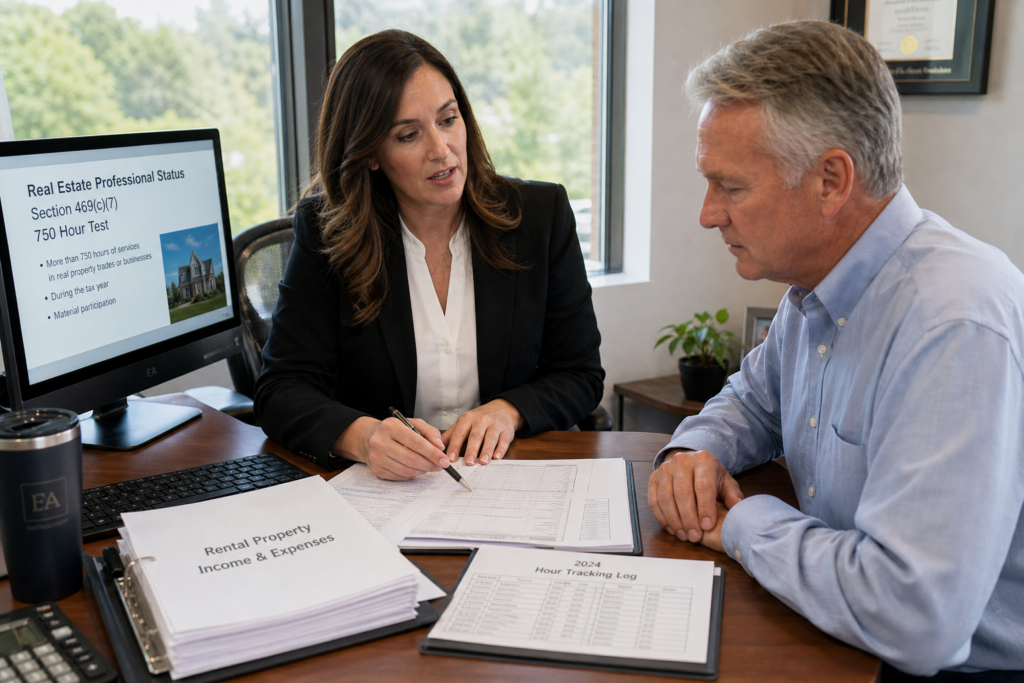
Real Estate Professional Status Section 469 750 Hour Test: The 2026 Advisory Playbook
The real estate professional status section 469 750 hour test is one of the most powerful tools in your advisory kit. For the 2026 tax year, it lets qualifying clients turn passive rental losses into active deductions. However, the rules are strict. Moreover, the IRS audits this status aggressively. This guide shows tax pros how to qualify clients, document hours, and defend the position with confidence.
Table of Contents
- Key Takeaways
- What Is Section 469 and Why Does It Matter?
- Who Qualifies as a Real Estate Professional in 2026?
- How Does the Section 469 750 Hour Test Work?
- What Is Material Participation and How Do You Prove It?
- How Does the 2026 Tax Law Affect This Strategy?
- What Are the Common Mistakes and Audit Triggers?
- Uncle Kam in Action: A Physician-Investor Win
- Next Steps
- Related Resources
- Frequently Asked Questions

Key Takeaways
- The status needs more than 750 hours and more than 50% of work time in real estate.
- Qualifying unlocks non-passive rental losses against W-2 and business income.
- Contemporaneous hour logs are the single best audit defense for 2026.
- Permanent 100% bonus depreciation makes this strategy stronger than ever.
What Is Section 469 and Why Does It Matter?
Quick Answer: Section 469 limits passive losses. It stops most investors from using rental losses against active income. Real estate professionals escape this limit.
Congress enacted Section 469 in 1986 to curb tax shelters. As a result, rental activities became “per se passive” for most taxpayers. In other words, rental losses could only offset passive income. They could not touch wages or business profits. This rule frustrates high-income clients every year.
However, the law carved out one major exception. A taxpayer who qualifies as a real estate professional treats rentals as non-passive. Therefore, their rental losses can offset ordinary income. This is where smart real estate professional status planning creates massive value for your clients.
Why the Passive Loss Rules Hurt Investors
Imagine a surgeon earning $600,000 who owns three rentals. Those rentals show a $90,000 paper loss from depreciation. Without the status, that loss just piles up as a suspended carryforward. Consequently, the client gets no current benefit. The IRS explains these rules in Publication 925 on passive activity.
The Value of Escaping Passive Treatment
Now flip the scenario. If that surgeon qualifies, the $90,000 loss becomes fully deductible. At a 37% bracket, that saves roughly $33,300 in one year. Furthermore, the loss can wipe out the 3.8% net investment income tax on other passive income. This is why the strategy attracts serious real estate investors and their advisors.
Pro Tip: Run the numbers before you promise savings. Suspended losses only help if the client has enough active income to absorb them.
Who Qualifies as a Real Estate Professional in 2026?
Quick Answer: Your client must pass two tests. First, over 50% of personal service time must be in real estate. Second, they need more than 750 hours in real property trades.
Under IRC §469(c)(7)(B), qualification rests on two hurdles. Both must be met in the same tax year. Miss either one, and the status fails. These rules remain unchanged for 2026, per current IRS guidance.
The Two-Part Qualification Test
- More than half of all personal service hours must go to real property businesses.
- More than 750 hours of service in real property trades or businesses.
The 50% test often trips up full-time W-2 employees. For example, a lawyer working 2,000 hours cannot easily beat that number in real estate. Therefore, the status usually fits self-employed clients, retirees, or a non-working spouse. Fold this into the broader conversation around entity design, 199A, and exit strategy on the front end of the engagement instead of trying to salvage things at filing time.
The Married Filing Jointly Advantage
Here is a key planning point. Only one spouse must meet both tests. However, both spouses’ hours count toward material participation later. As a result, a doctor spouse can keep working while the other spouse qualifies. This split strategy powers many high-income plans in 2026.
Did You Know? Time spent as an employee counts only if the client owns at least 5% of the employer. Otherwise, those hours do not qualify.
How Does the Section 469 750 Hour Test Work?
Quick Answer: The 750-hour test counts real property trade hours. These include development, construction, leasing, brokerage, and property management work.
The real estate professional status section 469 750 hour test asks a simple question. Did your client spend more than 750 hours in real property businesses? Yet the details get complex fast. Not every hour counts, and the IRS scrutinizes vague logs.
Which Activities Count Toward the 750 Hours?
The statute lists eleven real property trades or businesses. In addition, the hours must be real work, not passive research. The table below breaks down what counts.
| Counts Toward 750 Hours | Does Not Count |
|---|---|
| Property management and tenant screening | Investor-type research and reading |
| Construction and renovation work | Studying market reports for fun |
| Leasing, brokerage, and acquisitions | Commuting time to properties |
| Repairs, maintenance, and bookkeeping | Hours in non-owned employer real estate |
The Documentation Standard
The Tax Court demands credible records. Ballpark estimates rarely survive an audit. Therefore, push clients toward contemporaneous time logs. A good log lists the date, hours, activity, and property. You can review the statutory language in Section 469 of the tax code.
Pro Tip: Reconstructed logs built after an audit notice carry little weight. Set up tracking on January 1 instead.
What Is Material Participation and How Do You Prove It?
Quick Answer: Qualifying is step one. Next, your client must materially participate in each rental. The 500-hour test is the most common path.
Many advisors stop at the 750-hour test. That is a costly mistake. Real estate professional status only removes the “per se passive” label. After that, the client must still materially participate. Otherwise, the losses stay passive.
The Seven Material Participation Tests
The regulations list seven ways to prove material participation. Meeting any one test works. The most common tests appear below.
- The client works more than 500 hours in the activity.
- The client does substantially all the work in the activity.
- The client works over 100 hours and more than anyone else.
The Aggregation Election Saves the Day
Proving 500 hours per property is hard for owners of many rentals. Fortunately, the aggregation election under Reg. §1.469-9(g) helps. It groups all rentals into one activity. As a result, hours combine across every property. This single election often makes or breaks a plan. Uncle Kam’s platform uses the MERNA™ framework to surface this and related real estate professional strategies so tax pros do not leave six figure savings on the table for high earning investors.
Did You Know? The aggregation election must be filed with a written statement on the return. A missed election can sink an otherwise perfect plan.
How Does the 2026 Tax Law Affect This Strategy?

Quick Answer: The 2025 tax law made 100% bonus depreciation permanent. This turbocharges real estate professional planning for 2026.
The One Big Beautiful Bill Act reshaped this strategy. Signed on July 4, 2025, it restored full bonus depreciation permanently. Consequently, cost segregation now creates giant first-year losses again. Those losses pair perfectly with the real estate professional status section 469 750 hour test.
Cost Segregation Plus REPS
A cost segregation study reclassifies parts of a building. Roughly a third of value can shift to short-life property. Then bonus depreciation deducts it all in year one. For a $450,000 rental, that could mean $150,000 in deductions.
The Short-Term Rental Alternative
Not every client can pass the 750-hour test. However, the short-term rental strategy offers a backdoor. A property with an average guest stay of seven days or less is not a “rental activity.” Therefore, no real estate professional status is needed. The client only needs material participation, such as 100 hours and more than anyone else. This is a great fit for high-income professionals with limited time.
Pro Tip: Bonus depreciation is deferral, not forgiveness. Warn clients about recapture on sale, and plan for 1031 exchanges.
What Are the Common Mistakes and Audit Triggers?
Quick Answer: Weak logs, full-time W-2 jobs, and missed elections cause most failures. The IRS targets large rental losses.
This status draws audit attention. A big loss against a big salary raises a flag. Therefore, prevention beats defense. Position your firm as the guardrail with strong ongoing tax advisory support.
The Top Three Failure Points
- Claiming the status while working a demanding full-time W-2 job.
- Keeping vague or reconstructed hour logs after the fact.
- Forgetting the aggregation election on a multi-property portfolio.
Building an Audit-Proof File
Give every client a simple compliance checklist. It should require a daily time log and a year-end summary. In addition, keep calendars, emails, and invoices as backup. The Tax Court respects consistent, contemporaneous evidence. This turns a scary audit into a routine review.
Did You Know? Selling advisory and delivering it are different skills. Uncle Kam pairs software with training and a built-in marketplace of advisory leads. Ready to grow? Book a strategy session today.
Firms that master this niche charge premium advisory fees. Because the stakes are high, clients gladly pay for certainty. Learn from real documented client results before your next engagement.
Uncle Kam in Action: A Physician-Investor Win
Client Snapshot: A married couple came to a firm using Uncle Kam. The husband was an anesthesiologist. The wife had recently left her corporate job.
Financial Profile: The couple earned $720,000 in combined W-2 and 1099 income for 2026. They owned four long-term rentals worth about $2.1 million.
The Challenge: Their rentals generated $110,000 in suspended passive losses. However, none of it offset the husband’s high income. As a result, they overpaid tax by tens of thousands each year. The prior preparer never mentioned the real estate professional status section 469 750 hour test.
The Uncle Kam Solution: The advisor built a plan around the wife. She now managed the portfolio full-time. Therefore, she easily passed both the 50% test and the 750-hour test. Next, the advisor filed the aggregation election under Reg. §1.469-9(g). This grouped all four rentals into one activity. Then a cost segregation study unlocked $160,000 in bonus depreciation for 2026.
The Results: The combined losses became fully non-passive. Consequently, they wiped out a huge slice of the couple’s active income.
- Tax Savings: Roughly $71,000 in the first year alone.
- Investment: A $9,500 advisory fee for the plan and study coordination.
- Return on Investment: About 7.5x in year one.
The couple also got a client-ready plan with a documentation roadmap. Therefore, they felt confident and audit-ready. This is the power of advisory over simple tax prep.
Next Steps
You can turn this knowledge into revenue right now. Take these concrete steps this week.
- Screen your client list for high earners who own rentals.
- Give each prospect an hour-log template before January 1.
- Model REPS scenarios with a proactive tax planning process.
- Learn how the Uncle Kam marketplace helps tax pros transition to advisory and dominate the real estate niche with integrated software, training, and leads.
Related Resources
- In depth real estate professional status strategy guide for tax pros
- Case studies on leveraging Section 469 for high net worth clients
- Workflow checklists for documenting the 750 hour and material participation tests
Frequently Asked Questions
Does the 750-hour test change for 2026?
No, the core rule stays the same. Your client still needs more than 750 hours. In addition, they need more than 50% of work time in real estate. Always verify current rules at IRS.gov.
Can a W-2 employee qualify for the status?
It is very hard for full-time employees. The 50% test usually blocks them. However, employer hours count if the client owns at least 5% of that employer.
How long does it take to implement this plan?
Planning should start before the tax year begins. Hour tracking must run all year long. Therefore, the best time to set up is January 1.
Is a short-term rental easier than the 750-hour test?
Often, yes. A seven-day average stay avoids the rental activity label. As a result, your client only needs material participation. The 750-hour test does not apply.
What happens to losses if the client cannot qualify?
The losses become suspended passive losses. However, they are not gone forever. They carry forward and release when the property sells or produces passive income.
If the goal is to build a scalable advisory practice around real estate planning, shortcut the trial and error. Book a free strategy session with an Uncle Kam growth specialist and get a step by step roadmap to packaging, pricing, and delivering these engagements using the MERNA system.
This information is current as of 7/4/2026. Tax laws change frequently. Verify updates with the IRS if reading this later.
Last updated: July, 2026

