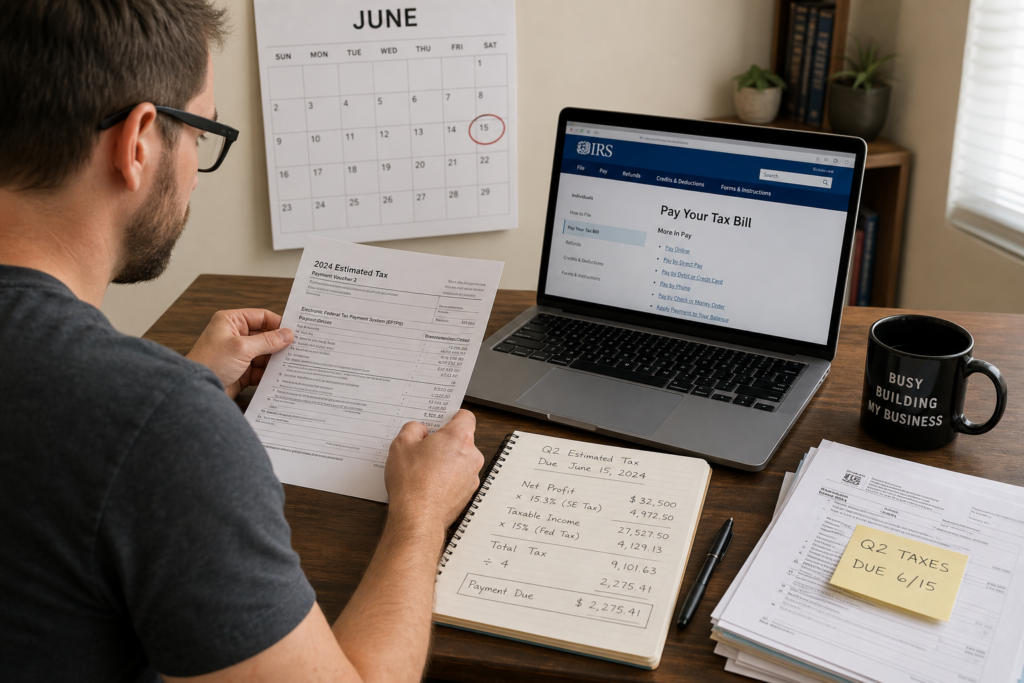
Quarterly Estimated Taxes 2025 Due Dates: Full Guide
Quarterly Estimated Taxes 2025 Due Dates: Full Guide
If you’re self-employed, freelance, or earn 1099 income, you need to know your quarterly estimated taxes 2025 due dates. Missing a deadline costs you money in IRS penalties and interest. This guide covers every IRS payment deadline, how to calculate what you owe, and smart strategies to reduce your tax bill through proper filing and quarterly tax planning for the 2026 tax year.
This information is current as of 6/9/2026. Tax laws change frequently. Verify updates with the IRS at IRS.gov Estimated Taxes if reading this later.
Table of Contents
- Key Takeaways
- What Are Quarterly Estimated Taxes and Who Needs to Pay?
- What Were the Quarterly Estimated Taxes 2025 Due Dates?
- What Are the 2026 IRS Quarterly Estimated Tax Due Dates?
- How Do You Calculate Your Quarterly Estimated Tax Payment?
- How Can You Avoid Underpayment Penalties?
- What Tax Law Changes in 2026 Affect Self-Employed Filers?
- Uncle Kam in Action: Freelancer Stops Paying Late Penalties
- Next Steps
- Related Resources
- Frequently Asked Questions
Key Takeaways
- The quarterly estimated taxes 2025 due dates have all passed — Q4 was January 15, 2026.
- For 2026, the next payment deadline is June 15, 2026 — act now to avoid a penalty.
- Self-employed individuals pay 15.3% in self-employment tax for 2026.
- Use the safe harbor rule — pay at least 100% of prior-year tax — to avoid penalties.
- The One Big Beautiful Bill Act added new deductions in 2026 that lower your estimated payments.
What Are Quarterly Estimated Taxes and Who Needs to Pay?
Quick Answer: If you expect to owe $1,000 or more in federal taxes, you must pay quarterly estimated taxes. This applies to freelancers, contractors, gig workers, and sole proprietors who do not have taxes withheld by an employer.
When you work for an employer, they withhold taxes from every paycheck. However, as a self-employed individual or 1099 contractor, no one withholds taxes for you. The IRS requires you to pay taxes as you earn income throughout the year. These payments are known as quarterly estimated taxes.
The IRS uses a “pay-as-you-go” system. If you wait until April to pay all your taxes at once, the IRS charges an underpayment penalty. Quarterly payments keep you in compliance and spread your tax burden over four installments.
Who Must Pay Quarterly Estimated Taxes?
You generally need to make quarterly estimated tax payments if both of these conditions apply to you:
- You expect to owe at least $1,000 in federal income tax for the year after subtracting withholding and credits.
- Your withholding and credits will cover less than 90% of the current year’s tax liability.
This rule catches a wide range of taxpayers. Freelancers and consultants are the most common group. However, it also affects business owners, landlords with rental income, investors with significant capital gains, and anyone with side income not covered by withholding. You can learn more about your obligations through the IRS official guidance on estimated taxes.
What Taxes Are Included in Your Quarterly Payment?
Your estimated quarterly payment covers two main tax obligations for self-employed workers:
- Federal income tax — based on your net business income and applicable tax bracket for 2026.
- Self-employment (SE) tax — 15.3% of net self-employment earnings for 2026. This covers Social Security (12.4%) and Medicare (2.9%).
You can deduct half of the SE tax you pay when calculating your adjusted gross income (AGI). This deduction helps reduce your federal income tax bill. You report these payments using IRS Form 1040-ES, which includes a worksheet to calculate your estimated tax.
Pro Tip: If you also receive W-2 income from a part-time employer, ask that employer to increase your withholding. This can help cover your 1099 income and reduce or eliminate your quarterly estimated payments.
What Were the Quarterly Estimated Taxes 2025 Due Dates?
Quick Answer: The quarterly estimated taxes 2025 due dates were April 15, June 16, September 15, and January 15, 2026. All four payments are now past due. If you missed any of them, you may owe IRS underpayment penalties.
The quarterly estimated taxes 2025 due dates applied to income earned throughout the 2025 tax year. Each payment covered a specific income period. Below is the full 2025 estimated payment schedule for reference.
| Payment Period (2025 Income) | 2025 Due Date | Status |
|---|---|---|
| January 1 – March 31, 2025 | April 15, 2025 | Past Due |
| April 1 – May 31, 2025 | June 16, 2025 | Past Due |
| June 1 – August 31, 2025 | September 15, 2025 | Past Due |
| September 1 – December 31, 2025 | January 15, 2026 | Past Due |
What If You Missed a 2025 Quarterly Payment?
If you missed one or more quarterly estimated taxes 2025 due dates, you are not alone. The IRS assesses an underpayment penalty for each quarter you fell short. However, you can still minimize the damage.
First, the penalty is calculated separately for each missed quarter. Therefore, paying later quarters on time reduces your overall penalty exposure. Second, you should file your 2025 return and pay any balance owed as soon as possible. The longer you wait, the more interest accrues. Third, you may qualify for a penalty waiver if you meet specific conditions, such as a casualty event, disability, or retirement at age 62 or older.
You can use IRS Form 2210 to calculate your underpayment penalty for the 2025 tax year. The IRS determines the penalty rate based on the federal short-term interest rate plus 3 percentage points. For 2026, the underpayment rate is 8% per year (verify current rate at IRS.gov). Use the right tax strategy to prevent this from happening again in 2026.
Pro Tip: There is also a special COVID-era opportunity right now. The National Taxpayer Advocate recommends filing IRS Form 843 by July 10, 2026. This protective claim could eliminate penalties and interest you were charged during the COVID disaster period (January 20, 2020 – July 10, 2023). Tens of millions of taxpayers may be eligible.
What Are the 2026 IRS Quarterly Estimated Tax Due Dates?
Quick Answer: The 2026 IRS quarterly estimated tax due dates are April 15, June 15, September 15, and January 15, 2027. The June 15 deadline is coming up immediately — act now to make your Q2 payment on time.
Now that the quarterly estimated taxes 2025 due dates have passed, your focus should shift fully to the 2026 tax year. The 2026 schedule gives you four opportunities to pay your taxes on time. The Q1 payment was due April 15, 2026. As of today, June 9, 2026, the Q2 payment deadline of June 15, 2026 is just days away.
| Quarter (2026 Income) | 2026 Due Date | Status |
|---|---|---|
| Q1: January 1 – March 31, 2026 | April 15, 2026 | Past Due |
| Q2: April 1 – May 31, 2026 | June 15, 2026 | Due in 6 Days — Act Now! |
| Q3: June 1 – August 31, 2026 | September 15, 2026 | Upcoming |
| Q4: September 1 – December 31, 2026 | January 15, 2027 | Upcoming |
How to Make Your 2026 Quarterly Payment
The IRS offers several ways to pay your quarterly estimated taxes. The easiest and fastest method is the IRS Direct Pay tool at IRS.gov/DirectPay. It is free, requires no registration, and processes payments instantly from your bank account.
You can also use the Electronic Federal Tax Payment System (EFTPS). This system requires a one-time enrollment but allows you to schedule payments in advance. This is especially useful for setting reminders for all upcoming quarterly deadlines at once. Additionally, you can mail a check using Form 1040-ES with payment vouchers.
No matter which method you choose, make sure your payment is received by the due date. Mailed payments must be postmarked by the deadline. Online payments submitted by 8:00 PM ET on the due date are credited same-day. Get professional tax advisory support if you need help setting up a reliable payment system.
Pro Tip: Set up calendar reminders today for all four 2026 deadlines. Add a one-week buffer before each deadline so you have time to gather records and submit payment without rushing.
How Do You Calculate Your Quarterly Estimated Tax Payment?
 Free Tax Write-Off Finder
Quick Answer: To calculate your quarterly payment, estimate your net self-employment income, multiply it by the 15.3% SE tax rate for 2026, add your federal income tax, and divide by four. Then deduct half of your SE tax before applying your income tax bracket.
Calculating your quarterly estimated taxes is one of the most important skills for any self-employed professional. Many freelancers overpay or underpay simply because they do not know the correct formula. The steps below walk you through the process for the 2026 tax year.
Step-by-Step Calculation for 2026
Follow these steps to estimate your quarterly payment accurately:
- Step 1 — Estimate net self-employment income: Take your expected gross 1099 or business income and subtract deductible business expenses.
- Step 2 — Calculate SE tax: Multiply net SE income by 92.35% (to account for the employer-equivalent portion), then multiply that result by 15.3%.
- Step 3 — Deduct half of SE tax: Subtract half of your SE tax from your net self-employment income. This reduces your taxable income for federal income tax purposes.
- Step 4 — Apply the standard deduction: For 2026, subtract $12,500 (single) or $25,000 (married filing jointly) from your adjusted income.
- Step 5 — Apply your tax bracket: Calculate your federal income tax using 2026 brackets on your taxable income.
- Step 6 — Add income tax + SE tax, then divide by 4: The result is your approximate quarterly payment.
Worked Example: Freelancer Earning $80,000 in 2026
Let’s walk through a real example. Imagine you are a self-employed graphic designer who expects to earn $80,000 in gross income for 2026. You have $10,000 in deductible business expenses, leaving net income of $70,000.
- Net SE income: $70,000
- SE tax base: $70,000 × 92.35% = $64,645
- SE tax (15.3%): $64,645 × 15.3% = approximately $9,891
- Half SE tax deduction: $9,891 ÷ 2 = $4,946
- Adjusted income for income tax: $70,000 − $4,946 = $65,054
- Less 2026 standard deduction (single): $65,054 − $12,500 = $52,554 taxable income
- Federal income tax (estimated, 22% bracket on portions): approximately $6,500–$7,500
- Total tax: ~$9,891 + ~$7,000 = approximately $16,891 for the year
- Quarterly payment: $16,891 ÷ 4 = approximately $4,223 per quarter
This is a simplified example. Your actual liability depends on your specific deductions, credits, and income distribution across quarters. Use our Delaware Self-Employment Tax Calculator to get a more precise estimate based on 2026 rates and your actual numbers.
Did You Know? Self-employed individuals also get to deduct 100% of health insurance premiums paid for themselves and their family members. This deduction reduces your AGI and your total estimated tax bill for 2026.
How Can You Avoid Underpayment Penalties?
Quick Answer: You avoid the underpayment penalty for 2026 by meeting the IRS safe harbor rule — pay at least 90% of this year’s tax liability, or 100% of last year’s tax (110% if your 2025 income exceeded $150,000).
The IRS underpayment penalty is one of the most frustrating surprises for self-employed workers. Fortunately, the IRS provides a clear set of “safe harbor” rules for 2026. If you meet any one of them, the penalty does not apply — even if you end up owing more at tax time.
The Three Safe Harbor Options for 2026
You are safe from the underpayment penalty in 2026 if you meet at least one of these conditions:
- Option 1 — 90% Rule: Your total 2026 estimated tax payments equal at least 90% of the total tax you owe for 2026.
- Option 2 — 100% of Prior Year: Your payments equal at least 100% of the total tax shown on your 2025 return. This is the easiest and most popular safe harbor method.
- Option 3 — 110% of Prior Year (High Earners): If your 2025 adjusted gross income exceeded $150,000 (or $75,000 for married filing separately), you must pay 110% of your 2025 tax liability to qualify for safe harbor.
The 100% of prior year option is the most powerful tool for self-employed individuals with variable income. Your income might be much higher or lower than expected. Nevertheless, if you paid the same total amount as your 2025 tax bill, the IRS will not assess a penalty — regardless of how much you owe on April 15, 2027.
Even Distribution vs. Annualized Income Method
The standard approach divides your total expected tax by four and pays equal installments. This works well if your income is steady throughout the year. However, many freelancers earn income unevenly — lots in Q3 and Q4, for example, or a big project contract in Q2.
In that case, the annualized income installment method (IRS Form 2210, Schedule AI) can save you money. Under this method, you calculate your actual income earned through each quarter and pay tax only on what you actually earned. This prevents overpayment in low-income quarters. It is more complex to calculate, but it can significantly reduce cash-flow strain. Review IRS Form 2210 instructions or work with a tax professional to use this method properly.
The MERNA Method used by Uncle Kam helps self-employed clients apply the right payment strategy based on their actual income patterns. This approach minimizes both overpayment and penalty risk throughout the year.
What Tax Law Changes in 2026 Affect Self-Employed Filers?
Quick Answer: The One Big Beautiful Bill Act (OBBBA), passed in July 2025, introduced several new deductions in 2026 that reduce taxable income for self-employed workers — including the no-tax-on-tips provision and new car loan interest deductions.
The tax landscape changed significantly for the 2026 filing year. The One Big Beautiful Bill Act introduced major new deductions now known as the “Working Families Tax Cuts.” According to IRS data, approximately 45% of all 2025 returns claimed at least one of these new deductions. The average refund for those filers was over $3,200. These deductions continue to apply to the 2026 tax year and directly affect how much you should pay in quarterly estimated taxes.
Key New Deductions Under the OBBBA for 2026
These Working Families Tax Cuts are especially important for self-employed filers to factor into their 2026 quarterly tax estimates:
- No tax on tips: Self-employed workers in tip-based industries can exclude qualifying tip income from federal income tax. This provision directly lowers your taxable income and your quarterly payment amount.
- No tax on overtime pay: Certain overtime compensation may be excluded from federal income tax for 2026. Consult a tax professional for details on qualifying income types.
- Car loan interest deduction: Self-employed individuals who use a vehicle for business can now deduct interest on auto loans as an additional itemized deduction under the 2026 OBBBA rules.
- Senior deductions: Expanded deductions for self-employed filers over age 65 are available for the 2026 tax year.
- Increased SALT cap: The state and local tax (SALT) deduction cap increased to $40,000 for 2026 (up from prior law). This benefits self-employed filers in high-tax states.
How These Changes Affect Your Quarterly Payment Amount
These new deductions lower your taxable income. As a result, your total 2026 tax liability is lower than it would have been under prior law. This means you can legitimately reduce your quarterly estimated tax payments for 2026.
However, to take advantage of these deductions in your estimated payment calculations, you must account for them proactively. Many self-employed filers wait until April to discover these savings — and meanwhile they overpay their quarterly taxes throughout the year. Proactive planning with a tax professional who understands self-employed tax obligations can get that money back in your pocket quarterly instead of waiting for a refund.
Pro Tip: If you earn tip income as a self-employed worker (e.g., gig work, food delivery, restaurant work), the OBBBA’s no-tax-on-tips provision could meaningfully reduce your 2026 quarterly estimated tax payments. Factor this in when calculating your Q3 and Q4 installments.
COVID-Era Refund Opportunity: Act Before July 10, 2026
There is also a time-sensitive opportunity for self-employed filers who paid IRS penalties or interest during the COVID-19 disaster period (January 20, 2020 – July 10, 2023). Following the Kwong v. United States court ruling, the National Taxpayer Advocate recommends filing IRS Form 843 by July 10, 2026. Label it “Protective Refund Claim Pursuant to Kwong Case.”
This deadline is just one month away. Tens of millions of taxpayers may be eligible for refunds or abatement of estimated tax penalties, failure-to-pay penalties, and interest from that period. Do not miss this deadline. An experienced tax advisor can help you determine if you qualify and prepare the claim quickly.

Uncle Kam in Action: Freelancer Stops Paying Late Penalties
Client Snapshot: Marcus is a self-employed UX designer based in Wilmington, Delaware. He works exclusively on 1099 contracts for tech companies across the country.
Financial Profile: Marcus earns approximately $95,000 per year in 1099 income. His income varies by quarter — Q1 and Q4 are typically his busiest seasons, while Q2 and Q3 are slower.
The Challenge: Marcus consistently made equal quarterly payments throughout the year. However, because Q1 was always his highest-income quarter, he underpaid relative to Q1 income. Every year he owed the IRS an underpayment penalty on his Q1 installment. He also missed two quarterly estimated taxes 2025 due dates because he was not tracking them closely. By January 2026, he owed $640 in underpayment penalties and nearly $1,200 in unpaid interest from prior years.
The Uncle Kam Solution: Uncle Kam’s team ran Marcus through the annualized income installment method using IRS Form 2210 Schedule AI. They identified that his Q1 income was consistently 45% of his annual total. Therefore, his Q1 payment should represent 45% of his estimated annual liability — not 25%. Uncle Kam also set Marcus up on the EFTPS system with automated reminders for all four 2026 quarterly deadlines. Additionally, the team discovered that Marcus had paid estimated tax underpayment penalties during the COVID disaster period and helped him file IRS Form 843 before the July 10, 2026 deadline to reclaim those penalties.
The Results:
- Tax Savings in 2026: Marcus eliminated all underpayment penalties — saving $640 per year in recurring penalties going forward.
- COVID Refund Recovered: The protective refund claim recovered an estimated $1,850 in penalties and interest from the COVID period.
- Investment: Marcus paid Uncle Kam $950 for advisory and filing services.
- Return on Investment: Marcus saved and recovered over $2,490 — more than 2.6x his investment — in year one alone.
Stories like Marcus’s are why proactive quarterly tax planning matters. See more results like these on our client results page.
Next Steps
Take these actions now to stay on top of your quarterly tax obligations for 2026:
- Make your Q2 payment immediately. The June 15, 2026 deadline is just days away. Use IRS Direct Pay to submit your payment today.
- File IRS Form 843 before July 10, 2026. If you paid penalties or interest from 2020–2023, this protective claim could return thousands of dollars to you.
- Recalculate your 2026 estimated payments. Factor in new OBBBA deductions and your actual Q1–Q2 income to adjust Q3 and Q4 payments.
- Connect with a tax pro. Get personalized quarterly tax planning through Uncle Kam’s tax strategy services.
- Bookmark the 2026 tax calendar. Use the Uncle Kam tax calendar to track all upcoming deadlines in one place.
Related Resources
- Self-Employed Tax Guide for 1099 Contractors
- Tax Prep and Filing Services for Freelancers
- Free Tax Calculators for Self-Employed Workers
- 2026 IRS Tax Deadline Calendar
- Uncle Kam Tax Strategy Blog
Frequently Asked Questions
What were the quarterly estimated taxes 2025 due dates?
The quarterly estimated taxes 2025 due dates were: Q1 — April 15, 2025; Q2 — June 16, 2025; Q3 — September 15, 2025; and Q4 — January 15, 2026. All four payment deadlines have now passed. If you missed any payments, you may owe an IRS underpayment penalty. File Form 2210 with your 2025 tax return to calculate any penalty owed.
What is the next quarterly estimated tax deadline in 2026?
The next deadline is June 15, 2026 — just days away as of this writing. This is your Q2 2026 estimated tax payment, covering income earned from April 1 through May 31, 2026. After that, Q3 is due September 15, 2026, and Q4 is due January 15, 2027. Use IRS Direct Pay to submit your payment instantly and confirm receipt.
Do I have to pay quarterly estimated taxes if I’m a new freelancer?
Yes, if you expect to owe $1,000 or more in federal tax for 2026. Many new freelancers miss this requirement in their first year. You should start making quarterly payments as soon as you begin earning self-employment income. However, if you just started freelancing in Q2 2026, you may not owe much for Q1. Focus on estimating your full-year income and dividing the remaining tax liability across Q2, Q3, and Q4 payments for 2026. Visit the Uncle Kam FAQ page for more beginner tax guidance.
What happens if I miss the June 15, 2026 estimated tax deadline?
If you miss the June 15, 2026 deadline, the IRS will charge an underpayment penalty for that quarter. The penalty is calculated based on the shortfall — the difference between what you paid and what you should have paid for Q2. It is calculated at 8% per year (verify at IRS.gov for the current rate) on the underpaid amount for the days it remains unpaid. The good news is that paying as soon as possible minimizes the penalty amount. Furthermore, your Q3 and Q4 payments can still qualify you for the annual safe harbor threshold.
Can I reduce my 2026 quarterly payments because of new OBBBA deductions?
Yes. The One Big Beautiful Bill Act introduced deductions for tips, overtime, car loan interest, and other categories that reduce your 2026 taxable income. If you qualify for any of these deductions, your total 2026 tax liability is lower. Therefore, your quarterly estimated payments should be lower too. The key is to factor these deductions into your estimates proactively — rather than discovering the savings at tax filing time. A professional tax advisor can help you update your 2026 estimated payments to reflect these new deductions.
Is the self-employment tax rate changing in 2026?
No. For 2026, the self-employment tax rate remains 15.3%. This consists of 12.4% for Social Security and 2.9% for Medicare. The Social Security portion applies only up to the annual wage base limit (verify the 2026 wage base at SSA.gov). Income above that threshold is subject only to the 2.9% Medicare portion. You can deduct half of your SE tax payment as an above-the-line deduction on your 2026 federal return.
What is IRS Form 1040-ES and do I need it?
IRS Form 1040-ES is the “Estimated Tax for Individuals” form. It includes worksheets to calculate your estimated quarterly payments and payment vouchers you can mail with a check. If you pay online through IRS Direct Pay or EFTPS, you do not need to submit the paper form. However, the worksheet portion is still useful for estimating your tax liability. You can download the current year form directly from the IRS.gov Form 1040-ES page. Most tax software programs also guide you through the calculation automatically.
Last updated: June, 2026

