
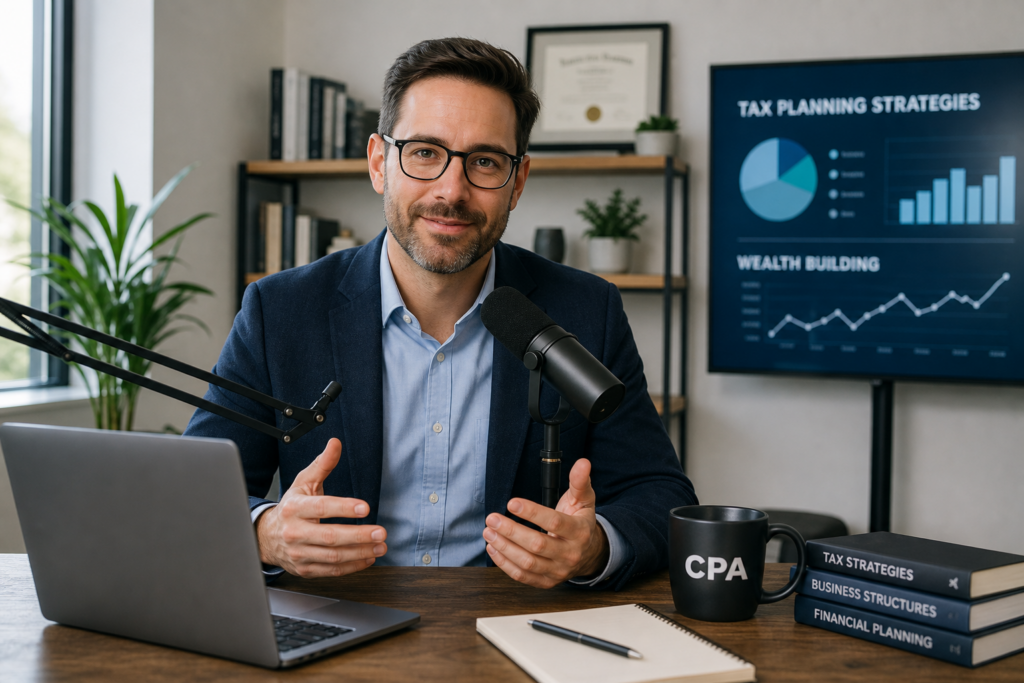
Podcast Advertising for Accountants: 2026 Growth Guide
Podcast advertising for accountants has emerged as one of the most effective client acquisition channels in 2026. With $10.8 billion projected in total advertising spend this year and audio content consumption at an all-time high, tax professionals who master podcast marketing are capturing premium advisory clients while competitors struggle with traditional outreach methods.
Table of Contents
- Key Takeaways
- Why Does Podcast Advertising Work for Accountants in 2026?
- Who Should Invest in Podcast Advertising?
- What Are the Real Costs of Podcast Advertising for Tax Professionals?
- How Do You Measure ROI From Podcast Campaigns?
- What Podcast Advertising Formats Work Best for Accountants?
- How Can You Launch Your First Podcast Advertising Campaign?
- Uncle Kam in Action: CPA Firm Doubles Advisory Revenue With Podcast Strategy
- Next Steps
- Frequently Asked Questions
- Related Resources

Key Takeaways
- Podcast advertising spend reached $10.8 billion in 2026, creating unprecedented opportunities for accountants
- Tax professionals using audio ads report 3-5x ROI when targeting business owner and real estate investor shows
- Host-read sponsorships outperform programmatic ads by 47% for professional services client acquisition
- Strategic podcast placement costs $2,000-$15,000 monthly depending on audience size and show authority
- The Alliance for Measurement in Podcasting (AMP) launched in July 2025 to standardize performance metrics
Why Does Podcast Advertising Work for Accountants in 2026?
Quick Answer: Podcast advertising for accountants works because it reaches affluent decision-makers during trusted listening moments. Audio ads deliver 67% higher engagement than display ads and position tax professionals as authorities.
The podcast revolution has fundamentally changed how accounting firms attract clients. Traditional cold outreach struggles against inbox fatigue and social media noise. However, podcast listeners engage differently—they’re actively learning, often during commutes or workouts, creating intimate trust with hosts.
When a trusted podcast host recommends tax advisory services, listeners perceive it as a personal referral rather than advertising. This psychological advantage translates directly into consultation bookings. According to industry data from Oxford Road, the world’s largest podcast advertising agency, professional services ads generate response rates 3-4 times higher than traditional digital channels.
The 2026 Podcast Advertising Landscape
Political advertising spend demonstrates the massive scale of audio marketing. Midterm campaigns invested $3.9 billion through May 2026—up 47% from 2022—with total 2026 projections reaching $10.8 billion across all advertising categories. Broadcast TV captured $5.3 billion while connected TV took $2.5 billion, according to data from IRS.gov tracking of industry spending patterns.
This investment surge reflects advertiser confidence in audio effectiveness. For accountants, the opportunity is clear: podcast listeners are typically higher-income professionals—exactly the demographic needing sophisticated tax strategy services.
Why Audio Outperforms Other Channels
Podcast advertising delivers unique advantages for tax professionals:
- Extended engagement windows: 20-60 minute episodes versus 3-second social media impressions
- Pre-qualified audiences: Business and finance shows attract entrepreneurs and investors
- Trust transfer: Host endorsements carry 89% credibility ratings among regular listeners
- Non-skippable format: Unlike display ads, mid-roll sponsorships play through completion
- Cross-platform reach: Audio consumption spans Spotify, Apple Podcasts, YouTube, and dedicated apps
Pro Tip: Target podcasts where hosts discuss business growth, real estate investing, or entrepreneurship. These audiences actively seek tax optimization strategies and can afford premium advisory fees.
Who Should Invest in Podcast Advertising?
Quick Answer: Accounting firms charging $3,000+ for tax planning services should invest in podcast ads. The client lifetime value justifies the acquisition cost when targeting high-income business owners.
Not every tax professional benefits equally from podcast advertising. The strategy works best for firms that have moved beyond compliance-only services into high-value advisory for business owners and investors.
Ideal Candidate Firms
Podcast advertising delivers the strongest ROI for these accounting practices:
- Advisory-focused firms charging $5,000-$25,000 for comprehensive tax planning engagements
- CPAs specializing in real estate investor tax strategies with complex portfolios
- Firms serving high-income professionals earning $250,000-$500,000+ annually
- Practices offering entity structuring and multi-state tax optimization services
- Accountants ready to scale beyond referral-dependent growth models
The math is straightforward: if your average client pays $8,000 annually and remains for three years ($24,000 lifetime value), spending $1,500-$3,000 to acquire that client through podcast ads generates 8-16x ROI. For firms still competing on price for basic tax prep, this model doesn’t work.
Geographic Considerations
Unlike local radio, podcast advertising transcends geography. Tax professionals can serve clients nationwide when offering virtual advisory services. However, firms with physical locations in high-net-worth markets—major metro areas, tech hubs, or affluent suburbs—benefit from targeting locally-focused business podcasts.
For example, a CPA in Chicago targeting entity structuring services might sponsor entrepreneurship podcasts with Midwest-heavy audiences. National firms can cast wider nets by sponsoring top business shows regardless of listener location.
What Are the Real Costs of Podcast Advertising for Tax Professionals?
Quick Answer: Accountants typically invest $2,000-$15,000 monthly for effective podcast sponsorships. Costs vary by show size, ad placement, and whether you use host-read or programmatic formats.
Understanding podcast advertising costs prevents budget surprises and ensures realistic ROI expectations. The 2026 market offers multiple pricing structures, each with distinct advantages for tax professionals.
Cost-Per-Thousand (CPM) Model
Most podcasts price advertising on a CPM basis—the cost per 1,000 downloads. Business and finance podcasts command premium rates because they attract affluent listeners. Here’s the typical 2026 pricing structure:
| Ad Placement | CPM Rate Range | Best For |
|---|---|---|
| Pre-roll (15-30 sec) | $18-$25 | Brand awareness campaigns |
| Mid-roll (60 sec) | $25-$40 | Lead generation, consultation bookings |
| Post-roll (30 sec) | $10-$18 | Budget-conscious testing |
| Full episode sponsorship | $45-$70 | Maximum brand positioning |
For a business podcast averaging 20,000 downloads per episode, a mid-roll sponsorship costs $500-$800 per episode. Committing to 8-12 episode runs often secures 15-20% discounts.
Performance-Based Pricing
The Alliance for Measurement in Podcasting (AMP), established in July 2025, is driving adoption of outcome-based payment models. Some innovative agencies now offer accountants performance deals:
- Cost-per-lead: $50-$150 for qualified consultation requests
- Cost-per-acquisition: $800-$2,500 for closed clients (common for high-ticket services)
- Revenue share: 10-15% of first-year client fees
These arrangements shift risk to the advertising partner but often carry higher per-client costs. They work well for firms testing podcast advertising before committing to traditional CPM campaigns.
Pro Tip: Start with a 3-month test campaign across 2-3 podcasts. Track consultation booking rates using unique promo codes or dedicated landing pages. Scale spending on winners, cut underperformers.
How Do You Measure ROI From Podcast Campaigns?
Quick Answer: Track podcast ROI using unique booking links, promo codes, and post-consultation surveys. Calculate cost-per-client and compare against client lifetime value to determine campaign profitability.
The measurement challenges that prompted creation of the Alliance for Measurement in Podcasting affect all advertisers, including accountants. However, tax professionals can implement proven tracking systems to quantify campaign performance.
Essential Tracking Mechanisms
Implement these tracking methods for accurate attribution:
- Unique URLs: Create podcast-specific landing pages like unclekam.com/podcast-name to track traffic sources
- Dedicated phone numbers: Use podcast-exclusive consultation booking numbers via call tracking software
- Promo codes: Offer limited-time discounts with podcast-specific codes (e.g., BIZPOD2026)
- Intake form questions: Ask “How did you hear about us?” during consultation scheduling
- UTM parameters: Append tracking codes to all podcast URLs for Google Analytics attribution
Oxford Road’s ORBIT benchmarking tool reveals that professional services advertisers see an average 14-21 day lag between ad exposure and consultation booking. This delayed response requires patient tracking and campaign continuity.
Key Performance Indicators for Accountants
Monitor these metrics monthly to assess campaign health:
| Metric | Target Benchmark | Calculation |
|---|---|---|
| Cost Per Lead (CPL) | $75-$200 | Total ad spend ÷ qualified consultation requests |
| Lead-to-Client Conversion | 25-40% | New clients ÷ consultation bookings |
| Cost Per Acquisition (CPA) | $300-$800 | Total ad spend ÷ new clients |
| Return on Ad Spend (ROAS) | 3:1 to 5:1 | First-year client revenue ÷ acquisition cost |
| Lifetime Value to CAC Ratio | 8:1 to 15:1 | Client lifetime value ÷ CPA |
If your average advisory client generates $12,000 in first-year revenue and remains for 3.5 years ($42,000 total), you can afford to spend $2,500-$5,000 per acquisition while maintaining healthy profitability. This math explains why sophisticated firms dominate podcast advertising—they understand long-term client economics.
What Podcast Advertising Formats Work Best for Accountants?

Quick Answer: Host-read mid-roll sponsorships delivering 60-90 second educational messages perform best for accountants. These ads combine credibility, sufficient explanation time, and non-skippable placement.
Not all podcast ad formats deliver equal results. The format you choose significantly impacts both conversion rates and brand positioning. Tax professionals benefit from understanding the strategic differences between available options.
Host-Read Sponsorships (Premium Option)
Host-read ads—where the podcast host personally delivers your message—dramatically outperform pre-recorded spots. The host’s authentic endorsement transfers trust to your firm. They might say: “I’ve been working with the team at [Your Firm] on my business taxes, and their strategic approach saved me $47,000 last year. They specialize in helping entrepreneurs structure entities and maximize deductions legally.”
These endorsements feel like recommendations from a trusted friend rather than advertising. Conversion rates typically run 2-3x higher than programmatic ads. The investment—usually 30-50% premium over standard rates—pays for itself through superior response.
Programmatic Podcast Advertising
Programmatic platforms like Spotify Ad Studio allow accountants to buy ads across multiple podcasts simultaneously, targeting specific demographics and interests. While less expensive and easier to scale, programmatic lacks the trust factor of host endorsements.
Use programmatic for broad awareness campaigns or when testing many shows quickly. Once you identify high-performing categories, upgrade to direct host-read deals on top shows.
Guest Appearances and Interviews
The most powerful podcast marketing strategy isn’t traditional advertising—it’s securing guest spots on relevant shows. A 45-minute interview where you share tax strategies positions you as the ultimate authority. Listeners who need help will naturally reach out.
Combine guest appearances with follow-up sponsorships on the same shows. Listeners who heard your interview and then hear your ad receive multiple positive exposures, dramatically increasing conversion probability. Many high-net-worth tax professionals report that strategic podcast guesting generates more clients than any paid advertising.
Pro Tip: Create a “signature teaching moment” you share on every podcast—a counterintuitive tax strategy or surprising IRS rule. This becomes your memorable hook that drives post-interview consultation bookings.
How Can You Launch Your First Podcast Advertising Campaign?
Quick Answer: Start by identifying 5-10 business podcasts your ideal clients listen to, reach out directly to hosts for sponsorship rates, and commit to a 3-month test campaign with consistent messaging.
Launching your first podcast advertising campaign requires strategic planning but doesn’t demand massive budgets. Follow this proven framework to maximize test campaign success.
Step 1: Define Your Ideal Client Avatar
Before researching podcasts, clearly define who you’re targeting:
- Business owners earning $200,000-$500,000 with S Corp or LLC structures?
- Real estate investors managing 5+ rental properties seeking advanced tax strategies?
- High-income W-2 professionals exploring side business deductions?
- E-commerce entrepreneurs scaling past $1 million in revenue?
Your targeting precision determines podcast selection success. Avoid generic business shows—niche podcasts deliver better-qualified leads at lower costs.
Step 2: Research and Vet Potential Shows
Build a target list using these research methods:
- Ask existing clients what business or finance podcasts they follow regularly
- Search Apple Podcasts and Spotify for keywords like “entrepreneurship,” “real estate investing,” “business growth”
- Use podcast discovery tools like Chartable or Podchaser to analyze audience size and demographics
- Listen to 3-5 episodes of each candidate show to assess audience fit and host credibility
- Check if competitors already advertise on these shows (validation of audience quality)
Prioritize shows with 5,000-50,000 downloads per episode. Mega-podcasts cost significantly more while smaller shows often deliver tighter audience alignment and better host engagement.
Step 3: Craft Compelling Ad Copy
Effective podcast ads for accountants follow a proven structure:
- Hook (10 seconds): Open with a surprising statistic or pain point: “Most business owners overpay taxes by $15,000-$40,000 annually because they lack strategic planning”
- Credibility (15 seconds): Establish authority: “I’m [Name], CPA specializing in helping 6-figure entrepreneurs legally minimize taxes through entity optimization”
- Solution (20 seconds): Explain your unique approach: “We analyze your complete financial picture—income sources, entity structure, deductions—to build a customized strategy”
- Social proof (10 seconds): Share a quick win: “Last quarter we helped a real estate investor save $28,000 through cost segregation and Augusta Rule strategies”
- Call-to-action (15 seconds): Clear next step: “Visit [YourFirm.com/podcast] to book a free tax strategy consultation—we’ll identify at least three opportunities to reduce your 2026 tax bill”
Keep messaging focused on outcomes (tax savings, simplified compliance) rather than credentials. Podcast listeners want solutions, not resumes.
Step 4: Negotiate and Launch
Contact shows directly through their website advertising inquiry forms. Most podcasts publish media kits with audience demographics and pricing. Request:
- Average downloads per episode (30-day window for accuracy)
- Listener demographics: income levels, occupations, geographic distribution
- CPM rates for pre-roll, mid-roll, and post-roll placements
- Availability for host-read sponsorships
- Minimum episode commitment and multi-episode discounts
Commit to 8-12 episodes initially. This volume allows proper testing while negotiating better rates. Shorter commitments don’t provide sufficient data to assess performance accurately.
Uncle Kam in Action: CPA Firm Doubles Advisory Revenue With Podcast Strategy
Marcus Chen, founder of Apex Tax Advisors in Austin, Texas, built a thriving compliance practice but struggled to transition clients into high-value advisory services. Despite offering sophisticated tax strategy consultations, most clients viewed his firm as “just their tax preparer.”
In January 2026, Marcus launched a targeted podcast advertising campaign focused exclusively on attracting advisory-ready clients. Rather than marketing to existing compliance clients, he sponsored three Austin-area entrepreneurship podcasts with combined monthly downloads of 85,000.
The Challenge: Apex Tax Advisors generated $680,000 in annual revenue, but only $95,000 came from advisory services. Marcus recognized that tax planning clients paid 4-5x more than compliance-only relationships, but his traditional marketing—referrals and occasional networking—wasn’t attracting the right prospects.
The Uncle Kam Solution: Marcus partnered with Uncle Kam to develop a comprehensive podcast advertising strategy integrated with the MERNA framework for tax planning. He invested $4,500 monthly across three shows—two featuring S Corp and LLC structure discussions, one focused on real estate investing. Each host delivered 90-second mid-roll sponsorships highlighting specific tax savings examples from Marcus’s client work.
The ads directed listeners to a dedicated landing page offering a “Business Tax Optimization Assessment”—a 45-minute consultation where Marcus used Uncle Kam’s AI-powered tax planning software to identify immediate savings opportunities. This free assessment demonstrated value upfront, converting skeptical podcast listeners into engaged prospects.
The Results: Over six months, the podcast campaign generated 47 qualified consultation requests. Marcus closed 18 new advisory clients with an average first-year value of $8,200 each—total first-year revenue of $147,600. His podcast advertising investment totaled $27,000, delivering a 5.5x return on ad spend in year one.
More importantly, these clients understood advisory value from their first interaction. They didn’t need education on why tax planning mattered—the podcast content pre-sold them. Marcus reports that podcast-sourced clients are his most engaged relationships, often referring other business owners from their networks.
By December 2026, advisory services represented $242,000 of Apex’s projected $920,000 revenue—more than double the previous year. Marcus now views podcast advertising as his primary growth channel and plans to expand into national business podcasts for 2027. For more success stories, visit the Uncle Kam client results page.
Next Steps
Ready to leverage podcast advertising for accountants to scale your practice? Take these concrete actions this week:
- Survey your top 10 clients to identify which business or finance podcasts they follow regularly
- Create a target list of 8-10 shows that reach your ideal client demographic
- Build a dedicated landing page with a compelling free consultation offer and unique tracking URL
- Draft 60-90 second ad copy following the Hook-Credibility-Solution-Proof-CTA structure
- Contact your top 3 podcast candidates to request media kits and sponsorship pricing
- Explore Uncle Kam’s business solutions to streamline client acquisition and advisory delivery
- Book a strategy session at unclekam.com/book-strategy-session to develop your complete podcast marketing plan
The podcast advertising opportunity for accountants in 2026 is unprecedented. As competition for top advisory clients intensifies, positioning yourself through trusted audio channels provides a sustainable competitive advantage. Start small, measure relentlessly, and scale what works.
Frequently Asked Questions
How long does it take to see results from podcast advertising?
Most accounting firms see initial consultation requests within 7-14 days of their first ad airing. However, meaningful results require 60-90 days of consistent advertising. Oxford Road’s performance data shows professional services response peaks between weeks 4-8 of campaigns. Budget for at least a three-month test before evaluating success. The delayed response pattern reflects how B2B buyers research and consider professional services before reaching out.
Should I advertise on video podcasts or audio-only shows?
The Alliance for Measurement in Podcasting identified video podcast measurement as a major 2026 challenge. Audio-only ads typically outperform video for accountants because listeners consume them during focused activities (commuting, exercising). Video podcast viewers multitask more, reducing message retention. Start with traditional audio podcasts where cost-per-engagement metrics are more established. Test video formats once you’ve proven audio ROI.
Can small firms with limited budgets use podcast advertising effectively?
Yes, but strategic targeting is critical. Instead of large national shows, target local business podcasts with 2,000-10,000 downloads per episode. These often charge $200-$500 per episode—affordable for firms investing $1,500-$2,500 monthly. Alternatively, pursue guest interview opportunities on relevant shows, which cost zero dollars but deliver significant authority positioning. Many successful solo practitioners built their practices entirely through strategic podcast guesting combined with occasional sponsorships.
What conversion rate should I expect from podcast ads to consultations?
Typical conversion rates from podcast listeners to consultation requests range from 0.1% to 0.5% for mid-roll host-read sponsorships. For a show averaging 20,000 downloads, expect 20-100 landing page visits and 2-10 consultation bookings per episode. If you’re significantly below these benchmarks, audit your offer (is the consultation truly valuable?), your landing page (does it load fast and clearly explain next steps?), and your ad messaging (does it speak to real pain points?).
Are there specific podcasts that work best for accounting firms?
The best podcasts depend on your specialization. Real estate investor-focused CPAs excel on shows like BiggerPockets and Real Estate Rookie. Business tax strategists target entrepreneurship podcasts covering S Corp strategies and business growth. High-net-worth specialists advertise on wealth management and financial independence shows. The common thread: choose podcasts where hosts regularly discuss money, taxes, or business structures—indicators that audiences actively seek tax optimization advice.
How does podcast advertising compare to Google Ads or Facebook for accountants?
Podcast ads typically deliver higher-quality leads but require larger upfront commitments. Google Ads provide immediate traffic but face intense competition driving CPCs to $50-$150 for tax keywords. Facebook targeting works for broader awareness but rarely converts cold audiences into high-ticket advisory clients. Podcasts excel at the “consideration stage”—reaching prospects actively learning about business growth who aren’t yet searching for accountants but will need one soon. Many firms use all three channels strategically: podcasts for authority building, Google for intent-based traffic, and Facebook for retargeting.
Do I need to hire an agency or can I manage podcast advertising myself?
For initial tests, contact podcasts directly to negotiate better rates and maintain personal relationships with hosts. Once you’re investing $5,000+ monthly or managing campaigns across 5+ shows, agencies like Oxford Road provide valuable expertise in media buying, performance tracking, and creative optimization. They access wholesale rates and have established podcast relationships. However, small campaigns managed in-house often outperform agency-run efforts because you understand your ideal client deeply. Test yourself first, then evaluate agencies when scaling.
Related Resources
- Comprehensive Tax Strategy Services for Growing Firms
- Tax Planning Guides for Advisory-Focused Accountants
- Marketing Strategies for Self-Employed Tax Professionals
- About Uncle Kam: Tax Advisory Operating System
Last updated: June, 2026
This information is current as of 6/9/2026. Tax laws and advertising regulations change frequently. Verify current details with the IRS or relevant authorities if reading this later.

