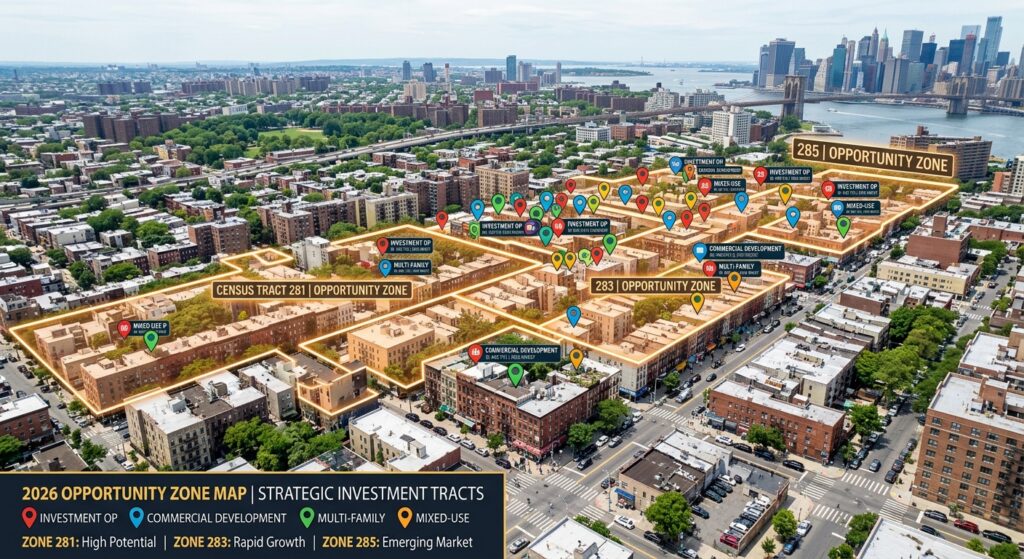
Opportunity Zone Map 2025: Complete 2026 Investor Guide
Opportunity Zone Map 2025: Complete 2026 Investor Guide
The opportunity zone map 2025 remains one of the most powerful tools a real estate investor can use to slash capital gains taxes in 2026. With the IRS releasing Rev. Proc. 2026-14 on April 6, 2026, the landscape for Qualified Opportunity Zones (QOZs) is changing fast. Knowing how to read the map, find the right census tracts, and act quickly gives you a major edge right now.
Table of Contents
- Key Takeaways
- What Is the Opportunity Zone Map and Why Does It Matter in 2026?
- How Do You Find and Use the Opportunity Zone Map in 2026?
- What Are the Tax Benefits of Investing in Opportunity Zones?
- What Is OZ 2.0 and How Does the New Redesignation Work?
- How Do You Invest in a Qualified Opportunity Zone in 2026?
- What Are the Most Common Opportunity Zone Investor Mistakes?
- Uncle Kam in Action: Real Estate Investor Saves $187,000
- Next Steps
- Related Resources
- Frequently Asked Questions
Key Takeaways
- The IRS released Rev. Proc. 2026-14 on April 6, 2026, listing new eligible census tracts for 2027 OZ designations.
- Only about 60% of the existing 8,764 Opportunity Zones qualify for OZ 2.0 redesignation under tighter criteria.
- Investing capital gains in a Qualified Opportunity Fund (QOF) can defer and potentially eliminate federal tax on those gains.
- The 2026 standard deduction for single filers is $16,100; for married filing jointly it is $32,200.
- Act fast — states must nominate tracts for 2027 OZ designation, and deadlines are approaching.
What Is the Opportunity Zone Map and Why Does It Matter in 2026?
Quick Answer: The opportunity zone map 2025 shows all federally designated low-income census tracts where investors can defer capital gains taxes by placing money into a Qualified Opportunity Fund. In 2026, major changes are under way as OZ 2.0 redesignations reshape which tracts qualify.
Opportunity Zones were created by the Tax Cuts and Jobs Act of 2017. They are specific census tracts that state governors nominated, and the U.S. Treasury certified. The goal was simple: encourage private investment in distressed communities by offering powerful tax incentives.
The opportunity zone map 2025 still reflects those original designations — more than 8,764 tracts spread across all 50 states, Washington D.C., and U.S. territories. However, 2026 is a pivotal year. The IRS published Revenue Procedure 2026-14 in April 2026. That document lists new census tracts that are eligible for nomination as 2027 Qualified Opportunity Zones. As a result, investors need to understand both the current map and what is changing.
Why Real Estate Investors Pay Attention to the OZ Map
The map is not just a geographic tool. It is the gateway to enormous tax savings. When you sell a property or investment and realize a capital gain, you normally owe tax right away. However, when you roll that gain into a Qualified Opportunity Fund within 180 days, you defer the tax. Furthermore, if you hold the investment for at least 10 years, you may owe zero federal tax on the appreciation from the QOF investment itself.
For a real estate investor who just sold an apartment building for a $500,000 gain, that means deferring — and potentially eliminating — a significant six-figure tax bill. That is why learning to read the opportunity zone map 2025 is not just useful. It is essential.
How Opportunity Zones Are Defined
A census tract qualifies as an Opportunity Zone if it meets the definition of a low-income community (LIC) under the IRS code. Specifically, a tract must have a poverty rate of at least 20%, or a median family income no more than 80% of the area median. Some adjacent non-LIC tracts also qualify under certain rules.
Each state’s governor nominates up to 25% of eligible LIC tracts (or a minimum of 25 tracts). The U.S. Treasury then certifies the nominations. This process created the existing map. Now, with OZ 2.0 under way, a new round of nominations is happening. Our tax strategy team can help you evaluate which markets are changing and how to position your portfolio accordingly.
Pro Tip: Do not assume a zone you invested in previously is automatically continuing under OZ 2.0. Verify your tract’s status using the updated 2026 IRS guidance before making new commitments.
How Do You Find and Use the Opportunity Zone Map in 2026?
Quick Answer: You can find the opportunity zone map 2025 using the CDFI Fund’s mapping tool, EJScreen, or third-party platforms. In 2026, you should also cross-reference Rev. Proc. 2026-14 to see which tracts are eligible for new OZ designations.
Finding the right opportunity zone is the first step in any OZ investment strategy. Fortunately, several reliable tools make this process straightforward.
Step 1: Use the CDFI Fund Mapping Tool
The U.S. Department of the Treasury’s Community Development Financial Institutions (CDFI) Fund maintains an official online mapping tool. You can search by address, city, or census tract number. The tool shows whether a specific location falls within a designated Opportunity Zone. This is your first stop.
Step 2: Look Up the Census Tract Number
Every property in the U.S. falls within a census tract. The U.S. Census Bureau’s TIGER tool lets you look up any address and identify its census tract GEOID number. You then compare that number to the IRS’s official list of Qualified Opportunity Zones to confirm eligibility. This is a critical step before committing any capital.
Step 3: Cross-Reference the 2026 OZ 2.0 Eligible Tracts
In 2026, a second step is essential. Rev. Proc. 2026-14 listed the census tracts eligible for nomination as 2027 OZs. Not every current OZ tract made this list. Moreover, the One Big Beautiful Bill Act imposed tighter eligibility criteria. Analysis by OZ research firms shows that only about 60% of the current 8,764 Opportunity Zones fully meet the new criteria. Therefore, some tracts that are OZs today may not be OZs in 2027.
At the same time, new tracts may be added. Consequently, investors who understand the transition can position themselves in zones that will remain active — or take advantage of new zones entering the program. Check HUD’s Opportunity Zone resource page for up-to-date mapping information.
Pro Tip: When evaluating a potential OZ investment in 2026, confirm the tract will remain designated through your intended hold period. A 10-year hold requires a zone active well into the mid-2030s.
Third-Party OZ Mapping Platforms
Several private platforms have built interactive maps on top of the IRS and Census data. These tools add layers like property data, demographic trends, economic indicators, and investment activity. While they are useful for deal sourcing, always verify tract eligibility against official government sources. The map you see on a third-party site may lag behind recent IRS updates.
What Are the Tax Benefits of Investing in Opportunity Zones?
Quick Answer: Opportunity Zone investors can defer capital gains taxes, potentially reduce the deferred gain, and exclude all appreciation from a 10-year QOF investment from federal tax. These three benefits compound into substantial savings for real estate investors in 2026.
The Opportunity Zone program delivers up to three distinct federal tax benefits. Each one builds on the prior, so holding longer produces exponentially better outcomes. Here is how each benefit works for 2026 investors.
Benefit 1: Capital Gains Deferral
When you sell an asset and realize a capital gain, you normally owe tax in the year of the sale. However, if you invest the gain into a Qualified Opportunity Fund within 180 days of the sale, you can defer paying tax on that gain. For 2026 investors, the standard long-term capital gains rate is 0%, 15%, or 20% depending on income. For high earners — those subject to the 20% rate plus the 3.8% Net Investment Income Tax (NIIT) — deferral alone is enormously valuable.
For example, if you sell a rental property and pocket a $300,000 long-term gain, you would normally owe up to $71,400 in federal tax (at the 20% rate plus 3.8% NIIT). By rolling that $300,000 into a QOF within 180 days, you postpone that entire payment. That capital remains working for you in the new investment instead.
Working with an experienced tax advisor is critical to time the QOF investment correctly and document the original gain properly. The 180-day clock starts on the date of the triggering sale event.
Benefit 2: Step-Up in Basis (Under Original OZ Rules)
Under the original OZ program created by the Tax Cuts and Jobs Act, investors who held their QOF investment for at least 5 years received a 10% step-up in the basis of the original deferred gain. A 7-year hold produced a 15% step-up. However, these basis step-up benefits were tied to December 31, 2026 recognition deadlines — which have now largely passed or are expiring. Consult a tax professional to determine if any step-up benefits still apply to your specific investment timeline.
Benefit 3: Tax-Free Appreciation (10-Year Hold)
This is the crown jewel of the OZ program. If you hold your QOF investment for at least 10 years and then sell, you may exclude ALL appreciation in the QOF from federal income tax. In other words, if your $300,000 QOF investment grows to $700,000 over a decade, the $400,000 gain is potentially tax-free at the federal level.
This benefit is what separates Opportunity Zones from nearly every other real estate tax strategy. Even a 1031 Exchange simply defers the gain — you still eventually owe tax. With a 10-year QOF hold, you may eliminate the tax on appreciation entirely. Explore more strategies at our tax strategy blog.
| OZ Tax Benefit | Holding Period Required | Tax Impact (2026) |
|---|---|---|
| Capital Gains Deferral | Invest within 180 days of gain | Postpone 0%–23.8% federal capital gains tax |
| Basis Step-Up on Deferred Gain | 5–7 years (deadlines mostly expired) | Up to 15% reduction in original gain recognized |
| Tax-Free Appreciation | 10+ years in the QOF | Zero federal tax on QOF investment growth |
What Is OZ 2.0 and How Does the New Redesignation Work?
 Free Tax Write-Off Finder
Quick Answer: OZ 2.0 is the next generation of Opportunity Zone designations. Driven by the One Big Beautiful Bill Act and implemented through Rev. Proc. 2026-12, this framework sets tighter eligibility rules and creates a new round of zone nominations for 2027. Approximately 60% of existing zones qualify under the stricter criteria.
The term “OZ 2.0” refers to the new round of Opportunity Zone designations taking shape in 2026. The One Big Beautiful Bill Act — the landmark federal legislation — expanded and renewed the OZ program with stronger accountability measures and tighter eligibility rules. This is not just a simple extension. It is a major overhaul that real estate investors must understand.
What Rev. Proc. 2026-12 and Rev. Proc. 2026-14 Mean for Investors
On April 6, 2026, the IRS and Treasury released two critical documents. Rev. Proc. 2026-12 established the new roadmap for OZ 2.0 designations — the rules, process, and timeline for states to nominate tracts. Rev. Proc. 2026-14 then published the specific list of census tracts eligible for those nominations. Together, these two revenue procedures define which communities can become 2027 Qualified Opportunity Zones.
State governors have a limited window to review the eligible tracts listed in Rev. Proc. 2026-14 and submit their nominations. The certification process mirrors the original 2018 round, but with updated data and tighter standards. For real estate investors, this window is a strategic opportunity. You can begin identifying attractive markets in newly eligible tracts before the competition does.
The 60% Eligibility Reality: What It Means for Existing OZ Investments
Analysis of the 8,764 current Opportunity Zones reveals that only about 60% fully meet the new OZ 2.0 criteria. The remaining 40% either no longer qualify as low-income communities, have seen too much economic improvement since initial designation, or fail other updated benchmarks under the One Big Beautiful Bill Act.
However, this does not mean existing investments in those zones lose their benefits. If you have already invested in a Qualified Opportunity Fund in a current OZ, your tax benefits are protected based on when you made the investment and the original certification of that zone. The new rules primarily affect future designations and new investments. Nevertheless, if you are planning a new investment in 2026, you should verify whether the target tract will remain designated under OZ 2.0. Our tax preparation and filing team can help you review the documentation and ensure compliance.
New OZ 2.0 Accountability Requirements
Beyond eligibility, the OZ 2.0 framework introduces enhanced accountability measures. Qualified Opportunity Funds under the new rules may face additional reporting obligations. The IRS wants better data on how OZ investments are actually impacting communities. Furthermore, the One Big Beautiful Bill Act also made changes to the types of businesses and properties that qualify, so due diligence is more important than ever. Review all requirements through the IRS Opportunity Zones official guidance page.
Pro Tip: If you are evaluating a market in a potentially redesignated OZ 2.0 tract, start with Rev. Proc. 2026-14’s census tract list and then map that data against local real estate fundamentals before committing capital.
How Do You Invest in a Qualified Opportunity Zone in 2026?
Quick Answer: To invest in a Qualified Opportunity Zone in 2026, you must roll eligible capital gains into a Qualified Opportunity Fund (QOF) within 180 days of the triggering sale event. The QOF must then deploy the capital into a Qualified Opportunity Zone Business or property located in a designated zone.
The investment process has several clear steps. Each step has IRS rules attached, so getting each one right protects your tax benefits. Here is the step-by-step workflow for a 2026 OZ investment:
Step 1: Trigger an Eligible Capital Gain
Not every gain qualifies for OZ deferral. The gain must be a short-term or long-term capital gain. Common sources include the sale of real estate, stocks, a business, or other capital assets. Ordinary income and depreciation recapture do not qualify for OZ deferral. However, for real estate investors, property sales are the most common source of eligible gains. Work with a qualified tax professional — our real estate investor tax team specializes in structuring these transactions correctly.
Step 2: Identify and Select a Qualified Opportunity Fund
A Qualified Opportunity Fund is any investment vehicle — typically a partnership or corporation — organized specifically to invest in QOZ property. The QOF must hold at least 90% of its assets in qualified opportunity zone property. You can invest in an existing QOF managed by a real estate sponsor, or you can self-certify your own QOF by filing IRS Form 8996 with your tax return.
Self-certifying a QOF gives you more control but also more compliance responsibility. You must meet the 90% asset test semi-annually and maintain proper records. Many investors prefer investing through established QOFs run by experienced real estate operators who already have projects in qualified zones.
Step 3: Invest Within the 180-Day Window
The 180-day clock is strict. You must invest the eligible gain — not the full sale proceeds, just the gain portion — into the QOF within 180 days of the date of the sale. Miss this window and the deferral opportunity disappears for that gain. There are limited exceptions for gains from partnerships and S corporations, where the 180-day period may start on different dates. Verify the specific start date with a tax professional before assuming.
Step 4: Report the Investment on Your Tax Return
You must report the deferral election using IRS Form 8949 and attach a completed Form 8997. Form 8997 tracks your OZ investments annually and reports the deferred gains each year until the gain is recognized. Proper annual reporting is essential to maintain the tax benefits. If you skip a year’s reporting, the IRS may challenge the entire deferral. Our tax filing team handles OZ reporting for real estate investors across the country.
| Step | Action Required | Key Deadline or Form |
|---|---|---|
| 1 | Realize eligible capital gain from asset sale | Date of sale starts the clock |
| 2 | Select or self-certify a Qualified Opportunity Fund | IRS Form 8996 |
| 3 | Invest gain into the QOF | Within 180 days of sale |
| 4 | Report deferral election on annual tax return | IRS Form 8949 and Form 8997 |
| 5 | Hold QOF investment 10+ years for maximum benefit | Election to exclude gain at sale |
What Are the Most Common Opportunity Zone Investor Mistakes?
Quick Answer: The most common OZ mistakes in 2026 include missing the 180-day reinvestment window, investing in a tract that is no longer qualified, failing to file Form 8997 annually, and not conducting proper due diligence on QOF operators.
The Opportunity Zone program is powerful, but it is also unforgiving. Small errors cost investors their entire tax benefits. Understanding these common pitfalls helps you avoid them. Our MERNA™ tax strategy process identifies these risks upfront and structures investments to prevent costly errors.
Mistake 1: Investing the Wrong Amount
You only need to invest the gain — not the full sales proceeds — into the QOF to receive the deferral. However, you must invest at least the gain amount. If you invest less than the full gain, you only defer what you invested. The rest is taxable immediately. Many investors confuse this with a 1031 exchange, where you must reinvest the full proceeds. The OZ rules are actually more flexible in this regard.
Mistake 2: Choosing a Poorly Managed QOF
Not all Qualified Opportunity Funds are equal. If a QOF fails the 90% asset test, the fund pays a penalty — but investors may also face complications with their deferred gains. Before investing, review the fund manager’s track record, the specific properties in the QOF’s portfolio, the fund’s compliance history, and the fee structure. Tax savings mean nothing if the underlying real estate investment underperforms. Always perform thorough investment due diligence independent of the tax benefits.
Mistake 3: Skipping Annual Form 8997 Reporting
Form 8997 must be filed every year you hold a QOF investment. Many investors file it correctly in Year 1 and then forget it in subsequent years. The IRS uses this form to track deferred gains year over year. Missing a filing can trigger IRS scrutiny and potentially cause the deferral to collapse. Set up a system with your tax preparer to include Form 8997 in every return until you exit the QOF. Connect with our team through our tax preparation services to ensure nothing falls through the cracks.
Mistake 4: Assuming the Zone Is Still Active Without Checking
In 2026, this mistake is especially costly. Because OZ 2.0 is redesignating which tracts qualify, some properties that were in Opportunity Zones as recently as last year may be in transition zones. Before making any new investment, use the CDFI mapping tool and cross-reference against Rev. Proc. 2026-14 to confirm the tract’s status. Do not rely on marketing materials from real estate sponsors without independent verification.
Pro Tip: When evaluating a QOF in 2026, ask the fund manager directly: “Is this tract on the Rev. Proc. 2026-14 eligible list?” A credible fund manager will have this answer ready — and in writing.

Uncle Kam in Action: Real Estate Investor Saves $187,000
Client Snapshot: Marcus T. is a real estate investor based in the Detroit metro area. He has been building a portfolio of multifamily properties for the past 12 years. He works with small residential buildings — typically 8 to 24 units — in secondary Michigan markets.
Financial Profile: Annual rental income of approximately $340,000. In early 2026, Marcus sold a 16-unit apartment building in suburban Detroit for a total gain of $620,000. Of that, roughly $490,000 was a long-term capital gain. The remainder was depreciation recapture, which does not qualify for OZ deferral.
The Challenge: Marcus was facing a potential $116,620 federal tax bill on the $490,000 long-term capital gain (at the 20% rate plus 3.8% NIIT). He wanted to reinvest the proceeds into a new market but was not sure how to protect the gains. His previous CPA had handled only basic compliance — no proactive tax planning.
The Uncle Kam Solution: Uncle Kam’s team reviewed the opportunity zone map 2025 against the newly released Rev. Proc. 2026-14 tract list for Michigan. They identified a 20-unit mixed-income property in a qualifying OZ census tract in a strong Detroit-area submarket. Within 55 days of the sale closing, Marcus invested $490,000 into a well-structured Qualified Opportunity Fund holding that property. Uncle Kam filed Form 8997 properly and set up ongoing compliance tracking.
The Results:
- Tax Deferred: $116,620 in federal capital gains tax deferred to future years
- Projected Tax-Free Appreciation: If the QOF grows to $900,000 over 10 years, the $410,000 appreciation is potentially 100% federal tax-free
- Uncle Kam Fee: $5,800
- First-Year ROI: Over 20x return on investment in deferred tax savings alone
Marcus now has $490,000 working in the market instead of a $116,620 check going to the IRS. That is the power of pairing the opportunity zone map 2025 with expert execution. See more client success stories at Uncle Kam and discover what proactive planning can do for your portfolio.
If you are a real estate investor with capital gains in your pipeline, use our Detroit CPA Self-Employment Tax Calculator to estimate your current tax exposure and see how much you could save with an OZ strategy.
Next Steps
If you are ready to take action on opportunity zone investing in 2026, here is what to do right now:
- Identify any capital gains events you have had or anticipate in the next 12 months.
- Use the CDFI Fund’s mapping tool and Rev. Proc. 2026-14 to verify target tracts in your markets.
- Schedule a tax advisory session with our real estate investor tax team to evaluate OZ strategy fit.
- Review prospective QOFs for compliance, track record, and asset quality before investing.
- Set up ongoing Form 8997 annual reporting through our tax preparation and filing service.
This information is current as of 5/18/2026. Tax laws change frequently. Verify updates with the IRS or your tax professional if reading this later.
Related Resources
- Real Estate Investor Tax Strategies — Uncle Kam
- 2026 Tax Strategy Planning for Investors
- Uncle Kam Tax Guides — Real Estate Edition
- Uncle Kam Tax Calculators for Investors
- High-Net-Worth Real Estate Tax Strategies
Frequently Asked Questions
Is the opportunity zone map 2025 still valid in 2026?
Yes, the opportunity zone map 2025 reflects the currently active OZ designations, and most are still valid in 2026. However, the OZ 2.0 process is under way. Rev. Proc. 2026-14, released in April 2026, lists the census tracts eligible for the next round of designations. Some current OZs may not continue under the new framework. Always verify your specific tract’s status through the IRS or CDFI Fund’s mapping tool before investing in 2026.
Can I still invest in a Qualified Opportunity Fund in 2026 and get tax benefits?
Absolutely. The core OZ tax benefits — capital gains deferral and the 10-year exclusion on QOF appreciation — are still available in 2026. If you have a capital gain from a sale event in 2026, you can invest that gain into a QOF within 180 days and defer the tax. Furthermore, if you hold the QOF investment for at least 10 years, you may exclude all appreciation from federal tax at the time of sale. The OZ 2.0 framework under the One Big Beautiful Bill Act also extends and potentially enhances the program going forward. Consult a qualified tax advisor to confirm current rules apply to your specific situation.
What is the difference between an Opportunity Zone and a Qualified Opportunity Fund?
These are two distinct things. An Opportunity Zone is a specific geographic area — a designated census tract — where investment activity qualifies for tax incentives. A Qualified Opportunity Fund is the investment vehicle that pools capital and deploys it into properties or businesses located within an Opportunity Zone. You invest in the QOF; the QOF then buys or develops property within the OZ. You cannot invest directly in the zone itself — you must go through a QOF to receive the tax benefits.
How many Opportunity Zones exist in the United States right now?
There are currently approximately 8,764 designated Opportunity Zones across all 50 states, Washington D.C., and U.S. territories. These were designated following the original 2018 round of nominations. Under OZ 2.0, a new round of designations is being prepared for 2027. Analysis from OZ research platforms shows that approximately 60% of the current zones meet the tighter new eligibility criteria. New tracts may also be added that were not previously designated. The final 2027 OZ list will depend on each state’s nominations following Rev. Proc. 2026-14.
Do I owe state income tax on OZ gains even if federal tax is deferred?
This depends entirely on the state where you file. The federal tax deferral and exclusion benefits apply only at the federal level. Many states — including California and North Carolina — do not conform to the federal OZ tax incentives. Consequently, you may still owe state capital gains tax on the same gain even if you defer it federally. Some states, including Michigan, Georgia, and others, do conform, providing both state and federal benefits. Always analyze state-level tax treatment alongside federal benefits before making an OZ investment decision.
What types of real estate qualify as Opportunity Zone investments?
Qualifying OZ real estate investments include most types of commercial and residential properties located within a designated zone. However, the property must meet specific requirements. In most cases, the QOF must either purchase the property directly or make substantial improvements to existing property. Substantial improvement generally means the QOF spends at least as much on improvements as the original cost of the building (excluding land). Raw land can also qualify under certain conditions if it is used in a qualified OZ business. Residential rental properties, commercial real estate, mixed-use developments, and ground-up construction projects are all common OZ investment types.
Last updated: May, 2026

