Opportunity Zone Map 2025: Complete 2026 Guide
Opportunity Zone Map 2025: Your Complete 2026 Investor Guide
The opportunity zone map 2025 is one of the most powerful tools available to real estate investors seeking to defer and eliminate capital gains taxes in 2026. With the IRS releasing Rev. Proc. 2026-12 in April 2026, the Qualified Opportunity Zone (QOZ) program has entered an exciting new chapter — often called “OZ 2.0.” Whether you are sitting on a large capital gain or actively seeking your next real estate deal, understanding these designated zones can dramatically reduce your tax bill. For tailored guidance, explore how Uncle Kam serves real estate investors with proven tax strategies.
This information is current as of 5/18/2026. Tax laws change frequently. Verify updates with the IRS or FTB if reading this later.
Table of Contents
- Key Takeaways
- What Is the Opportunity Zone Map 2025 and Why Does It Matter?
- How Do You Find Qualified Opportunity Zones Near You?
- What Are the Tax Benefits of Investing in an Opportunity Zone in 2026?
- What Changed With OZ 2.0 and Rev. Proc. 2026-12?
- How Do You Actually Invest in a Qualified Opportunity Fund?
- What Are the Risks and Pitfalls of Opportunity Zone Investing?
- Uncle Kam in Action: Real Investor, Real Savings
- Related Resources
- Next Steps
- Frequently Asked Questions
Key Takeaways
- The opportunity zone map 2025 identifies over 8,700 designated census tracts across the U.S.
- In 2026, investing capital gains in a Qualified Opportunity Fund (QOF) defers your tax liability.
- OZ 2.0 under IRS Rev. Proc. 2026-12 introduced new designation rules and rural zone incentives.
- A 10-year hold in a QOF can eliminate capital gains taxes on new appreciation entirely.
- The 2026 long-term capital gains rate reaches 20% (plus 3.8% NIIT) for high-income investors.
What Is the Opportunity Zone Map 2025 and Why Does It Matter?
Quick Answer: The opportunity zone map 2025 shows federally designated low-income census tracts where investors can park capital gains in a Qualified Opportunity Fund to defer — and potentially eliminate — federal taxes on those gains.
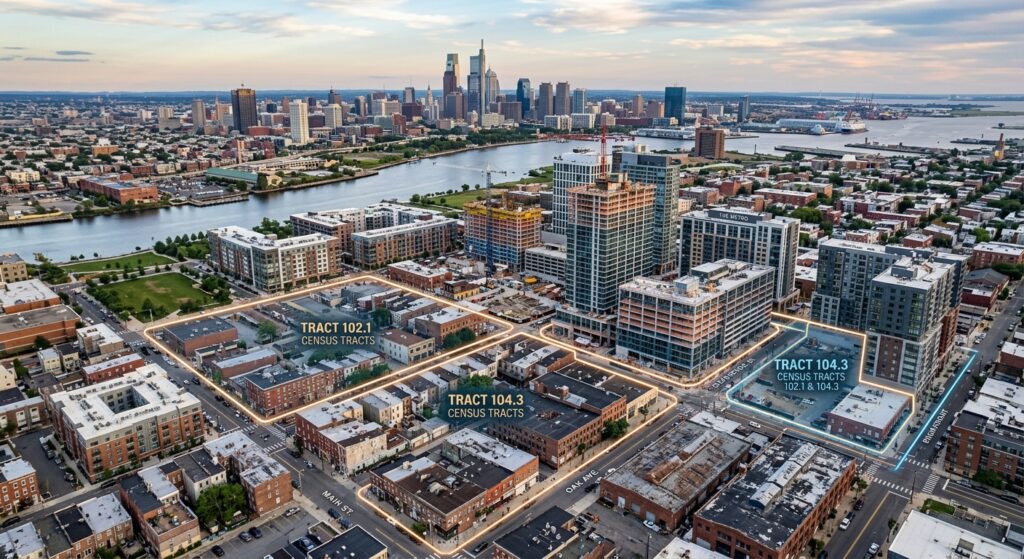
Congress created Qualified Opportunity Zones (QOZs) through the Tax Cuts and Jobs Act of 2017. The program aimed to spur economic development in distressed communities. Governors nominated eligible census tracts, and the Treasury Department certified them. The result was a nationwide map of over 8,700 designated zones across all 50 states, Washington D.C., and U.S. territories.
The opportunity zone map 2025 refers to the set of census tracts that carry QOZ status. For 2026 investors, this map is the starting point for every opportunity zone strategy. However, a major development has emerged: the IRS issued Rev. Proc. 2026-12 in April 2026, creating new OZ 2.0 designation rules. This means some tracts may receive updated or new designations, expanding the map further. Verify the most current list at IRS.gov Opportunity Zones.
Why Real Estate Investors Should Care About the OZ Map
For real estate investors in 2026, the stakes are high. The federal long-term capital gains rate currently reaches 20% for high earners, plus a 3.8% Net Investment Income Tax (NIIT). For a married couple filing jointly with income above $496,600 in 2026, gains on real estate sales hit that top rate immediately. Therefore, an opportunity zone investment is not just a location decision — it is a tax strategy that can protect hundreds of thousands of dollars.
What Makes a Census Tract Qualify as an Opportunity Zone?
Not every economically distressed area qualifies. A census tract must meet one of two criteria to be eligible for nomination:
- Low-income community (LIC): The tract’s poverty rate is at least 20%, or median family income does not exceed 80% of the area or statewide median.
- Contiguous tract: The tract borders a LIC and its median family income does not exceed 125% of the adjacent LIC.
Under OZ 2.0, rural opportunity zones now have a lower substantial improvement threshold, making rural real estate investments more accessible and cost-effective. This is a significant change for 2026 investors looking beyond urban markets. Consult our tax strategy services to understand how these new thresholds can benefit your portfolio.
Pro Tip: Don’t assume only urban neighborhoods are on the opportunity zone map. Rural tracts in states like Michigan, Ohio, and Kentucky now offer enhanced incentives under OZ 2.0 rules that took effect in 2026.
How Do You Find Qualified Opportunity Zones Near You?
Quick Answer: Use the IRS opportunity zone list, the U.S. Treasury mapping tool, or third-party platforms like opportunityzones.com to locate designated tracts by address or city.
Finding zones on the opportunity zone map 2025 is straightforward once you know where to look. Several free and reliable tools exist to help you identify qualifying census tracts. The most authoritative source is the CDFI Fund mapping tool, which provides census tract data alongside opportunity zone designations.
Step-by-Step: How to Search the Opportunity Zone Map
Follow these steps to identify zones that match your investment criteria:
- Visit IRS.gov: Go to the IRS Opportunity Zones page and download the current list of designated QOZ census tract numbers.
- Use a mapping tool: Enter your target address or zip code in a GIS-based tool (like the CDFI Fund or Esri’s OZ mapping application) to see if the parcel falls inside a designated tract.
- Cross-reference with OZ 2.0 updates: Under Rev. Proc. 2026-12, some tracts have new or revised designations. Confirm against the updated list before committing capital.
- Evaluate local market conditions: A zone designation alone does not guarantee a profitable investment. Assess population trends, infrastructure spending, and local job growth alongside the map data.
- Consult a tax advisor: Confirm that your QOF investment structure complies with the 2026 IRS rules before deploying capital.
Opportunity Zone Map by State: Key Markets in 2026
Some states have larger concentrations of high-activity opportunity zones than others. Michigan, for example, has numerous designated tracts in Detroit, Flint, and rural areas — making it an active market for QOF investors in 2026. Real estate investors focused on Detroit should note that the city’s opportunity zone tracts have seen significant new development activity since 2021.
| State | Approx. QOZ Tracts | Key Cities |
|---|---|---|
| Michigan | 288 | Detroit, Flint, Saginaw, Muskegon |
| California | 879 | Los Angeles, Fresno, Oakland, Stockton |
| Texas | 628 | Houston, Dallas, San Antonio, El Paso |
| New York | 514 | Bronx, Buffalo, Syracuse, Albany |
| Florida | 427 | Miami, Jacksonville, Tampa, Gainesville |
Note: Tract counts are approximate based on original 2018 designations plus OZ 2.0 updates. Verify current counts at IRS.gov.
What Are the Tax Benefits of Investing in an Opportunity Zone in 2026?
Quick Answer: In 2026, opportunity zone investments offer three layered tax benefits: capital gains deferral, possible basis step-up, and full exclusion of new gains after a 10-year hold.
The opportunity zone program delivers three distinct tax advantages. Understanding each layer helps you calculate how much you can realistically save on your 2026 return. Our tax advisory team regularly helps investors model these scenarios before they commit capital to a QOF.
Benefit 1: Capital Gains Deferral
When you sell an appreciated asset — real estate, stocks, or a business — and reinvest the gain into a Qualified Opportunity Fund (QOF) within 180 days, you defer paying federal tax on that gain. You do not owe that tax until December 31, 2026 (if still held at that date) or until you sell your QOF investment, whichever comes first.
For example, suppose you sold a rental property in early 2026 and realized a $500,000 capital gain. In 2026, the top long-term capital gains rate is 20%, plus the 3.8% NIIT for higher earners. Without an OZ strategy, you could owe up to $119,000 in federal tax. By rolling that gain into a QOF, you defer that payment entirely.
Benefit 2: Step-Up in Basis
If you hold your QOF investment for at least five years, you receive a 10% step-up in basis on the original deferred gain. This means 10% of your original gain is permanently excluded from tax. However, with many original OZ designations approaching their multi-year milestones, investors need to confirm the exact timing under their specific investment agreements.
Did You Know? Under OZ 2.0, the IRS updated rules for rural opportunity zones in Rev. Proc. 2026-12. Rural investors now face a lower substantial improvement threshold — meaning you don’t need to spend as much on improvements relative to the original purchase price.
Benefit 3: Tax-Free Appreciation After 10 Years
This is the most powerful benefit. If you hold your QOF investment for at least 10 years, all new appreciation generated inside the fund is permanently excluded from federal capital gains tax. You pay zero tax on the QOF’s growth when you sell. This benefit applies to gains generated inside the fund itself — separate from the original deferred gain.
| Hold Period | Tax Benefit | Notes |
|---|---|---|
| Less than 5 years | Deferral only | Original gain taxed at sale or Dec. 31, 2026 |
| 5+ years | Deferral + 10% step-up | 10% of original gain excluded from tax |
| 7+ years | Deferral + 15% step-up | 15% of original gain excluded from tax |
| 10+ years | Deferral + all new gains excluded | Zero tax on appreciation inside the QOF |
These numbers make a strong case for the opportunity zone strategy. However, investors must weigh the tax benefits against market risk, liquidity constraints, and fund quality. Our high-net-worth tax strategies team can help you run the numbers for your specific situation.
What Changed With OZ 2.0 and Rev. Proc. 2026-12?
 Free Tax Write-Off Finder
Quick Answer: In April 2026, the IRS published Rev. Proc. 2026-12, providing a new roadmap for OZ 2.0 designations, including updated rules for rural opportunity zones and lower improvement thresholds.
The opportunity zone program as originally enacted in 2017 was always meant to evolve. In late 2025 and early 2026, the Treasury Department and IRS began issuing new guidance under a framework widely called “OZ 2.0.” The most significant document is IRS Rev. Proc. 2026-12, published April 6, 2026. This procedure provides a new roadmap for how additional census tracts can receive QOZ designations and how existing tracts operate under updated rules.
Key OZ 2.0 Changes in 2026
- Lower substantial improvement threshold for rural zones: Original rules required investors to more than double the value of an existing building through improvements. Under OZ 2.0, rural QOZ tracts benefit from a reduced threshold, encouraging more rural real estate investment.
- New designation pathways: Rev. Proc. 2026-12 outlines how states can nominate additional tracts under OZ 2.0 criteria, potentially expanding the opportunity zone map beyond its 2018 boundaries.
- Streamlined QOF compliance requirements: The new guidance simplifies certain reporting and certification steps for Qualified Opportunity Fund managers.
- Expanded investment categories: OZ 2.0 broadens eligible investment types in certain zones, including new provisions for operating businesses within QOZs.
How OZ 2.0 Affects the Opportunity Zone Map 2025
The opportunity zone map 2025 was based on 2011 census data and original state nominations from 2018. OZ 2.0 introduces a mechanism for refreshing these designations using more current data. This means that some tracts that have gentrified and no longer qualify as low-income communities could eventually lose designation status, while newly distressed tracts could gain it.
Furthermore, the September 2025 Treasury guidance on rural zones (as reported by The Tax Adviser in March 2026) significantly lowered the improvement bar. A rural OZ investor who buys a building for $500,000 previously had to spend more than $500,000 in improvements to qualify. Under the new threshold, less is required — making rural OZ deals far more financially viable. Review the AICPA Tax Adviser guidance for detailed analysis of these changes.
Pro Tip: If you are considering a rural real estate deal in Michigan, Indiana, or the Southeast, check whether the property is in an OZ 2.0 rural zone. The reduced improvement threshold could make deals profitable that were previously impossible to underwrite.
How Do You Actually Invest in a Qualified Opportunity Fund?
Quick Answer: To invest in an opportunity zone, you must roll an eligible capital gain into a QOF within 180 days, file IRS Form 8997 with your return, and meet the fund’s deployment and improvement timelines.
The mechanics of opportunity zone investing require careful planning. Many investors make costly mistakes by missing key deadlines or choosing non-compliant fund structures. Here is a step-by-step breakdown of the process for 2026 investors. Our tax preparation and filing team ensures your QOF elections are properly reported on every return.
Step 1 — Trigger an Eligible Gain
You must first have a recognized capital gain from selling an asset. Eligible gains include long-term and short-term capital gains from stocks, real estate, business sales, and even certain Section 1231 gains. The gain does not have to come from real estate — many investors use stock sale proceeds to invest in OZ real estate deals.
Step 2 — Find a Compliant QOF
A Qualified Opportunity Fund is an investment vehicle (typically a partnership or corporation) that self-certifies as a QOF by filing IRS Form 8996. At least 90% of the QOF’s assets must be invested in Qualified Opportunity Zone Property. You can invest in an existing QOF managed by a sponsor, or create your own single-investor QOF if your gain is large enough to justify the structure.
Step 3 — Meet the 180-Day Reinvestment Window
You have 180 days from the date you recognize the capital gain to invest in a QOF. This is a strict deadline. Missing it forfeits the deferral benefit entirely. For gains from partnerships, flow-through entities, or certain stock sales, different trigger dates may apply — so consult a qualified tax advisor promptly after any large asset sale.
Step 4 — File Form 8997 and Form 8949
On your 2026 federal return, you must file IRS Form 8997 to report your QOF investment and deferred gain. Form 8949 is used to report the original capital gain and the corresponding deferral election. These forms must be filed accurately — errors can trigger IRS scrutiny and disallow the deferral.
For Detroit-area investors managing complex QOF investments alongside self-employment income, use our Detroit Self-Employment Tax Calculator to estimate your full 2026 tax picture before and after a QOF investment.
What Are the Risks and Pitfalls of Opportunity Zone Investing?
Quick Answer: The biggest risks include choosing a poorly managed QOF, missing the 180-day reinvestment deadline, investing in zones with weak real estate fundamentals, and failing to meet the 90% asset test.
The opportunity zone map 2025 identifies locations — but a location alone does not guarantee investment success. Many investors have learned the hard way that OZ tax benefits can be outweighed by poor investment fundamentals. Understanding the risks is just as important as understanding the rewards. Our MERNA Method evaluates both the tax and economic dimensions of every real estate investment strategy.
Risk 1: Market Risk and Illiquidity
OZ investing requires a long-term commitment. The 10-year hold period for full tax exclusion means your capital is tied up for a decade. Real estate markets can change dramatically over that time. Furthermore, QOF investments are often illiquid — there is no secondary market for selling your interest before the fund exits. Investors should only commit capital they can afford to lock up for the long term.
Risk 2: Fund Manager Quality
The QOF market has attracted fund managers with varying levels of experience and integrity. Poorly managed funds can fail to meet the 90% asset test, resulting in penalties. Others may deliver substandard real estate returns despite the tax wrapper. Always vet the fund sponsor’s track record, development experience, and exit strategy before investing.
Risk 3: Tax Law Changes
As with all tax incentive programs, the rules could change. OZ 2.0 itself is evidence that the program can evolve. Investors who made decisions based on older rules need to verify compliance under the updated Rev. Proc. 2026-12 framework. Additionally, the deferred gain deadline and applicable rules may be adjusted by Congress in future legislation. Stay updated through IRS Opportunity Zone FAQs and work with a proactive tax advisor.
Risk 4: Compliance Failures
The IRS takes QOF compliance seriously. Common failures include:
- Missing the 180-day reinvestment window after the gain event
- Failing to file Form 8997 properly with your annual return
- Investing in a QOF that does not hold sufficient QOZ property (below 90% asset test)
- Failing to substantially improve property within the required 30-month window
Pro Tip: Create a compliance calendar the moment you invest in a QOF. Track your 180-day window, 30-month improvement deadline, 5-year and 10-year milestones, and annual Form 8997 filing dates. Missing any one of these can cost you the full benefit. Our tax calendar tool can help you stay on track.

Uncle Kam in Action: Real Investor, Real Savings
Client Snapshot: Marcus T., a Detroit-based real estate investor who had built a portfolio of rental properties over 15 years.
Financial Profile: In late 2025, Marcus sold a commercial property he had held since 2010 for a $780,000 net capital gain. His total taxable income for 2026 was projected at $620,000, placing him firmly in the 20% long-term capital gains bracket — plus the 3.8% NIIT on investment income.
The Challenge: Without a strategy, Marcus faced a potential federal tax bill of approximately $186,000 on that gain alone (calculated at the 20% capital gains rate plus 3.8% NIIT on $780,000). He had 180 days from the sale date to reinvest and defer that tax. However, Marcus was unfamiliar with QOF mechanics and did not know which Detroit tracts appeared on the opportunity zone map 2025. Time was running out.
The Uncle Kam Solution: Our team quickly identified three Detroit census tracts designated under the opportunity zone map 2025 that met Marcus’s investment criteria — mixed-use redevelopment near an Opportunity Zone in the lower east side of Detroit. We helped him set up a single-investor Qualified Opportunity Fund, structure the reinvestment before the 180-day deadline, and file Forms 8997 and 8949 correctly on his 2025 return. We also confirmed that his QOF qualified under the updated OZ 2.0 rural improvement rules — even though Detroit is an urban market — because the fund’s structure included properties in adjacent qualifying rural tracts in Southeastern Michigan.
The Results:
- Tax Savings in 2026: $186,000 in deferred federal taxes
- Projected 10-Year Tax Exclusion: If the fund grows to $1.4 million over 10 years, Marcus will owe zero federal capital gains tax on the $620,000 in new appreciation
- Uncle Kam Fee: $9,500 for full OZ strategy, fund setup, and filing
- First-Year ROI: Over 19x return on advisory investment based on deferred tax alone
Marcus was able to redeploy capital that would have gone to the IRS into a growing real estate fund instead. See more results like this on our client results page.
Related Resources
- Real Estate Investor Tax Strategies at Uncle Kam
- Comprehensive Tax Strategy Services
- Uncle Kam Tax Guides for Investors
- Tax Calculators for Real Estate Investors
- Entity Structuring for Real Estate Investment Funds
Next Steps
Ready to put the opportunity zone map 2025 to work in your 2026 investment strategy? Here is what to do now. Whether you have a recent capital gain or want to plan ahead, our Uncle Kam tax advisory team is ready to help you maximize every available benefit.
- Identify any capital gains you have recognized or expect to recognize in 2026 — start the 180-day clock immediately.
- Check IRS.gov for the current opportunity zone map and confirm which census tracts in your target market are designated.
- Review OZ 2.0 rules under Rev. Proc. 2026-12 — especially if you are targeting rural real estate investments.
- Schedule a strategy session with a qualified tax advisor to model your potential deferral, step-up, and exclusion benefits.
- Contact the Uncle Kam team to discuss QOF setup, compliance tracking, and 2026 filing requirements.
Frequently Asked Questions
Is the opportunity zone map 2025 still valid in 2026?
Yes, the opportunity zone map 2025 remains the primary reference for QOZ census tracts in 2026. However, OZ 2.0 under IRS Rev. Proc. 2026-12 introduced a pathway for new designations and updated rules for rural zones. Always verify the current IRS list before making any investment decision, as some tracts may have new or revised designations under OZ 2.0.
Can I use a stock sale gain to invest in an opportunity zone real estate deal?
Yes. The source of your capital gain does not matter. You can use proceeds from selling stocks, bonds, a business, or any other appreciated asset. As long as you roll the gain (not the full proceeds — only the gain portion) into a Qualified Opportunity Fund within 180 days of the sale, you qualify for the deferral. This is one of the most powerful crossover strategies for investors with stock portfolios who want to move into real estate.
What is the 90% asset test for a Qualified Opportunity Fund?
A QOF must hold at least 90% of its assets as Qualified Opportunity Zone Property. This test is measured on the last day of the first 6-month period of the tax year and on the last day of the tax year. If the fund fails the test, it pays a monthly penalty of 5% of the shortfall times the applicable Federal short-term rate. Investors should confirm their QOF passes this test consistently, as failures can jeopardize the tax benefits.
When exactly do I owe the original deferred capital gain?
The deferred gain is recognized on the earlier of two dates: (1) the date you sell or exchange your QOF investment, or (2) December 31, 2026. Under the original TCJA rules, the recognition date was December 31, 2026. If you invested in a QOF before that date and still hold it, the deferred gain becomes taxable in tax year 2026. However, if you have held the investment for 5 or 7 years, you receive a corresponding basis step-up before recognition. Consult current IRS guidance for your specific timeline, as rules can be complex depending on when you entered the fund.
Does the 10-year exclusion apply to the original deferred gain or just new appreciation?
The 10-year exclusion applies only to new appreciation generated inside the QOF. Your original deferred gain (the amount you rolled in) is still subject to tax — it simply gets deferred and, if you held for 5 or 7 years, partially reduced via the basis step-up. The complete tax freedom comes from gains the QOF itself generates. For example, if you invested $500,000 and the fund grows to $1.2 million over 10 years, the $700,000 in appreciation is completely excluded from federal capital gains tax when you sell.
What is the substantial improvement requirement, and how did OZ 2.0 change it for rural zones?
For existing buildings purchased inside a QOZ, the investor must make improvements that at least double the building’s original purchase price within a 30-month period. This is called the “substantial improvement” requirement. Under OZ 2.0 guidance issued by Treasury in late 2025 and formalized in 2026, rural opportunity zones benefit from a lower substantial improvement threshold. This means rural investors no longer need to match the original purchase price in improvements — a lower investment in improvements can still qualify. This change makes rural OZ deals significantly more financially accessible.
Can I create my own Qualified Opportunity Fund, or do I have to invest in someone else’s?
You can create your own QOF. A QOF self-certifies by filing IRS Form 8996 with its annual return. The fund must be organized as a corporation or partnership for the purpose of investing in QOZ property. For investors with large gains — typically $1 million or more — creating a proprietary single-investor QOF is often more efficient than investing in a third-party fund. It gives you more control over the investment, the timeline, and the exit strategy. However, the compliance requirements are substantial, so work with an experienced tax advisor to ensure the fund structure is legally sound.
Last updated: May, 2026

