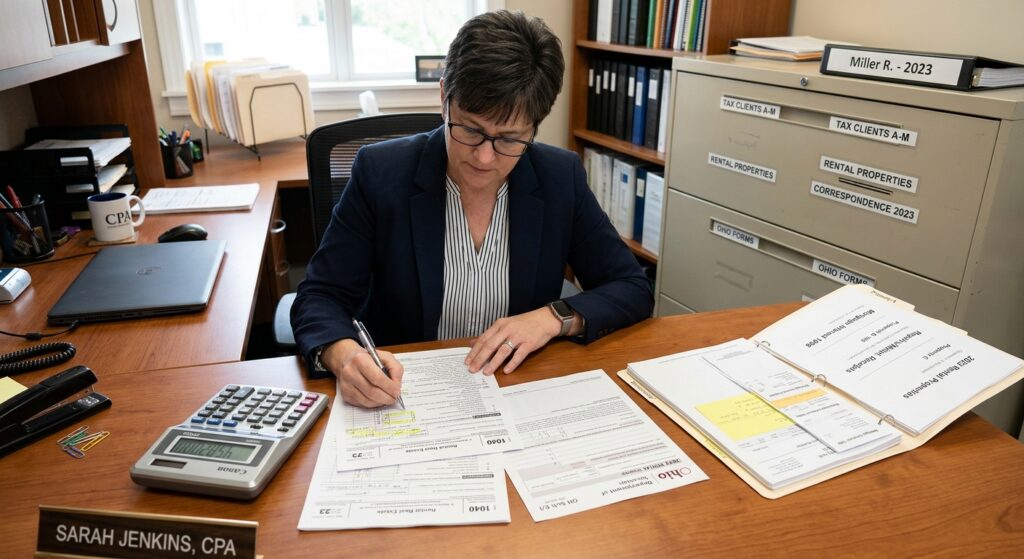
Ohio Schedule E Help: Complete 2026 Guide to Reporting Rental Income and Pass-Through Losses
Ohio Schedule E Help: Complete 2026 Guide to Reporting Rental Income and Pass-Through Losses
If you own rental properties in Ohio, receive partnership income, or invest in S corporations, you’ll need to navigate ohio schedule e help on your tax filing. For the 2026 tax year, understanding how federal Schedule E flows into your Ohio IT 1040 return is critical to maximizing deductions and managing passive activity losses. Whether you have one rental property or a diversified real estate portfolio, this guide provides everything you need to file correctly and confidently.
Table of Contents
- Key Takeaways
- What Is Schedule E and Who Needs It?
- How Schedule E Income Flows to Your Ohio Tax Return
- Rental Real Estate Income and Ohio
- Partnership and S-Corp Income for Ohio Filers
- Step-by-Step: Filing Schedule E for Ohio
- Common Ohio Schedule E Mistakes and How to Avoid Them
- Uncle Kam in Action
- Next Steps
- Frequently Asked Questions
Key Takeaways
- Schedule E reports: Rental real estate, royalties, partnerships, S corporations, trusts, and estates on your 2026 federal return.
- Ohio mapping: Schedule E income flows to Ohio IT 1040 and additional Ohio schedules for state tax calculation.
- Deductions matter: Mortgage interest, property taxes, repairs, and depreciation reduce your taxable rental income for 2026.
- Passive loss limits: Most investors cannot deduct passive losses exceeding $25,000 annually unless they qualify for real estate professional status.
- Documentation critical: Keep meticulous records of all expenses, rent collected, and mortgage statements for IRS audit protection.
What Is Schedule E and Who Needs It?
Quick Answer: Schedule E (Supplemental Income and Loss) reports rental property income, pass-through losses, and investment earnings that don’t fit on Schedule C. Any Ohio resident with rental properties, partnership stakes, or S corp ownership must file Schedule E for 2026.
IRS Schedule E is one of the most misunderstood tax forms. Many Ohio property owners underreport deductions or incorrectly classify income, costing themselves thousands in potential tax savings. The form serves a specific purpose: capturing income and losses from passive and investment sources that generate taxable income outside your primary business or employment.
For the 2026 tax year, Schedule E applies to landlords with one property or fifty properties. It also covers investors receiving K-1 forms from partnerships, S corporations, and limited liability companies taxed as partnerships. Even if your rental activity showed a loss, you must file Schedule E to report that loss to the IRS.
Who Must File Schedule E in 2026
- Landlords renting residential or commercial property
- Short-term rental (Airbnb, VRBO) owners reporting business income
- General partners and limited partners in partnerships
- S corporation shareholders receiving distributions
- Beneficiaries of trusts or estates distributing income
- Royalty recipients (mineral, oil, intellectual property, or patent)
The form consists of multiple parts depending on your income sources. Part I handles rental real estate. Part II covers royalties. Parts III and IV address partnerships, S corporations, and estates. For Ohio filers, understanding which section applies prevents costly filing errors.
Schedule E vs. Schedule C: Understanding the Difference
Many Ohio taxpayers confuse Schedule E with Schedule C (business profit and loss). The distinction matters significantly. Schedule C is for active business income where you materially participate. Schedule E is for passive rental activities. If you actively manage a short-term rental business, you might use Schedule C instead. For traditional long-term rentals where you’re a passive investor, Schedule E is correct. This classification affects self-employment taxes, deduction limits, and passive loss restrictions for your 2026 filing.
How Schedule E Income Flows to Your Ohio Tax Return
Quick Answer: Federal Schedule E income transfers to your federal Form 1040. That amount then flows to Ohio Form IT 1040 Schedule B to calculate your Ohio taxable income for 2026. Ohio also requires additional forms for partnerships and S corporations.
Ohio taxes all federal taxable income, with specific adjustments. When you complete federal Schedule E for 2026, your net rental income or loss goes to your federal Form 1040 (line 5 for rental income). From there, working with tax guidance for real estate investors becomes essential to understand Ohio-specific treatment. Ohio individual income tax requires you to report the same Schedule E information on your state return, then make adjustments for deductions that Ohio does or doesn’t allow.
Ohio Schedule E Reporting Requirements
Ohio does not have a separate “Schedule E” form. Instead, Ohio has the IT 1040-CR (Credit) forms and IT BUS (Business Income) schedules for specific situations. For most landlords, the federal Schedule E net amount transfers directly. Ohio then applies its 3.99% individual income tax rate (as of 2026) to that net income. However, Ohio also allows various deductions and credits that might differ from federal treatment, requiring careful reconciliation between your federal filing and Ohio return.
If your Ohio-source rental property is in a pass-through entity (partnership or S corp), you’ll receive a K-1 form. K-1 reporting requires additional Ohio forms depending on entity type. The IRS provides detailed Schedule E instructions at IRS.gov explaining each line. Ohio’s Department of Taxation website provides corresponding state guidance on how those amounts map to your Ohio return.
| Income Type | Federal Form/Line | Ohio Form/Line | 2026 Special Notes |
|---|---|---|---|
| Rental Real Estate | Schedule E, Part I | IT 1040 Schedule B | Ohio applies 3.99% tax rate |
| Partnership K-1 Income | Schedule E, Part III | IT 1040-CR Schedule 6 | Report total on IT 1040, Line 4 |
| S Corp Distribution | Schedule E, Part III | IT 1040-CR Schedule 5 | Report on IT 1040, Line 4 |
| Royalty Income | Schedule E, Part II | IT 1040 Schedule B | Subject to Ohio 3.99% income tax |
Rental Real Estate Income and Ohio
Quick Answer: Report all rental income on federal Schedule E Part I. Deduct legitimate property expenses including mortgage interest, property tax, repairs, and depreciation. For 2026, the passive loss limit remains $25,000 annually for most taxpayers.
Reporting rental real estate correctly on Schedule E for 2026 requires understanding federal versus Ohio treatment. Federally, you report gross rent received, then deduct expenses. Ohio accepts the same net figure but may have different rules for specific deductions like property tax assessment caps available in Ohio.
For Ohio landlords, key deductible expenses include: mortgage interest (not principal), property taxes on the rental, insurance premiums, repairs and maintenance, utilities, homeowners association fees, property management fees, advertising for tenants, and depreciation on the building structure. Depreciation is particularly valuable—the building value (not land) is deducted over 27.5 years, creating substantial tax deductions even when cash flow is positive.
Understanding Passive Loss Limitations for Ohio Landlords
This is where many Ohio investors make costly mistakes. Under federal law, passive losses are limited. If your Schedule E shows a loss exceeding $25,000 annually, you cannot deduct the excess against your W-2 wages or other active income unless you qualify for real estate professional status (REPS). The $25,000 allowance assumes modified adjusted gross income under $100,000 and phasing out at higher incomes. Ohio applies the same passive loss limitations on state returns for 2026.
If you have multiple properties and losses exceed the limit, excess losses carry forward indefinitely. You can deduct them in future years when you have passive income from other sources. Understanding this requirement prevents overstating losses on your 2026 filing and drawing IRS scrutiny.
Does Your Rental Qualify as a Trade or Business in Ohio?
Short-term rentals (Airbnb, VRBO, vacation rentals) sometimes qualify as active business income rather than passive income. If you rent properties for fewer than 15 days annually, the income is treated differently—it’s not considered business income. If you rent 15+ days and personally provide substantial services (cleaning between guests, coordinating logistics), you might claim active business status, bypassing passive loss limitations. This distinction matters significantly for your 2026 Ohio and federal filings. Document your management time carefully if claiming active status.
Partnership and S-Corp Income for Ohio Filers
 Free Tax Write-Off Finder
Quick Answer: Partnerships and S corporations issue K-1 forms showing your income allocation. Report K-1 income on Schedule E Part III for 2026, then transfer to Ohio IT 1040 using Ohio-specific schedules and forms.
If you’re a partner in a real estate partnership or S corporation shareholder, you receive a K-1 form (for partnerships) or K-1 Schedule (for S corps) showing your pro-rata share of income, losses, deductions, and credits. The partnership or S corp calculates these amounts and reports them on the K-1. Your job is reporting them accurately on your individual return.
For 2026 Ohio returns, K-1 income flows through Schedule E to your federal 1040, then to Ohio IT 1040-CR Schedule 5 or 6 depending on entity type. Ohio taxes this income the same way federally—at 3.99% individual income tax rate. However, passive loss limitations still apply. If your K-1 shows allocated losses, those losses are passive unless the partnership qualifies as real estate professional.
Handling K-1 Discrepancies
Sometimes K-1 amounts don’t match partnership/S corp filings (Form 1065 or 1120-S). The partnership might have made an error, or your basis might differ from other partners. If you catch an error on your K-1, contact the partnership immediately—they may amend their return, which requires you to amend yours too. Report discrepancies to the IRS using Form 8082 (Disclosure Statement) if you’re adjusting the K-1 figures on your return. For Ohio, coordinate any K-1 amendments with your state filing to avoid audit risk.
Step-by-Step: Filing Schedule E for Ohio
Quick Answer: Gather all rental income documentation and expense records. Complete federal Schedule E Part I. Calculate your net rental income or loss. Transfer to federal Form 1040. Then report the same amount on Ohio IT 1040 Schedule B. Verify passive loss limits apply.
Step 1: Gather Your 2026 Rental Documentation
Before you touch Schedule E, collect all rental records for 2026. This includes lease agreements showing rent amounts, bank deposits or rent payment records, mortgage statements showing 2026 interest paid, property tax bills, homeowners insurance declarations showing the 2026 premium, repair invoices, utility bills if you paid them, property management company statements, and depreciation schedules from prior years.
Create a spreadsheet organizing monthly rent received and expenses paid. Include running totals for mortgage interest, property tax, insurance, repairs, utilities, and other deductible items. This organization prevents errors and speeds up schedule completion.
Step 2: Complete Federal Schedule E Part I
Schedule E Part I requires detailed property information and income/expense entries. You’ll list each rental property separately on its own Schedule E Part I section. For each property, enter the address, property type (house, condo, apartment building), dates rented, and your ownership percentage if applicable. Then enter total rent received for 2026, followed by all allowed deductions. The difference is your net rental income or loss.
Key deduction lines include: interest paid (usually on mortgage), property taxes, insurance, repairs and maintenance, utilities, depreciation, and other expenses. Use our self-employment tax calculator to model different deduction scenarios and see 2026 tax impact before finalizing your return.
Step 3: Transfer Income to Federal Form 1040
Your total net rental income or loss from all Schedule E Part I sections goes to Federal Form 1040, Line 5 (Rental real estate, royalties, partnerships, S corporations, trusts, etc.). If you show a net loss, only include the loss if you’re under the passive loss phase-out limits ($25,000 for single filers with income under $100,000). Otherwise, carry the excess forward on Schedule E for future years.
Step 4: Report Schedule E Income on Ohio IT 1040
Ohio individual income tax applies to all federal taxable income. Take the same Schedule E total you reported federally and report it on your Ohio IT 1040 Schedule B (Itemized Income Sources). Ohio will apply its 3.99% individual income tax rate to this amount. Ohio also allows certain deductions federal returns don’t permit and vice versa, so reconciling the two returns ensures accuracy for your 2026 filing. Many Ohio landlords hire professionals for this reconciliation work because errors create audit exposure.
Common Ohio Schedule E Mistakes and How to Avoid Them
Pro Tip: IRS data shows 30% of Schedule E filers underreport expenses or misclassify income. Using professional tax help for your 2026 filing reduces audit risk and identifies overlooked deductions worth thousands.
Mistake 1: Deducting Principal Payments Many property owners deduct mortgage principal as an expense. Principal is never deductible—only interest qualifies. Ensure your mortgage statement clearly separates interest from principal. Deducting principal is one of the easiest IRS audit triggers.
Mistake 2: Forgetting Depreciation Recapture Depreciation deductions reduce your cost basis in the property. When you sell, depreciation taken is recaptured at 25% tax rate, not the lower long-term capital gains rate. Many investors ignore this impact, discovering too late that their depreciation strategy triggered unexpected taxes. Plan for this when modeling your 2026 deductions.
Mistake 3: Misunderstanding Passive Loss Limits Many investors claim Schedule E losses exceeding passive loss limits. The IRS disallows these, creating audit correspondence. Know your passive loss limit before filing. If your losses exceed the limit, work with a tax professional to structure properly or explore real estate professional status if applicable.
Mistake 4: Reporting Gross Rent Instead of Net Some filers list total rent collected on Line 1, then skip expense lines entirely. This is incorrect. You must itemize expenses to calculate net income. Itemizing also provides documentation if audited.
Mistake 5: Missing Ohio-Specific Adjustments Ohio has unique deductions and credits that federal forms don’t capture. Missing these costs thousands. Review the Ohio Department of Taxation website after filing federally to identify state adjustments applicable to your situation.
| Common Error | Why It Matters | 2026 Prevention |
|---|---|---|
| Deducting Principal | IRS audit trigger; overstates deductions | Separate interest/principal on mortgage statements |
| Exceeding Passive Loss Limits | IRS disallows excess losses automatically | Calculate your passive loss limit before filing |
| Missing Depreciation | Wastes tax deductions; complicates future sales | Have depreciation schedule prepared; plan for recapture |
| Incorrect K-1 Reporting | Mismatch with partnership/entity filing creates audit | Verify K-1 accuracy immediately; follow up on errors |

Uncle Kam in Action: Sarah’s Multi-Property Success
Client Profile: Sarah, a 52-year-old Ohio physician with $180,000 annual income, owns three rental properties in Columbus. She’d been filing her own returns and claiming substantial depreciation but wasn’t aware of passive loss limitations or Ohio-specific Schedule E reporting rules.
The Challenge: Sarah calculated a $35,000 combined loss across her three properties for 2026, including $12,000 in depreciation deductions. She attempted to deduct the full amount against her W-2 physician income. On her own, she would have overstated losses and drawn an audit.
The Uncle Kam Solution: Our team analyzed Sarah’s rental situation and determined that while she did qualify for the $25,000 passive loss allowance due to her income level, she could deduct only that amount against her active income. The additional $10,000 loss carried forward to future years. We also identified that she wasn’t tracking depreciation recapture liability—future property sales would trigger a 25% tax on accumulated depreciation. We modeled a refinancing strategy that could accelerate deductions in the current year. Finally, we prepared separate Ohio IT 1040 schedules showing the same income was taxable in Ohio at 3.99% unless covered by state exemptions.
The Results: By correctly applying passive loss limitations, calculating depreciation properly, and using our client result strategies, Sarah properly filed her 2026 federal and Ohio returns. She received a $15,000 deduction she’d have missed alone (the refinancing accelerated one-year deductions). The correct treatment also positioned her properties optimally for future sales, avoiding surprise tax bills. Her annual tax burden dropped by $4,200 through proper Schedule E preparation and strategic planning.
Investment: Sarah paid Uncle Kam $1,500 for comprehensive Schedule E preparation, coordination with her accountant, and tax planning. ROI: 280% first year ($4,200 in tax savings ÷ $1,500 fee) plus ongoing planning benefits for future years.
Next Steps
1. Gather All 2026 Rental Documentation Collect lease agreements, rent receipts, mortgage statements, property tax bills, insurance declarations, and expense records. Organize by property and month for easy Schedule E completion.
2. Calculate Your Passive Loss Limit Determine your 2026 modified adjusted gross income (MAGI) and check if you qualify for the $25,000 passive loss allowance. If income exceeds $150,000, your limit phases out. Know this number before filing.
3. Consult with a Tax Professional Schedule E complexity varies by situation. Professional tax preparation near you in Ohio ensures you navigate passive loss limits, depreciation recapture, K-1 reporting, and Ohio-specific adjustments correctly. The cost typically pays for itself through optimization.
4. Review Depreciation Strategies If you haven’t calculated depreciation, work with your preparer to establish cost segregation or standard depreciation schedules. This creates substantial deductions for properties owned since 2026 or earlier.
5. File Timely and Accurately File by April 15, 2026 deadline (or October 15 with extension) using professional preparation if your situation is complex. Accurate filing protects you from audit and optimizes your 2026 tax result.
Frequently Asked Questions
Do I need Schedule E if I only have one rental property?
Yes. Even one rental property requires Schedule E reporting for 2026. The number of properties doesn’t matter—if you’re reporting rental income or loss, Schedule E is required federally and on your Ohio return.
Can I deduct repair expenses on Schedule E?
Yes, maintenance and repairs are fully deductible on Schedule E. Paint, roof replacement, plumbing repairs, and carpet cleaning qualify. However, improvements that add value or extend property life (capital improvements) must be depreciated over several years, not deducted immediately. Distinguish between repairs and improvements carefully.
How does Ohio tax Schedule E rental income differently than federal?
Ohio taxes Schedule E income at 3.99% individual income tax rate (as of 2026) on the same net amount you report federally. However, Ohio allows different deductions in some cases, particularly property tax deductions and credits. Always reconcile federal Schedule E figures with Ohio IT 1040 to identify adjustments.
What is the passive loss limit for 2026?
For 2026, you can deduct up to $25,000 in passive rental losses if your modified adjusted gross income is $100,000 or less. For income above $100,000, the deduction phases out by $1 for every $2 over the limit. Above $150,000 income, the limit is zero unless you qualify for real estate professional status.
Do I need to report K-1 income on Schedule E?
Yes. K-1 income from partnerships and S corporations reports on Schedule E Part III. The form lines guide you through reporting the income and applicable credits or deductions. Ensure your K-1 from the entity matches exactly—discrepancies trigger IRS examination.
What is real estate professional status (REPS) and do I qualify?
REPS allows unlimited passive loss deductions if you spend more than half your working hours on real estate activities and more than 750 hours annually on real estate. If you qualify, Schedule E losses bypass the $25,000 limit. Qualification requires detailed documentation. Consult a professional to determine eligibility for 2026.
How long should I keep Schedule E records?
Keep all Schedule E supporting documents for at least seven years from the filing date. The IRS typically has three years to audit, but under certain circumstances, they have six years. With real estate involved, keep records longer due to depreciation recapture obligations continuing until property sale.
What happens if I report Schedule E losses but don’t qualify for the full deduction?
The IRS will disallow losses exceeding your limit. You’ll receive audit correspondence requesting explanation. If disallowed, the excess loss carries forward indefinitely until you have passive income from other sources. Avoid this by calculating your limit before filing.
Can I use losses from one property to offset income from another?
Yes. All your Schedule E properties aggregate for passive loss limit calculations. If Property A shows $40,000 income and Property B shows $15,000 loss, you net to $25,000 income. This aggregation occurs automatically on Schedule E.
What is depreciation recapture and when does it matter?
Depreciation taken on Schedule E reduces your cost basis in the property. When you sell, the depreciation taken is recaptured and taxed at 25% (not the favorable long-term capital gains rate). This becomes relevant when you’re ready to sell. Plan for this tax impact when modeling depreciation benefits.
Should I file Schedule E myself or use a professional?
If you have straightforward single-property rentals with minimal complexity, DIY filing is possible using tax software. However, if you have multiple properties, K-1 income, passive loss concerns, or Ohio-specific adjustments, professional preparation is worth the investment. Errors cost far more than professional fees.
This information is current as of 5/17/2026. Tax laws change frequently. Verify updates with the IRS or Ohio Department of Taxation if reading this later.
Related Resources
- Real Estate Investor Tax Strategies Guide
- Tax Preparation Services in Ohio
- Comprehensive 2026 Tax Planning Strategy
- Entity Structure Optimization for Real Estate
- View Real Client Success Stories
Last updated: May, 2026

