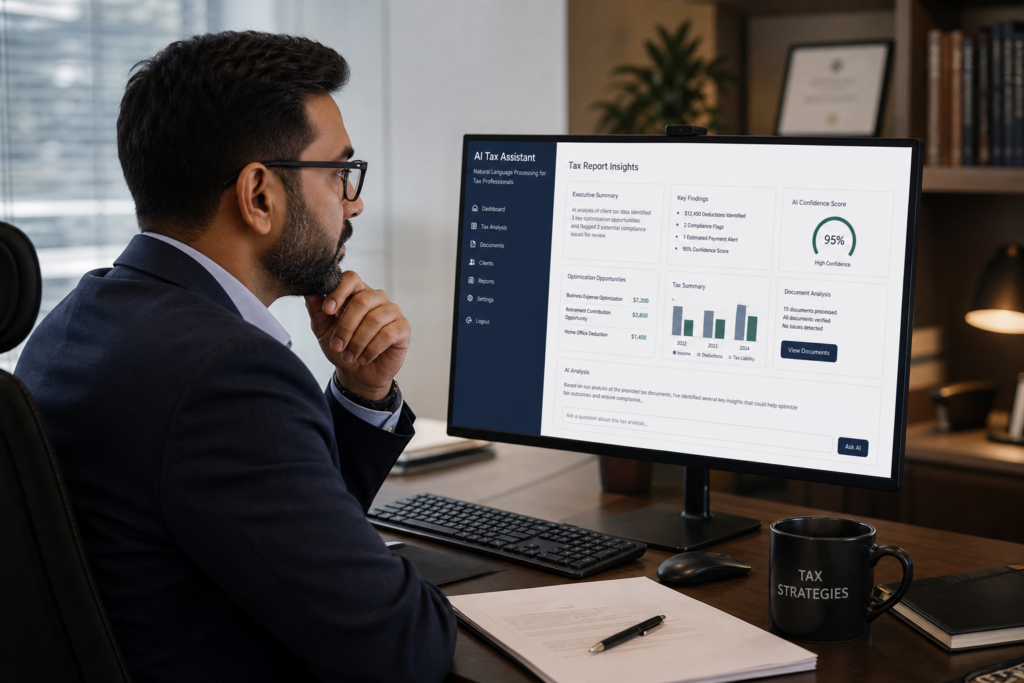
Natural Language Processing Accounting: The 2026 Guide for the AI-Anxious Tax Pro
Natural language processing accounting sounds intimidating, but it should not scare you. In 2026, natural language processing accounting simply means software that reads plain English and helps you work faster. If you feel anxious about AI, you are not alone. Yet the tax pros who learn these tools now will win the next decade. This guide explains what the technology does, what the IRS expects, and how you can use it to grow a profitable tax advisory practice.
Table of Contents
- Key Takeaways
- What Is Natural Language Processing Accounting?
- Will NLP Replace Tax Professionals in 2026?
- What Does the IRS Require for AI Use?
- How Can Tax Pros Use NLP to Scale Advisory Services?
- What Are the Risks of NLP in Accounting?
- How Do You Start Using NLP Safely?
- Uncle Kam in Action
- Next Steps
- Related Resources
- Frequently Asked Questions
 For Tax Professionals
Build your next chapter in tax advisory.
Explore how Uncle Kam Pro could support the next stage of your practice.
Key Takeaways
- NLP reads plain English and speeds up research, drafting, and data entry.
- AI will not replace you; it exposes which firms are built to scale.
- IRS Alert 2026-19 confirms Circular 230 applies fully to AI-assisted work.
- A qualified human must always be the named preparer of any tax position.
- Use NLP to move from low-margin prep to high-value tax planning.
What Is Natural Language Processing Accounting?
Quick Answer: Natural language processing accounting uses AI to read and understand human language. It turns emails, receipts, and questions into structured data or clear answers.
Natural language processing, or NLP, is a branch of artificial intelligence. It lets computers read text the way people do. In accounting, NLP scans documents, pulls out numbers, and answers plain-English questions. For example, you can ask, “What deductions apply to a real estate agent?” and get a fast summary. Therefore, NLP saves hours on manual work.
The technology matters more than ever in 2026. According to IRS guidance on Circular 230, virtually all professional tax firms already use some form of AI. Many pros use it without realizing it. As a result, understanding NLP is now a core skill, not a luxury.
Common NLP Tasks in Tax Work
NLP tools handle many repetitive tasks. Consequently, you free up time for higher-value work. Here are common uses in a modern firm:
- Reading receipts and invoices to auto-fill expense fields
- Drafting client emails and engagement letters
- Summarizing IRS notices in plain language
- Searching tax code and regulations by question
- Categorizing bank transactions for bookkeeping
Why This Matters for Anxious Tax Pros
Many pros fear that machines will take their jobs. However, the data tells a different story. Stanford economist Nick Bloom noted in 2026 that AI adoption is everywhere, yet productivity gains stay hard to see. The value shows up in complex work where people apply judgment on top of AI. In other words, your expertise is the differentiator. NLP handles the grunt work, but you still drive strategy for your clients and your business owner clients.
Pro Tip: Start with one NLP task, like drafting emails. Master it before you add more tools.
Will NLP Replace Tax Professionals in 2026?
Quick Answer: No. NLP will not replace tax pros. Instead, it exposes which firms are organized enough to scale and which are not.
The fear of replacement misses the point. AI shines a light on structure. Firms with clear processes gain the most from NLP. Meanwhile, firms with messy workflows see little benefit. Therefore, the real question is not “Will AI replace me?” It is “Is my firm built to scale?” Uncle Kam was built to answer exactly that question. Learn how the Uncle Kam marketplace helps tax pros transition to advisory.
Adoption Is High, But Value Is Concentrated
In 2026, AI spending is exploding. Gartner projects that global spending on AI models and platforms will reach $64 billion, up 63.4% from $39 billion in 2025. Yet most firms capture little measurable value. As a result, the winners are firms that redesign their operations, not just buy software. Adoption alone does not equal advantage.
The Human Edge Still Wins
NLP cannot replace professional judgment. It cannot defend a position under audit. Furthermore, it cannot sign a return or carry Circular 230 duties. You do all of that. So your value grows as routine tasks shrink. Smart pros use this shift to sell more proactive tax strategy and fewer one-off returns.
Did You Know? Nearly 90% of audit partners in a 2026 CAQ survey called their clients’ AI governance “developing” or “early stage.”
What Does the IRS Require for AI Use?
Quick Answer: The IRS confirmed in 2026 that Circular 230 applies fully to AI-assisted work. A qualified human must remain the named preparer.
On June 24, 2026, the IRS Office of Professional Responsibility issued Alert 2026-19. It is called “Introductory Guidelines for Responsible AI Use in Federal Tax Practice.” This alert is not a new law. Instead, it confirms that your existing ethics rules apply to AI. You can review the official framework on the IRS Tax Professionals page.
You Are Always Accountable
AI tools cannot be the preparer of a tax position. They cannot be disciplined under Circular 230. Moreover, they cannot defend a study under exam. Only a licensed human can. So your name must stand behind every work product. This rule protects you and your clients.
Penalties Still Apply to Weak Positions
The stakes remain high. Under Internal Revenue Code Section 6662, a 20% accuracy penalty applies to substantial understatements. That penalty rises to 40% for certain gross valuation errors. AI-generated work does not lower these risks. Therefore, you must review every output before you file. Blind trust in a chatbot is a fast path to trouble.
Pro Tip: Write a simple AI policy for your firm now. Alert 2026-19 signals that firms should formalize their practices.
How Can Tax Pros Use NLP to Scale Advisory Services?
Quick Answer: NLP handles routine prep tasks so you can sell high-margin planning. Advisory work pays far more than filing returns.
Tax prep is a commodity. Tax planning is not. NLP lets you shift your time from data entry to strategy. As a result, you can charge more and serve fewer, better clients. This is how you build a scalable firm. Ready to move faster? Book a strategy session to map your transition.
From Prep to Planning
Use NLP to speed up intake and document review. Then spend the saved hours on planning. For example, run scenarios for an S corp election or a cost segregation study. Strategies should never be run in isolation. Modern entity-aware tax planning software uses the MERNA framework to review the whole portfolio at once, across 1040s, 1120-S returns, and K-1s. This keeps your advice accurate and defensible.
Prove Value Before the Engagement
The biggest friction for many pros is proving value early. NLP-powered assessments solve this. You can run a client-ready tax assessment on a prospect in minutes. Then you show the savings before they sign. Consequently, closing advisory clients gets easier. Wilmington and Bridgeport firms often model entity savings first. Connecticut business owners weighing an S corp election can use our LLC vs S-Corp Tax Calculator for Bridgeport to estimate 2026 savings.
Sample ROI Calculation
Imagine you save five hours per week using NLP tools. That equals about 250 hours per year. If you bill advisory at $300 per hour, that time is worth $75,000. Even a modest software cost delivers a strong return. In short, the math favors adoption.
Did You Know? For 2026, the Section 179 expensing limit rose to $2.5 million, with a $4 million investment limit.
What Are the Risks of NLP in Accounting?

Quick Answer: The main risks are hallucinations, data security, and blind reliance. Human review controls all three.
NLP tools are powerful, but they are not perfect. They can invent facts, a problem called hallucination. They can also mishandle sensitive client data. Therefore, you need clear guardrails. The good news is that these risks are manageable with basic controls.
The Hallucination Problem
An NLP tool may cite a tax rule that does not exist. It may also apply an outdated figure. For instance, it might quote a 2025 mileage rate. Remember, the IRS raised the business rate to 76 cents per mile as of July 1, 2026. Always verify numbers against official IRS updates. Never file a position based on unchecked AI output.
Data Security and Ethics
Client data must stay protected. Do not paste Social Security numbers into public chatbots. The IESBA released a 2026 publication on ethics for accountants using new technology. It stresses confidentiality and professional care. Furthermore, you should use tools with strong security controls. Your clients trust you with their data, so guard it carefully.
2026 NLP Risk and Control Table
| Risk | Impact | Control |
|---|---|---|
| Hallucination | Wrong tax position, penalties | Verify every output on IRS.gov |
| Data leakage | Breach of confidentiality | Use secure, private tools |
| Blind reliance | Circular 230 violation | Keep a human as named preparer |
Pro Tip: Treat AI like a smart intern. Check its work before it reaches a client.
How Do You Start Using NLP Safely?
Quick Answer: Start small, write an AI policy, and pick secure tools. Then measure results before you expand.
You do not need to overhaul your firm overnight. A step-by-step plan works best. Moreover, a slow rollout keeps you compliant. Here is a simple path to follow in 2026.
A Five-Step Rollout Plan
- Pick one task, such as drafting emails or summaries.
- Write a short AI policy that names a human reviewer.
- Choose secure tools that protect client data.
- Train your team on prompts and review steps.
- Track time saved and reinvest it into advisory.
Match Tools to Your Goals
Not every tool fits every firm. Some vendors focus on assessments. Others focus on planning or workflow. Uncle Kam combines software, training, and a client marketplace into one advisory operating system. This lets you sell and deliver planning in one place. Firms serving self-employed and 1099 clients often see the fastest wins. Ready to build a firm that scales? Learn how the Uncle Kam marketplace helps tax pros transition to advisory and get the AI software, MERNA certification, and warm leads you need. Before you scale, review your firm’s structure and your entity structuring services for clients.
NLP Tool Comparison by Firm Goal
| Firm Goal | Best NLP Use | 2026 Priority |
|---|---|---|
| Cut prep time | Document reading, data entry | High |
| Win advisory clients | Client-ready assessments | Very high |
| Improve accuracy | Research and code search | Medium |
Before you jump to the next steps, remember one thing. The tool matters less than your process. A clear process turns NLP into real growth. If you want help building that process, our team can guide you toward a scalable advisory model. Learn more on our tax advisory services page.
Uncle Kam in Action: How an Anxious Solo CPA Doubled Advisory Revenue
Client Snapshot: Maria is a solo CPA in Connecticut. She ran a busy tax prep shop and felt nervous about AI. She worried it would make her skills obsolete.
Financial Profile: Her firm earned about $220,000 in annual revenue. Most of that came from low-margin prep work. She had almost no recurring advisory income.
The Challenge: Maria worked 60-hour weeks during tax season. She had no time to sell planning. Prospects often walked away because she could not show value fast enough. As a result, her income stayed flat for three years.
The Uncle Kam Solution: Maria adopted an NLP-driven workflow. First, she used AI to speed up document review and email drafting. Next, she ran client-ready assessments on every prospect before the engagement. She followed IRS Alert 2026-19 and kept herself as the named preparer on all work. Then she used the MERNA framework to model S corp elections and retirement strategies across entities. Her review process caught errors before any filing.
The Results: Maria saved roughly eight hours per week. She reinvested that time into advisory calls. Within one year, she closed 22 new planning clients. Her advisory revenue grew by $96,000. She paid $12,000 for the Uncle Kam system and coaching.
- Tax Savings Delivered to Clients: Over $310,000 collectively
- New Advisory Revenue: $96,000 in year one
- Investment: $12,000
- First-Year ROI: 8x return on her investment
Maria no longer fears AI. Instead, she uses it to grow. See more wins like hers on our client results page.
Next Steps
You now understand how natural language processing accounting works in 2026. The next move is action. Here are clear steps to take this week:
- Write a one-page AI policy for your firm today.
- Pick one task to automate with NLP this month.
- Run a test assessment on one prospect.
- Explore proactive tax strategy services to grow revenue.
- Book a Free Strategy Session to build your roadmap with a growth strategist.
The future of tax belongs to firms built to scale. Do not let AI expose gaps in your operation. Instead, use it to leap ahead. Apply to join the network and get the complete system to launch or scale your advisory firm.
Related Resources
- AI Tax Planning Software
- The MERNA Method Explained
- Strategies for High-Net-Worth Clients
- Uncle Kam Tax Strategy Blog
Frequently Asked Questions
Is natural language processing accounting the same as automation?
No. Automation follows fixed rules. NLP reads and understands human language. Therefore, NLP can handle unstructured text like emails and receipts. It does more than simple rule-based tasks.
Does the IRS allow tax pros to use AI in 2026?
Yes. IRS Alert 2026-19 confirms that AI use is allowed. However, Circular 230 still applies fully. A qualified human must remain the named preparer. You are always accountable for the work.
Will NLP make tax preparers obsolete?
No. NLP handles routine work, but it cannot replace judgment. It cannot defend positions under audit. As a result, your advisory skills become more valuable, not less.
How much can NLP save my firm?
Savings vary by firm. Many pros save five to eight hours per week. At advisory rates, that time can be worth tens of thousands per year. Track your results to measure the real return.
What is the biggest risk with NLP tools?
The biggest risk is blind trust. NLP tools can invent facts or use old figures. So you must verify every output on IRS.gov. Human review keeps you compliant and safe.
This information is current as of 7/20/2026. Tax laws change frequently. Verify updates with the IRS if reading this later.
Last updated: July, 2026

