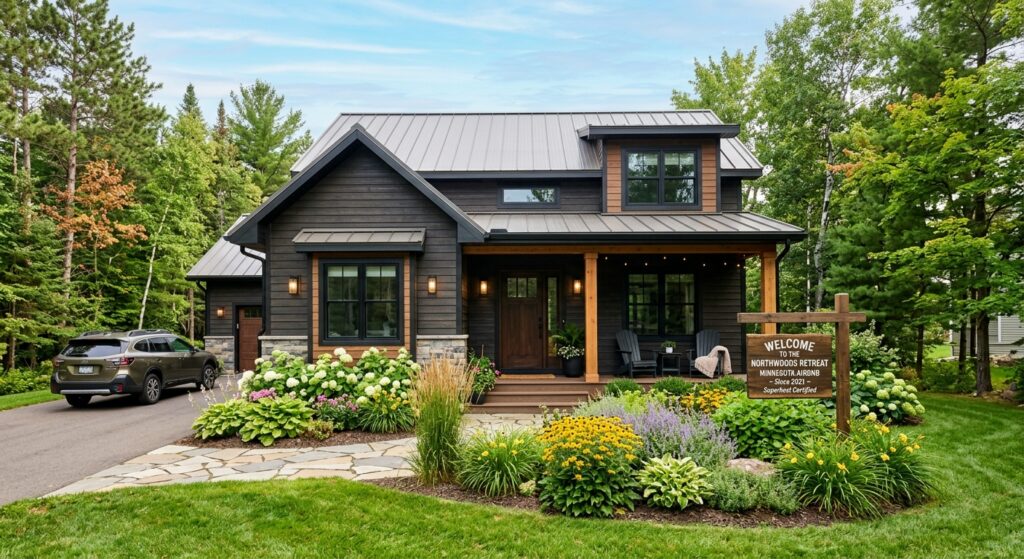
Minnesota Airbnb and Short-Term Rental Taxes for 2026: A Comprehensive Host Guide
Minnesota Airbnb and Short-Term Rental Taxes for 2026: A Comprehensive Host Guide
Minnesota Airbnb hosts and short-term rental operators must navigate a complex tax landscape in 2026, combining federal self-employment obligations with state income tax requirements. Whether you’re a first-time Airbnb host or managing a multi-property portfolio, understanding Minnesota Airbnb taxes is essential to maximizing your income and maintaining IRS compliance. With self-employment tax rates at 15.3% and evolving state regulations, strategic tax planning can save you thousands of dollars annually while protecting your rental business from costly audits.
Table of Contents
- Key Takeaways
- How Federal Self-Employment Taxes Apply to Your Airbnb Income
- What is Schedule C and Why Do Airbnb Hosts Need It?
- How is Self-Employment Tax Calculated on Airbnb Income?
- What Depreciation Deductions Can Airbnb Hosts Claim?
- Can You Qualify for Real Estate Professional Status as an Airbnb Host?
- What Are Minnesota-Specific Airbnb Tax Requirements?
- Frequently Asked Questions
Key Takeaways
- Minnesota Airbnb income requires Schedule C reporting and self-employment tax at 15.3% for 2026.
- Property depreciation deductions (27.5-year schedule) can significantly reduce taxable income.
- Real estate professional status allows rental losses to offset active W-2 or 1099 income.
- Minnesota’s proposed HF 4616 wealth tax targets high-net-worth property owners with $10M+ in assets.
- Meticulous record-keeping of income, expenses, and improvements protects against IRS audit risk.
How Federal Self-Employment Taxes Apply to Your Airbnb Income
Quick Answer: All Airbnb rental income in Minnesota is subject to federal self-employment tax at 15.3%, which covers Social Security and Medicare obligations.
When you operate an Airbnb or short-term rental in Minnesota, the IRS treats your rental income as self-employment income. Unlike long-term rental properties (which may qualify for passive income treatment), short-term rentals are considered active business income. This distinction matters significantly for tax purposes in 2026. The self-employment tax rate consists of two components: 12.4% for Social Security taxes and 2.9% for Medicare taxes, totaling 15.3% of your net earnings.
The IRS begins charging self-employment tax once your net rental income exceeds $400 in any tax year. Net income is your gross rental revenue minus all allowable business expenses, including mortgage interest, property taxes, utilities, cleaning costs, maintenance, insurance, and platform fees paid to Airbnb. This means you don’t pay self-employment tax on your gross revenue but rather on your profit after deductions—a critical distinction that many new Minnesota Airbnb hosts overlook.
Understanding the Two Components of Self-Employment Tax
The Social Security portion (12.4%) applies only to net earnings up to $168,600 for the 2026 tax year. Once you exceed this threshold, you pay no additional Social Security tax. However, the Medicare portion (2.9%) applies to all net self-employment income with no income limit. Additionally, if your total income exceeds $200,000 (single) or $250,000 (married filing jointly), you’ll pay an additional 0.9% Medicare surtax. For high-income Minnesota Airbnb hosts operating multi-property portfolios, this creates substantial tax liability that requires strategic planning.
Pro Tip: You can deduct half of your self-employment tax as an above-the-line deduction on your 2026 Form 1040, directly reducing your taxable income even if you don’t itemize deductions.
Why Minnesota Airbnb Income Requires Self-Employment Tax
The IRS classifies short-term rental activity as active business income because you provide services—cleaning, hosting, guest communication—that transform the rental into a commercial operation. This differs from passive real estate investment where you collect rent with minimal involvement. Minnesota short-term rental operators must recognize this distinction and file accordingly. Failure to report self-employment taxes can trigger IRS audits, penalties, and interest charges that compound over multiple years.
What is Schedule C and Why Do Airbnb Hosts Need It?
Quick Answer: Schedule C (Profit or Loss From Business) reports your Airbnb income and deductions to the IRS and is filed with your 2026 Form 1040 tax return.
Schedule C is an IRS form where self-employed individuals and business owners report income and expenses. For Minnesota Airbnb hosts, Schedule C captures your complete rental business activity. You report gross rental income (all money received from guests), subtract all allowable business expenses, and arrive at your net profit or loss. The net profit is then used to calculate your self-employment tax and becomes part of your overall taxable income on your 1040 return. For 2026, filing an accurate Schedule C is non-negotiable for tax compliance.
Key Income and Expense Categories on Schedule C
- Gross rental income from all sources (Airbnb, VRBO, direct bookings)
- Mortgage interest and property taxes (business-use portion)
- Utilities, cleaning, and maintenance supplies
- Airbnb and platform fees (commission payments)
- Depreciation and Section 179 deductions
- Insurance, licensing, and professional services (accounting)
- Advertising and marketing costs
- Home office deduction (if applicable)
Common Schedule C Mistakes for Minnesota Hosts
Many Minnesota Airbnb hosts overlook deductible expenses, underpay self-employment taxes, or fail to distinguish between personal and business use. For example, if you use one bedroom in your primary residence for Airbnb, you cannot deduct 100% of your mortgage interest—only the business-use percentage. Some hosts also forget to deduct platform fees, credit card processing charges, or photography costs for listing improvements. Another common error is failing to report cash payments from direct bookings. The IRS expects 100% reporting of all income sources, and Airbnb’s automated 1099-K reporting means the IRS already knows your platform income.
How is Self-Employment Tax Calculated on Airbnb Income?
Quick Answer: Self-employment tax is calculated as 15.3% of 92.35% of your net Schedule C profit, with special rules for high earners and quarterly estimated payments.
Calculating self-employment tax involves several steps. Start with your Schedule C net profit from your Airbnb business. Multiply that profit by 92.35% (this accounts for the deductible portion of SE tax). Then multiply by 15.3% to get your self-employment tax. For example, if you earned $50,000 net profit from your Minnesota Airbnb in 2026, your calculation would be: $50,000 × 92.35% = $46,175 × 15.3% = $7,066 in self-employment tax. This is substantial additional tax beyond your regular income tax liability.
Understanding this calculation matters because it affects your quarterly estimated tax payments throughout 2026. If your 2025 Airbnb income generated significant self-employment tax, you likely owe quarterly payments to avoid penalties. Minnesota requires payments on April 15, June 15, September 15, and January 15. Underpayment penalties compound, making it critical to estimate accurately. Our Minnesota self-employment tax calculator can help you estimate your specific liability based on projected 2026 income.
| Net Schedule C Profit | Self-Employment Tax (2026) |
|---|---|
| $25,000 | $3,533 |
| $50,000 | $7,066 |
| $75,000 | $10,599 |
| $100,000 | $14,132 |
Pro Tip: If you operate multiple short-term rentals in Minnesota, you can file a single Schedule C combining all rental income and expenses, simplifying your tax filing while maintaining detailed records for each property.
Estimated Tax Payments and Safe Harbor Rules
For 2026, if you expect to owe $1,000 or more in combined income and self-employment taxes, the IRS requires quarterly estimated payments. You’re safe from penalties if you pay the lesser of 90% of your 2026 tax or 100% of your 2025 tax (110% if your 2025 adjusted gross income exceeded $150,000). Many Minnesota hosts underpay estimated taxes early in the year, discovering massive balances due by April. Setting aside 25-30% of Airbnb profits for taxes prevents this painful surprise.
What Depreciation Deductions Can Airbnb Hosts Claim?
 Free Tax Write-Off Finder
Quick Answer: Residential rental properties can be depreciated over 27.5 years, and furnishings/equipment can be depreciated over 5-7 years, creating significant deductions that reduce taxable income but trigger recapture tax when sold.
Depreciation is one of the most powerful tax tools available to Minnesota Airbnb hosts because it allows you to deduct the cost of your property over decades. The building structure (not land) can be depreciated over 27.5 years, meaning you divide the property’s cost by 27.5 to get your annual deduction. Furniture, appliances, and equipment deduct over 5-7 years. This creates large deductions that reduce your taxable income without requiring actual cash outflow. For example, if your property cost $300,000 and you paid $20,000 for furnishings, you could deduct approximately $10,909 annually for the building plus $2,857 for furnishings—totaling $13,766 in depreciation. This substantially reduces your self-employment tax in 2026.
Depreciation Recapture and Sale Implications
The critical catch is depreciation recapture tax. When you sell your Minnesota rental property, the IRS taxes all accumulated depreciation at 25% (Section 1250 property). This means if you depreciated $150,000 over 10 years before selling, you’d owe $37,500 in recapture tax (25% × $150,000) at sale—regardless of whether you realized gain. This recapture tax is separate from capital gains tax on property appreciation. Strategic property owners use 1031 exchanges to defer both depreciation recapture and capital gains by reinvesting proceeds into another rental property. For 2026, understanding this recapture risk is essential before claiming depreciation deductions.
Cost Segregation Analysis for Accelerated Depreciation
Some Minnesota Airbnb hosts with higher-value properties use cost segregation studies to accelerate depreciation. This involves breaking down your property into components—appliances, flooring, fixtures, landscaping—which may depreciate over 5-15 years instead of 27.5 years. A cost segregation study costs $1,000-$5,000 but can save tens of thousands in current taxes. However, this strategy works best for properties over $500,000 and requires documentation. For typical 1-2 property Minnesota hosts, standard depreciation is adequate.
Can You Qualify for Real Estate Professional Status as an Airbnb Host?
Quick Answer: Real Estate Professional Status (REPS) allows rental losses to offset active W-2 or 1099 income if you meet strict involvement requirements—but qualification is challenging for part-time hosts.
Real Estate Professional Status (REPS) is a high-value tax strategy for qualifying Minnesota Airbnb hosts. Normally, rental real estate losses are passive and can only offset other passive income (like rental gains from another property). However, if you qualify for REPS, your rental losses can offset active W-2 wages or 1099 self-employment income from your main job. For a Minnesota host earning $100,000 from employment plus operating a money-losing Airbnb, REPS could allow you to deduct Airbnb losses against your employment income, reducing total taxable income to zero.
Strict Requirements for REPS Qualification
The IRS has two demanding requirements for REPS: (1) More than 50% of your gross income must come from real estate activities, and (2) You must spend more than 750 hours annually in real estate work. For a Minnesota host with a W-2 job, meeting the 750-hour threshold requires approximately 15 hours weekly—essentially a second full-time job. Additionally, only one spouse in a married couple needs to qualify, though documentation is critical. The IRS scrutinizes REPS claims closely, and inadequate time records often result in audit failures. Minnesota hosts considering REPS should maintain detailed logs of property management hours, tenant communication, repair coordination, and administrative work.
Pro Tip: If you actively manage multiple Minnesota rental properties and spend significant time on property operations, REPS could be the single most valuable tax strategy available to you, potentially saving $10,000+ annually in taxes.
Documentation Required for REPS Claims
If you claim REPS for your Minnesota Airbnb business, maintain contemporaneous time logs documenting hours spent on property maintenance, guest communication, cleaning coordination, marketing, tax preparation, and administrative tasks. Spreadsheets, calendar entries, and email records showing your involvement are necessary. The IRS may request detailed documentation during an audit, and absent records weaken your REPS claim. Many professionals underestimate time spent managing properties until they actually track it—you might discover you qualify for REPS when you didn’t expect to.
What Are Minnesota-Specific Airbnb Tax Requirements?
Quick Answer: Minnesota treats Airbnb income as state taxable income and may introduce additional wealth taxes for high-net-worth hosts; detailed record-keeping is required for state compliance.
Minnesota state tax law requires all short-term rental income to be reported and taxed as ordinary income. Unlike some states that offer specific short-term rental deductions or exemptions, Minnesota follows federal rules closely. Your Schedule C net profit from your Airbnb is reported on Minnesota Form M1, and you owe Minnesota income tax on that profit. Minnesota’s income tax rates run from 5.35% to 9.85% depending on your income level, making state taxes substantial for high-volume hosts. Additionally, Minnesota is considering HF 4616, a new wealth tax proposal affecting individuals and trusts with taxable wealth exceeding $10 million from tax year 2026 onward. If passed, this 1% annual tax on wealth could impact high-net-worth Minnesota Airbnb hosts with multiple properties and significant investment portfolios.
Minnesota 1099-K Reporting and Income Verification
Airbnb issues Form 1099-K to hosts for bookings exceeding $20,000 annually (for most 2026 transactions). This report goes directly to both you and the Minnesota Department of Revenue, which cross-checks reported income against your tax filings. Underreporting Airbnb income when the IRS and state have independent documentation creates enormous audit risk. Minnesota’s Department of Revenue has specialized audit teams targeting rental income, so proper reporting is essential. Even if your Airbnb income falls below the 1099-K threshold, report all income to avoid mismatches in IRS records.
| Tax Obligation | Minnesota Requirement |
|---|---|
| State Income Tax | Report on Form M1; tax at 5.35%-9.85% rates |
| Schedule C Filing | Required federal form reported to state |
| Self-Employment Tax | 15.3% federal; Minnesota has no SE tax |
| Quarterly Estimates | Federal required if owing $1,000+ |
Minnesota Business Tax and Licensing
While Minnesota has no specific business license requirement for Airbnb hosts, you must register with the state if you have employees. Most solo hosts don’t need formal licensing, but check with your county assessor’s office about property tax implications. Some Minnesota counties require short-term rental permits, and failing to obtain them can result in fines. Additionally, your homeowner’s insurance may not cover short-term rental liability—you’ll likely need commercial or short-term rental insurance, which is a deductible business expense.

Uncle Kam in Action: Sarah’s Minnesota Airbnb Tax Transformation
Sarah operated two Airbnb properties in Minneapolis, earning $75,000 annually while working full-time as a teacher earning $55,000. She’d been filing her Airbnb income on Schedule C but was unaware of self-employment tax implications or depreciation deductions. Her initial self-calculation showed $4,500 owed in taxes, but she had no substantial deductions beyond basic expenses.
Working with Uncle Kam’s tax strategists, we identified several optimization opportunities. First, we documented her 900+ hours annually spent managing properties—tenant communication, cleaning coordination, maintenance scheduling, and marketing. This qualified her for Real Estate Professional Status. Second, we calculated depreciation deductions: the two properties’ buildings could be depreciated over 27.5 years, plus furniture and equipment over 5-7 years. This generated $18,000 in annual depreciation deductions. Combined, these strategies converted her $75,000 Airbnb profit into a $5,000 net loss for federal tax purposes, allowing her to offset $5,000 of her teaching salary income.
The tax result: Instead of owing $11,500 in federal and self-employment taxes, Sarah owed just $2,100. This $9,400 first-year savings ($9,000 federal + $400 state) paid for professional tax advisory, and the long-term recurring savings transformed her rental business economics. The investment paid dividends immediately while positioning her portfolio for future growth.
Next Steps
Start implementing these 2026 Minnesota Airbnb tax strategies immediately. First, gather all 2025 rental income documentation—1099-Ks, bank statements, and guest payment records. Second, establish a detailed expense tracking system for 2026, categorizing mortgage interest, property taxes, utilities, repairs, supplies, insurance, and professional fees. Third, review your property’s original acquisition cost to calculate depreciation accurately. Fourth, consult a Minnesota tax professional about Real Estate Professional Status qualification and your specific situation. Finally, schedule quarterly tax planning reviews to track progress and adjust estimated payments. Minnesota Airbnb hosts who implement comprehensive tax strategies early in the year maximize savings and remain fully compliant with federal and state requirements. Our Minnesota tax preparation experts can guide you through every step, identifying strategies tailored to your portfolio size and complexity.
Frequently Asked Questions
Do I need to file Schedule C if my Airbnb income is under $400?
No self-employment tax is required below $400 in net profit, but you should still report the income on your tax return. Even small amounts appear on 1099-Ks, and omission creates audit risk. The IRS matches third-party reporting documents against filed returns, so report all income regardless of amount.
What happens if I use one room of my primary residence for Airbnb?
You must allocate property expenses between personal and rental use based on the percentage of space used. If one bedroom of four is used for Airbnb, approximately 25% of mortgage interest, property tax, utilities, and insurance are deductible. The same allocation applies to depreciation. Document the actual square footage of rental versus personal space to support your allocation.
Can I deduct losses from my Airbnb if I have another job?
Without Real Estate Professional Status, Airbnb losses are passive and can only offset other passive income. With REPS qualification, losses can offset your W-2 wages or self-employment income. Many Minnesota hosts don’t realize they might qualify for REPS until they document their time spent on property management.
How much does it cost to get a cost segregation study for my Minnesota property?
A professional cost segregation study typically costs $1,500-$5,000 depending on property size and complexity. The study can generate $10,000-$50,000+ in accelerated depreciation over 5-7 years, making the investment worthwhile for properties exceeding $500,000. For smaller Airbnb properties, standard depreciation is adequate.
Will Minnesota’s HF 4616 wealth tax affect my Airbnb business?
HF 4616 would tax wealth exceeding $10 million at 1% annually starting in 2026. For most Minnesota Airbnb hosts with 1-5 properties, this won’t apply unless your total wealth (real estate + investments + business interests) exceeds $10 million. High-net-worth hosts with substantial portfolios should monitor this bill’s status and plan accordingly.
How do I handle mortgage interest deduction if the mortgage exceeds property value?
You can deduct mortgage interest on your Schedule C for the business-use portion of the property. If your Minnesota Airbnb property is worth $300,000 but you owe $350,000, the excess isn’t a concern for rental deduction purposes. All interest on the rental portion of the mortgage is deductible even if mortgage principal exceeds property value.
Related Resources
- Real Estate Investor Tax Strategies
- Comprehensive Tax Strategy Planning
- IRS Publication 527: Residential Rental Property
- 2026 Tax Preparation and Filing Services
- IRS Schedule C Instructions and Guidance
Last updated: May, 2026

