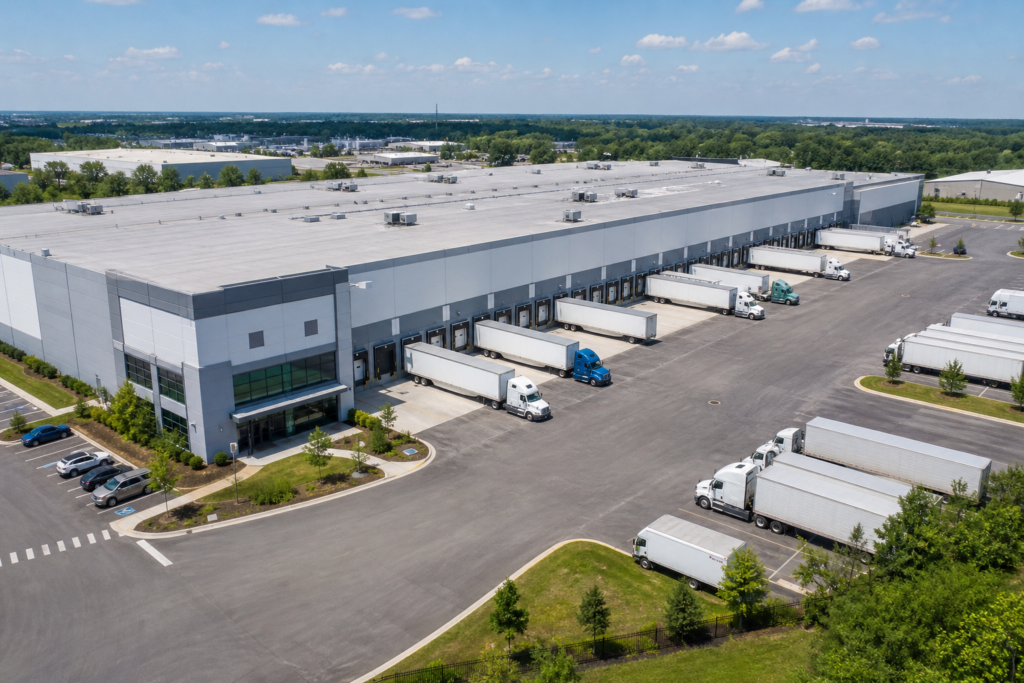
Industrial Property Investment Taxation: 2026 Guide
Industrial Property Investment Taxation: 2026 Guide
Industrial property investment taxation is at a turning point in 2026. The One Big Beautiful Bill Act (P.L. 119-21), signed into law on July 4, 2025, restored 100% bonus depreciation and made the 20% QBI deduction permanent. For real estate investors eyeing warehouses, distribution centers, and manufacturing facilities, the tax landscape has never been more favorable. This guide breaks down every major rule you need to know for 2026.
Table of Contents
- Key Takeaways
- What Is Industrial Property Investment Taxation?
- How Does 100% Bonus Depreciation Work in 2026?
- How Can Cost Segregation Reduce Your Tax Bill?
- What Are the Tax Benefits of Net Leases on Industrial Property?
- How Does the QBI Deduction Apply to Industrial Property Income?
- What Is Depreciation Recapture on Industrial Property?
- How Do 1031 Exchanges Help Industrial Property Investors?
- Uncle Kam in Action: Industrial Investor Cuts Tax Bill by $87,000
- Next Steps
- Related Resources
- Frequently Asked Questions
Key Takeaways
- The One Big Beautiful Bill Act restored 100% bonus depreciation for 2026, per IRS Notice 2026-11.
- Cost segregation studies can dramatically accelerate deductions on industrial properties in 2026.
- The 20% QBI deduction under Section 199A is now permanent, benefiting pass-through industrial investors.
- Net leases shift operating costs to tenants, creating cleaner, more predictable taxable income streams.
- Section 1031 exchanges remain a powerful tool to defer capital gains tax on industrial property sales.
What Is Industrial Property Investment Taxation?
Quick Answer: Industrial property investment taxation refers to the federal, state, and local tax rules that govern income, depreciation, gains, and deductions for warehouse, manufacturing, and logistics real estate. For 2026, major legislative changes have made this an especially favorable tax environment for investors.
Industrial real estate covers warehouses, distribution centers, manufacturing plants, flex-space facilities, cold storage units, and logistics hubs. These property types are taxed differently from residential rentals in several key ways. Understanding those differences is the first step to building a sound real estate tax strategy.
How Industrial Properties Are Classified for Tax Purposes
The IRS classifies most industrial buildings as nonresidential real property. Under the Modified Accelerated Cost Recovery System (MACRS), the standard depreciation period for industrial buildings is 39 years. However, components within industrial buildings — like specialized equipment pads, electrical systems, and HVAC — may qualify for shorter recovery periods through cost segregation. This distinction is critical for investors seeking faster deductions.
Types of Income from Industrial Properties
When you invest in industrial real estate, you generate several types of taxable income. Each type is treated differently under the tax code.
- Rental income: Ordinary passive income, offset by depreciation, operating expenses, and mortgage interest.
- Capital gains: Profit on sale taxed at long-term rates (0%, 15%, or 20%) if held over one year.
- Depreciation recapture: Previously deducted depreciation taxed at a maximum rate of 25% under Section 1250.
- Net Investment Income Tax (NIIT): An additional 3.8% tax on passive investment income above certain income thresholds.
For detailed guidance on how these income types interact, the IRS Rental Income and Expenses guide provides a useful starting framework. Furthermore, the 2026 changes to bonus depreciation rules — clarified in IRS Notice 2026-11 — significantly alter the calculus for industrial property investment taxation.
Pro Tip: Industrial properties held inside an LLC or S-Corp structure give you more flexibility. Use our LLC vs S-Corp Tax Calculator for Louisville to model the structure that best fits your 2026 industrial investment tax strategy.
How Does 100% Bonus Depreciation Work in 2026?
Quick Answer: For 2026, the One Big Beautiful Bill Act (P.L. 119-21) restored 100% bonus depreciation on eligible property. IRS Notice 2026-11 clarifies exactly which assets qualify. Industrial investors can now deduct the full cost of qualifying assets in the year they are placed in service.
Bonus depreciation was phasing down under prior law — dropping to 60% in 2024 and 40% in 2025. The One Big Beautiful Bill Act reversed that trend entirely. As a result, industrial property investors who place qualified assets in service during the 2026 tax year can deduct 100% of eligible costs immediately. This is a major win for industrial property investment taxation planning.
What Assets Qualify for 100% Bonus Depreciation?
Not everything in an industrial property automatically qualifies. However, many components do. Qualified property generally includes assets with a MACRS recovery period of 20 years or less.
- Qualified improvement property (QIP) — improvements to existing building interiors
- 5-year property: specialized manufacturing equipment, computers, and fixtures
- 7-year property: office furniture, general-use equipment, and machinery
- 15-year property: land improvements such as paving, fencing, and landscaping
- Personal property associated with an industrial building (identified via cost segregation)
Importantly, the structural components of the building itself — walls, floors, roofing — still depreciate over 39 years. However, a cost segregation study can reclassify a significant portion of those costs into shorter-lived categories. For more on qualified property categories, see the IRS Publication 946, How To Depreciate Property.
Bonus Depreciation vs. Section 179 for Industrial Property
Many investors confuse bonus depreciation with Section 179 expensing. They are similar in effect but differ in key ways. Section 179 has a deduction limit and cannot create a net operating loss (NOL). Bonus depreciation has no such cap and can create an NOL that carries forward. For large industrial acquisitions, bonus depreciation is generally more powerful.
| Feature | Bonus Depreciation (2026) | Section 179 (2026) |
|---|---|---|
| Rate | 100% | Up to annual limit |
| Deduction Cap | None | Yes (verify current limit at IRS.gov) |
| Can Create NOL? | Yes | No |
| Applies to QIP? | Yes | Yes |
| Applies to Used Property? | Yes (new to taxpayer) | Yes |
Pro Tip: If you buy a $3 million industrial warehouse and a cost segregation study reclassifies $900,000 into 5- and 15-year property, you could potentially deduct the entire $900,000 in 2026 using 100% bonus depreciation. That is a significant reduction in your taxable income for the year.
How Can Cost Segregation Reduce Your Tax Bill?
Quick Answer: A cost segregation study breaks your industrial building into components. Many components qualify for 5-, 7-, or 15-year depreciation instead of 39 years. When combined with 2026’s 100% bonus depreciation, the result is a massive front-loaded tax deduction.
Cost segregation is one of the most powerful strategies in real estate tax planning. It works by having an engineering-based study identify every building component and assign the correct depreciation class to each. Without a study, investors typically depreciate the entire building over 39 years and miss significant early deductions.
What Gets Reclassified in an Industrial Property Cost Segregation Study?
Industrial properties are particularly well-suited for cost segregation because they contain many specialized components. These components often qualify for shorter depreciation periods than the building shell itself. Common reclassified items include:
- Electrical distribution systems serving manufacturing equipment (5-year)
- Crane rails and specialized flooring (5 or 7-year)
- Dock levelers and loading equipment (7-year)
- Site improvements such as parking lots and fencing (15-year)
- Specialized HVAC and exhaust systems (7 or 15-year)
- Interior finishes not structural in nature (15-year QIP)
Cost Segregation Example: $5 Million Industrial Warehouse
Consider an investor who acquires a $5 million industrial warehouse in 2026. Without a cost segregation study, the full $5 million depreciates over 39 years — yielding about $128,205 per year in deductions. That is a modest offset against rental income.
Now apply a cost segregation study. Suppose the study reclassifies 25% of the building value — or $1.25 million — into shorter-lived categories. All $1.25 million qualifies for 100% bonus depreciation in 2026. The remaining $3.75 million depreciates over 39 years at roughly $96,154 per year. In year one, this investor’s total deduction jumps from $128,205 to $1,346,154. That difference is the power of combining cost segregation with 2026’s restored bonus depreciation rules.
| Scenario | Year 1 Deduction | At 35% Effective Rate |
|---|---|---|
| Standard 39-Year MACRS | $128,205 | $44,872 tax savings |
| Cost Segregation + 100% Bonus (2026) | $1,346,154 | $471,154 tax savings |
| Difference | +$1,217,949 | +$426,282 additional savings |
These numbers illustrate why cost segregation is one of the most impactful tools in industrial property investment taxation. The study itself typically costs $5,000 to $15,000 for a mid-size property. That is a small price compared to the six-figure tax savings it can generate. The IRS Cost Segregation Audit Techniques Guide provides the official framework that both practitioners and the IRS use to evaluate these studies.
What Are the Tax Benefits of Net Leases on Industrial Property?
Quick Answer: A net lease (NNN) agreement requires tenants to pay property taxes, insurance, and maintenance. This simplifies the landlord’s tax reporting. It creates a predictable, clean income stream that is easier to plan around when managing industrial property investment taxation.
Net leases are the dominant structure in the industrial sector. Major institutional investors like Gladstone Commercial — which recently acquired a 153,890 sq. ft. industrial property in Newport News, VA for $22.75 million — specifically target fully leased, long-term net lease assets. The reason is simple: they generate stable, predictable income with minimal expense management required from the landlord. From a taxation standpoint, this structure carries distinct advantages.
Understanding the Three Types of Net Leases
Not all net leases are equal. Each type shifts a different degree of expense responsibility to the tenant:
- Single Net (N): Tenant pays property taxes. Landlord pays insurance and maintenance.
- Double Net (NN): Tenant pays property taxes and insurance. Landlord pays maintenance.
- Triple Net (NNN): Tenant pays property taxes, insurance, AND maintenance. Landlord receives pure base rent.
For industrial property investors, the NNN structure is most common. It means the landlord’s taxable income is simply the base rent received, less depreciation and financing costs. This clean income calculation makes tax planning far more predictable. Working with a tax advisor who understands net lease structures ensures you are maximizing every available deduction against that income.
How Net Leases Interact with Passive Activity Rules
Income from industrial net leases is typically treated as passive income under the IRS’s passive activity rules. This means losses from one passive activity can offset income from another. However, if you qualify as a real estate professional under IRS rules — spending more than 750 hours per year in real estate activities — you can use rental losses to offset ordinary income. For high-income industrial investors, this distinction can result in tens of thousands of dollars in additional tax savings. The IRS Publication 925, Passive Activity and At-Risk Rules, explains the full framework.
Did You Know? State-level property tax changes can also affect NNN lease economics. Florida, for instance, is currently exploring significant property tax reforms following a special legislative session called by Governor DeSantis in 2026. Industrial investors in affected states should monitor local tax developments closely, as they may shift the effective cost burden between landlord and tenant depending on lease terms.
How Does the QBI Deduction Apply to Industrial Property Income?
 Free Tax Write-Off Finder
Quick Answer: The Section 199A Qualified Business Income (QBI) deduction allows eligible real estate investors to deduct up to 20% of their qualified business income in 2026. The One Big Beautiful Bill Act made this deduction permanent, removing the prior 2025 sunset deadline.
The QBI deduction is one of the most valuable provisions for business owners and real estate investors who hold property through pass-through entities — LLCs, partnerships, S-Corps, or as sole proprietors. For 2026, if your industrial property investment qualifies, you may deduct 20% of your net rental income before calculating your tax. This effectively reduces your top marginal rate by approximately one-fifth.
Does Industrial Rental Income Qualify for the QBI Deduction?
The question of whether rental income qualifies for the QBI deduction depends on whether the activity rises to the level of a trade or business. Under IRS Revenue Procedure 2019-38, landlords who meet a 250-hour rental services safe harbor may treat their rental activity as a qualified trade or business. For industrial investors who actively manage leases, maintenance, and tenant relationships, meeting this threshold is often achievable. Furthermore, triple-net leases that require minimal landlord involvement can sometimes fall outside the safe harbor, so careful documentation is essential.
Income Limits and Wage Limitations for the QBI Deduction
The QBI deduction is subject to income-based limitations for higher earners. Above certain taxable income thresholds, the deduction becomes limited based on W-2 wages paid by the business and the unadjusted basis of qualified property. Real estate investors can sometimes navigate these limitations by choosing the right entity structure. A skilled entity structuring strategy can make a significant difference in how much of the 20% deduction you can actually claim. Always verify current thresholds at IRS.gov’s QBI Deduction page for the most up-to-date 2026 limits.
What Is Depreciation Recapture on Industrial Property?
Quick Answer: When you sell an industrial property for a gain, the IRS recaptures the depreciation you previously deducted. Under Section 1250, unrecaptured depreciation on real property is taxed at a maximum federal rate of 25%. This is separate from the long-term capital gains rate applied to the remaining gain.
Depreciation recapture is one of the most misunderstood elements of industrial property investment taxation. Many investors are surprised to discover that the same depreciation deductions that sheltered rental income now become taxable upon sale. Understanding this mechanism before you sell is critical to accurate financial planning.
How Depreciation Recapture Is Calculated
Here is a simplified example. You purchase an industrial building for $2 million. Over five years, you deduct $256,410 in depreciation (the 39-year straight-line rate applied to the building cost, excluding land). When you sell the building for $2.5 million:
- Your adjusted basis = $2,000,000 − $256,410 = $1,743,590
- Total gain = $2,500,000 − $1,743,590 = $756,410
- Depreciation recapture portion = $256,410, taxed at max 25%
- Remaining capital gain = $500,000, taxed at long-term capital gains rates
In this example, the 25% recapture tax on $256,410 equals $64,103 in federal taxes. Additionally, the $500,000 capital gain is taxed at 0%, 15%, or 20% depending on your income. High earners also face the 3.8% Net Investment Income Tax on top of these rates. This layered tax treatment is a key reason why proper filing strategy and exit planning matter enormously in industrial real estate.
Strategies to Minimize Depreciation Recapture
The good news is that investors have several options to reduce or defer depreciation recapture exposure. Each strategy has specific requirements and trade-offs.
- 1031 Exchange: Defer both capital gains and depreciation recapture by rolling proceeds into a like-kind property.
- Installment Sale: Spread gain recognition over multiple years to manage tax bracket exposure.
- Delaware Statutory Trust (DST): Use a DST as replacement property in a 1031 exchange while reducing active management obligations.
- Opportunity Zone Investment: Reinvest gains into a Qualified Opportunity Zone Fund to defer and potentially reduce taxable gain.
How Do 1031 Exchanges Help Industrial Property Investors?
Quick Answer: A Section 1031 like-kind exchange allows you to sell one industrial property and roll the proceeds into another qualifying property. This defers all federal capital gains tax and depreciation recapture, preserving capital for reinvestment and portfolio growth.
The 1031 exchange is the crown jewel of real estate tax deferral. For industrial property investors, it is especially powerful because industrial assets — warehouses, distribution centers, manufacturing plants — are considered like-kind to each other and to most other real estate. Therefore, you can swap an aging warehouse for a newer distribution hub without paying a dollar in current capital gains tax.
Key 1031 Exchange Rules for 2026
The IRS enforces strict deadlines and requirements for 1031 exchanges. Missing any of them can invalidate the exchange and trigger full immediate taxation. Here are the core rules you must follow:
- 45-Day Identification Window: You must identify potential replacement properties within 45 days of selling your relinquished property.
- 180-Day Closing Deadline: You must close on the replacement property within 180 days of the sale.
- Equal or Greater Value: The replacement property must be of equal or greater value to fully defer the gain.
- Qualified Intermediary Required: You cannot touch the sale proceeds. A qualified intermediary must hold funds between transactions.
- Investment Intent: Both properties must be held for investment or productive use in a trade or business.
The official IRS guidance on like-kind exchanges can be found in IRS Form 8824 and its instructions. Before entering any exchange, consult a tax advisor who specializes in real estate investor taxation to ensure the transaction is structured correctly. A single misstep can cost you hundreds of thousands in unexpected taxes.
Building a Diversified Industrial Portfolio Through 1031 Chains
Sophisticated industrial investors use 1031 exchanges in sequence — a so-called “1031 chain” — to continuously trade up in property quality and size without ever paying capital gains tax. Each exchange resets the depreciation schedule, allowing investors to claim fresh depreciation deductions on the higher-value replacement property. Over time, this strategy can compound both portfolio value and tax efficiency dramatically. The National Association of Realtors Commercial Division provides additional market data on industrial property investment trends that can help inform your exchange strategy.

Uncle Kam in Action: Industrial Investor Cuts Tax Bill by $87,000
Client Snapshot: Marcus is a 44-year-old real estate investor based in Louisville, Kentucky. He holds four industrial properties — three small warehouses and a flex-space distribution center — all structured under separate LLCs.
Financial Profile: Combined industrial portfolio value of $4.2 million. Annual net rental income of $310,000 before depreciation.
The Challenge: Marcus had been depreciating his properties on standard 39-year schedules. He had never ordered a cost segregation study. Furthermore, his properties were generating significant passive income, and he was paying taxes at his top marginal rate on most of it. He came to Uncle Kam frustrated — his industrial properties were profitable, but his tax bill felt disproportionately high.
The Uncle Kam Solution: Uncle Kam recommended a comprehensive strategy that targeted the three biggest opportunities in Marcus’s situation. First, they ordered a cost segregation study on his largest warehouse, a 48,000 sq. ft. facility purchased for $1.8 million. The study reclassified $490,000 into 5-, 7-, and 15-year property — all eligible for 2026’s 100% bonus depreciation. Second, they reviewed Marcus’s LLC operating agreements to ensure his rental activities met the 250-hour safe harbor for the Section 199A QBI deduction. Third, they modeled a 1031 exchange on one of his older warehouses to defer a $220,000 gain and reinvest into a larger distribution center.
The Results:
- Tax Savings: $87,000 in 2026 federal and state taxes saved through the combined strategies.
- Capital Gain Deferred: $220,000 via the 1031 exchange, preserving cash flow for the new acquisition.
- Uncle Kam Fee: $5,800 for the comprehensive tax strategy engagement.
- First-Year ROI: Over 15x return on Uncle Kam’s advisory fee.
Marcus’s story is not unique. Hundreds of industrial investors leave significant money on the table every year simply because they are not using the strategies available to them. See more real results at Uncle Kam’s Client Results page. The right industrial property investment taxation strategy can transform your portfolio’s after-tax performance dramatically.
Next Steps
Industrial property investors who take action now will be best positioned for 2026’s favorable tax environment. Here is what to do next:
- Order a cost segregation study on any industrial property you acquired in the last three years.
- Review your entity structure to ensure you qualify for the 20% QBI deduction.
- Evaluate any planned property sales to determine whether a 1031 exchange makes sense.
- Document all rental service hours carefully to support passive loss or QBI deduction claims.
- Schedule a tax advisory consultation to build a comprehensive industrial property tax strategy for 2026.
This information is current as of 5/31/2026. Tax laws change frequently. Verify updates with the IRS at IRS.gov if reading this later.
Related Resources
- Real Estate Investor Tax Strategies — Uncle Kam
- Comprehensive Tax Strategy Services
- Entity Structuring for Real Estate Investors
- Uncle Kam Tax Calculators
- Tax Strategy Blog — More Real Estate Articles
Frequently Asked Questions
Is industrial real estate a good investment from a tax perspective in 2026?
Yes. For 2026, industrial property investment taxation has become especially favorable. The One Big Beautiful Bill Act restored 100% bonus depreciation (clarified by IRS Notice 2026-11) and made the 20% QBI deduction permanent under Section 199A. Additionally, long-term capital gains rates remain lower than ordinary income rates. Combined with cost segregation and 1031 exchange strategies, industrial real estate offers some of the most powerful tax-shielding opportunities available to individual investors in 2026.
How long do I have to hold an industrial property to get long-term capital gains treatment?
You must hold the property for more than one year to qualify for long-term capital gains rates. For 2026, long-term rates are 0%, 15%, or 20% depending on your taxable income. Most industrial investors fall into the 15% or 20% bracket. Remember, depreciation recapture is taxed separately at a maximum of 25% under Section 1250, regardless of how long you hold the asset. Planning your hold period carefully can significantly reduce your overall tax burden on industrial property sales.
Can I deduct all my industrial property expenses in 2026?
Under a triple-net lease, tenants typically cover most operating expenses like property taxes, insurance, and maintenance. However, you as the landlord can still deduct mortgage interest, depreciation, property management fees, professional fees, and any capital improvements you make. With 100% bonus depreciation available in 2026, large capital expenditures on qualifying assets can be fully deducted in the year they occur. Always keep detailed records, as the IRS requires documentation for all claimed deductions.
What happens to my depreciation deductions if I do a 1031 exchange?
When you complete a 1031 exchange, the depreciation deductions are not lost — they are deferred. The adjusted basis of your old property carries over into the new replacement property. Your depreciation history follows you. However, on the new property, you also get to begin a fresh depreciation schedule on the excess value above your carryover basis. This means a successful exchange preserves your prior depreciation tax benefits while adding new ones. Working with a qualified intermediary and a tax professional ensures the transaction is properly structured and reported on IRS Form 8824.
Do state property tax changes affect industrial investors in net lease properties?
Yes, state tax changes matter — even in net lease agreements. In a NNN lease, the tenant pays property taxes. However, if local tax rates rise sharply, that increased burden can make the property less attractive to tenants and harder to re-lease at favorable rates. Florida’s ongoing discussions around property tax phase-outs and other state-level reforms illustrate how dynamic this landscape is in 2026. Industrial property investors should monitor state and local tax legislation in every market where they hold assets, as these developments affect lease economics and ultimately property valuations.
What entity structure is best for industrial property investment taxation?
The best structure depends on your specific situation, but many industrial investors benefit from holding properties in a single-member or multi-member LLC for liability protection and pass-through taxation. For investors with higher income, an S-Corp may provide additional tax optimization through salary and distribution planning. The right structure affects your eligibility for the QBI deduction, your passive activity loss utilization, and your exit tax treatment. Use our LLC vs S-Corp Tax Calculator for Louisville to model the structure that generates the most after-tax income from your industrial real estate holdings. Additionally, Uncle Kam’s MERNA Method provides a systematic framework for structuring and optimizing your real estate tax position comprehensively.
How does the Net Investment Income Tax (NIIT) affect industrial property investors?
The 3.8% Net Investment Income Tax applies to the lesser of your net investment income or the amount by which your modified adjusted gross income (MAGI) exceeds threshold amounts. For 2026, these thresholds apply to high earners. Passive rental income from industrial properties typically counts as net investment income. However, if you qualify as a real estate professional — by spending more than 750 hours annually in real property trades or businesses and more time in real estate than in any other activity — your rental income may be excluded from NIIT. This qualification can save high-income industrial investors thousands of dollars per year. Consult a high-net-worth tax specialist to evaluate whether this status applies to your situation.
Last updated: May, 2026

