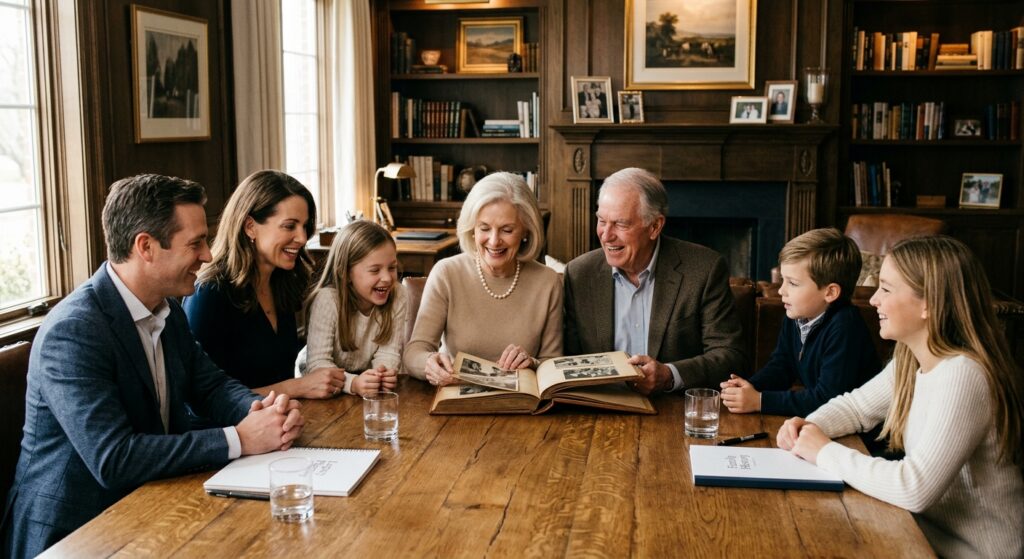
High Net Worth Family Storytelling: The 2026 Guide to Legacy, Wealth Transfer, and Heir Readiness
For 2026, high net worth family storytelling has become the missing link in wealth transfer. High net worth family storytelling is the practice of passing down purpose, values, and history alongside money. Right now, an estimated $100 trillion is starting to move from Boomers to their heirs. However, the tax rules and the family readiness behind that number are both shifting fast. This guide blends hard 2026 data with human strategy. Learn more about our tax planning for high-net-worth individuals as you read.
TL;DR: In 2026, the federal estate and gift tax exemption sits at $15 million per person and $30 million per couple, with no scheduled sunset. Yet only about 35% of family offices have a defined succession plan. High net worth family storytelling closes that gap by preparing heirs, not just paperwork.
Table of Contents
- Key Takeaways
- What Is High Net Worth Family Storytelling?
- Why Does Storytelling Matter in 2026?
- How Does the 2026 Estate Tax Exemption Work?
- How Do You Build a Succession Plan That Lasts?
- How Do You Prepare Heirs for Wealth?
- Uncle Kam in Action
- Next Steps
- Related Resources
- Frequently Asked Questions
Key Takeaways
- High net worth family storytelling preserves values, not just money, across generations.
- For 2026, the estate and gift tax exemption is $15 million per person, with no sunset.
- Only about 35% of family offices have a defined succession plan.
- Heir readiness, not tax law, is now the biggest risk to legacies.
- Storytelling and smart structuring together protect wealth for decades.
What Is High Net Worth Family Storytelling?
Quick Answer: High net worth family storytelling is the deliberate practice of sharing family history, values, and purpose with heirs. It works alongside estate planning to prepare the next generation.
High net worth family storytelling turns cold numbers into a living legacy. It answers the questions that documents cannot. Where did this wealth come from? What does it stand for? What should it never be used for? As a result, heirs inherit meaning along with money.
Most estate plans focus on transfer mechanics. However, mechanics alone do not build stewards. Storytelling fills that gap. Moreover, it connects a trust document to a real human purpose. Therefore, families who tell their story tend to keep wealth longer.
Defining Key Wealth Terms
First, let us define the language of wealth. These terms appear throughout this guide.
- HNW (High Net Worth): Individuals with investable assets above $1 million.
- UHNW (Ultra High Net Worth): Individuals with net worth of $30 million or more.
- Family Office: A private team that manages a wealthy family’s finances and legacy.
- Exemption Sunset: A scheduled date when a tax exemption drops automatically.
Why Numbers Alone Fail
Consider a family that transfers $30 million cleanly. The tax work is flawless. However, the heirs have no idea why the money exists. Consequently, they spend it without a plan. Studies of wealthy families show that most fortunes fade by the third generation. Storytelling is the tool that fights this pattern. For deeper strategy, explore our proactive tax strategy services.
Pro Tip: Record a short family history video each year. It becomes priceless once the founding generation is gone.
Why Does High Net Worth Family Storytelling Matter in 2026?
Quick Answer: In 2026, a massive wealth transfer is underway while tax enforcement weakens and heirs remain unprepared. Storytelling addresses the human risk that tax planning cannot.
The year 2026 is a turning point. An estimated $100 trillion is moving between generations. Meanwhile, nearly every assumption behind that number is shifting. Tax enforcement, family structure, and asset types are all changing at once. Therefore, families need more than a static plan.
The data reveals a striking gap. Generous exemptions sit next to weak preparation. For example, IRS audit revenue fell about 35% in fiscal 2025, according to reporting on federal enforcement trends. As a result, the binding constraint is no longer tax risk. Instead, it is heir readiness.
The 2026 Wealth Landscape in Numbers
This table shows the key 2026 figures shaping UHNW planning today.
| Metric (2026) | Figure | Why It Matters |
|---|---|---|
| Estate/gift exemption (per person) | $15 million | No scheduled sunset |
| Exemption (married couple) | $30 million | Portability applies |
| Family offices with succession plan | ~35% | Major readiness gap |
| UHNW heirs rated “very prepared” | ~36% | Preparation crisis |
| India UHNWIs (net worth $30M+) | 19,877 | Projected 25,217 by 2031 |
Notably, wealth is also growing fast outside the West. India alone recorded 19,877 UHNWIs in 2026. That figure may reach 25,217 by 2031. Verify current federal figures at IRS.gov estate tax guidance.
The Enforcement Paradox
Weaker enforcement may feel like relief. However, it creates a trap. Families relax on documentation and structure. Then rules can shift again with new legislation. Therefore, discipline still pays. Learn how we help wealthy clients through our ongoing tax advisory relationships.
Did You Know? About 61% of UHNW families worry that inherited wealth will hurt their heirs’ motivation.
How Does the 2026 Estate Tax Exemption Work?
Quick Answer: For 2026, each person can shield $15 million from estate and gift tax. Married couples can shield up to $30 million using portability.
The federal estate tax applies to assets you leave at death. The gift tax applies to large transfers during life. Both share one lifetime exemption. For 2026, that exemption is $15 million per person. Above the exemption, the top federal rate reaches 40%.
Importantly, the 2026 exemption has no scheduled sunset. In prior years, planners feared a sharp drop. That fear pushed many rushed transfers. Now, families can plan with more calm. However, no rule is truly permanent. Congress can change it. Review official rules at the IRS gift tax page.
A Simple Estate Tax Example
Consider a married couple worth $40 million in 2026. Their combined exemption is $30 million. So $10 million remains taxable. At a 40% rate, the estate tax bill is roughly $4 million. Smart structuring can reduce or defer that cost.
- Taxable estate above exemption: $10 million
- Estimated federal estate tax (40%): about $4 million
- Tools to reduce it: trusts, gifting, and charitable giving
The Annual Gift Exclusion
Beyond the lifetime exemption, you can give smaller annual gifts tax-free. This annual exclusion adjusts for inflation each year. Consequently, steady gifting shrinks a taxable estate over time. Furthermore, it lets you tell your story while alive. You watch heirs use the gift wisely. Verify current annual exclusion limits at IRS.gov.
Pro Tip: Pair annual gifts with a family letter. Explain the purpose behind each gift you make.
How Do You Build a Succession Plan That Lasts?
 Free Tax Write-Off Finder
Quick Answer: A lasting plan pairs legal structures with clear roles, ongoing communication, and family storytelling. It names successors and prepares them early.
Only about 35% of family offices have a defined succession plan. That gap is dangerous. A great plan is not one document. Instead, it is a system. It combines legal tools, governance, and human preparation. Therefore, start early and revisit it often.
Entity structure also matters for wealthy families. Holding companies and family LLCs can simplify transfers. Moreover, the right structure can lower ongoing tax friction. Wealthy Delaware families often use these tools. Use our LLC vs S-Corp Tax Calculator for Delaware to compare entity outcomes for 2026.
A 7-Step Succession Checklist
Follow this checklist to build a resilient plan. Each step blends structure with storytelling.
- Write your family mission and values statement first.
- Name successors and backup successors for each key role.
- Choose the right entities, such as a family holding LLC.
- Fund and update trusts that match your 2026 exemption.
- Hold regular family meetings to share the story.
- Train heirs on money, roles, and responsibility.
- Review the full plan at least once every year.
Structure Meets Story
Legal tools protect assets. However, stories protect purpose. The best plans use both. For example, a trust can hold a business. Meanwhile, a family charter explains why the business exists. As a result, heirs understand their role. Explore smart setups through our entity structuring services.
Did You Know? About 36% of UHNW families deliberately hide the full size of their wealth from heirs.
How Do You Prepare Heirs for Wealth?
Quick Answer: Prepare heirs through gradual disclosure, financial education, real responsibility, and consistent family storytelling. Start years before any transfer happens.
Heir preparation is the heart of high net worth family storytelling. Only about 36% of UHNW families call their heirs “very prepared.” That number should worry every wealthy parent. Fortunately, preparation is a skill you can teach. Moreover, it starts long before any inheritance.
Disclosure is a delicate balance. Too little breeds shock and mistakes. Too much can breed entitlement. Therefore, share information in stages. For example, teach budgeting first. Then introduce investing. Finally, reveal the full picture when heirs are ready.
The Disclosure Ladder
Use a staged approach to teach heirs at each age. This ladder builds skill and trust over time.
| Life Stage | Focus | Story Element |
|---|---|---|
| Teens | Budgeting and work ethic | Founder’s early struggles |
| Twenties | Investing and saving | How the business grew |
| Thirties | Governance and roles | Family values and mission |
| Forties+ | Full stewardship | The complete legacy |
Financial Education Tools
Formal education helps heirs feel confident. Many families use trusted resources for this. For example, the CFPB Money as You Grow program offers age-based lessons. In addition, university programs teach wealth stewardship. The Harvard Extension School offers finance courses too. These tools support the storytelling process.
Pro Tip: Give young heirs a small, real investment account. Let them learn from wins and losses safely.
Family philanthropy also builds character. When heirs give together, they learn shared purpose. Groups like the Council on Foundations guide family giving. Before you plan your next steps, review our wealth strategy resources for affluent families.

Uncle Kam in Action: The Founding Family That Almost Lost Its Story
Client Snapshot: The Reyes family built a manufacturing business over 35 years. Two founders, now in their late 60s, wanted to retire.
Financial Profile: The family’s net worth reached $34 million in 2026. Most of that value sat inside the business itself.
The Challenge: The founders had no succession plan. Their three adult children knew little about the finances. Furthermore, the family faced an estate above the $30 million couple exemption. As a result, roughly $4 million looked exposed to estate tax. The heirs also felt disconnected from the business story.
The Uncle Kam Solution: We built a full plan that paired structure with storytelling. First, we set up a family holding LLC to simplify transfers. Next, we funded trusts that matched the 2026 exemption. Then we started an annual gifting program to shrink the taxable estate. Meanwhile, we launched quarterly family meetings. In those meetings, the founders shared the company’s history. Heirs learned the values behind the wealth. We also created a written family charter.
The Results: The strategy cut the projected estate tax exposure sharply. Through trusts and gifting, the family reduced taxable assets significantly. Estimated estate tax savings reached about $2.8 million over the plan’s horizon. The heirs also became active, informed stewards.
- Estimated Tax Savings: ~$2.8 million
- Investment in Uncle Kam: $48,000 first-year planning fee
- First-Year ROI: Well above a 2x return on fees
See more outcomes like this on our client results page. The Reyes family kept both their wealth and their story.
Next Steps
Ready to protect both your wealth and your legacy? Take these clear actions now.
- Write your family mission statement this month.
- Review your estate plan against the 2026 exemption.
- Schedule your first family storytelling meeting.
- Book a consult through our tax advisory team.
- Compare entity options with our structuring specialists.
Related Resources
- Tax Planning for High-Net-Worth Individuals
- Proactive Tax Strategy Services
- The MERNA Method Explained
- Comprehensive Tax Guides
Frequently Asked Questions
What is high net worth family storytelling?
It is the practice of passing down values and history with wealth. It prepares heirs to become responsible stewards. Moreover, it works alongside estate planning.
What is the 2026 estate tax exemption?
For 2026, the exemption is $15 million per person. Married couples can shield up to $30 million. There is no scheduled sunset. Verify current figures at IRS.gov.
How prepared are UHNW heirs today?
Only about 36% of UHNW families rate heirs as very prepared. As a result, heir readiness is now a top wealth risk. Storytelling helps close that gap.
What defines an ultra high net worth family?
A UHNW family holds net worth of $30 million or more. This threshold is used across major global wealth reports. It signals complex planning needs.
When should we start family storytelling?
Start now, regardless of your heirs’ ages. Begin with simple stories and small lessons. Then expand the detail as heirs mature. Consistency matters most.
Does storytelling replace legal estate planning?
No, it complements legal planning. Trusts and entities protect assets. Meanwhile, storytelling protects purpose. Therefore, use both together for the best results.
This information is current as of 9/27/2026. Tax laws change frequently. Verify updates with the IRS if reading this later.
Last updated: September, 2026

