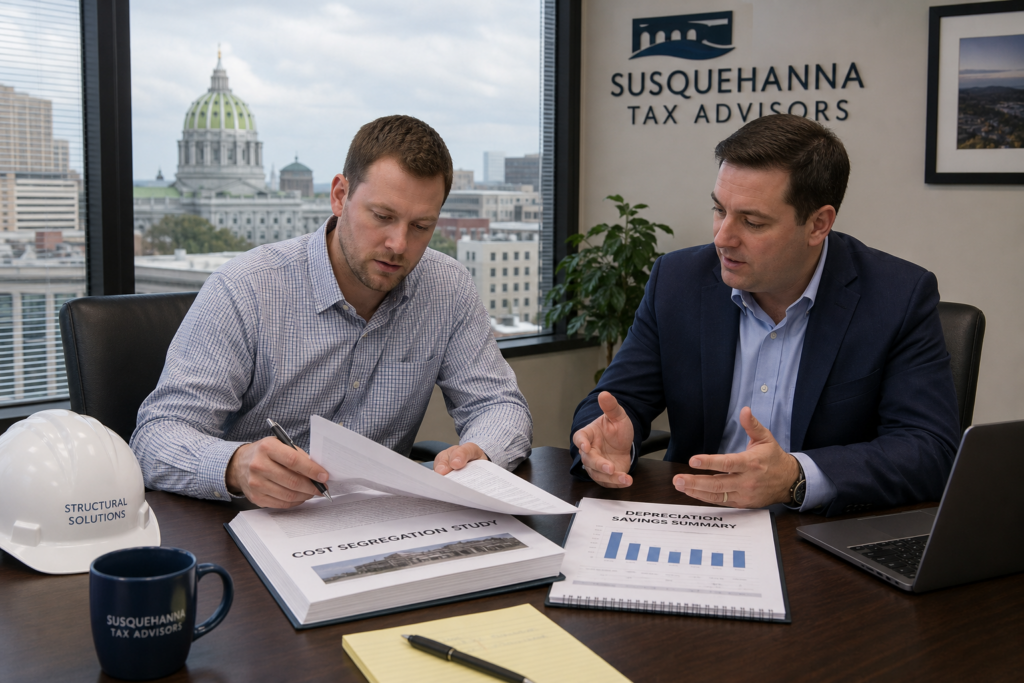
Harrisburg Cost Segregation Study Cost: 2026 Pricing Guide
Understanding the Harrisburg cost segregation study cost helps property owners plan smarter for the 2026 tax year. Most Harrisburg investors pay between $3,000 and $15,000 for a quality study, depending on property size and complexity. This guide breaks down pricing, factors that move the number, and real ROI. If you own commercial or investment property, the numbers below will help you decide.
Table of Contents
- Key Takeaways
- What Is a Cost Segregation Study?
- How Much Does a Harrisburg Cost Segregation Study Cost?
- What Factors Affect Your Study Cost?
- How Much Can You Save With a Cost Segregation Study in 2026?
- Is a Cost Segregation Study Worth It for You?
- How Do You Choose a Provider in Harrisburg?
- Uncle Kam in Action
- Next Steps
- Related Resources
- Frequently Asked Questions
Key Takeaways
- The Harrisburg cost segregation study cost typically ranges from $3,000 to $15,000 in 2026.
- Property size, complexity, and building type drive the final price.
- OBBBA made 100% bonus depreciation permanent, boosting first-year savings.
- A quality study often returns 5x to 10x its fee in year one.
- Avoid cheap $395 AI studies that fail IRS audit scrutiny.
What Is a Cost Segregation Study?
Quick Answer: A cost segregation study reclassifies building components into shorter depreciation classes. This accelerates deductions and lowers your current tax bill.
A cost segregation study is an engineering-based tax analysis. It breaks a building into its individual parts. Instead of depreciating everything over 27.5 or 39 years, a study moves eligible items into faster classes. As a result, you claim larger deductions sooner. Many Harrisburg real estate investors use this strategy to free up cash quickly.
The IRS Cost Segregation Audit Techniques Guide sets the standard. A quality study classifies each asset, explains why it is Section 1245 or Section 1250 property, and reconciles back to actual cost. Therefore, a proper study needs real documentation, not guesswork.
Which Property Components Qualify?
Studies reclassify items that support the business, not the structure itself. For example, common short-life components include:
- Carpeting, cabinetry, and decorative lighting (5-year property).
- Parking lots, landscaping, and fencing (15-year property).
- Specialized electrical and plumbing tied to equipment.
- Security systems and dedicated data wiring.
Why Accelerated Depreciation Matters
Depreciation is a non-cash deduction. However, it directly reduces taxable income. Moving assets into 5- and 15-year buckets front-loads those deductions. Consequently, you keep more cash in the early years. That timing benefit is why studies remain popular with high-net-worth investors who want to reinvest quickly.
Pro Tip: Studies work best when you plan them the same year you buy or place the property in service.
How Much Does a Harrisburg Cost Segregation Study Cost?
Quick Answer: The Harrisburg cost segregation study cost usually falls between $3,000 and $15,000 in 2026. Small residential properties sit at the low end.
Pricing depends heavily on property type and value. A single-family rental study often costs $3,000 to $5,000. Meanwhile, a mid-size commercial building can run $8,000 to $15,000. Large or complex properties may cost even more. For a deeper look at local services, review options for Harrisburg cost segregation and tax planning.
Be cautious about ultra-cheap offers. In 2026, a wave of $395 to $500 AI-generated studies flooded the market. According to Accounting Today reporting from July 2026, these studies often cannot be reproduced or defended. Therefore, a low price can create serious audit risk.
Typical Cost Ranges by Property Value
The table below shows common 2026 pricing bands for Harrisburg-area properties. Use it as a planning estimate only.
| Property Value | Property Type | Typical 2026 Study Cost |
|---|---|---|
| Under $500K | Residential rental | $3,000 – $5,000 |
| $500K – $1.5M | Small commercial | $5,000 – $9,000 |
| $1.5M – $5M | Mid-size commercial | $9,000 – $15,000 |
| Over $5M | Large/complex | $15,000+ |
How Providers Structure Fees
Most reputable firms charge a flat fee. This keeps incentives aligned and avoids inflated allocations. Some firms tier pricing by square footage. Others quote after a free feasibility review. Harrisburg property owners should always request a written scope. Furthermore, that scope should reference the IRS guide and promise audit support.
Did You Know? A defensible study rebuilds a building component by component using permits, invoices, and photos, not templates.
What Factors Affect Your Study Cost?
Quick Answer: Property size, complexity, documentation quality, and provider experience all move the price. Bigger and more complex means higher cost.
No two buildings are identical. As a result, quotes vary widely. A simple warehouse costs less to analyze than a mixed-use building. Likewise, a new-construction project with full records is faster to study. Harrisburg business owners should gather documents early to control costs.
Property Size and Complexity
Larger buildings have more components to classify. Consequently, engineers spend more hours on-site and in analysis. Complex properties like medical offices, restaurants, and hotels also carry specialized systems. Those systems require detailed review. Therefore, expect higher fees for these building types.
New Construction vs. Acquisition
New construction often includes detailed contractor cost breakdowns. Those records make classification faster and cheaper. In contrast, an acquisition may lack itemized costs. In that case, engineers rebuild costs from permits and site inspections. The IRS guide is clear that actual costs beat estimates. So strong records reduce both cost and audit risk.
Provider Experience and Scope
Experienced engineering firms charge more than bargain vendors. However, they deliver defensible reports. A full study includes a site visit, asset photos, and a reconciliation to total cost. Meanwhile, cheap AI studies skip this rigor. Pennsylvania investors should verify credentials and ask about audit defense. For guidance, the SBA business tax resources explain why documentation matters.
Pro Tip: Ask every provider whether their report reconciles to your actual purchase price and closing statement.
How Much Can You Save With a Cost Segregation Study in 2026?
Quick Answer: Savings often reach 5x to 10x the study fee in year one. Permanent 100% bonus depreciation amplifies the benefit in 2026.
The 2026 tax year offers a major advantage. The One Big Beautiful Bill Act (OBBBA) made 100% first-year bonus depreciation permanent for qualifying property acquired after January 19, 2025. As reported by Accounting Today in July 2026, this change fueled surging demand. Therefore, reclassified 5- and 15-year assets can be fully expensed in year one.
Consider a $1 million Harrisburg commercial building. Suppose a study reclassifies 25% of the basis, or $250,000, into short-life property. With 100% bonus depreciation, you deduct that $250,000 in year one. At a 32% marginal rate, that equals roughly $80,000 in tax savings. Meanwhile, the study cost only about $9,000. Delaware and out-of-state freelancers can also estimate self-employment obligations with our Self-Employment Tax Calculator for planning.
Sample ROI Calculation
The table below shows a simple payback comparison for three Harrisburg property scenarios. All figures are estimates for illustration only.
| Property | Study Cost | Year-1 Tax Savings | Rough ROI |
|---|---|---|---|
| $400K rental | $4,000 | $28,000 | 7x |
| $1M commercial | $9,000 | $80,000 | 8.9x |
| $3M mixed-use | $14,000 | $210,000 | 15x |
Passive Activity and Grouping Rules
Big deductions are not automatic. Passive activity rules can limit how you use losses. However, real estate professionals and short-term rental owners may qualify for exceptions. The IRS Publication 925 on passive activity rules explains the details. Consequently, smart tax planning matters as much as the study itself.
A local Tax Preparation Near Me in Pennsylvania team can confirm whether your losses are usable this year.
Is a Cost Segregation Study Worth It for You?
 Free Tax Write-Off Finder
Quick Answer: A study is usually worth it when your property basis exceeds $500,000 and you expect taxable income. The savings dwarf the fee.
Not every property benefits equally. A very small rental with a low basis may not justify the cost. However, most properties above $500,000 clear the threshold easily. Furthermore, owners who plan to hold for several years capture the most value. A quick feasibility review answers the question fast.
Best Candidates for a Study
Certain owners see outsized results. For example, strong candidates include:
- Commercial building owners with $500K+ basis.
- Short-term rental owners offsetting active income.
- Investors who recently renovated a property.
- Owners with high current-year taxable income.
When to Wait or Skip
Sometimes timing hurts the benefit. If you plan to sell soon, depreciation recapture may reduce net savings. Likewise, if you have little taxable income, the deduction may sit unused. Nevertheless, a professional can model both outcomes. A smart proactive tax strategy plan weighs recapture against upfront savings.
Pro Tip: A look-back study can capture missed deductions on properties bought in prior years, without amending returns.
How Do You Choose a Provider in Harrisburg?
Quick Answer: Choose a provider that uses engineering methods, reconciles to actual cost, and offers audit defense. Avoid template-only vendors.
Provider quality decides whether your study survives an audit. The IRS guide favors detailed, evidence-based work. Therefore, you want a firm that inspects the property and documents each asset. Working with a trusted Pennsylvania tax preparation team keeps the study aligned with your full return.
Questions to Ask Before You Hire
Ask direct questions before signing. Strong providers answer them clearly. For example:
- Do you perform a physical site inspection?
- Does the report reconcile to my actual cost basis?
- Will you provide free audit defense if needed?
- Can I see a sample deliverable and references?
Red Flags to Avoid
Some warning signs signal risk. A $395 study with no site visit is a red flag. Reports that cannot be reproduced also fail scrutiny. According to industry experts, AI-only studies often produce different answers on the same property. Consequently, they become indefensible on a signed return. When in doubt, verify the firm follows official IRS depreciation guidance.

Uncle Kam in Action: How a Harrisburg Investor Saved $92,000
Client Snapshot: Marcus is a Harrisburg real estate investor. He owns a growing portfolio of commercial and rental properties across central Pennsylvania.
Financial Profile: Marcus earns roughly $420,000 per year from combined rental income and an active consulting business. In early 2026, he purchased a $1.3 million mixed-use building near downtown Harrisburg.
The Challenge: Marcus faced a large 2026 tax bill. He knew depreciation could help. However, he worried about the Harrisburg cost segregation study cost and audit risk. He had received two cheap $450 AI-based quotes online. Nevertheless, neither firm offered a site visit or audit defense.
The Uncle Kam Solution: Our team ran a feasibility review first. Then we coordinated an engineering-based study that reconciled to his actual closing costs. The study reclassified about 28% of his basis, or roughly $364,000, into 5- and 15-year property. Because OBBBA made 100% bonus depreciation permanent, Marcus deducted that amount in year one. Furthermore, we confirmed his short-term rental units allowed active loss treatment.
The Results: The strategy produced strong, measurable outcomes for 2026.
- Tax Savings: Approximately $92,000 in first-year federal tax reduction.
- Investment: $11,000 for the engineering-based study and planning.
- Return on Investment: Roughly 8.4x in the first year alone.
Marcus reinvested the savings into a new property down payment. As a result, he expanded his portfolio faster. See more outcomes like this on our client results and case studies page.
Next Steps
Ready to act on your Harrisburg property? Take these concrete steps now.
- Gather your closing statement, permits, and renovation invoices.
- Request a free feasibility review to confirm expected savings.
- Compare quotes and reject template-only $395 studies.
- Book a call to build your personalized tax advisory plan.
Related Resources
- Tax Strategies for Real Estate Investors
- Entity Structuring for Property Owners
- Uncle Kam Tax Strategy Blog
- Free Tax Calculators
Frequently Asked Questions
How much does a cost segregation study cost in Harrisburg?
Most Harrisburg studies cost $3,000 to $15,000 in 2026. Small rentals sit at the low end. Larger commercial buildings cost more. Avoid $395 AI studies that lack audit support.
What property size makes a cost segregation study worthwhile?
Properties with a basis above $500,000 usually justify the fee. However, owners with high taxable income can benefit at lower values too. A feasibility review confirms the answer quickly.
Are cost segregation study fees tax-deductible?
Yes, study fees are generally deductible as a business expense. Therefore, the true cost is even lower after tax. Always confirm treatment with your tax advisor for 2026.
How long does a cost segregation study take?
Most studies take four to eight weeks. Timing depends on property size and documentation. Good records speed the process. A site inspection is usually scheduled early.
Does 100% bonus depreciation still apply in 2026?
Yes. The One Big Beautiful Bill Act made 100% first-year bonus depreciation permanent for qualifying property acquired after January 19, 2025. Consequently, 2026 studies deliver strong first-year savings.
This information is current as of 7/27/2026. Tax laws change frequently. Verify updates with the IRS if reading this later.
Last updated: July, 2026

