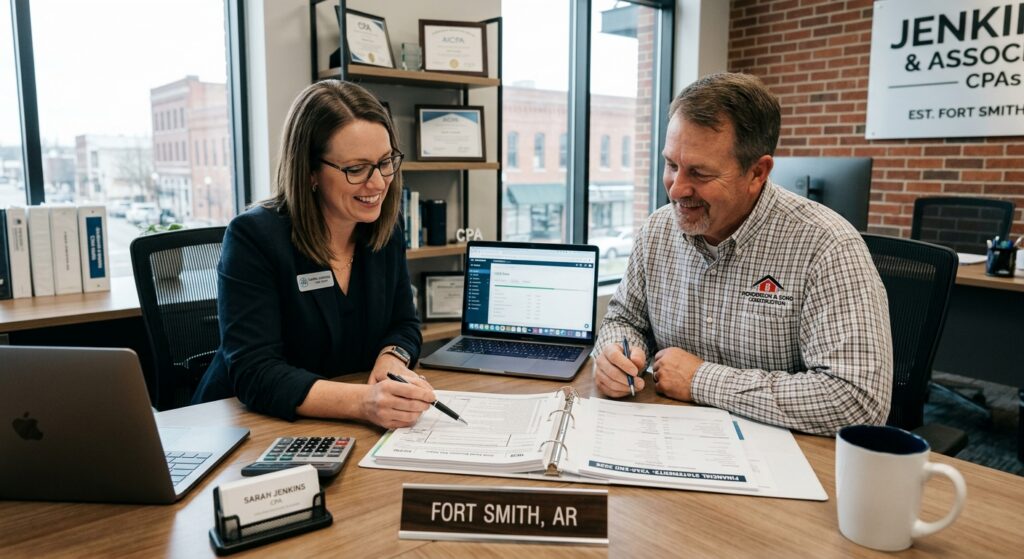
Fort Smith CPA: 2026 Small Business Tax Planning & Calculator Services

Fort Smith CPA: 2026 Small Business Tax Planning & Calculator Services
Running a small business in Fort Smith means juggling operations, growth, and compliance—all while watching your bottom line. A Fort Smith CPA can transform your tax strategy from a stressful obligation into a profit-maximizing advantage. For the 2026 tax year, small business owners face new opportunities through Tax Preparation Near Me in Arkansas services, enhanced deductions, and strategic entity planning. Whether you’re a sole proprietor, LLC owner, or S-Corp operator, understanding 2026 tax rules and Arkansas-specific requirements can save you thousands. Use our Fort Smith tax preparation services to estimate your tax burden accurately and plan year-round strategies that keep more money in your business.
Table of Contents
- Key Takeaways
- How Does Our Fort Smith Small Business Tax Calculator Work?
- Why Work With a Fort Smith CPA Instead of DIY Tax Software?
- What Are the Most Overlooked 2026 Business Tax Deductions?
- How Does Your Business Entity Choice Impact 2026 Taxes?
- What Are Arkansas-Specific Tax Requirements for Fort Smith Businesses?
- How Does Our Fort Smith Tax Preparation Process Work?
- Uncle Kam in Action
- Next Steps
- Frequently Asked Questions
Key Takeaways
- Fort Smith CPAs help maximize 2026 deductions and minimize tax liability for small business owners.
- For 2026, standard deductions for single filers are $15,000 and $30,000 for married filing jointly.
- Arkansas has specific 1099-NEC filing thresholds ($2,500) different from federal rules ($2,000 for 2026).
- Entity structure (LLC vs. S-Corp) decisions impact self-employment tax and overall 2026 tax savings.
- Our interactive tax calculator provides free 2026 estimates; professional review ensures accuracy and optimization.
How Does Our Fort Smith Small Business Tax Calculator Work?
Quick Answer: Our Fort Smith small business tax calculator is a free tool that estimates your 2026 tax liability based on income, expenses, and filing status. It’s a starting point for planning, not a replacement for professional CPA guidance.
Our Small Business Tax Calculator is designed specifically for Fort Smith business owners who want a quick snapshot of their 2026 tax position. The calculator guides you through entering your 2026 income, deductible expenses, filing status, and business entity type. Within seconds, you get an estimated tax liability—no guessing, no manual calculations.
Step-by-Step Calculator Process
- Step 1: Enter Your 2026 Income — Gross business income (all revenue sources for the year).
- Step 2: Subtract Deductible Business Expenses — Include home office, vehicle mileage, supplies, payroll, rent, utilities, and contractor payments (over the $2,000 1099-NEC threshold in Arkansas).
- Step 3: Select Your Filing Status — Choose single, married filing jointly, or head of household for accurate standard deduction calculation (2026 figures: $15,000 single, $30,000 MFJ, $21,000 HOH).
- Step 4: Identify Your Business Entity — Select sole proprietor, LLC (taxed as sole prop), LLC (taxed as S-Corp), or S-Corporation to calculate self-employment tax impact.
- Step 5: Review Your Estimate — See your estimated federal tax, self-employment tax (15.3% rate), and total 2026 tax obligation.
Example: A Fort Smith construction contractor with $85,000 in 2026 gross revenue and $25,000 in deductible expenses (materials, labor, vehicle) would have $60,000 in net business income. After subtracting the standard deduction ($15,000 for single filers in 2026), taxable income is $45,000. The calculator estimates federal income tax plus 15.3% self-employment tax on the net business income. The actual liability depends on marginal tax brackets, which our calculator adjusts automatically for 2026.
Pro Tip: Use your 2026 calculator results as a conversation starter during your Fort Smith CPA consultation. Bring the printout so we can identify deductions you may have missed and model entity structure changes to reduce your tax.
What the Calculator Does NOT Cover
- State income tax (Arkansas rules vary by entity and income level).
- Quarterly estimated tax penalties or underpayment thresholds.
- Advanced credits (Earned Income Tax Credit, R&D Credit, Small Business Health Insurance Deduction).
- Entity restructuring scenarios or optimal S-Corp salary/distribution splits.
That’s where a Fort Smith CPA enters the picture. After you get your estimate, our team dives deeper into optimization strategies, ensuring you’re not leaving deductions on the table.
Why Work With a Fort Smith CPA Instead of DIY Tax Software?
Quick Answer: A Fort Smith CPA uncovers missed deductions, navigates Arkansas-specific rules, and creates year-round strategies—saving you far more than the service cost.
DIY tax software is affordable and accessible, but it’s reactive. You feed it numbers, and it calculates what you owe. A Fort Smith CPA is proactive. We look at your 2026 business structure, quarterly income patterns, upcoming purchases, and strategic opportunities—then recommend changes that minimize tax while keeping you compliant.
Key Differences: DIY Software vs. Fort Smith CPA
| Factor | DIY Tax Software | Fort Smith CPA |
|---|---|---|
| Deduction Discovery | You identify deductions; software verifies. | We audit your business to find missed deductions (home office, vehicle, equipment, charitable donations). |
| Arkansas Tax Rules | Generic federal focus; state rules may be incomplete. | Deep expertise in Arkansas income tax, 1099-NEC thresholds ($2,500), and Fort Smith local requirements. |
| Entity Optimization | Calculates tax for current entity only. | Models LLC vs. S-Corp vs. C-Corp to show you exact 2026 tax savings from restructuring. |
| Year-Round Support | Available only at tax time. | Quarterly planning calls, estimated tax guidance, and mid-year strategy adjustments. |
| Cost | $100–$300 for business return. | $1,500–$5,000 depending on complexity, but often saves $5,000–$25,000 in taxes through optimization. |
For Fort Smith business owners earning $100,000+, the ROI on CPA services is undeniable. One strategic S-Corp election or home office deduction discovery pays for itself in the first year.
Understanding Arkansas and Fort Smith Tax Rules
Arkansas small businesses face unique tax considerations. The state’s 1099-NEC reporting threshold is $2,500 when no state income tax is withheld—higher than the 2026 federal threshold of $2,000. This means Fort Smith business owners must track and report independent contractor payments differently for Arkansas than for federal filings. Additionally, Arkansas requires direct state filing when state income tax is withheld, creating compliance obligations beyond federal requirements.
Our Fort Smith CPA firm ensures compliance with both federal and Arkansas rules. We file your 2026 federal Schedule C, IRS forms (1040, 1120-S, 1120 for C-Corps), and Arkansas Department of Finance & Administration filings—all coordinated and error-free.
What Are the Most Overlooked 2026 Business Tax Deductions?
Quick Answer: Home office, vehicle mileage, equipment depreciation, and contractor payments are top missed deductions. Fort Smith CPAs identify these systematically through documentation review.
Fort Smith business owners often leave thousands in deductions unclaimed simply because they forget to track them or don’t realize they’re deductible. Our CPA review process catches these gaps and ensures your 2026 return reflects every legitimate deduction.
Top Overlooked Deductions for Fort Smith Businesses
- Home Office Deduction — If you use a dedicated room or space for your business, you can deduct a percentage of rent, mortgage interest, utilities, and insurance. Fort Smith homes with dedicated offices often see $3,000–$8,000 annual deductions.
- Vehicle and Mileage — Track all business-related miles (client visits, supply runs, site inspections). For 2026, the IRS standard mileage rate varies; deduct either the rate times miles or actual vehicle expenses (gas, repairs, insurance, depreciation). Fort Smith contractors often miss $2,000+ in mileage deductions.
- Equipment Depreciation — Computers, software, machinery, and tools don’t vanish from your return. Use depreciation schedules (MACRS) to spread the cost over useful life. Bonus depreciation (enhanced for 2026) allows immediate deduction of qualifying property purchases.
- Contractor and Freelancer Payments — If you paid contractors $2,500+ (Arkansas threshold) or $2,000+ (federal threshold for 2026) in a single transaction, issue a 1099-NEC. These payments reduce your business income and generate proper documentation.
- Professional Services and Licenses — CPA fees, attorney fees, bookkeeper costs, and industry licenses are all deductible. Save every receipt.
- Business Meals and Entertainment — Meals with clients or business partners are deductible at 50% (or full deduction if part of an employee meal or certain charitable events). Keep detailed records of attendees and business purpose.
- Insurance and Health Deductions — Health insurance premiums paid for yourself (if self-employed), liability insurance, workers’ comp, and disability coverage.
Did You Know? The 2026 tax year allows enhanced bonus depreciation on qualifying business property. This means if you purchased equipment or machinery in 2026, you may deduct the full cost immediately rather than depreciating over multiple years—a huge win for growing Fort Smith businesses making capital investments.
How Does Your Business Entity Choice Impact 2026 Taxes?
 Free Tax Write-Off Finder
Quick Answer: Sole proprietor, LLC, S-Corp, and C-Corp structures create different 2026 tax outcomes. S-Corps often save self-employment tax (15.3% rate); C-Corps defer tax but trigger double taxation. Your choice depends on income and growth goals.
Your Fort Smith business structure choice ripples through every tax calculation. The entity you choose determines how your 2026 income is taxed, what deductions you can claim, and how much self-employment tax you pay. Making the wrong choice can cost thousands annually.
Comparing Entity Structures for Fort Smith Businesses (2026)
| Entity Type | Filing Requirement | Self-Employment Tax | 2026 Ideal For |
|---|---|---|---|
| Sole Proprietor | Schedule C (Form 1040) | 15.3% on all net income | Solo contractors under $80K income |
| LLC (Default Tax) | Schedule C (Form 1040) | 15.3% on all net income | Liability protection without S-Corp complexity |
| S-Corporation | Form 1120-S | 15.3% on W-2 salary only (not distributions) | Fort Smith businesses earning $100K+ (SE tax savings) |
| C-Corporation | Form 1120 | No SE tax; corporate income tax only | Reinvesting profits; sophisticated tax planning |
A Fort Smith construction business grossing $150,000 annually could save $8,000–$12,000 per year by electing S-Corp status. Here’s why: As a sole proprietor or LLC, all $150,000 is subject to 15.3% self-employment tax ($22,950). As an S-Corp, you take a reasonable W-2 salary (say, $100,000—also subject to SE tax: $15,300) and distribute the remaining $50,000 as dividends (no SE tax). Total SE tax: $15,300 vs. $22,950—a $7,650 savings just from structure.
What Are Arkansas-Specific Tax Requirements for Fort Smith Businesses?
Quick Answer: Arkansas businesses must file state returns, track the $2,500 1099-NEC threshold, comply with sales tax (6.5% statewide plus local rates), and file direct when state tax is withheld.
Fort Smith, Arkansas is home to many growing businesses, but state tax compliance often gets overlooked. Arkansas does not allow federal-only filings; you must prepare and file a separate state return (whether you owe state tax or not). Understanding Arkansas-specific rules ensures you stay compliant and don’t miss opportunities for state credits or deductions available to Fort Smith businesses.
Key Arkansas Tax Compliance for 2026
- Form AR1000 Filing — Most Fort Smith businesses file the equivalent of the federal Form 1040 for state purposes. Self-employed and small business owners report Arkansas taxable income.
- 1099-NEC Threshold ($2,500) — File direct with the state when you pay a single contractor $2,500+ and no state income tax is withheld. This differs from the federal $2,000 threshold for 2026.
- Sales Tax Collection — Fort Smith’s combined sales tax is 8.625% (6.5% state + 2.125% local). If you sell taxable goods or services (not all services are taxable), you must register, collect, and remit sales tax monthly or quarterly.
- Arkansas Withholding — If you have Arkansas employees, you must withhold state income tax and remit it quarterly. The state Department of Finance & Administration tracks withholding separately from federal IRS.
- No Separate LLC Tax — Arkansas taxes LLCs the same as federal—no separate entity-level tax. However, you must still file an annual report with the Secretary of State ($50–$150 fee).
Fort Smith CPAs navigate these state-level requirements daily, ensuring your business stays in good standing with both the IRS and Arkansas Department of Finance & Administration. Missing a filing or miscalculating the 1099-NEC threshold can trigger penalties and audits.
How Does Our Fort Smith Tax Preparation Process Work?
Quick Answer: Our process begins with a discovery call and calculator estimate, moves to deep tax planning and deduction optimization, and concludes with professional filing and ongoing support.
A Fort Smith CPA should feel like a partner, not a vendor. Our process is collaborative and transparent, built to help you understand your tax position while maximizing savings.
Step 1: Discovery Call & Free Tax Estimate
You schedule a 30-minute call with our Fort Smith tax team. We discuss your business type, 2026 income, major expenses, and tax concerns. Many clients start with our free calculator estimate—you input rough numbers, and we give you a ballpark 2026 tax liability. This conversation uncovers opportunities we’ll explore further.
Step 2: Detailed Tax Planning & Deduction Audit
You provide 2026 financial records: bank statements, credit card receipts, invoices, mileage logs, and 1099-NEC forms for contractors you paid. Our CPA team systematically reviews these documents to:
- Identify missed deductions (home office, vehicle, equipment).
- Model entity restructuring (should you become an S-Corp?).
- Calculate quarterly estimated tax for 2026 (and 2027 preview).
- Ensure Arkansas and federal compliance (1099-NEC thresholds, state filing, sales tax).
Step 3: Professional Filing & Year-Round Support
Once we’ve optimized your 2026 return, we prepare and file federal (Form 1040, 1120-S, 1120) and Arkansas state returns. You receive a detailed tax summary showing your liability, deductions, and savings. More importantly, we set up quarterly planning calls to monitor your business progress, adjust estimated taxes if needed, and identify mid-year optimization opportunities.
This is the advantage of working with a Fort Smith CPA: you’re not forgotten after April 15. We’re here year-round, ensuring you stay on track and avoid surprises.

Uncle Kam in Action: Fort Smith Construction Contractor Saves $9,500 on 2026 Taxes
Client Profile: Marcus is a Fort Smith-based commercial HVAC contractor, operating as a sole proprietor. In 2025, he grossed $180,000 in revenue and owed $28,000 in federal taxes. He was stressed about his 2026 tax liability and tired of leaving money on the table.
The Challenge: Marcus tracked his income and paid invoices, but he wasn’t systematically deducting business expenses. He had a dedicated office in his home (unused for deductions), drove clients to job sites (no mileage tracking), and purchased new tools and equipment (depreciated manually, missing bonus depreciation opportunities). He was paying solo, with no plan for entity optimization or quarterly taxes. His sole proprietor status subjected all profits to 15.3% self-employment tax.
The Uncle Kam Solution: During our 2026 discovery call, Marcus used our Small Business Tax Calculator. His rough estimate showed $185,000 in gross revenue and $35,000 in expenses—a $150,000 net income subject to full SE tax. Our Fort Smith CPA team saw immediate opportunities:
- Home Office Deduction: Marcus’s dedicated 200 sq ft office (4% of 5,000 sq ft home) entitled him to $8,000 in annual deductions (utilities, insurance, mortgage interest, maintenance).
- Vehicle & Mileage: After reviewing logs, Marcus drove 24,000 business miles in 2026. At the standard mileage rate, that’s $5,760 in deductions (not previously claimed).
- Equipment Depreciation & Bonus Depreciation: Marcus purchased $22,000 in tools and HVAC equipment in 2026. Instead of spreading depreciation over years, he claimed $22,000 in bonus depreciation immediately (enhanced for 2026).
- S-Corp Election: We modeled an S-Corp election for 2026. Marcus would take a W-2 salary of $120,000 (reducing SE tax) and distribute $65,000 in business profits as dividends (no SE tax). This structure saved $9,500 in self-employment tax annually.
The Results: Marcus’s optimized 2026 return showed:
- New deductions identified: $35,760 (home office + mileage + bonus depreciation).
- Self-employment tax savings from S-Corp: $9,500 annually.
- Adjusted 2026 federal tax liability: $18,500 (vs. the estimated $28,000 he feared).
- Total First-Year Savings: $9,500.
Marcus’s investment in professional Tax Preparation Near Me in Arkansas was $2,800 for 2026 preparation and S-Corp setup. His return on investment was 3.4x in year one alone. Going forward, the S-Corp election and quarterly planning with our Fort Smith CPA team will yield $9,500+ in SE tax savings every year. Plus, his financial records are now organized, and he’s on track for quarterly estimated taxes—no more surprises.
Next Steps
Your 2026 tax strategy doesn’t start on April 1st; it starts today. Take these three immediate actions:
- Run Your Free Tax Estimate: Use our Fort Smith Small Business Tax Calculator to see your rough 2026 liability. Gather your 2026 income, deductible expenses, and filing status. Get an instant estimate—no obligation.
- Schedule Your Discovery Call: Book a 30-minute call with our Fort Smith CPA team. Bring your calculator results and tell us your biggest tax concerns. We’ll discuss opportunities and whether restructuring makes sense for your business.
- Start Tracking 2026 Expenses: From today forward, save every receipt, log your mileage, and document home office usage. Clean records make our job easier and catch more deductions. Check out our Fort Smith tax preparation services for guidance on what to track.
Frequently Asked Questions
How Accurate Is a Small Business Tax Calculator?
Our calculator is accurate within 5–10% if you input correct figures. It applies 2026 standard deductions ($15,000 single, $30,000 MFJ) and self-employment tax rates (15.3%) automatically. However, calculators don’t account for advanced credits, multi-state income, or complex deductions. Use it as a starting estimate, then have a Fort Smith CPA refine it based on your full financial picture.
Do I Still Need a Fort Smith CPA If I Use a Tax Calculator?
Absolutely, especially if you earn $80,000+. The calculator tells you what you owe; a Fort Smith CPA tells you how to owe less. We find deductions, model entity changes, and ensure Arkansas compliance. The calculator is a tool; our expertise is the advantage.
What Are the Key Differences Between Federal and Arkansas Tax Thresholds for 1099-NEC?
For 2026, the federal 1099-NEC threshold is $2,000 per contractor (raised from $600). Arkansas’s threshold is $2,500 when no state income tax is withheld. Fort Smith businesses must file separate reports for federal (using $2,000 threshold) and Arkansas (using $2,500 threshold). Track contractor payments carefully to avoid duplicate reporting or missed filings.
Should I Elect S-Corp Status for My Fort Smith Business?
S-Corp elections make sense for Fort Smith business owners earning $100,000+ annually. The strategy: take a reasonable W-2 salary and distribute remaining profits as dividends (avoiding 15.3% self-employment tax on distributions). Savings typically range from $3,000–$15,000 annually depending on income. Our CPA team models both scenarios and recommends the best structure for your situation.
What Fort Smith Business Deductions Am I Likely Missing?
Common missed deductions include home office (if you work from home part-time), vehicle mileage (track all business miles, not just major trips), equipment purchases (eligible for bonus depreciation in 2026), professional services (CPA, lawyer, consultant), and business meals (50% deductible). During your Fort Smith CPA consultation, we audit your expenses and identify what you’ve overlooked.
How Often Should I Meet With My Fort Smith CPA?
We recommend quarterly check-ins—January (Q4 planning), April (Q1 review), July (mid-year adjustment), and October (Q3 review + 2027 preview). For growing businesses or those with significant changes, monthly calls ensure you stay on track, adjust estimated taxes if needed, and capitalize on opportunities. Annual meetings are the minimum; proactive businesses meet more frequently.
What Records Do I Need to Bring to My Fort Smith CPA Appointment?
Bring (or email) 2026 bank statements, credit card statements, invoices sent to clients, 1099-NEC forms for contractors paid, mileage logs, home office documentation (photos, square footage), equipment receipts, and any other business-related expenses. If you have payroll, bring payroll records and W-2 copies. Digital copies or organized folders speed up our review and lower your cost.
When Should Fort Smith Businesses File 2026 Tax Returns?
Federal and Arkansas individual returns are due April 15, 2027. S-Corp (Form 1120-S) returns are due March 15, 2027 (unless you file an extension). We recommend filing early—January through March 2027—to maximize refunds and avoid the April rush. If you extend, federal deadline moves to October 15, 2027, but estimated taxes for 2027 are still due quarterly.
Related Resources
- Tax Strategy for Small Business Owners
- LLC vs. S-Corp: Entity Structure Planning
- Resources for Business Owners
- Business Solutions: Bookkeeping & Payroll
Last updated: May, 2026
Compliance Checkpoint: This information is current as of 5/25/2026. Tax laws change frequently. Verify updates with the IRS (IRS.gov) or Fort Smith CPA if reading this later. This article provides general guidance; consult a professional before making tax or entity decisions for your specific situation.

