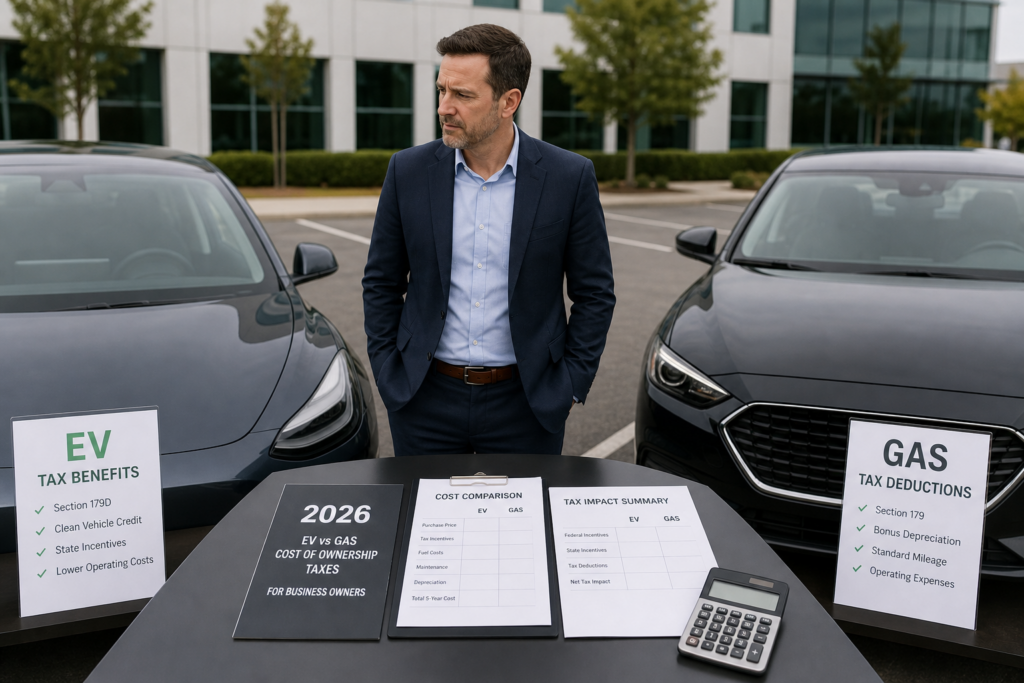
EV vs Gas Cost of Ownership Taxes: 2026 Guide
EV vs Gas Cost of Ownership Taxes: 2026 Guide
Understanding the EV vs gas cost of ownership taxes is more important than ever for business owners in 2026. The federal clean vehicle tax credit was eliminated by the One Big Beautiful Bill Act, signed into law on July 4, 2025. However, smart vehicle tax deductions still exist. This guide breaks down every tax angle so you can make the right call for your bottom line. For personalized guidance, explore Uncle Kam’s tax strategy services.
Table of Contents
- Key Takeaways
- What Happened to the Federal EV Tax Credit in 2026?
- What Are the Total Ownership Costs: EV vs Gas?
- How Can Business Owners Deduct EV Costs in 2026?
- How Does Section 179 Apply to EV vs Gas Vehicles?
- What About EV Insurance Costs vs Gas Vehicles?
- How Do Fuel Costs Affect Total EV vs Gas Ownership Taxes?
- What State-Level EV Incentives Still Exist in 2026?
- Uncle Kam in Action
- Next Steps
- Related Resources
- Frequently Asked Questions
Key Takeaways
- The federal $7,500 EV clean vehicle tax credit was eliminated starting in 2026.
- Business owners can still use Section 179 to deduct up to $28,000 on qualifying passenger vehicles in 2026.
- EV fuel costs remain lower than gas, but Strait of Hormuz fuel price spikes make EVs even more attractive in 2026.
- EV insurance premiums run higher than gas vehicles, but the gap is narrowing in 2026.
- State-level tax credits and utility rebates can still offset EV purchase costs for business owners.
What Happened to the Federal EV Tax Credit in 2026?
Quick Answer: The federal $7,500 clean vehicle credit was repealed by the One Big Beautiful Bill Act, signed July 4, 2025. It no longer applies to 2026 vehicle purchases.
The EV vs gas cost of ownership taxes equation changed dramatically in 2026. For years, buyers of new electric vehicles could claim a federal clean vehicle tax credit of up to $7,500 under the Inflation Reduction Act. That incentive is gone. The One Big Beautiful Bill Act (also known as the Working Families Tax Cuts Act), signed into law on July 4, 2025, eliminated this credit effective for tax year 2026 and beyond.
As a result, EV registrations in the U.S. dipped 9.8% in April 2026, according to Automotive News. However, business owners shouldn’t write off EVs just yet. The total tax picture is more nuanced. Furthermore, global EV demand is surging — the IEA’s Global EV Outlook 2026 projects 23 million EV sales worldwide this year, nearly 30% of all cars sold. Therefore, the U.S. policy shift is an outlier, not a global trend.
Was the Used EV Credit Also Eliminated?
Yes. The used clean vehicle credit (previously up to $4,000) was also eliminated as part of the same legislation. Consequently, buyers of used EVs no longer receive a federal tax break either. Nevertheless, some state programs still offer used EV rebates. Business owners should verify state-level rules with a tax advisor before purchasing.
What About Commercial Clean Vehicle Credits?
The previous Section 45W commercial clean vehicle credit was similarly repealed. In 2025, this credit applied to business-use EVs and allowed up to $7,500 for lighter vehicles and $40,000 for heavy vehicles. In 2026, that credit no longer applies. However, business owners can still benefit from depreciation deductions (Section 179 and bonus depreciation), which apply equally to EV and gas vehicles. As a result, your tax filing strategy now matters more than ever when comparing vehicle costs.
Pro Tip: Even without the federal EV credit, business deductions like Section 179 can still favor EVs. Work with a tax strategist to find the best path for your situation. Verify current rules at IRS.gov.
What Are the Total Ownership Costs: EV vs Gas?
Quick Answer: Over five years, EVs often cost less to own despite higher sticker prices. Lower fuel and maintenance costs offset the upfront premium, especially given 2026 gas price spikes.
When comparing EV vs gas cost of ownership taxes for business, you need to look at more than just the purchase price. Total cost of ownership includes purchase price, fuel, maintenance, insurance, and tax treatment. In 2026, gas prices spiked sharply following the closure of the Strait of Hormuz on March 4, 2026. This geopolitical event — which disrupts roughly 27% of global maritime crude oil trade — made EVs more attractive for high-mileage business owners.
Five-Year Cost Comparison: EV vs Gas
The table below shows a simplified five-year total ownership comparison for a typical mid-size business vehicle. All estimates are based on 2026 market conditions and reflect a 15,000-mile annual business use assumption.
| Cost Category | Electric Vehicle (EV) | Gas Vehicle |
|---|---|---|
| Average Purchase Price | $46,000 | $36,000 |
| 5-Year Fuel Cost (2026 prices) | $3,500 (electricity) | $14,000–$18,000 (gas) |
| 5-Year Maintenance | $2,500 | $6,000–$8,000 |
| 5-Year Insurance | $9,000–$12,000 | $7,000–$9,000 |
| Federal Tax Credit (2026) | $0 (eliminated) | $0 |
| 5-Year Total Est. Cost | $61,000–$64,000 | $63,000–$71,000 |
Note: These are illustrative estimates. Your actual costs will vary by vehicle, location, and usage. However, the trend is clear. Despite the elimination of the federal EV tax credit, EVs can still match or beat gas vehicles on total five-year cost. This is especially true when gas prices are elevated due to geopolitical factors.
Maintenance Cost Advantage for EVs
EVs have fewer moving parts than gas vehicles. They don’t need oil changes, transmission service, or exhaust repairs. In contrast, gas vehicles typically require more frequent maintenance visits. For a business owner driving 15,000+ miles per year, the maintenance savings can add up to $3,500–$5,500 over five years. Moreover, fewer maintenance visits mean less downtime for your business.
Did You Know? Globally, EV sales surged by 30% year-over-year in Europe and 80% in the Asia-Pacific region in Q1 2026, according to the IEA Global EV Outlook 2026. The U.S. is the outlier, not the trend.
How Can Business Owners Deduct EV Costs in 2026?
Quick Answer: Business owners can still deduct EV costs using Section 179, bonus depreciation, and the standard mileage rate — the same methods available for gas vehicles.
Even without the federal tax credit, the EV vs gas cost of ownership taxes comparison still favors strategic business owners. The IRS provides several deduction methods that apply to both types of vehicles. As a business owner or self-employed taxpayer, you have powerful tools to reduce your vehicle’s net cost. These tools work the same way whether you drive an EV or a gas vehicle.
The Standard Mileage Rate Method
The IRS sets an annual standard mileage rate for business vehicle use. For 2026, the IRS standard mileage rate for business use has been set — verify the exact current rate at IRS.gov standard mileage rates. In 2025, the rate was 70 cents per mile. The 2026 rate may reflect 2026 fuel cost changes. Therefore, confirm the current rate before filing. This method is especially useful if you drive a lot and want simplicity.
Here’s the key point: the standard mileage rate applies to EVs and gas vehicles equally. However, since EVs have lower actual fuel and maintenance costs, the actual expense method may yield a larger deduction for gas vehicles. Conversely, for EVs, the standard mileage method may actually overstate your costs, giving you a larger deduction than actual expenses. A tax professional can calculate which method works better for your vehicle and driving patterns.
The Actual Expense Method
Under the actual expense method, you deduct the real costs of operating the vehicle for business. This includes fuel, insurance, repairs, registration fees, lease payments, and depreciation. For gas vehicles with higher fuel and maintenance costs, this method can produce a larger deduction in years with high mileage. For EVs, actual expenses are typically lower, but depreciation can be significant if you purchase outright. Work with your tax advisor at Uncle Kam Tax Advisory to compare both methods for your specific vehicle.
Pro Tip: Use the Georgia Self-Employment Tax Calculator to estimate how vehicle deductions reduce your net self-employment income and tax. Try our Georgia Self-Employment Tax Calculator to run the numbers for 2026.
How Does Section 179 Apply to EV vs Gas Vehicles?
Quick Answer: For 2026, Section 179 allows business owners to immediately deduct up to $28,000 of a qualifying passenger vehicle’s cost. This applies to both EVs and gas vehicles equally.
Section 179 is one of the most powerful tools in a business owner’s tax arsenal. It lets you deduct the cost of qualifying business property — including vehicles — in the year of purchase rather than depreciating over several years. For 2026, the IRS caps the Section 179 deduction for passenger vehicles at $28,000. This cap applies to vehicles with a gross vehicle weight rating (GVWR) under 6,000 pounds, regardless of whether they are electric or gas-powered. Verify current limits at IRS Publication 946.
Heavy SUVs and Trucks: Different Rules Apply
Vehicles with a GVWR over 6,000 pounds qualify for more generous Section 179 treatment. These include heavy SUVs, pickup trucks, and vans used for business. In 2026, a heavy SUV or truck can qualify for a much larger Section 179 deduction — up to the full purchase price in some cases, subject to overall Section 179 limits and business income requirements. This rule applies equally to electric trucks and SUVs (like the Ford F-150 Lightning or Rivian R1T) and their gas counterparts.
For business owners considering the EV vs gas cost of ownership taxes angle, the heavy vehicle rules create an interesting opportunity. An electric truck like the F-150 Lightning (GVWR: 7,050 lbs) would qualify for full Section 179 expensing, just like a gas F-150. The tax treatment is identical. Furthermore, the EV’s lower fuel and maintenance costs add additional long-term savings. As a result, heavy-duty electric vehicles can be especially tax-efficient for business owners who need large trucks anyway.
Bonus Depreciation in 2026
Bonus depreciation allows additional first-year write-offs beyond the standard Section 179 limits. Under the One Big Beautiful Bill Act, 100% bonus depreciation was extended and made permanent for qualifying business property. This applies to both EV and gas vehicles that meet the business-use requirements. Consequently, a business owner who buys a qualifying vehicle and uses it 100% for business could potentially deduct the full purchase price in 2026. Consult your tax professional to confirm eligibility based on your specific vehicle and usage.
| Deduction Type | EV (Under 6,000 lbs) | Gas (Under 6,000 lbs) | Heavy Truck/SUV (Over 6,000 lbs) |
|---|---|---|---|
| Section 179 Cap (2026) | $28,000 | $28,000 | Up to full cost |
| 100% Bonus Depreciation | Subject to luxury auto rules | Subject to luxury auto rules | Available if business use ≥50% |
| Standard Mileage Rate | Available | Available | Available |
| Federal Clean Vehicle Credit | $0 (eliminated 2026) | N/A | $0 (eliminated 2026) |
This information is current as of 6/17/2026. Tax laws change frequently. Verify updates with the IRS if reading this later.
What About EV Insurance Costs vs Gas Vehicles?
 Free Tax Write-Off Finder
Quick Answer: In 2026, EV insurance premiums remain higher than gas vehicle premiums. However, the gap is narrowing as insurers gain more data and repair networks improve.
For business owners calculating the EV vs gas cost of ownership taxes picture, insurance is a meaningful variable. According to Automotive News (June 2026), EV insurance costs are higher than those for comparable gas vehicles, but the gap is closing. The main drivers of higher EV premiums include higher repair costs for EV-specific parts, a more limited network of certified EV repair shops, and higher replacement costs for battery packs following accidents.
Why EV Insurance Is More Expensive
Three key factors drive higher EV insurance costs:
- Parts cost: EV-specific components, especially battery modules, cost significantly more to replace than gas engine parts.
- Specialized labor: Not every repair shop is equipped to work on EVs. Fewer shops means higher labor costs and longer repair times.
- Insurer risk assessment: Insurers are still building historical data on EV claim frequency and severity, which leads to conservative (higher) premium pricing.
How the Gap Is Closing in 2026
The good news for EV owners is that the insurance premium gap is shrinking. Insurers are building better claims data as EV fleets grow. More repair shops are getting EV-certified. Additionally, manufacturers are designing EVs with easier repairability in mind. As a result, analysts expect EV and gas vehicle insurance costs to converge significantly by 2028.
From a tax perspective, business owners can deduct insurance premiums as a business expense for vehicles used in business operations. This applies equally to EV and gas vehicle insurance. Therefore, while EV insurance is currently higher, the full deduction offsets a portion of that extra cost. Your effective after-tax insurance cost for an EV is lower than the sticker premium suggests, especially if you are in a higher tax bracket.
Pro Tip: Shop EV insurance across multiple carriers. Not all insurers price EV risk the same way. Comparing quotes can save you $500–$1,500 per year on premiums. Look for insurers with dedicated EV programs and certified repair networks.
How Do Fuel Costs Affect Total EV vs Gas Ownership Taxes?
Quick Answer: EVs cost roughly 60–70% less to fuel than gas vehicles in 2026. High gas prices due to the Strait of Hormuz disruption make EV fuel savings even more significant this year.
Fuel costs are perhaps the most significant ongoing advantage of EVs over gas vehicles. The EV vs gas cost of ownership taxes comparison must include this variable. In 2026, fuel prices rose sharply after Iranian forces declared the Strait of Hormuz closed on March 4, 2026, disrupting roughly 27% of global maritime crude oil trade, according to the Congressional Research Service. Gas prices surged as a result, widening the fuel cost gap between EVs and gas vehicles.
Annual Fuel Cost Comparison
For a business owner driving 15,000 miles per year, the fuel cost difference is substantial. A typical gas vehicle averaging 30 miles per gallon at $4.50/gallon (2026 average, elevated by supply disruptions) costs roughly $2,250/year in fuel. A comparable EV at 4 miles per kWh and $0.16/kWh average electricity costs roughly $600/year. That’s a savings of about $1,650 per year, or $8,250 over five years.
From a tax deduction standpoint, fuel costs for business vehicles are fully deductible as a business expense (under the actual expense method) or covered by the standard mileage rate. However, here’s the key insight: lower fuel costs for EVs mean a lower deduction under the actual expense method. Nevertheless, when you factor in the overall savings, the lower deduction is more than offset by the actual cash you keep in your pocket. Your net after-tax cost of fuel is lower with an EV, period.
The Standard Mileage Rate Advantage for EVs
Here’s an interesting tax strategy angle: the IRS standard mileage rate is designed to reflect average vehicle costs including fuel. For gas vehicles, actual fuel costs at 2026 elevated prices may approach or exceed what the standard mileage rate assumes. For EVs, actual fuel and maintenance costs are well below what the standard mileage rate assumes. This means EV owners using the standard mileage method may be claiming a deduction larger than their actual costs — a legal and advantageous outcome. Explore more strategies with Uncle Kam’s business owner tax resources.
What State-Level EV Incentives Still Exist in 2026?
Quick Answer: Many states still offer EV purchase rebates, income tax credits, and utility incentives in 2026, even though the federal credit is gone. Georgia business owners should check state-specific programs.
The elimination of the federal EV tax credit doesn’t mean EV incentives have disappeared entirely. Many states maintain their own EV rebate and credit programs. For Georgia business owners evaluating the EV vs gas cost of ownership taxes decision, state and utility programs can still reduce the effective purchase cost of an EV. However, programs vary widely and change frequently, so verify current availability with your tax advisor or the U.S. Department of Energy’s Alternative Fuels Data Center.
Types of State and Local EV Incentives
Even without federal credits, business owners may still access:
- State income tax credits: Some states offer direct tax credits for EV purchases, separate from the now-repealed federal credit.
- State sales tax exemptions: Several states exempt EVs from all or a portion of sales tax at purchase.
- Utility company rebates: Many electric utilities offer rebates of $500–$2,000 for EV purchases and/or home charger installation.
- HOV lane access: Some states allow EVs to use HOV lanes regardless of occupancy, saving commute time for business owners.
- Reduced registration fees: Some states offer lower annual registration fees for EVs, though a proposed federal highway bill could add a $130 annual EV fee in coming years.
Charging Infrastructure Deductions
Business owners who install EV charging equipment at their business location may still deduct that cost as a business expense. This is separate from any vehicle credit. The depreciation deduction for a Level 2 commercial charger — typically costing $2,000–$8,000 installed — can provide a meaningful additional write-off. Document everything and keep installation invoices for your tax records. For guidance on business deductions and entity structuring, Uncle Kam’s team can help maximize every deduction available.
Pro Tip: Keep all receipts for EV charging at public stations. These counts as a deductible business fuel expense — just like gas receipts — when the vehicle is used for business travel.

Uncle Kam in Action: Georgia Business Owner Navigates EV Tax Strategy
Client Snapshot: Marcus T. owns a mid-size construction consulting firm in Atlanta, Georgia. He drives roughly 22,000 miles per year for client visits, job site inspections, and vendor meetings. His vehicle is central to his business operations.
Financial Profile: Annual business revenue of $420,000. Net self-employment income before vehicle deductions of approximately $180,000. Marcus pays self-employment tax at the 15.3% rate on his net earnings, which means vehicle deductions are especially valuable — they reduce both income tax and self-employment tax liability simultaneously.
The Challenge: In early 2026, Marcus was preparing to purchase a new vehicle for business use. He initially assumed the $7,500 federal EV credit made an electric vehicle the obvious choice. However, after the One Big Beautiful Bill Act eliminated the credit, he wasn’t sure whether an EV still made financial sense. He also didn’t understand how the Section 179 deduction compared between EV and gas options.
The Uncle Kam Solution: Uncle Kam’s tax team ran a complete EV vs gas cost of ownership taxes analysis for Marcus. First, they identified that his target vehicle — a Ford F-150 Lightning (GVWR: 7,050 lbs) — qualified as a heavy vehicle, not subject to the $28,000 Section 179 passenger car cap. As a result, Marcus could deduct a much larger portion of the truck’s purchase price under Section 179 and 100% bonus depreciation in tax year 2026. Second, the team calculated that Marcus’ actual fuel cost savings over five years would exceed $13,000 given 2026 elevated gas prices. Third, they helped Marcus explore Georgia utility rebate programs that added another $1,500 in savings.
The Results:
- Tax Savings (Year 1): $22,400 through Section 179 and depreciation deductions on the EV truck.
- 5-Year Fuel Savings: Estimated $13,200 compared to the equivalent gas truck.
- Uncle Kam Investment: $2,400 for annual tax advisory services.
- First-Year ROI: More than 9x return on Uncle Kam’s advisory fee.
Marcus said: “I almost skipped the EV because I thought the credit was gone and I’d be paying more. Uncle Kam showed me the full picture — and the EV actually made more financial sense, not less.” Discover more stories like this at Uncle Kam’s client results page.
Next Steps
Ready to optimize your EV vs gas cost of ownership taxes for 2026? Take these steps now to get ahead of your tax liability. Our team at Uncle Kam Tax Strategy can help you work through each one.
- Step 1: Identify your vehicle’s GVWR. This determines whether the $28,000 Section 179 cap applies or you can deduct more.
- Step 2: Calculate your expected annual mileage. Higher mileage makes the standard mileage method worth comparing to actual expenses.
- Step 3: Research Georgia state and utility EV rebate programs. These can offset thousands in upfront EV costs.
- Step 4: Run your numbers with the Georgia Self-Employment Tax Calculator to see how vehicle deductions cut your 2026 tax bill.
- Step 5: Schedule a review with Uncle Kam’s advisory team to build a complete vehicle tax strategy tailored to your business.
Related Resources
- Uncle Kam Tax Strategy Services — 2026 Business Planning
- Tax Resources for Small Business Owners
- Uncle Kam Tax Guides — Deductions and Credits Explained
- Business Tax Calculators for 2026
- The MERNA Method — Strategic Tax Reduction for Business Owners
Frequently Asked Questions
Is the $7,500 EV tax credit still available in 2026?
No. The federal clean vehicle tax credit of up to $7,500 was eliminated by the One Big Beautiful Bill Act, signed July 4, 2025. This credit does not apply to vehicles purchased in tax year 2026 or later. Business owners should rely on Section 179, bonus depreciation, and state-level incentives to offset EV costs instead.
Is an EV still worth buying for a business in 2026 without the federal credit?
Often yes, depending on your business needs and driving patterns. The EV vs gas cost of ownership taxes picture in 2026 still favors EVs in several ways. Fuel savings are significant due to 2026 gas price spikes. Maintenance costs are lower. Section 179 and bonus depreciation apply equally to EVs and gas vehicles. State incentives may still reduce your upfront cost. The right answer depends on your specific vehicle, usage, and tax situation — which is exactly what a tax advisor can help you evaluate.
How does self-employment tax interact with vehicle deductions?
Vehicle deductions are especially valuable for self-employed business owners. In 2026, the self-employment tax rate remains at 15.3% on net self-employment income (12.4% for Social Security on earnings up to $184,500, plus 2.9% Medicare). Vehicle deductions reduce your net Schedule C income, which in turn reduces both your income tax and your self-employment tax. This double tax benefit makes vehicle deductions particularly powerful for freelancers, contractors, and sole proprietors.
What records do I need to keep for a business vehicle deduction?
The IRS requires a contemporaneous mileage log for vehicle deductions. This log must record the date of each business trip, the destination, the business purpose, and the miles driven. Apps like MileIQ or Everlance can automate this process. In addition, keep all fuel receipts, maintenance invoices, insurance statements, and lease agreements. Good recordkeeping is your best protection in an IRS audit. Review IRS Publication 463 for full requirements.
Does it matter if I lease an EV vs buy it outright for business tax purposes?
Yes, it matters significantly. If you buy an EV outright, you can take Section 179 and bonus depreciation deductions in the year of purchase. If you lease, you deduct the business-use portion of your lease payments as an expense, spread over the lease term. However, leased vehicles over a certain value are subject to an “inclusion amount” that reduces your deduction. For 2026, consult Uncle Kam’s tax advisors to determine whether buying or leasing produces the better tax outcome for your specific EV model and business situation.
Are there any new EV fees coming that business owners should know about in 2026?
Potentially yes. A proposed federal highway bill (the BUILD America 250 Act, as of June 2026) includes a provision for a $130 annual registration fee on electric vehicles. This fee is proposed — not yet law — and faces opposition in Congress. Additionally, some states have already introduced EV road-use fees to compensate for gas tax revenue lost as more drivers go electric. Business owners with EV fleets should monitor this legislation closely. Any mandatory EV registration fees would be deductible as a business vehicle expense.
Which is better for tax deductions: the standard mileage rate or actual expenses?
It depends on the vehicle type and driving volume. For high-mileage EV drivers, the standard mileage rate may produce a larger deduction because the rate reflects average gas vehicle costs — higher than an EV’s actual costs. For gas vehicle owners with high actual fuel costs in 2026 (due to price spikes), actual expenses may be more valuable. You must choose one method consistently — you cannot switch freely between years after beginning with actual expenses. Have your tax advisor run both calculations before filing your 2026 return.
Last updated: June, 2026

