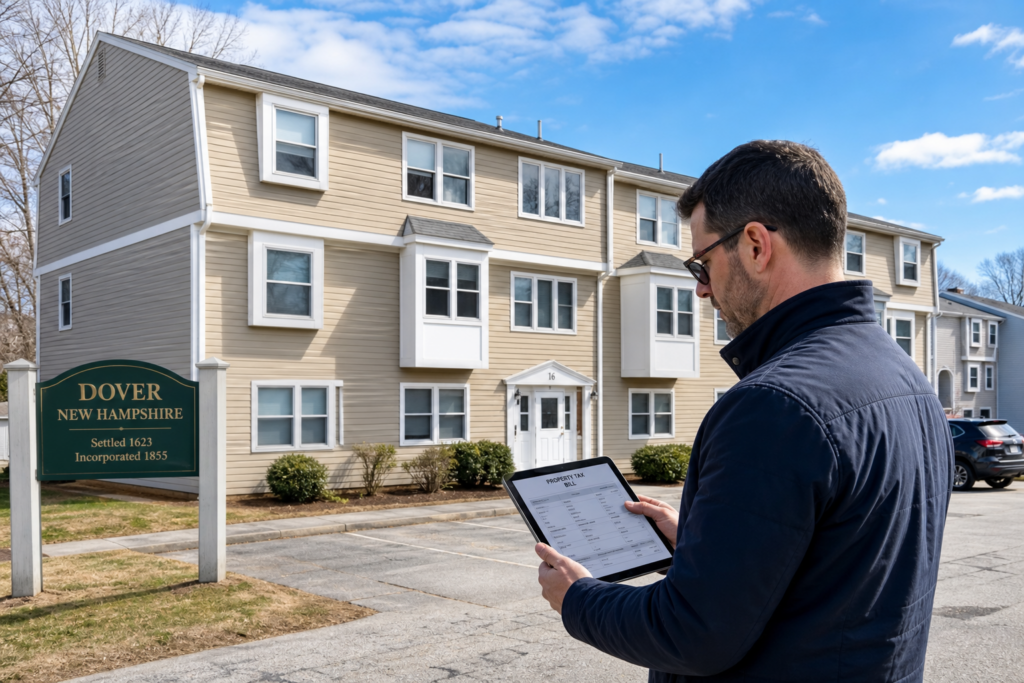
Dover Multi-Family Property Taxes 2026: Rates, Assessments & Savings
If you own or plan to buy rental buildings in the Garrison City, understanding Dover NH tax preparation and property tax planning is essential. Dover multi-family property taxes directly shape your cash flow, cap rate, and long-term returns. This 2026 guide explains how New Hampshire assesses your building, what the effective rate means, how to appeal, and which planning moves protect your profit. Investors, landlords, and developers will find practical, local guidance here.
Table of Contents
- Key Takeaways
- How Does Dover Calculate Property Taxes on Multi-Family Buildings?
- What Are Dover Multi-Family Property Tax Rates in 2026?
- How Do You Calculate Tax on a Dover Multi-Family Building?
- How Do You Appeal a Dover Multi-Family Property Tax Assessment?
- How Can You Plan Around Dover Multi-Family Property Taxes in 2026?
- Uncle Kam in Action
- Related Resources
- Next Steps
- Frequently Asked Questions
Key Takeaways
- New Hampshire has no wage income or sales tax, so property taxes fund most local services.
- Dover multi-family property taxes are based on assessed market value times the combined rate.
- Dover’s 2026 effective rate sits near 1.5% of value on typical properties.
- Owners can appeal assessments; abatement applications are generally due by March 1.
- Smart planning pairs local appeals with federal depreciation to protect your returns.
How Does Dover Calculate Property Taxes on Multi-Family Buildings?
Quick Answer: Dover multiplies your building’s assessed value by the combined tax rate per $1,000. That rate blends municipal, school, state education, and county levies.
New Hampshire funds local government mainly through property taxes. Therefore, Dover multi-family property taxes carry real weight for every landlord. The city assessor estimates your property’s market value each year. Then the city applies a rate expressed in dollars per $1,000 of value.
Because New Hampshire skips a general income tax, property owners shoulder more of the load. As a result, understanding your assessment matters more here than in many states. The New Hampshire Department of Revenue Administration oversees statewide assessing standards. You can review its guidance on the New Hampshire Department of Revenue Administration website.
What Is Assessed Value for Multi-Family Property?
Assessed value is the city’s estimate of your property’s worth. For multi-family buildings, assessors weigh income, sales, and replacement cost. Consequently, a well-leased four-unit building often carries a higher value than a vacant one.
New Hampshire requires assessments near full market value. Moreover, the state calculates an equalization ratio to compare towns fairly. When ratios drift, the state flags towns for revaluation. Real estate investors should watch this closely, and Uncle Kam helps real estate investors plan for property taxes across markets.
How the Equalization Ratio Works
The equalization ratio compares assessed values to actual sale prices. For example, a 90% ratio means assessments run below market. Therefore, your assessed figure may not equal today’s sale price. Investors use this ratio to test whether an assessment is fair.
Pro Tip: Request your property record card early. Errors in unit count or square footage inflate Dover multi-family property taxes every single year.
What Are Dover Multi-Family Property Tax Rates in 2026?
Quick Answer: Dover’s 2026 effective property tax rate sits near 1.5% of value. The combined rate stacks municipal, school, state, and county portions.
New Hampshire towns set rates each fall after budgets pass. The Department of Revenue Administration then certifies the final rate. Dover multi-family property taxes therefore reflect a combined rate applied to assessed value. Recent data places Dover’s effective burden near 1.5% of market value.
Unlike some states, New Hampshire does not use split residential and commercial classes. Consequently, a triplex faces the same base rate as a single-family home. However, higher assessed values on larger buildings still drive bigger bills. You can confirm certified rates through the New Hampshire municipal tax rate portal.
Components of the Dover Tax Rate
Your total rate blends four parts. Each part funds a different layer of government. The table below shows how a combined rate typically breaks down in a New Hampshire city like Dover.
| Rate Component | Purpose | Share of Bill |
|---|---|---|
| Municipal | City services and operations | ~25% |
| Local school | Dover public schools | ~55% |
| State education | Statewide education funding | ~10% |
| County | Strafford County services | ~10% |
These shares shift yearly with local budgets. Nevertheless, schools usually claim the largest slice. Business owners weighing New Hampshire markets can also review tax planning options for business owners with our team.
Did You Know? New Hampshire ranks among the highest states for effective property tax rates nationwide.
Why Multi-Family Values Differ From Single-Family
Assessors often value income properties using rent and expenses. Therefore, strong rents can push assessed values higher. In addition, larger buildings carry more land and improvements. As a result, Dover multi-family property taxes on a fourplex usually exceed a nearby single-family home.
How Do You Calculate Tax on a Dover Multi-Family Building?
Quick Answer: Divide assessed value by 1,000, then multiply by the combined rate. This gives your annual property tax bill.
The math stays simple once you know the rate. First, take your assessed value. Next, divide it by 1,000. Finally, multiply by the certified combined rate. This formula drives every Dover property tax bill.
A Four-Unit Building Example
Assume a four-unit building assessed at $600,000. Also assume a combined rate of $22.50 per $1,000. First, divide $600,000 by 1,000 to get 600. Then multiply 600 by $22.50. The annual bill equals $13,500.
- Assessed value: $600,000
- Value in thousands: 600
- Combined rate: $22.50 per $1,000
- Annual tax: $13,500
Now consider the cash flow impact. That $13,500 bill equals $1,125 per month. Therefore, it reduces your net operating income directly. Investors must budget this cost before setting rents.
Impact on NOI and Cap Rate
Property taxes reduce net operating income, or NOI. Lower NOI then lowers your building’s value at a given cap rate. Consequently, a tax spike can shrink your equity overnight. This is why appeals and planning matter so much.
Pro Tip: Model taxes at the top of your rate range. This protects your underwriting if Dover raises the rate mid-cycle.
Federal rules also shape your after-tax return. Residential rental buildings depreciate over 27.5 years under IRS rules. You can confirm this schedule in IRS Publication 527 on residential rental property. Pairing depreciation with local planning improves your total position.
How Do You Appeal a Dover Multi-Family Property Tax Assessment?
 Free Tax Write-Off Finder
Quick Answer: File an abatement application with the city, generally by March 1 after your final tax bill. If denied, appeal to the BTLA or Superior Court by September 1.
You do not have to accept a high assessment. New Hampshire gives owners a clear appeal path. First, you request an abatement from the city. Then, if denied, you escalate to the state Board of Tax and Land Appeals.
The Abatement Process Step by Step
- Review your property record card for factual errors.
- Gather comparable sales and a rent roll to support value.
- File the abatement application with Dover by March 1.
- Await the city decision within the statutory window.
- Appeal to the BTLA or Superior Court by September 1 if denied.
Strong evidence wins appeals. Therefore, an income approach with real rents often helps multi-family owners. You can learn more about the state board at the New Hampshire Board of Tax and Land Appeals site. Investors in Dover should also secure professional Dover NH tax preparation support before filing.
What Evidence Supports an Appeal?
Assessors respond to facts, not opinions. Consequently, you need documented proof of value. A recent appraisal carries strong weight. In addition, comparable sales and actual operating numbers help greatly.
- Independent appraisal near the assessment date
- Recent sales of similar Dover multi-family buildings
- Rent roll, vacancy data, and expense records
- Photos showing deferred maintenance or damage
Pro Tip: Missing the March 1 deadline usually ends your appeal for that year. Calendar it now to protect your rights.
How Can You Plan Around Dover Multi-Family Property Taxes in 2026?
Quick Answer: Combine annual assessment reviews, appeals, and federal depreciation. This lowers both your local bill and your federal taxable income.
Good planning starts before you buy. First, model taxes into your underwriting. Then review each assessment every year. Finally, coordinate local strategy with federal tax planning. This layered approach protects your returns.
Budgeting for Annual Tax Bills
Dover bills property taxes in installments during the year. Therefore, set aside monthly reserves for the full amount. This habit prevents cash crunches at bill time. It also keeps your NOI predictable for lenders.
Entity choice also matters for landlords. Many investors hold rentals in an LLC for liability protection. Our team helps with entity structuring for real estate portfolios. In addition, business owners can estimate liabilities with our Small Business Tax Calculator for San Francisco as a planning reference.
Pairing Local and Federal Strategy
Property taxes remain deductible against rental income. Consequently, your $13,500 bill lowers federal taxable income. Cost segregation can further accelerate depreciation on eligible components. As a result, your after-tax cash flow improves significantly.
The IRS explains rental deductions in its official guidance. Review the IRS rental real estate income and deductions page for details. High-income landlords should also explore advanced strategies for high-net-worth investors and proactive real estate tax strategy planning.
Did You Know? Renovations can raise your assessment. Plan appeals and budgets before major upgrades begin.
Comparing Planning Approaches
| Strategy | Primary Benefit | Best For |
|---|---|---|
| Annual assessment review | Catches errors early | All owners |
| Abatement appeal | Lowers local tax bill | Over-assessed buildings |
| Cost segregation | Accelerates depreciation | Larger portfolios |
| Reserve budgeting | Protects cash flow | Every landlord |

Uncle Kam in Action: A Dover Landlord Cuts Her Tax Burden
Client Snapshot: Maria owns three multi-family buildings in Dover, New Hampshire. She manages twelve units and works full time in healthcare. Rising assessments worried her deeply in early 2026.
Financial Profile: Her portfolio generated about $180,000 in annual rental revenue. Combined assessed value reached roughly $1.6 million. Her total property tax bill approached $36,000 per year.
The Challenge: Maria believed the city over-assessed one triplex. In addition, she never claimed accelerated depreciation. As a result, she overpaid both locally and federally. She feared her cash flow could not absorb another increase.
The Uncle Kam Solution: Our team reviewed each property record card carefully. We found a unit count error on the triplex. Therefore, we prepared an abatement application with a rent roll and comparable sales. Meanwhile, we ordered a cost segregation study on her largest building.
Next, we coordinated the local appeal with her 2026 federal return. We deducted all property taxes against rental income. Furthermore, we accelerated depreciation on qualifying components. This combined approach attacked both tax layers at once.
The Results: The abatement reduced her assessed value and cut her local bill by about $4,200. The cost segregation study created strong first-year depreciation. Together, these moves saved Maria roughly $19,000 in year one.
- Tax Savings: About $19,000 in the first year
- Investment: $6,500 in professional fees
- Return on Investment: Nearly 3x in year one
Maria now reviews her assessments every year. See more outcomes on our client results and case studies page.
Related Resources
- Tax Preparation Near Me in New Hampshire
- Ongoing Tax Advisory for Investors
- Free Tax Calculators and Tools
- Real Estate Tax Strategy Blog
Next Steps
Take control of your Dover multi-family property taxes today. A few focused actions can protect thousands in returns. Investors near the Seacoast can also compare providers through our New Hampshire tax preparation directory.
- Pull each property record card and check for errors now.
- Calendar the March 1 abatement deadline immediately.
- Build monthly reserves for your full annual tax bill.
- Book a strategy call for tax prep and filing support.
Frequently Asked Questions
When are Dover property tax bills due?
Dover bills property taxes in installments during the year. The city typically issues bills twice, with due dates in summer and winter. Always confirm exact 2026 dates on your official tax bill.
Do multi-family properties pay higher rates than single-family homes?
No, New Hampshire uses one base rate per town. However, larger assessed values raise the total bill. Therefore, Dover multi-family property taxes often exceed single-family taxes in dollars.
What happens to taxes after I renovate or add units?
Major upgrades usually raise your assessed value. Consequently, your tax bill often increases the next cycle. Plan for this before starting large projects.
How often are Dover assessments updated?
New Hampshire requires periodic revaluations to keep values near market. In addition, the state monitors equalization ratios each year. Full revaluations often occur every few years.
Is hiring a professional worth the cost for an appeal?
Often, yes, especially for larger buildings. A successful appeal can save thousands each year. Moreover, savings compound across your holding period.
Can I deduct Dover property taxes on my federal return?
Yes, property taxes on rentals are deductible against rental income. This reduces your federal taxable income. Keep detailed records to support every deduction.
This information is current as of 7/27/2026. Tax laws and local rates change frequently. Verify updates with the IRS or the New Hampshire Department of Revenue Administration if reading this later.
Last updated: July, 2026

