Dover Crypto Taxes 2026: The Complete Delaware Filing Guide
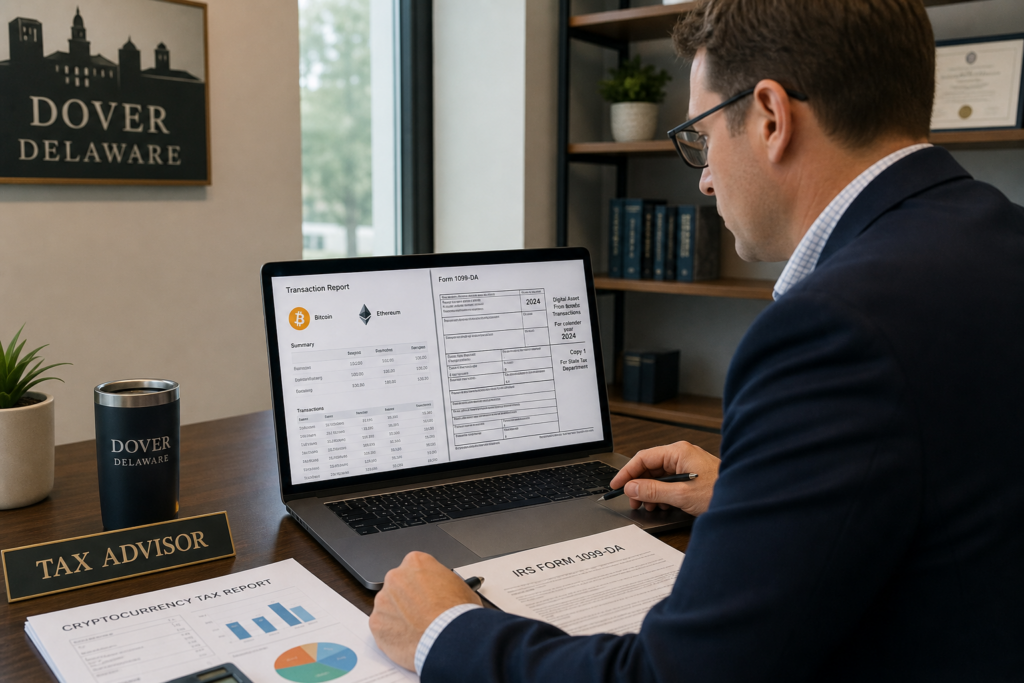
Understanding Dover crypto taxes starts with one key fact for 2026. If you live in Dover and work with a Dover tax preparation specialist, you must report crypto at both the federal and Delaware level. The IRS treats cryptocurrency as property, so nearly every sale, swap, or reward creates a taxable event. Delaware then taxes those gains as ordinary income. This guide breaks down the rules clearly.
Table of Contents
- Key Takeaways
- How Is Crypto Taxed in Dover, Delaware?
- Do You Pay Delaware State Tax on Crypto Gains?
- What Is Form 1099-DA and How Does It Affect You?
- How Do You Report Crypto on Your Tax Return?
- Can You Write Off Crypto Lost to a Scam or Kiosk?
- How Can Dover Residents Lower Their Crypto Tax Bill?
- Uncle Kam in Action
- Related Resources
- Next Steps
- Frequently Asked Questions
Key Takeaways
- The IRS taxes crypto as property, so most sales trigger capital gains.
- Delaware taxes crypto gains as ordinary income, up to 6.6% for 2026.
- Exchanges now issue Form 1099-DA for the 2026 tax year.
- Capital losses can offset gains plus $3,000 of ordinary income yearly.
- Staking, mining, and airdrops count as taxable ordinary income.
How Is Crypto Taxed in Dover, Delaware?
Quick Answer: Crypto in Dover faces two layers of tax. The IRS taxes it as property, and Delaware taxes gains as ordinary income.
For 2026, the rules around Dover crypto taxes follow a two-part structure. First, the federal government treats digital assets as property under longstanding IRS digital asset guidance. Therefore, when you sell or trade crypto, you realize a capital gain or loss. Second, Delaware layers its own income tax on top of that gain. As a result, Dover residents must plan carefully to avoid surprises.
Many investors assume crypto is invisible to tax authorities. However, that idea is outdated. Consequently, understanding both layers matters more than ever. A proactive crypto tax strategy plan helps you stay compliant while keeping more of your gains.
What Counts as a Taxable Event?
A taxable event happens whenever you dispose of crypto. Furthermore, some events create ordinary income instead of capital gains. Below are the most common triggers Dover residents face.
- Selling crypto for U.S. dollars.
- Swapping one coin for another token.
- Using crypto to buy goods or services.
- Receiving staking rewards, mining income, or airdrops.
What Is Not Taxable?
Not every action triggers tax. For example, buying crypto with cash is not taxable. Likewise, moving coins between your own wallets creates no gain. Nevertheless, you must still keep records for later. Many self-employed crypto investors lose deductions simply because they discard transaction data.
Pro Tip: Export your full transaction history every quarter. This habit prevents costly reconstruction work at tax time.
Do You Pay Delaware State Tax on Crypto Gains?
Quick Answer: Yes. Delaware taxes crypto gains as ordinary income at rates reaching 6.6% for the 2026 tax year.
Unlike the federal system, Delaware offers no preferential rate for long-term gains. Instead, the state taxes all capital gains as ordinary income. Consequently, a Dover investor pays the same state rate whether the coin was held one month or five years. You can review the official brackets through the Delaware Division of Revenue.
Delaware does provide one bright spot. The state charges no sales tax, so spending crypto never triggers a state sales levy. However, disposing of that crypto still creates a federal capital gain. Therefore, Dover residents benefit from working with a Tax Preparation Near Me in Delaware provider who understands both systems.
Delaware Crypto Tax Brackets for 2026
The table below shows how Delaware taxes crypto income. Notably, the top rate applies to income above $60,000. Most active traders reach this bracket quickly.
| Delaware Taxable Income (2026) | Marginal Rate |
|---|---|
| $2,001 – $5,000 | 2.2% |
| $5,001 – $10,000 | 3.9% |
| $10,001 – $20,000 | 4.8% |
| $25,001 – $60,000 | 6.6% (over $60,000) |
Did You Know? Delaware residents file crypto gains on Form 200-01, the resident individual income tax return.
Federal vs. Delaware Treatment
The key difference lies in holding periods. Federally, long-term gains receive rates of 0%, 15%, or 20%. Delaware ignores that distinction entirely. As a result, high earners can face a combined effective rate near 30% once federal, state, and the 3.8% Net Investment Income Tax stack together.
What Is Form 1099-DA and How Does It Affect You?
Quick Answer: Form 1099-DA is the new IRS crypto reporting form. Exchanges issue it for the 2026 tax year.
Starting with the 2026 tax year, brokers and exchanges must report your crypto transactions on Form 1099-DA. Therefore, the IRS now receives direct data about your trades. This change dramatically increases audit risk for non-reporters. You can learn more through the IRS newsroom announcements.
Furthermore, exchanges must include cost basis for crypto you purchased on or after January 1, 2026. Consequently, matching your records to the 1099-DA becomes critical. Any mismatch may trigger an IRS notice. Dover investors should reconcile their books carefully.
How 1099-DA Changes Recordkeeping
Because exchanges now report gross proceeds, you cannot omit small trades. Moreover, coins bought before 2026 may lack reported cost basis. In those cases, you must supply your own records. A dedicated crypto tax filing service can bridge these gaps efficiently.
Pro Tip: Keep pre-2026 purchase receipts. Without basis records, the IRS may treat your full sale as gain.
How Do You Report Crypto on Your Tax Return?
Quick Answer: Report crypto sales on Form 8949 and Schedule D. Report crypto income on Schedule 1 or Schedule C.
Reporting crypto follows a clear sequence. First, you categorize each transaction. Then, you calculate gains and losses. Finally, you place the totals on the correct federal forms. Delaware residents carry those federal figures onto Form 200-01. The official Form 8949 instructions explain the layout.
Step-by-Step Crypto Reporting
- Gather all exchange records and Form 1099-DA statements.
- Sort transactions into short-term and long-term categories.
- Calculate each gain or loss using cost basis.
- Enter sales on Form 8949 and total on Schedule D.
- Report staking or mining income on Schedule 1 or C.
Sample Dover Crypto Calculation
Suppose a Dover investor buys $5,000 of Bitcoin. Later, she sells it for $9,000 after holding 18 months. Her long-term gain equals $4,000. Federally, she pays 15%, or $600. Delaware then taxes that $4,000 at 6.6%, adding $264. Her total tax reaches $864.
Did You Know? Business owners paid in crypto must report the fair market value as ordinary business income.
Active traders and crypto business owners often benefit from entity planning. In some cases, an entity structuring review reduces overall exposure.
Can You Write Off Crypto Lost to a Scam or Kiosk?
 Free Tax Write-Off Finder
Quick Answer: Sometimes. Investment theft losses may qualify, but personal scam losses face strict limits under current law.
Delaware regulators have scrutinized crypto kiosks after a rise in scams. Consequently, many Dover residents lost funds through fraudulent kiosk transactions. The tax treatment of these losses depends heavily on the facts. Generally, theft losses tied to a profit motive may be deductible. However, personal casualty and theft losses remain restricted through 2025 law that carries into 2026.
How Scam Losses Are Treated
If you bought crypto as an investment and lost it to fraud, you may claim a theft loss. Nevertheless, the rules are complex and require documentation. You should review the IRS Publication 547 guidance on casualties and theft. Because these claims draw scrutiny, professional guidance matters.
Protecting Yourself From Kiosk Fraud
Older investors face the highest scam risk. Therefore, awareness protects both your money and your tax position. Keep every kiosk receipt and report fraud immediately. Moreover, document all communications for a potential theft loss claim.
Pro Tip: Never send crypto to resolve a supposed tax debt. The IRS never demands crypto payments.
How Can Dover Residents Lower Their Crypto Tax Bill?
Quick Answer: Use tax-loss harvesting, long-term holding, and entity planning to reduce federal and Delaware crypto taxes.
Smart planning saves real money on Dover crypto taxes. First, harvesting losses offsets gains dollar for dollar. In addition, excess losses reduce up to $3,000 of ordinary income each year. Any remaining loss carries forward indefinitely. High earners especially benefit from proactive wealth tax planning strategies.
Second, holding assets longer than one year secures preferential federal rates. However, Delaware still taxes at ordinary rates. Therefore, federal timing matters most for state residents. Ongoing crypto tax advisory support keeps your plan aligned with market moves.
Tax-Loss Harvesting in Action
Imagine a Dover trader with a $10,000 gain and a $6,000 unrealized loss. By selling the losing position, she nets her taxable gain to $4,000. As a result, she saves both federal and Delaware tax on $6,000. This simple move often produces four-figure savings.
| Strategy | Federal Benefit | Delaware Benefit |
|---|---|---|
| Tax-loss harvesting | Offsets gains + $3,000 income | Reduces state ordinary income |
| Long-term holding | 0%, 15%, or 20% rate | No preferential rate |
| Entity structuring | Potential deductions | Business expense offsets |
Donating Appreciated Crypto
Donating appreciated crypto to charity avoids capital gains entirely. Furthermore, you may claim a fair market value deduction. Consequently, high-net-worth Dover residents often pair giving with tax planning. This strategy delivers both social and financial returns.

Uncle Kam in Action: How a Dover Crypto Trader Saved $18,400
Client Snapshot: Marcus, a 41-year-old software consultant in Dover, actively trades crypto. He also earns 1099 income from freelance development work.
Financial Profile: Marcus earned $220,000 in combined consulting and crypto income during 2026. His portfolio held roughly $310,000 in digital assets.
The Challenge: Marcus faced a large tax bill. He realized $95,000 in short-term crypto gains. Because these were short-term, both the IRS and Delaware taxed them at ordinary rates. Moreover, he never tracked his cost basis carefully. As a result, his estimated liability climbed steeply.
The Uncle Kam Solution: Our team rebuilt his transaction history from exchange exports. Then, we identified $40,000 in unrealized losses. Consequently, we harvested those losses to offset his gains. Next, we shifted his freelance work into an S-Corp structure. This move reduced his self-employment tax burden. Finally, we established a quarterly estimated payment plan to avoid penalties.
The Results: Marcus cut his combined federal and Delaware tax bill dramatically. His documented savings reached $18,400 in the first year alone.
- Tax Savings: $18,400 in year one.
- Investment: $4,200 in Uncle Kam fees.
- Return on Investment: roughly 4.4x in the first year.
Marcus now files with confidence and clean records. You can explore more outcomes on our client results page. His story shows how planning turns crypto chaos into control.
Related Resources
- Uncle Kam Tax Strategy Blog
- Comprehensive Tax Guides Library
- Tax Help for Real Estate Investors
- 2026 Tax Deadline Calendar
Next Steps
Ready to take control of your Dover crypto taxes? Local Dover investors can connect with our Dover crypto tax experts today. Take these steps now to protect your gains.
- Export your full 2026 crypto transaction history immediately.
- Reconcile your records against each Form 1099-DA received.
- Review harvesting opportunities before year-end with a crypto tax advisor.
- Schedule a planning call to map your 2026 strategy.
Frequently Asked Questions
Is cryptocurrency legal to own in Dover, Delaware?
Yes. Owning and trading crypto is fully legal in Dover. However, you must report all taxable activity. Both the IRS and Delaware require accurate reporting for 2026.
Does Delaware tax long-term crypto gains differently?
No. Delaware taxes all crypto gains as ordinary income. Unlike the federal system, the state offers no lower long-term rate. The top 2026 rate reaches 6.6%.
Do I report small crypto trades under $200?
Yes, you must report them. A proposed de minimis exemption has not become law as of 2026. Therefore, current IRS rules require reporting every disposal.
How are staking rewards taxed in 2026?
Staking rewards count as ordinary income at receipt. You report their fair market value on that date. Later, selling those coins may create an additional capital gain.
What happens if I ignore Form 1099-DA?
Ignoring it invites IRS scrutiny. Because exchanges now report directly, mismatches trigger notices. Consequently, unreported gains can lead to penalties and interest.
This information is current as of 8/3/2026. Tax laws change frequently. Verify updates with the IRS or Delaware Division of Revenue if reading this later.
Last updated: August, 2026

