
Cost Segregation Tax Planning Software: 2026 Guide
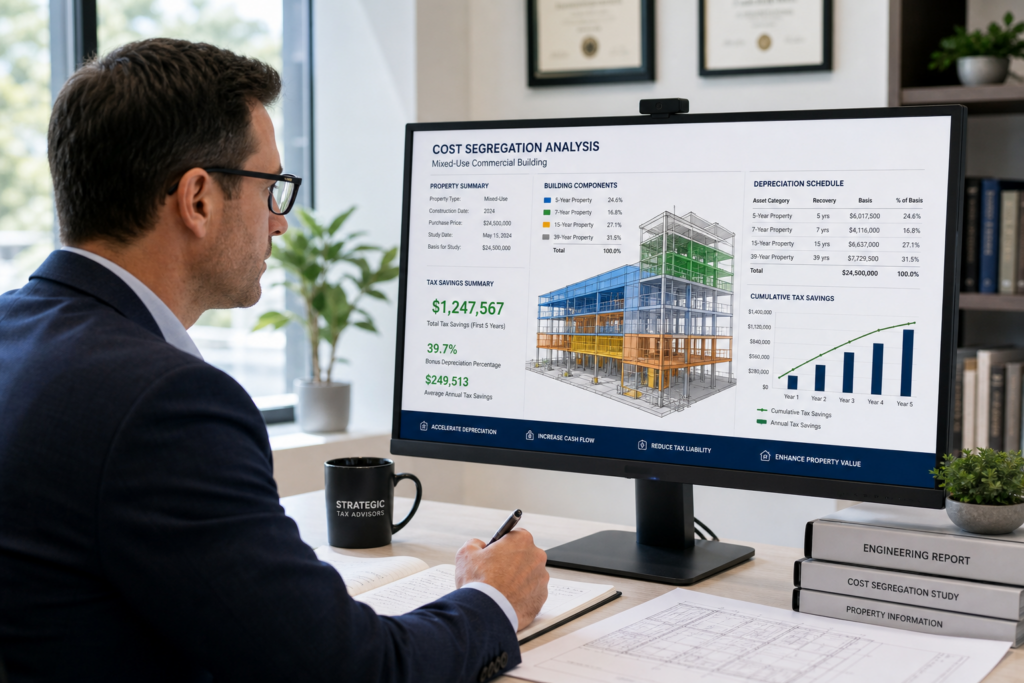
For the 2026 tax year, cost segregation tax planning software has evolved from a post-close compliance tool into a strategic M&A planning necessity. With 100% bonus depreciation restored under the One Big Beautiful Bill Act (OBBBA), tax professionals can now transform decades of depreciation into immediate cash-flow benefits for clients acquiring real estate or operating businesses.
Table of Contents
Used by 2,400+ tax professionals
- Key Takeaways
- What Is Cost Segregation Tax Planning Software?
- How Does OBBBA Change Cost Segregation Planning for 2026?
- What Features Should Tax Professionals Prioritize in Software Selection?
- How Do You Integrate Cost Segregation into M&A Transactions?
- What Compliance and Disclosure Requirements Exist for 2026?
- When Should Production Businesses Consider Qualified Production Property?
- Uncle Kam in Action: Manufacturing Acquisition Success
- Next Steps
- Frequently Asked Questions
- Related Resources

Key Takeaways
- Cost segregation software enables immediate 100% bonus depreciation under 2026 OBBBA rules for qualifying property
- Engineering-based analysis reclassifies building components into 5-, 7-, and 15-year recovery periods
- Pre-close planning can materially enhance deal economics and after-tax returns for clients
- ASU 2023-09 requires detailed jurisdiction-level reporting and eight-category rate reconciliations
- Modern software must handle scenario modeling for international provisions like NCTI and FDDEI
What Is Cost Segregation Tax Planning Software?
Quick Answer: Cost segregation tax planning software automates engineering-based analysis that identifies building components qualifying for accelerated depreciation, transforming 27.5- or 39-year property into 5-, 7-, or 15-year assets.
Cost segregation tax planning software combines engineering methodologies with tax compliance automation. At its core, the software performs detailed asset-level analysis to identify commercial building components that qualify for shorter recovery periods than standard real property classifications. For the 2026 tax year, this capability has become essential for tax advisory professionals helping clients maximize returns on property acquisitions.
The engineering-based approach examines every component of a commercial structure. Therefore, specialty electrical systems, dedicated plumbing, decorative finishes, site improvements, and equipment-related buildouts can be reclassified as personal property or land improvements. Consequently, these reclassifications accelerate depreciation schedules significantly under IRS Publication 946.
Core Software Capabilities
Modern cost segregation tax planning software must deliver three critical functions for 2026 compliance:
- Detailed asset classification following IRS guidelines and Cost Segregation Audit Techniques Guide
- Scenario modeling for pre-close transaction planning and post-close optimization
- Integration with corporate tax provision software for ASU 2023-09 compliance
- Documentation generation supporting Form 3115 automatic method changes
- Audit trail creation for IRS examination defense
The Evolution From Compliance to Strategy
Historically, cost segregation occurred after property acquisition as a compliance exercise. However, the 2026 regulatory environment has fundamentally altered this timeline. With 100% bonus depreciation available under Section 168(k), the potential tax benefit can equal the entire reclassified asset value in year one. Moreover, this immediate deduction creates material cash-flow impacts that influence acquisition pricing and deal structure.
For business owners and investors, this shift means depreciation planning must occur before the transaction closes. Additionally, the software must support real-time analysis during due diligence periods when deal terms remain negotiable.
Pro Tip: Engage cost segregation specialists during the letter of intent phase, not after closing. Early analysis can reveal tax benefits that justify higher purchase prices or inform earnout structures.
How Does OBBBA Change Cost Segregation Planning for 2026?
Quick Answer: The One Big Beautiful Bill Act restored 100% bonus depreciation for property placed in service after January 19, 2025, transforming cost segregation from gradual acceleration into immediate full deduction.
The One Big Beautiful Bill Act (OBBBA), signed into law on July 4, 2025, represents the most significant depreciation policy shift since the Tax Cuts and Jobs Act. Under current Section 168(k) guidance, eligible property acquired and placed in service after January 19, 2025, qualifies for 100% additional first-year depreciation. Consequently, the benefit of cost segregation analysis has expanded dramatically for real estate investors and operating businesses.
Critical Timing Requirements
The timing rules for 2026 bonus depreciation are precise and unforgiving. Missing any threshold eliminates the deduction entirely:
| Requirement | 2026 Threshold | Consequence of Missing |
|---|---|---|
| Construction Start Date | After Jan 19, 2025, before Jan 1, 2029 | Ineligible for bonus depreciation |
| Placed in Service | After July 4, 2025, before Jan 1, 2031 | No immediate deduction available |
| Depreciation System | MACRS required (not ADS) | Reduced to standard depreciation |
| Original Use | Must commence with new owner (limited exceptions) | Disqualification from 100% rate |
| Election Filing | With timely filed return (including extensions) | Complete loss of benefit |
These requirements underscore why cost segregation tax planning software must integrate directly with transaction timelines. Furthermore, software must track construction commencement dates, substantial improvement testing, and original use determinations—all elements requiring detailed documentation.
Immediate Cash-Flow Impact on Deal Economics
Under pre-OBBBA rules, a $5 million building component reclassification might save $1.5 million over seven years in present value terms. However, with 100% bonus depreciation in 2026, that same reclassification produces a $1.85 million cash benefit in year one (assuming a 37% marginal rate). Consequently, after-tax internal rates of return can increase by 200-400 basis points on leveraged real estate transactions.
For clients evaluating competing acquisition opportunities, this immediate benefit materially affects which deals pencil out. Moreover, sellers increasingly request cost segregation analysis during marketing to demonstrate tax-efficient ownership structures to buyers.
International Provisions Affecting Multinationals
OBBBA also reshaped international tax provisions effective in 2026. The shift from GILTI (Global Intangible Low-Taxed Income) to Net CFC Tested Income (NCTI) and the renaming of FDII to Foreign-Derived Deduction Eligible Income (FDDEI) create new planning considerations. Therefore, tax professionals working with multinational clients must ensure their software handles cross-border scenario modeling accurately.
What Features Should Tax Professionals Prioritize in Software Selection?
Quick Answer: Prioritize software offering engineering-grade asset classification, ASU 2023-09 compliance reporting, scenario modeling capabilities, and seamless integration with existing tax provision systems.
Selecting cost segregation tax planning software for 2026 requires evaluating technical capabilities against both current compliance requirements and future legislative adaptability. The right platform transforms how tax strategy teams deliver value to clients throughout the transaction lifecycle.
Engineering-Based Asset Classification
The foundation of any cost segregation analysis is accurate asset classification. Therefore, software must support detailed component-level categorization following IRS guidelines:
- 5-year property: Carpeting, decorative finishes, specialty electrical for equipment
- 7-year property: Furniture, fixtures, office equipment, manufacturing machinery
- 15-year property: Land improvements, site utilities, parking lots, landscaping
- 27.5-year property: Residential rental structural components
- 39-year property: Nonresidential structural components and systems
Moreover, the software must distinguish between structural components (longer life) and personal property or land improvements (shorter life). This distinction requires understanding building systems, construction methodologies, and functional use analysis.
ASU 2023-09 Compliance Integration
ASU 2023-09 is now in effect for public business entities, requiring detailed eight-category disaggregated rate reconciliations and jurisdiction-level taxes-paid disclosures. Non-public entities must comply beginning in 2026. Consequently, cost segregation software must export data in formats supporting these new disclosure requirements.
Specifically, the software should track depreciation adjustments by state, calculate deferred tax impacts by jurisdiction, and support scenario analysis for rate reconciliation disclosure thresholds. Additionally, integration with corporate tax provision platforms like Thomson Reuters ONESOURCE or similar systems ensures seamless data flow.
Pre-Close Scenario Modeling
The shift to pre-close planning demands robust scenario modeling capabilities. Tax professionals need software that can quickly answer questions like:
- What is the after-tax IRR difference between various asset allocation strategies?
- How do different placed-in-service dates affect first-year tax benefits?
- What portion of the purchase price should allocate to personal property versus real property?
- How do state tax implications vary across different depreciation strategies?
Furthermore, scenario modeling must account for limitations like passive activity loss rules, basis limitations, and at-risk rules that can defer or eliminate depreciation benefits for certain taxpayers.
Pro Tip: Look for software with built-in limitation calculators. Many cost segregation benefits are theoretical if passive loss limitations apply. Accurate modeling prevents overstating tax savings to clients.
Audit Documentation and Defense Support
IRS scrutiny of cost segregation studies has increased as the dollar amounts at stake have grown. Therefore, software must generate comprehensive audit documentation including:
- Detailed engineering reports with photographs and building schematics
- Asset-by-asset classification justifications citing IRS guidance
- Depreciation schedules showing year-by-year tax impact
- Form 3115 preparation for method changes when applicable
- Form 8594 asset acquisition statements for Section 1060 transactions
How Do You Integrate Cost Segregation into M&A Transactions?
Quick Answer: Integrate cost segregation during due diligence by coordinating with transaction counsel, performing preliminary analysis before LOI execution, and structuring asset purchase agreements to optimize depreciation treatment.
Successful M&A integration of cost segregation requires coordination across multiple workstreams. Tax professionals must work closely with transaction attorneys, financial advisors, and the client’s internal team to ensure depreciation planning influences deal structure rather than merely documenting it after closing.
Phase 1: Letter of Intent Stage
Before the LOI is signed, conduct preliminary cost segregation analysis using available property information. This early assessment should estimate:
- Total reclassifiable asset value (typically 20-40% of building value)
- First-year cash tax savings under 100% bonus depreciation
- Impact on after-tax returns and maximum justifiable purchase price
- Potential deal structure implications (asset vs. stock, allocation negotiations)
This preliminary analysis informs the buyer’s maximum acceptable price. Moreover, it identifies whether asset purchase treatment should be a deal requirement versus accepting stock purchase structures.
Phase 2: Due Diligence Period
During due diligence, commission a detailed engineering-based cost segregation study. This comprehensive analysis should occur simultaneously with other due diligence activities. Specifically:
- Site visits by qualified engineers to document building components
- Review of construction documents, blueprints, and improvement histories
- Detailed asset classification following the IRS Cost Segregation Audit Techniques Guide
- Coordination with financial due diligence to verify improvement capitalizations
Additionally, the due diligence period is when you identify potential issues like mixed-use spaces, related-party leases, or prior cost segregation studies that could affect available benefits.
Phase 3: Purchase Agreement Negotiation
Cost segregation findings should directly inform purchase agreement provisions. Critical negotiation points include:
- Asset purchase vs. stock purchase structure election
- Form 8594 asset allocation methodology and dispute resolution procedures
- Representation that seller has not previously claimed bonus depreciation
- Original use certifications for property placed in service post-acquisition
- Indemnification provisions for tax positions taken in cost segregation
Furthermore, the purchase agreement should specify placed-in-service dates and closing mechanics to ensure bonus depreciation requirements are satisfied. Late discovery that construction start dates fell outside the qualifying window can eliminate hundreds of thousands in expected benefits.
Phase 4: Post-Close Implementation
After closing, several implementation steps remain critical:
- File Form 8594 with both buyer and seller returns showing agreed allocation
- Make bonus depreciation election on timely filed return (including extensions)
- File Form 3115 if reclassifying previously acquired property
- Update fixed asset systems with detailed component-level depreciation schedules
- Prepare audit defense documentation for permanent files
These filing requirements are unforgiving. Missing the election deadline or failing to properly designate qualified property can permanently forfeit the benefit. Therefore, sophisticated tax planning software should include deadline tracking and election preparation workflows.
What Compliance and Disclosure Requirements Exist for 2026?

Quick Answer: For 2026, compliance requires meeting ASU 2023-09 disclosure standards, maintaining detailed engineering documentation, filing timely elections, and preparing for increased IRS examination activity.
The compliance landscape for cost segregation has grown substantially more complex in 2026. Tax professionals must navigate federal filing requirements, state-specific rules, and new financial reporting standards simultaneously.
ASU 2023-09 Financial Statement Disclosure
ASU 2023-09 fundamentally changed income tax disclosure requirements. Public entities must now provide:
- Eight-category disaggregated rate reconciliation when categories exceed 5% threshold
- Jurisdiction-level income taxes paid disclosures for federal, state, and foreign
- Year-over-year explanations of significant changes in effective tax rate
- Pre-tax income disaggregation between domestic and foreign operations
Cost segregation creates significant book-tax differences that flow through rate reconciliation disclosures. Therefore, software must track state-by-state depreciation differences and calculate the disclosure impact of each jurisdiction’s unique depreciation rules. Additionally, organizations using blended state approaches historically must now pivot to jurisdiction-specific tracking.
Federal Filing Requirements
Federal compliance for cost segregation involves multiple forms and elections:
| Form | Purpose | Deadline |
|---|---|---|
| Form 4562 | Report depreciation and make bonus depreciation election | Return due date (with extensions) |
| Form 8594 | Asset acquisition statement for Section 1060 transactions | Return for year of sale/purchase |
| Form 3115 | Automatic method change for prior-year property reclassification | Return for year of change |
| Supporting Statement | Detailed cost segregation report and engineering study | Maintain in permanent files |
Each form requires specific information that must be supported by the underlying engineering analysis. Moreover, elections once made generally cannot be revoked, making proper preparation essential.
State-Level Variations
State conformity to federal bonus depreciation varies significantly. Some states fully conform to 100% bonus depreciation. Others partially conform or decouple entirely. Consequently, cost segregation tax planning software must track:
- State-by-state depreciation addbacks and subtractions
- Multi-year tracking for states using phase-in or bonus depreciation caps
- Apportionment impacts when property is used in multiple jurisdictions
- State-specific reporting forms and disclosure requirements
For example, California historically has not conformed to federal bonus depreciation, requiring separate state depreciation schedules. Therefore, the federal cash-flow benefit may be partially offset by state tax increases in high-tax jurisdictions.
When Should Production Businesses Consider Qualified Production Property?
Quick Answer: Manufacturing and production businesses should evaluate Qualified Production Property (QPP) under Section 168(n) when acquiring facilities where production activities occupy substantial building square footage.
For production-oriented businesses, Section 168(n) provides a potentially more powerful tool than traditional cost segregation. The Qualified Production Property (QPP) provision allows 100% special depreciation allowance on eligible nonresidential real property itself—not just personal property and land improvements.
Understanding the Integral Use Requirement
The most challenging QPP requirement is integral use. Only building portions used as an integral part of qualified production activity are eligible. Specifically excluded are:
- Offices and administrative spaces
- Lodging, parking, and retail areas
- Research and development facilities
- Software development spaces
- Engineering and design centers
Mixed-use facilities require careful physical mapping. The analysis is based on actual use, not facility descriptions. Therefore, a building labeled “manufacturing facility” may only qualify partially if significant space houses non-production activities.
However, a 95% de minimis rule provides relief. If at least 95% of the facility’s use is qualified production activity, the entire property can receive QPP treatment. This rule requires proper election and detailed use documentation.
However, a 95% de minimis rule provides relief. If at least 95% of the facility’s use is qualified production activity, the entire property can receive QPP treatment. This rule requires proper election and detailed use documentation.
QPP Election Mechanics
QPP elections must specifically identify the nonresidential real property and designate the qualifying portion. The election is made on the federal income tax return for the placed-in-service year. Moreover, the election is irrevocable, making careful analysis before filing essential.
Sophisticated cost segregation tax planning software should model both traditional cost segregation and QPP treatment to identify the optimal approach. In some cases, combining both strategies yields maximum benefit—QPP treatment for production areas and traditional cost segregation for supporting spaces.
Pro Tip: Commission space utilization studies during due diligence for production facilities. Detailed floor plans showing production vs. administrative space are essential for defending QPP elections under IRS examination.
Comparing Traditional Cost Segregation vs. QPP
| Factor | Traditional Cost Segregation | Qualified Production Property |
|---|---|---|
| Eligible Property | Personal property and land improvements only | Nonresidential real property structure itself |
| Business Type | All commercial properties | Production, manufacturing, refining businesses only |
| Typical Reclassification | 20-40% of building value | Potentially 100% if 95% threshold met |
| Use Requirement | Component-level functional analysis | Integral to production activity |
| Documentation | Engineering study with component details | Space utilization study plus engineering report |
Uncle Kam in Action: Manufacturing Acquisition Success
A regional manufacturing firm approached Uncle Kam during negotiations to acquire a specialty metals production facility for $28 million. The deal included $18 million in real property (building and land) and $10 million in equipment and working capital.
The Challenge: The client’s initial tax analysis showed standard 39-year depreciation on the building, producing minimal first-year tax benefit. With a 37% combined federal and state rate, the acquisition appeared to strain cash flow projections. Moreover, the client faced a competing bid from a larger manufacturer with deeper pockets.
The Uncle Kam Solution: Our tax advisory team commissioned an integrated cost segregation and QPP analysis during the 45-day due diligence period. The engineering study revealed that 92% of the facility’s square footage housed production activities. Additionally, traditional cost segregation identified $4.2 million in personal property and land improvements.
We structured a three-pronged depreciation strategy using advanced tax planning software:
- QPP election on the production building portion ($13.8 million)
- Traditional cost segregation on support spaces and improvements ($4.2 million)
- Separate treatment for land and administrative office space ($4.0 million standard)
The Results: The combined strategy produced $18 million in first-year 100% bonus depreciation. At the client’s 37% tax rate, this generated $6.66 million in immediate cash tax savings—a 238% first-year return on the $28,000 Uncle Kam advisory fee.
This cash-flow improvement allowed the client to increase their acquisition offer by $3.5 million while maintaining target returns. They won the competitive bid process. Furthermore, the detailed pre-close analysis eliminated post-closing uncertainty and positioned the tax treatment for IRS examination defense.
The client subsequently engaged Uncle Kam for entity structuring consultation on their holding company design and ongoing tax advisory services. Learn more about similar success stories at our client results page.
Next Steps
Tax professionals ready to leverage cost segregation tax planning software for 2026 should take these immediate actions:
- Evaluate current software capabilities against ASU 2023-09 disclosure requirements and OBBBA provisions
- Identify clients with pending property acquisitions and initiate pre-close cost segregation analysis
- Review existing portfolios for opportunities to file Form 3115 method changes on prior acquisitions
- Establish relationships with qualified engineering firms for detailed component-level studies
- Develop standard engagement workflows integrating cost segregation into business advisory and M&A services
Ready to transform your tax planning practice? Book a strategy session with Uncle Kam to explore how integrated software solutions and expert advisory services can help you deliver exceptional client results while building a more profitable practice.
Frequently Asked Questions
Can cost segregation be performed on property acquired before 2026?
Yes, cost segregation can be applied retroactively to property acquired in prior years using Form 3115 automatic accounting method change procedures. However, bonus depreciation availability depends on when the property was originally placed in service. For property placed in service before January 20, 2025, the bonus depreciation percentage may be lower or unavailable depending on acquisition year. Additionally, the look-back analysis must account for depreciation already claimed. Software should calculate the Section 481(a) adjustment properly to avoid overstating current-year benefits. Most taxpayers have four years to perform cost segregation without filing amended returns through the Form 3115 process.
How much does cost segregation typically save in taxes for 2026?
Tax savings vary based on property type, but typical commercial buildings have 20-40% of their value eligible for reclassification. With 100% bonus depreciation in 2026, a $10 million building might reclassify $3 million into personal property and land improvements. At a 37% combined tax rate, this produces $1.11 million in first-year cash savings. Without cost segregation, that same $3 million depreciates over 39 years, providing only $77,000 in annual benefit. The acceleration produces approximately $660,000 in net present value benefit over the property’s holding period. Manufacturing facilities qualifying for QPP treatment can see even larger benefits, potentially achieving 100% depreciation on qualifying building portions.
What happens if my client sells property after claiming accelerated depreciation?
Property dispositions trigger depreciation recapture under Section 1245 and Section 1250. Personal property and land improvements reclassified through cost segregation are Section 1245 assets. Therefore, all depreciation claimed is recaptured as ordinary income upon sale. This recapture occurs regardless of whether the property is sold at a gain or loss. However, the time-value benefit of accelerated depreciation typically outweighs recapture costs, especially when the holding period exceeds five years. Software should model the after-tax economics including recapture to provide accurate return projections. Additionally, some taxpayers structure like-kind exchanges or opportunity zone deferrals to manage recapture timing. The key is setting proper client expectations during the initial planning phase.
Does cost segregation work for rental properties owned by individuals?
Yes, but passive activity loss limitations often limit immediate benefit for non-real estate professionals. Rental real estate income is generally passive income. Depreciation deductions from cost segregation create passive losses. These losses can only offset passive income, not W-2 wages or business income. However, the losses carry forward indefinitely and can be used when the property generates passive income or upon disposition. Real estate professionals who materially participate in rental activities can claim losses against active income. Additionally, the $25,000 rental loss allowance (phased out above $100,000 AGI) applies to both standard and accelerated depreciation. Therefore, cost segregation benefits high-income individuals differently than it benefits operating businesses or real estate professionals. Software should include passive activity limitation calculators to provide accurate first-year benefit projections.
What documentation does the IRS require to support cost segregation positions?
The IRS expects detailed engineering-based studies prepared by qualified professionals. Documentation should include site visit reports with photographs, building schematics showing component locations, asset-by-asset classification with IRS authority citations, and detailed depreciation schedules. The IRS Cost Segregation Audit Techniques Guide outlines expectations for study quality. Key elements include quantifying square footage and construction costs for each reclassified component, demonstrating that reclassifications follow the building’s actual construction and use, and supporting that original use requirements are satisfied for bonus depreciation claims. Software-generated reports must be supplemented with engineer certifications and site documentation. Additionally, retain construction documents, blueprints, purchase agreements, and settlement statements. For IRS examinations, the burden of proof rests with the taxpayer to demonstrate proper asset classification.
Can cost segregation be combined with opportunity zone deferral strategies?
Yes, cost segregation and opportunity zone (OZ) investments can work together synergistically. When an OZ fund acquires qualifying property, cost segregation maximizes depreciation deductions that offset the fund’s operating income. This preserves the OZ investment for capital gains exclusion at the 10-year mark. However, careful planning is required because the OZ rules include working capital safety harbor limitations and substantial improvement requirements. The substantial improvement test requires doubling the property’s basis within 30 months. Accelerated depreciation reduces basis more quickly, which affects the improvement calculation timing. Additionally, the original use requirement for bonus depreciation generally requires new construction or substantial rehabilitation. Therefore, used property acquisitions may not qualify for 100% bonus depreciation even with cost segregation. Software should model both the OZ qualification mechanics and depreciation benefits to ensure strategies don’t conflict.
How do state tax rules affect cost segregation benefits?
State conformity to federal bonus depreciation varies dramatically. Some states like Florida and Texas fully conform, allowing 100% bonus depreciation at the state level. Others like California historically decoupled, requiring separate state depreciation schedules with no bonus depreciation. This creates substantial compliance complexity and can reduce or eliminate state-level benefits. For 2026, tax professionals must verify current-year conformity status because states regularly change their positions. Additionally, states using apportionment formulas may allocate depreciation benefits across multiple jurisdictions. This means the effective state tax rate on federal depreciation savings varies based on the taxpayer’s state footprint. Software must track jurisdiction-specific addbacks, subtractions, and multi-year adjustments for states with phase-in rules. The combined federal and state benefit should drive the cost-benefit analysis of performing cost segregation studies.
What is the typical timeline for completing a cost segregation study?
Pre-close studies for M&A transactions typically require 3-6 weeks from engagement to final report. The timeline includes initial property review and cost estimation (3-5 days), on-site engineering inspection and documentation (1-2 days), detailed asset classification and calculation (2-3 weeks), and report preparation and quality review (1 week). Expedited timelines are possible for rush transactions, sometimes completing studies in 10-14 days with premium fees. Post-close studies performed for compliance purposes have more flexible timelines, often taking 6-8 weeks. However, the federal return filing deadline (including extensions) constrains the ultimate completion date for current-year benefits. Form 3115 method changes have specific filing deadlines tied to the return due date. Therefore, initiating the study early in the tax year is advisable. Software can accelerate the process by standardizing data collection, automating calculations, and streamlining report generation.
Related Resources
- Comprehensive Tax Strategy Services
- <Real Estate Investor Tax Planning
- The MERNA Method for Tax Planning
- Tax Preparation and Compliance Services
- Tax Planning Guides and Resources
Last updated: June, 2026
This information is current as of 6/5/2026. Tax laws change frequently. Verify updates with the IRS or consult a tax professional if reading this later.

